Here and Now
Here & Now for June 13, 2025
Season 2300 Episode 2348 | 26m 49sVideo has Closed Captions
Watch the entire episode of Here & Now for June 13.
Watch the entire episode of Here & Now for June 13.
Problems playing video? | Closed Captioning Feedback
Problems playing video? | Closed Captioning Feedback
Here and Now is a local public television program presented by PBS Wisconsin
Here and Now
Here & Now for June 13, 2025
Season 2300 Episode 2348 | 26m 49sVideo has Closed Captions
Watch the entire episode of Here & Now for June 13.
Problems playing video? | Closed Captioning Feedback
How to Watch Here and Now
Here and Now is available to stream on pbs.org and the free PBS App, available on iPhone, Apple TV, Android TV, Android smartphones, Amazon Fire TV, Amazon Fire Tablet, Roku, Samsung Smart TV, and Vizio.
Providing Support for PBS.org
Learn Moreabout PBS online sponsorshipThe following program is a PBS Wisconsin Original production.
>> The Governor's budget is always reckless spending that the state can't afford.
>> Following failed negotiations with the governor.
Republicans in the state legislature unveiled their vision of the numbers for education, shared revenue, and taxes.
[MUSIC] I'm Frederica Freyberg tonight on here.
And now.
We look at the numbers from the powerful Budget Committee and a proposal to try out wraparound mental health support in schools.
Then we zoom in on central Wisconsin communities and the impact of federal cuts.
And finally, from addiction recovery to assistance in the classroom, what the ruling on AmeriCorps funding means for state programs.
It's "Here& Now" for June 13th.
>> Funding for "Here& Now" is provided by the Focus Fund for Journalism and Friends of PBS Wisconsin.
>> Billions of dollars separate Republican state budget provisions from the two year spending plan.
Governor Tony Evers first introduced last night.
The Joint Finance Committee voted to increase K-12 school funding by $336 million.
That's $3 billion less than Evers called for.
On special education funding, Republican budget writers targeted $228 million, putting the percentage of state funding going to schools for those services at 37.5%.
In the second year, far short of the 60%.
Evers and Advocates wanted.
On income tax cuts, Republicans expanded the second lowest bracket, taxed at 4.4% to single filers, making up to about $50,000.
That's up from those making 30,000.
They also included $700 million in tax cuts for retirees with an income tax exclusion for the first $24,000 of income for filers 67 years or older.
For more on all of this, we go to senior political reporter Zac Schultz at the Capitol and Halzack.
>> Hello, Fred.
>> So that's quite a gulf in K-12 spending between Republican budget riders and Evers.
>> Yeah, that is a big gulf.
And the question that remains to be seen is how Governor Evers will take this when this budget eventually gets to his desk.
We had known all along that there was going to be a big gulf between what he wanted and what Republicans would agree to, but this is even bigger than what we had thought at first, simply because they're not funding any of the per pupil aides that Governor Evers created in his partial veto of the last budget.
Remember the 400 year veto that increased per pupil funding by $325 a kid per year for 400 years?
The Supreme Court held that up as legal, but Republicans did not put any state money behind that, so it will be up to individual school districts to their levy will be increased.
But you have to then decide if they want to raise property taxes to gather all that revenue for operations.
>> On special education funding, the majority raised the percentage of funding coming from the state from 33% to 37, and a half percent in the second year, but that again is far short of what Evers and Advocates wanted.
>> Yeah, and we've been covering this on "Here& Now" for quite a few years about that shortfall in special education funding coming from both the state and the federal government.
Neither have held up their end of the bargain for what they promised, dating back to the 70s.
And IT school districts that are left picking up the pieces, and they're the ones who have to figure out how do we provide the services to these special needs kids.
And often they end up taking it out of general dollars.
That would serve the rest in all of the student body.
Often that's the driver for a lot of these districts going to referendum over the last decade is they simply need more money to fund don't give the money, that's guaranteed to these special education students, they can be sued.
And quite often they have been.
As more and more parents and advocates say go fight for the rights of your child, it's the school districts that have to find the money to make up for it.
Now, this is an increase in Republicans are saying this is well above where it's been in recent years and decades, and even dating back to when Governor Evers was the secretary of education at DEI.
This is above what he was requesting, but it's still far short of what Democrats would like to see now.
>> On tax cuts.
It's $1.3 billion to expand the second lowest tax bracket.
And for retirement income tax cuts.
Now, this wouldn't seem to be something that the governor would oppose with his veto pen.
Right?
>> No.
These tax cuts definitely feel more in line with what Governor Evers has proposed over his first four budgets versus what Republicans have passed in their first three budgets, which were targeted toward higher end earners in Governor Evers vetoed all of those.
This time around, if you remember, back in December, Assembly Speaker Robin Vos said he wanted to know for sure what Governor Evers would sign into law for tax cuts rather than see a veto come out.
When Republicans propose their budget.
He wanted to pass a separate bill.
That didn't happen, but they did enter into negotiations that went on for apparently nearly a month between the upper leadership of Republicans and Evers and his staff.
And it has the feeling of the result that comes into this budget feels sounds like what Governor Evers may have agreed to.
I spoke to some staffers for Democrats, and the negotiations, but they got the sense that this was in line with what Governor Evers had said.
So if that's the case, Republicans went into negotiations, found out what Evers could support in terms of tax cuts on his end, put it in the budget, and now they're not giving Evers what he wanted in terms of education and basically daring him to say, veto this budget, if you will.
But it does have a little more money for cuts that, in theory, fit more with who you want to see tax cuts go for.
Typically lower income people.
>> So next week the Joint Finance Committee is taking up corrections and the UW system.
How big ticket are those.
>> Well those could be very big ticket.
UW has not received nearly as much in recent budgets as they have asked for.
They continue to ask for hundreds of millions of dollars.
And Republicans have not been giving it to them.
Could they see more of this time?
We don't know.
Corrections.
Obviously, Governor Evers has asked for a lot of money to completely rearrange the corrections down the green Bay facility eventually.
We don't know what that will look like.
And there's one more.
The Department of Children and Families, which could include any child care subsidies that could go out providers and parents.
That was one of the things that Evers and his team were negotiating.
So we don't know where that will fall is left.
So some big ticket items that could include some money or might include nothing, we don't really know, but we are keeping on track for having this budget get done.
Near the end of June.
budget writers have made this document veto proof?
Do you suppose?
>> Well, nothing's veto proof because Governor Evers can still lower dollar amounts and make these tax cuts smaller or eliminate entire sections, as he likely will for some of the provisions that are put in there.
But they're going to make it much more difficult for him to create new language, as he did with that 400 year veto.
We were talking about in education from the last budget.
>> All right, Zac Schultz, thank you so much for joining us.
>> My pleasure.
>> Governor Tony Evers declared 2025 the year of the kid and his two year budget called for more than $300 million in direct spending on school mental health treatment and staffing.
Last night, the Joint Finance Committee approved $20 million in One-Time funding to expand K-12 mental health programs.
Meanwhile, a bill in the legislature calls for a two year pilot program in two schools in Wisconsin providing wraparound, school centered mental health services.
Even through the summer break.
Senate.
Author of the bill, Republican Senator Jesse James of Thorp, joins us with more.
And thanks a lot for being here.
>> So you've said that advocacy for youth Mental health is your number one priority.
Why the urgency on that?
>> So, well, it comes from my personal life.
It comes from my outside career of this building.
As a law enforcement officer, as well as what I've seen with and heard from constituents from my district and from across the state.
The impacts that we've seen in our mental health, behavioral health crises that our youth have been experiencing across our state.
Have have been on the rise.
And I've dealt personally more with more youth in crisis than I have adults in my law enforcement capacity over the last five years where I work as a part time police officer in the village of Cadott.
So that that raised some concerns for me.
And, you know, our state does okay when it comes to these crises, whether it's an adult or youth, but I think trying to get our youth the services, resources, education, prevention, coping strategies, everything that they need as a youth that they can mature and grow into, into the young adult life will set them up for success in the future as they continue to reside in our state.
>> So the school centered pilot program proposed would provide wraparound mental health services in two schools.
What would that look like?
>> So in two schools, one would be urban, semi-urban school, and the other one would be a rural school.
You know, the things that happen up in the village of Cadott happen in the city of Milwaukee.
And I think the key element to this is the data collecting.
There will be a report that will be have to be submitted from whoever were to receive the grant.
Funding for this, and they have to provide a report back.
And that's some of the issues that we have in our state is the lack of information sharing.
We the schools, do a good job tracking it, but at the state level, none of that information is shared.
So we would have to personally go to each of our school districts to find out what's going on with mental health.
How many students are impacted by it, whether it's elementary, middle school, high school, and without that data, it's very hard for us as a legislature to make decisions moving forward.
We can just say, yeah, there's a problem, but we just throw money at it with no data reporting or collecting.
That's that's a foolish that's a foolish decision in my opinion.
>> And so what would those wraparound services look like?
>> Well, it's huge in.
The key element to this is that the parents are involved in then also the community buy in is there as well with the partnerships and collaboration.
But the wraparound, it's a year long process.
It's not just during the school year where when the children are in crisis, they're receiving the services and resources available to them.
This is a year long process.
Yvonne continues on through the summertime to where those continued treatment options are available to the youth and the family.
>> So I understand that an agency like Lutheran Social Services could hold the contract to provide the program, and there are estimates there that it would cost about $850,000 over two years.
In the end of those two years, if this proves super successful, how could it be paid for in more schools than 2 across the state?
>> Well, that's that's a good question.
I think we're still waiting to see what's happening at the federal level, with all the decisions being made there.
You know, this is our attempt at at the state level to implement something so that we can see the figures, we can get the data.
Once we get that kind of reporting done, and we as a legislature in the stakeholders are interested in this topic, this issue, we can bring forth further decisions, further funding, further modifications that would need to be taken place.
I mean, this is going to be a continued work in progress.
>> Is there is there some concern on the part of lawmakers that just a lot of money is thrown at these, you know, at mental health programs?
Again, without the return of the evidence based success?
Is that kind of what's partly driving the idea here?
>> 100%.
So last session, I've had superintendents in my office during budget talks this this spring and summer.
Here to where last session, they just funneled out a whole bunch of dollars to our school districts.
One school district received $4,000.
That's not going to pay for staff.
That's not going to, you know, get what that school district may need to provide mental health services to their students.
Now, I did share options with them, but for example, that school district, they had a guest speaker come in and talk to the students.
So we can do better in with that funding.
They didn't have.
They didn't have to report back on what they use that money for.
So and that was every school district in our state.
There's something wrong with that.
We need to know how our dollars are being spent, the impact that it's having in our schools, especially when it comes to our youth.
So there's things that we can do.
It's all about communication, negotiation and compromise.
>> All right, all right.
Well, we leave it there.
Senator Jesse James, thank you so much for joining us.
>> Thank you for having me.
Have a great day.
>> You, too.
Amid budget news and federal spending cuts, it can be easy to lose sight of real life losses.
Families are encountering in Wisconsin, with 57% of its residents living just above or at the poverty level.
The small community of Nekoosa relies on programs like AmeriCorps and the 21st Century Community Learning Centers for things like food assistance and childcare.
“Here& Now” reporter Aditi Debnath sat down with Tracy Vruwink, who oversees these programs, to talk about what these cuts mean for Nekoosa families.
>> You oversee the 21st century Community Learning Center grant, which supports this Boys and Girls Club of Nekoosa program.
Can you talk about what that support looks like in terms of what services you offer?
>> Yeah.
So after school or actually it's before and after school.
So we open at 630 in the morning until school starts.
We do enrichment activities.
We feed the kids sometimes breakfast depending.
A lot of kids come to school, you know, hungry after school.
They come, we do activities.
They go outside, they go to the gym.
We do homework help.
We do career launch.
We do snack.
And again, there's a lot of these kids that come in here and have snack, and then they don't eat again until they come back in the morning.
So which is very unfortunate.
But we have, you know, food to provide them.
And we help support the backpack program where the kids get to take home food for the week weekend so that they have food to eat.
Community Learning Center grant was taken away, what would that mean for your program?
>> We would probably have to scale it back immensely, because the funding for this program is what.
Helps the kids.
And if we don't have that funding, we'd have to find the funding from somewhere else, or the Boys and Girls Club would have to run it themselves.
And I don't believe we would be able to run a morning program at that point.
It would be strictly afternoon.
All the things that they do would be cut back because we wouldn't have the funding to do that.
So it would just it would make a huge difference.
We might be able to even take less kids, and that would be an enormous shock for the community.
>> What would that mean for the families who bring their kids here?
>> It would be devastating for them.
It truly would.
Parents have to work, and a lot of parents can't be home until, you know, after 6:00 at night.
So without this program, those kids are going to have nowhere to go.
And they need somewhere to go.
And I think our programs, all after school programs, help those kids to be able to feel like they're safe and they're cared for.
They have food to eat, they're learning.
There's no learning loss.
They don't have someone to help them.
They're not going to succeed.
A lot of our families rely on us to cover the cost of child care, because the Boys and Girls Club, we can't charge a fee here because of the grant.
So that's free childcare, which is saving families anywhere between 150 to $200 a week just for care for one child.
Losing the after school programs would exacerbate existing inequalities in access to education and opportunities, particularly for these kids, because 99% of them are low income.
It would reduce community engagement.
The kids come here and they just hang out.
If they had to go home after school by themselves, they would probably be getting into trouble.
When they're here, we know they're safe.
We keep them out of trouble.
They learn a lot of things.
In the ten years that you've been in this job, has it always been so uncertain?
>> Never.
We've gotten the CLC grant to five year terms in a row now.
So funding goes away.
I really, honestly don't know what we're going to do.
Like I said, it would probably be on a smaller scale, but then we probably won't be able to serve the 200 children that we serve now, because, you know, the funding just won't be there to do that.
>> You also oversee the AmeriCorps program, which helps the this community Nekoosa get food on their table.
Can you talk about that program and how it came about?
>> We were contacted by the Wisconsin Partnership Program, which is a grant, and they offered for us to write a grant to get an AmeriCorps staff here in our district.
So we did that, and we got Nikki.
She came in and it's all about like the food insecurities.
Nikki started a food pantry, so we went from servicing three families.
We're up to 21 families now.
We have a couple of churches who do some fundraisers, and they donate money so that we can buy groceries to donate to the families.
When AmeriCorps was cut out by the federal government cutting the funding, we had to stop doing that.
We had nobody to do it.
Well, then we found a different way to go around it.
Nikki's now employed by the YMCA, and she is able to run the food pantry through the Nekoosa School District because we are a partner with the district.
So she's still able to, you know, service those families.
>> And what did that mean for that?
You know, week where Nikki was no longer your employee and that.
>> She volunteered that week, basically just so that we could keep the families eating.
pantry, what would those families be experiencing?
>> They would have to find a means to get to Wisconsin Rapids, to the food pantries there.
A lot of them don't have a means to get there.
We don't have a bus system here.
It's generally if they can get a ride or something like that.
reinstated that.
The programing.
Does that give you any relief?
>> Not really.
Who's going to want to apply for a job that they're not really sure if it's going to keep going or not?
You know, it's you need to have an income.
You need to support your family, even though the AmeriCorps income is small, it's still something.
And you can't just not have that.
That income.
I've been doing this grant for ten years.
I've had an AmeriCorps staff every year at this school and at the elementary school.
Some years.
That staff is so beneficial to helping the kids.
They help them with their homework.
They help them with their reading.
They're like an extension of the teachers day because they're there at the end of the school day, and then they're working with them on their homework.
It's just they're so beneficial.
I, I just honestly think that they're important for every school to have.
AmeriCorps is where it needs to be.
>> Wisconsin was among states that sued over the Trump administration's nearly $400 million cut to AmeriCorps.
Subsequently, a federal court issued a temporary injunction restoring its programs and funding in Wisconsin.
About $14 million goes to AmeriCorps programs and schools, health care clinics, and in nonprofits.
Where does all this leave the program?
In Wisconsin, we turn to the executive director of Serve Wisconsin, a state agency that partners with AmeriCorps to recruit and train volunteer workers who receive stipends for living expenses.
Jeanne Duffy joins us now.
And thanks very much for being here.
>> So how welcome was the news that the court issued this temporary injunction?
>> Oh, it was very welcome.
It was a joyous moment.
It was just a reaffirm affirmation of our work, what we do, and that the rule of law still stands, that you cannot illegally terminate grants.
>> How disruptive, though, to the programs was the elimination of the grant?
>> Oh, it's been a roller coaster.
And as you know, it's a lot easier to break things than to bring things back.
We had almost 400 members serving in April when we got notice that the grant terminations, the grants were terminated, and many of those people are, you know, between ages and 20 and 25, so they can't sit around and wait for another six weeks to see if they are going to be brought back to service.
So a lot of our members have already moved of our programs kept their members on and service, and many so they can instantly return to service, but it's a hard row to hoe to bring things back.
>> What is the purpose of AmeriCorps?
>> Yes, AmeriCorps is a lovely program, so I would say that.
But our mission is to bring people together through service, and we serve some of our most vulnerable citizens and communities, and we help connect people in service to build civic engagement and empathy amongst our our citizens and our young people.
So every year we have over 1000 young people primarily serving across the state from, you know, superior down to Kenosha.
And they are doing a variety of things.
And through their service, they are gaining essential workforce development skills, leadership skills, communication skills, and learning how to bridge divides and becoming engaged citizens.
and where in the state are they?
>> Yeah, so like I said, we are statewide.
We have members serving at youth shelters statewide, and they're helping homeless and runaway youth.
Over 1000 every year get back into safe housing.
And what's so sad about that is it often means not going home.
We are AmeriCorps members, are primarily known for working in schools, and every year we help over 17,000 students through tutoring, after school programs, or getting into college.
Summer is a prime time for AmeriCorps.
We have conservation programs working across the state, doing improving over 600 acres of our lands, removing invasive species, planting trees, doing flood mitigation and work such as that.
>> Wow.
A lot of different kinds of programs that people are working in.
>> If there's a community need, there's probably an AmeriCorps member serving there.
>> So at this point, notwithstanding, the young people, the volunteers, the members, as they're called, having possibly left, have services returned to normal.
>> Yes.
So we have many programs that staff summer camps, such as Easter Seals and Boys and Girls Club of Greater Milwaukee.
So Easter Seals runs two summer camps to help people of all abilities have a, you know, a quality summer camp experience.
Like many kids love and AmeriCorps members are being returned to service to help staff those programs in the Milwaukee area.
You know, people, parents count on summer camps for child care during the summer.
And we have over 50 members who serve in summer camps in the Milwaukee area.
So the Boys and Girls Club are bringing those people back to help staff the summer camps.
>> At this point, what is the status of the court process?
>> So we had the grant terminations April 25th and then shortly after the state of Wisconsin joined a multi-state lawsuit for suing against the illegal termination of the grants.
We have an injunction.
And that was last week.
And right now the injunction is standing, and the federal government has not appealed the injunction, but they have up to 60 days to file an appeal.
time, while waiting really for a final resolution, where does that uncertainty leave people in the program?
Both those who work for it and those who are recipients of it?
>> Yeah, no.
Like I said, it's a roller coaster and many people don't want to take the risk because AmeriCorps is a cost reimbursement program.
So these nonprofits, they have to expend the money before they get reimbursed by the federal government.
So they by bringing members back, they're putting their own financial security at risk and hoping that they'll get reimbursed by the federal government.
The state of Wisconsin, you know, is providing the assurances that we can.
But it is a risk.
And also, we've committed to members to and so members have to know that, you know, these are primarily young people.
Maybe they're in college, maybe they're not.
But, you know, they're counting on this for their summer experience.
So if it gets terminated, it could disrupt their plans too.
>> All right.
Well, we will be watching.
Jeanne Duffy.
Thanks very much.
>> No, thank you for having me.
>> For more on this and other issues facing at PBS Wisconsin.
Org and then click on the news tab.
That's our program for tonight.
I'm Frederica Freyberg.
Have a good weekend.
[MUSIC] >> Funding for "Here& Now" is provided by the Focus Fund for Journalism and
Here & Now opening for June 13, 2025
Video has Closed Captions
Clip: S2300 Ep2348 | 1m 6s | The introduction to the June 13, 2025 episode of Here & Now. (1m 6s)
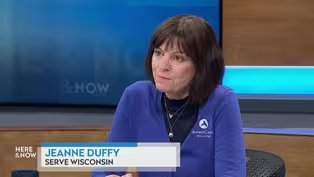
Jeanne Duffy on AmeriCorps Funding and Its Work in Wisconsin
Video has Closed Captions
Clip: S2300 Ep2348 | 5m 32s | Jeanne Duffy on the status of AmeriCorps projects in the midst of a lawsuit over funding. (5m 32s)
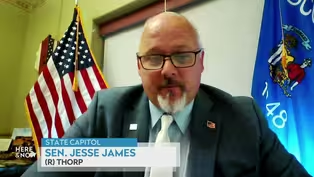
Sen. Jesse James On Mental Health Services Offered At School
Video has Closed Captions
Clip: S2300 Ep2348 | 6m 51s | Jesse James on a bill creating a pilot program for school-centered mental health services. (6m 51s)
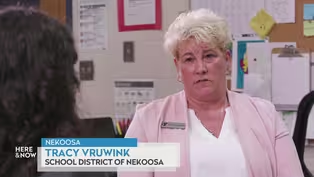
Tracy Vruwink On Impacts of Federal Funding Cuts in Nekoosa
Video has Closed Captions
Clip: S2300 Ep2348 | 6m 21s | Tracy Vruwink on how federal defunding can affect school programs and food pantries. (6m 21s)
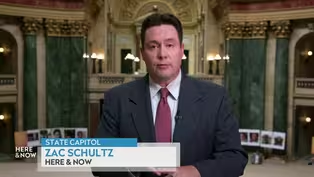
Zac Schultz On Lawmakers Writing Wisconsin's 2025-27 Budget
Video has Closed Captions
Clip: S2300 Ep2348 | 6m 20s | Zac Schultz on how the Joint Committee on Finance is assembling the 2025-27 state budget. (6m 20s)
Providing Support for PBS.org
Learn Moreabout PBS online sponsorship
- News and Public Affairs

Top journalists deliver compelling original analysis of the hour's headlines.

- News and Public Affairs

FRONTLINE is investigative journalism that questions, explains and changes our world.












Support for PBS provided by:
Here and Now is a local public television program presented by PBS Wisconsin