Here and Now
Here & Now for June 6, 2025
Season 2300 Episode 2347 | 26m 49sVideo has Closed Captions
Watch the entire episode of Here & Now for June 6.
Watch the entire episode of Here & Now for June 6.
Problems playing video? | Closed Captioning Feedback
Problems playing video? | Closed Captioning Feedback
Here and Now is a local public television program presented by PBS Wisconsin
Here and Now
Here & Now for June 6, 2025
Season 2300 Episode 2347 | 26m 49sVideo has Closed Captions
Watch the entire episode of Here & Now for June 6.
Problems playing video? | Closed Captioning Feedback
How to Watch Here and Now
Here and Now is available to stream on pbs.org and the free PBS App, available on iPhone, Apple TV, Android TV, Android smartphones, Amazon Fire TV, Amazon Fire Tablet, Roku, Samsung Smart TV, and Vizio.
Providing Support for PBS.org
Learn Moreabout PBS online sponsorshipThe following program is a PBS Wisconsin original production.
>> Canadian wildfire smoke blankets the state, prompting air quality alerts, with more expected on the horizon and through a haze of budget negotiations, state lawmakers are at an impasse.
While a federal deal inches forward.
[MUSIC] tonight on "Here& Now".
Republican Senator Ron Johnson on where he stands with the reconciliation bill.
The Milwaukee Common Council president discusses heightened Ice activity in his community and an effort to revive native languages.
Also confronts past traumas.
It's "Here& Now" for June 6th.
>> Funding for Here and Now is provided by the Focus Fund for Journalism and Friends of PBS Wisconsin.
>> Elon Musk calls it an abomination.
Democrats hate it.
And some Republican U.S.
Senators are blasting its spending.
The federal reconciliation budget bill is taking it from all sides, even as President Donald Trump and the House speaker praise it as big and beautiful.
According to the Congressional Budget Office, the House reconciliation bill will add $2.4 trillion to the federal debt over ten years.
That's after cutting spending by 1.2 trillion and decreasing revenues by 3.6 trillion.
Those numbers add up in a bad way, according to Wisconsin Republican U.S.
Senator Ron Johnson, who joins us now from Washington.
And, Senator, thanks very much for being here.
you're doing well.
>> I am so are you still a hard no on the reconciliation bill in its current form, even after talking to President Trump.
>> In its current form.
But let me point out the good parts of the bill would take away a eliminate an massive automatic tax increase on virtually every American that pays tax.
It certainly default.
The House has done some pretty good work at looking at programs, trying to eliminate the waste, fraud, and abuse of the Obamacare portion of Medicaid that's necessary to do so.
We can protect the benefits for the vulnerable, for disabled children, pregnant women, the people that Medicaid was actually designed for, not to single, able bodied, working age, childless adults.
So again, the house has done a lot of good work.
You know, my main beef is the debate in the House was pretty lacking in terms of looking at the numbers we really need to be looking at.
They throw out 1.5 trillion.
Sounds like a lot, but over ten years it's barely a rounding error in the $89 trillion was spent in the two.
In the $22 trillion additional deficit, which again, we can argue I'm not a big fan of CBO scores.
Their static scoring versus dynamic.
But, you know, set the score aside.
Look at the ten year projection.
It's pretty grim.
And so my main point is we have to look at the facts and figures.
Our goal should be to bend the deficit curve down right now.
Continues to skyrocket.
But but again, the good news is I think we've got good people in the positions.
I respect the president.
I know he wants to tackle this problem.
The speaker leader Thune chairman Crapo president's got a first class economic team.
So my next step is sitting down with Secretary Besson again and going through the numbers.
Let's get our facts straight.
Let's get on the same page.
From that standpoint.
Then, you know, figure out how we can do something that's really hard.
You know, one of the points the president made in the meeting is, you know, Democrats are always so unified.
And I pointed out, well, that's because they're doing the easy thing.
They're spending money.
They're mortgaging our kids future.
It's hard to be the parent.
It's easy to be the parent and say, hey, we're going to go to Disney World.
It's hard to be the parent who says, we can't afford that.
I know we all want to go to Disney World.
We just can't afford that.
We're kind of that in that position right now.
We're trying to rein in all this massive deficit spending, growth and the deficits.
>> Elon Musk calls this a massive, outrageous, pork filled, disgusting abomination.
Is that too strong, then?
>> Well, the spending is on some pretty necessary items.
You know, the top priority government is defense.
So it spends more on defense, realizing that we're probably going to have a hard time passing appropriation bills, probably operating on a continuing resolution for the next fiscal year.
And also recognizes we have to secure the border, and we do need to deport criminals and members of violent gangs and human sex and drug traffickers.
So there is some funding we have to provide.
Otherwise there are some real spending reductions here.
Again, not enough to solve our problem.
And that's all I'm pointing out, is we have to look at that problem.
We have to continue to highlight it.
We have to lead and we have to lead about doing something that's really hard.
>> If adding $2.4 trillion to the national debt is irresponsible in your mind, as I've as I've heard you say, why not dial back the tax cuts?
>> Let's not tax cuts.
It's preventing a tax increase.
And it is true.
The Tax Cut and Jobs Act, when we enacted that federal revenue was 17.1% of our economy.
Right now, federal revenue is 17.1% of our economy.
So we actually lowered rates, and we're still taking in over ten years.
Now, the same percentage of GDP.
And what is interesting is no matter how much you try punishing success, and I've got a great chart goes back, I think more than 50 years showing top marginal tax rate of 91%, 70%, 50%.
Again we spend all over the place, but over 50 years, the average revenue we've been able to extract from the American economy, the American people, 17.1%.
So we're at that average at some point in time, we need to recognize that reality, recognize that the top 1%.
Yeah, they earn 20% of the income.
They pay more than 40% of the tax.
At some point you have to realize that's probably a fair share.
We've got progressive rates.
So again, I'm not into raising people's taxes that would harm the economy.
Recognizing that economic growth is the number one component to try and get ourselves out of this deep hole that we dug.
>> Would you be looking for deeper cuts to social safety net programs?
Is that a place you could find savings, even looking for cuts in Medicare?
>> No.
What I've been pointing out is Covid created a massive surge in federal government spending.
We were spending $4.4 trillion in 2019.
This year, we'll spend in excess of $7 trillion.
That's a 58% increase.
I've been just saying let's return to a reasonable pre-pandemic level.
I've laid out options.
Clinton in 1998.
Obama in 2014.
Trump in 2019.
You exempt Social Security, Medicare, and interest spend what you need to spend, but all other outlays, actual outlays, increase by population growth, inflation.
You end up with a baseline budget somewhere between 5.5 and $6.5 trillion.
That's a reasonable approach.
It's a reasonable control.
So that's basically looking at spending across the board line by line.
That's what I've been suggesting and pretty well requiring is we need a process to control spending, go line by line, program by program.
There's over 2600 programs in the federal government.
My belief is we could eliminate hundreds of those programs, probably eliminate tens or hundreds of billions of spending that nobody would even notice, except for the grifters who are sucking down the waste, fraud, and abuse.
>> What about clawing back money already appropriated, like in the rescission package that just went to Congress?
That cuts $9.4 billion from US aid and PBS and NPR, bearing in mind that we're sitting in a PBS station right now conducting this interview.
But I trust you'll vote yes on that first rescission package.
>> I completely support what President Trump and Elon Musk did with DOGE.
They exposed just grotesque examples of waste, fraud and abuse.
Again, we're $37 trillion in debt.
We have deficits, you know, projected to average $2.2 trillion over the next ten years.
You need to start eliminating spending.
And so you just can't afford this anymore.
Again, we can't go to Disney World.
We simply can't afford it.
>> And so you would like to see all the DOGE cuts codified in in the way of a rescission package.
>> Yeah.
Again, I can't say every last one of them, but I would be generally supportive.
And again, that's pretty much up to the white House to they have to propose, you know, you know, prepare those rescission packages.
And then, you know, we get an up or down vote on it.
>> What about the Trump administration's tariffs?
What is your position on those at this point?
>> Well, again, I'm pretty much an unabashed free trader.
I realize that there are products that we've allowed to be offshored that are strategic.
We've got to bring them back.
I know that China is a real abuser of world trading organizations.
President Trump has a negotiating strategy.
I really don't want to reduce his leverage in that.
I do hope that he concludes it.
And we, you know, come to some, you know, steady point so we can return certainty and stability to, to our economy.
>> All right.
Senator Ron Johnson, we leave it there.
Thanks very much for your time.
>> Wisconsin once again makes national headlines by way of immigration, when a man who was arrested by Ice while dropping his daughter off at school was accused of sending letters threatening to assassinate President Trump.
Prior to his arrest, Ramon Morales Reyes was helping police as a crime victim and witness.
And in a disturbing twist, the very man he was set to testify against is the man who allegedly penned the letters with intent to frame him and have him deported.
Despite his innocence in the threats, he remains in Ice custody at the Dodge County Jail pending his removal proceedings.
The Department of Homeland Security says.
Democratic Representatives Mark Pocan and Gwen Moore paid a visit to the Dodge County Jail this week to try to speak with Mr. Morales Reyes and to see the conditions of the only Ice detention facility in the state.
>> My concern is that, you know, if this case if, if, if Mr. Morales Reyes is indeed deported, US deported because he came to the attention of Ice, US because he was a victim of crime that we can we can just forget about ever, ever, ever being able to get any cooperation out of immigrants that they will not help local police and their enforcement efforts won't help the FBI in securing the whereabouts of people who truly are criminals, people who people who truly are writing letters threatening the life of the president.
This is a much bigger issue.
And that I think that Mr. Morales Reyes is a victim.
He's a victim.
>> The immigration case of Morales Reyes isn't the only one in Milwaukee raising concerns.
There's also Yessenia Ruano, a teacher's aide in the public schools and mother who was told to self-deport to El Salvador even though she has a pending visa application for human trafficking victims and no criminal history.
Her immediate removal from the U.S. Was put on hold for now.
But local leaders have taken a stand over the federal immigration crackdown, releasing public statements in solidarity.
The Milwaukee Common Council declares Ice actions further fuel anti-immigrant sentiment being pushed at the national level.
Council President Jose Perez joins us now.
And thanks very much for being here.
>> Thank you for having me here in the opportunity to share the Common Council's view and the things we're doing here in Milwaukee.
>> Tell tell us more about why you feel the council should weigh in on these cases.
These people.
>> Well, you know, I think Milwaukee has always been a welcoming place for immigrants.
Our council cares about fairness, about process.
And it's important that these things are held front and center.
You have teacher's aide who has been entrusted by the community to look after our children.
Been here 14 years, no criminal record, and we want a system that supports our milwaukeeans that way and creates opportunities and a path for citizenship, because that's what the American Dream is about.
And the Council felt compelled to show some solidarity about what we consider as fairness in this broken system that we have.
>> How, in your mind, have you seen a rush to judgment in these cases?
>> You know, when we think about the impact of human.
Trafficking, these things take time.
These things we feel deserve a due process.
And in this case, having to wait so long and then for the moment of having to deport Self-deport in a community where we want and need more teachers and people in education, there is a rush to judgment and to be much more fair than that.
>> Does it feel like immigrants in your city and across the state are not being given that that due process or that that process is quick and can be too often flawed?
>> Yeah, well, it feels that way, especially when it takes as long as it does.
People petition, have to wait years even in Yessenia Reynolds case, 14 years to come to a conclusion.
After applying for the visa.
It just takes a long time and disparages people from staying within the process, continuing to apply.
It's expensive so that that sense of it not being a fair process that is inclusive creates lots of animosity about the hope that if you do all the right things, in the end, you know, the immigration process will make the right decision.
>> How does the kind of Ice enforcement that we've seen recently tear at the fabric of your community?
>> Well, we have milwaukeeans that are sending their children to school, are showing up for work that have have done nothing wrong or are waiting on the system, feeling that it's coming after them.
And the Latino community has been the Latino and immigrant community has had a huge impact on the economics in Milwaukee, have stabilized the population growth.
We're cranking out young people, educated, going to college, and yet it doesn't feel like the sense of the rate of return or the investment back in the Latino immigrant community is, is making any sense.
So it's created fear.
It's created a sense of not wanting to participate.
And we need we need public safety.
Very important.
We need our immigrants to always contact the police, to have all the confidence that the system is working.
And when they're in fear or living in fear in the shadows, it's difficult to do that.
>> Does the attention that you and others are putting on these cases, these people forced the Department of Homeland Security, do you think, to afford more thoughtful kind of enforcement, including due process?
>> Well, that's what we're hoping.
We're hoping that the attention we're we're providing to it isn't one of agitation or being antagonistic.
But when we see good people in our community that have invested time and energy, that are doing the right things, we're calling on the system.
To be fair.
We're calling on the system to really look at the folks and the fabric of our community.
What makes it up, and really being conscious about that.
We don't we don't always feel that that's the case.
>> Have you or the council had communication with Ice or the Trump administration.
Not directly.
I know that we that would be something for us to consider.
I know that we've reached out to our congressional reps when we hear of things in the community hoping that since at that federal level, they can communicate with Ice around the truth, around either raids or why people are deported, or figuring out this list, how does someone make this list of folks that are being either we hear that they're they're following people in communities.
They're pulling them over.
And sometimes we want to know what is the criteria to make this list.
So we're educated about these stops, knowing why they're doing what they're doing.
But we haven't heard a word.
>> Council President Jose Perez, thanks very much for joining us.
>> Thank you for having me.
>> Smoke from Canadian wildfires this week left Wisconsin in a state of haze and health warnings midweek.
Milwaukee had the worst air quality in the nation as the fires burn and new ones break out.
It could be a summer long threat.
Kurt Kotenberg with the National Weather Service in Green Bay shares, the forecast for smoky conditions.
>> What helps get the wildfire air down to us in Wisconsin is the wind direction at the high levels of the atmosphere, and we've had this is pretty persistent weather pattern over the past few weeks, and that's been a very weather pattern that's had very strong winds over Canada that have literally been pointing the winds into Wisconsin.
They're blowing it about 125 miles an hour at 20,000ft.
So very high up there.
You're getting very fast winds that are ushering all of this wildfire smoke into Wisconsin.
And comparing trends from now versus the past ten years, the trends are above normal for wildfires that have been occurring in Canada, and it's just kind of a more of a local thing as to why that smoke is reaching us here in Wisconsin.
Some year, it's a different weather pattern where the smoke is not being brought down into Wisconsin.
But this year, unfortunately, it is and has been, and it seems like the wildfire trend is only going to continue to get worse in Canada.
Not every single day is going to feature poor air quality, but more often than not, we might start to see days with poor air quality.
Here in Wisconsin for June July into maybe even August and September.
>> At the state capital budget riders are at work fashioning the two year spending plan with Republican leaders now declaring an impasse in negotiations with Governor Tony Evers.
One of the items in the Evers budget allocating $11 million in tribal gaming revenue for Native American language revitalization.
For a look at that work "Here& Now", reporter Erica Ayisi spoke with Menominee and Ojibwe tribal members who are bringing their indigenous languages back from a past policy of silence.
This report is in collaboration with our partners at ICT, formerly Indian Country.
Today.
>> Scott Gaetz, Panchakarma, Co-Chair.
>> Trinaty Caldwell is learning how to speak Menominee, an indigenous Native American language.
>> The ability to talk in the language freely that to be able to do it now, today is a blessing because our elders weren't allowed that freedom.
>> Caldwell's native ancestors spoke languages that are now nearly extinct.
>> Pewaukee Kamala.
>> Adult language learners at the Menominee Language Campus are on a mission to revitalize their indigenous language from a past of systematic erasure.
>> Like even just saying Pozo wasn't always the most comfortable thing right away.
>> Really?
>> Yeah, it wasn't ubiquitous.
I didn't really hear it a lot.
>> Netsky, wakizashi.
>> Shannon Dennis Matsui, comic time where.
>> There was no meaningful social or community access to the language.
>> Rohn Kern RFK, Jr, director of revitalization for Menominee U.
Says their doors opened in 2024 after creating a community of native language learners online.
>> That means if you're not looking to be a teacher or be a student, there was no place for you in revitalization.
stipend to normalize speaking Menominee on the reservation.
of the places here on the reservation, or do our business, be it at tribal offices and or anywhere else that we might see people who have taken their opportunity to join this revitalization and do that same business in the language.
>> So we.
>> Alexander Medina says he's now exposed to more conversational Menominee vocabulary that his non-native stepfather dissuaded him from learning as a child.
>> Sometimes it was kind of heavy handed and kind of bad.
How how much he didn't want us to basically just be Manam, be Menominee like, use rez slang.
We'd get in trouble.
learning the language, does it have an impact on your self-esteem and your identity?
>> Absolutely.
It kind of clicked to me that it's not illegal.
It's not banned anymore.
So we should do what we can to salvage the culture we have left.
>> Martin Ranay is.
>> Schoenike language revitalization efforts stem from a troubling past.
>> Cieri coming.
>> A boarding school experience was very effective in what it set out to do, which was to kill the Indian, save the man and every man, woman and child.
And our ancestors.
Three four generations over had this horrific life experience.
>> For over 60 years, there were at least 11 federal Indian boarding schools across Wisconsin, including two here in Menominee Nation in Keshena.
These schools were designed to culturally assimilate Native American children into American culture by forcibly removing them from their families and banning them from speaking their native tongue.
>> The most common thread that you see in conversations about language loss really begin in the 19th century, and it often revolves around federal Indian boarding schools and Indian schooling in non-native institutions.
>> Sasha Maria Suarez, professor of History and American Indigenous Studies at UW-Madison, says the federal Indian schools across the state were managed by religious institutions which colonized Native American children and prohibited their language.
What was it to be replaced with?
>> English even if they went into federal Indian boarding schools with no grasp of the English language, that was really the only language they were permitted to speak.
>> Severed ties to indigenous languages has been a generational issue for all tribal communities.
>> For over a century.
These kinds of policies that have tried to diminish and disrupt indigenous language use.
>> My great grandma, she spoke Menominee.
There were some things that were passed down and some things that weren't.
And the language just was not one of them.
>> Menominee Ho-Chunk, Oneida, Ojibwe, Stockbridge-munsee, and Potawatomi are some of Wisconsin's indigenous languages.
>> Schimming and.
Waupan.
>> Suarez says Wisconsin's indigenous languages did not completely lose their voices.
>> Those elders who had been to schools, who maintained an awareness of their indigenous languages, started using education to teach their languages to the next generations.
>> In Bad River, for a new generation of language speakers and singers, Dylan Jennings of the band Bizhiki wants Ojibwe traditional sounds to be a part of the modern music scene.
[MUSIC] >> What we're.
>> You know, expressing ourselves and making things that we like.
But another part of it, too, was us using our platform to normalize our our sounds, our style of singing and our language.
>> Their song unbound is about preserving Bad River waters.
>> We just have to remember to utilize our language and all those tools that we've been given.
And today, all federally recognized native tribes in Wisconsin offer indigenous language learning opportunities.
revitalization efforts in those decades following World War two demonstrates really clearly how boarding schools failed in terms of trying to dismantle and disrupt indigenous languages.
>> In 2021, Governor Tony Evers issued an executive order formally apologizing for Wisconsin's role in the Indian boarding schools era through state and private funding, language revitalization efforts.
At Menominee, you plan to continue?
>> I don't have an education beyond high school, but I have a resilient spirit that's willing to give all that it can to see through the revitalization of the language.
>> Macheel.
IL Shaikh.
>> In Menominee Nation for "Here& Now" and ICT.
I'm Erica Ayisi.
>> Mendota.
>> For more on this and other issues facing Wisconsin, visit our website at PBS Wisconsin.
Org and then click on the news tab.
That's our program for tonight.
I'm Frederica Freyberg.
Have a good weekend.
[MUSIC] >> Funding for "Here& Now" is provided by the Focus Fund for Journalism and Friends of PBS Wisconsin.
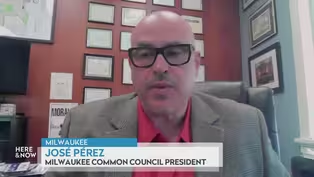
Alderman José Pérez On ICE Arrests of Milwaukee Immigrants
Video has Closed Captions
Clip: S2300 Ep2347 | 5m 55s | José Pérez on community support for residents of Milwaukee who were detained by ICE. (5m 55s)
Here & Now opening for June 6, 2025
Video has Closed Captions
Clip: S2300 Ep2347 | 1m 4s | The introduction to the June 6, 2025 episode of Here & Now. (1m 4s)
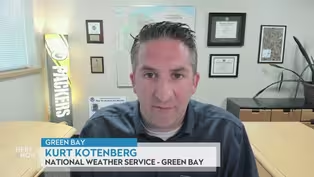
Kurt Kotenberg On Tracking Wildfire Smoke Across Wisconsin
Video has Closed Captions
Clip: S2300 Ep2347 | 7m 8s | Kurt Kotenberg on wildfire smoke in Wisconsin and the potential for such conditions. (7m 8s)
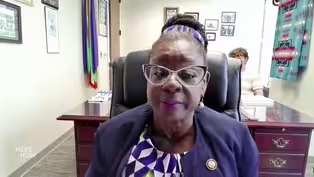
Moore, Pocan Seek To Visit ICE Detainees At Juneau Facility
Video has Closed Captions
Clip: S2300 Ep2347 | 1m 53s | Gwen Moore and Mark Pocan visit an ICE detention facility after an immigrant was framed. (1m 53s)
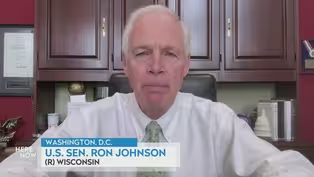
US Sen. Ron Johnson on a 2025 Tax Bill and the Federal Debt
Video has Closed Captions
Clip: S2300 Ep2347 | 11m 21s | Ron Johnson on a 2025 reconciliation policy bill cutting federal taxes and spending. (11m 21s)
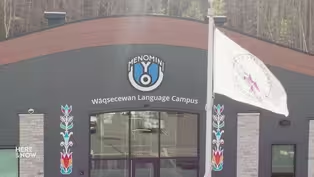
Wisconsin Native Languages Shift From Silence To Celebration
Video has Closed Captions
Clip: S2300 Ep2347 | 7m 29s | A movement to revitalize Indigenous languages is taking root across Wisconsin. (7m 29s)
Providing Support for PBS.org
Learn Moreabout PBS online sponsorship
- News and Public Affairs

Top journalists deliver compelling original analysis of the hour's headlines.

- News and Public Affairs

FRONTLINE is investigative journalism that questions, explains and changes our world.












Support for PBS provided by:
Here and Now is a local public television program presented by PBS Wisconsin