Here and Now
Here & Now for May 10, 2024
Season 2200 Episode 2243 | 26m 48sVideo has Closed Captions
Watch the entire episode of Here & Now for May 10.
Watch the entire episode of Here & Now for May 10.
Problems playing video? | Closed Captioning Feedback
Problems playing video? | Closed Captioning Feedback
Here and Now is a local public television program presented by PBS Wisconsin
Here and Now
Here & Now for May 10, 2024
Season 2200 Episode 2243 | 26m 48sVideo has Closed Captions
Watch the entire episode of Here & Now for May 10.
Problems playing video? | Closed Captioning Feedback
How to Watch Here and Now
Here and Now is available to stream on pbs.org and the free PBS App, available on iPhone, Apple TV, Android TV, Android smartphones, Amazon Fire TV, Amazon Fire Tablet, Roku, Samsung Smart TV, and Vizio.
Providing Support for PBS.org
Learn Moreabout PBS online sponsorship.
PBS Wisconsin original production.
20 24 election coverage.
The fits and starts of negotiations between UW-Madison protesters another presidential campaign visit to Wisconsin this week from Joe Biden courting black voters and announcing Microsoft's next plans for Mount Pleasant.
2026, we will invest and spend $3.3 billion by.
>> I'm Frederica Freyberg tonight on "Here& Now" campus protesters in UW-Madison administration reach a chord.
We look at the long term impacts of the protesters message.
The Ho-Chunk nation votes to decriminalize marijuana.
We speak with their attorney general, how services for survivors of domestic and sexual violence will undergo deep funding cuts, and the lethal consequences behind the while in police custody.
It's "Here& Now" for May 10th.
>> Funding for here and Now is provided by the Focus Fund for Journalism and Friends of PBS.
Wisconsin.
campus are coming down.
Students for Justice in Palestine agreed to clear the protest encampment, not disrupt graduation ceremonies this weekend and not set up tents again.
In an agreement with the UW-Madison administration.
For its part, the administration will set up a meeting between protesters, the UW Foundation and Alumni Association to discuss how the university's endowment is demands was for the university to divest of investments with Israel.
We want justice, also help UW divest now.
When negotiations broke down between protesters and the university midweek, about 200 people rallied and voiced their disappointment over the Chancellor, saying she lacked authority to divest of investments with Israel.
But in following days talks resumed, with the university eager to end the encampment, which was agreed to Friday just ahead of graduation ceremonies.
What are the implications of these protests at the university campus and campuses across the country?
UW-Madison journalism professor Douglas McLeod is an expert on social protest and media coverage of it.
He joins us now.
Thanks very much for being here.
>> Thank you.
produced messages that support the status quo when covering social protest.
Is coverage of these protests across the country and here supporting the status quo?
>> For the most part, yes.
Most of the research that we've been doing over 35 years has looked at sort of mainstream media coverage in newspapers and then sort of the three minute news packages that are produced to cover social protests.
And we found that just a very common pattern of coverage that sort of typifies a lot of different kinds of protest.
We've looked at left wing protesters, right wing protesters, we've looked at all sorts of different kinds of antiwar, anti-globalization, Asian protests, Black Lives Matter protests, and so we've discovered there's this sort of common pattern when it comes to sort of mainstream news reports.
>> So in this case, what even is the status quo potentially being hewed to?
>> So generally speaking, the status quo would refer to sort of the policies and procedures of the institutions of power, government or corporations, who are often the chosen target of protesters.
But as part of this protest paradigm coverage, their chosen enemy is often ignored and instead the focus is on the actions of the protest, and it's framed as kind of police versus protesters.
And in that sense, the coverage tends to insulate the institution, like government or corporations, from, from critical coverage of some of their policies and, and positions that the protesters would like to raise.
>> And so in your mind, as, as an expert researcher in this field, what is the danger to kind of, civic understanding if it's really kind of one sided?
>> Well, I mean, I think to some degree you can kind of see some of the dangers right now in the current protests.
There's been a lot of attention on police actions on campuses around the country, a lot of attention to encampments being removed, a lot of attention to clashes between protesters and counter protesters, but not much mainstream news coverage is really kind of explaining, hey, what's this protest all about?
What's going on in Gaza?
And how are the protesters trying to effect change when it comes to that particular issue?
>> Speaking of kind of the police movements around these protesters as a as a faculty member on this campus, what was your reaction when the police moved in on the UW-Madison encampment?
>> The concerns are that some of their actions against faculty and students are sometimes more aggressive than they might need to be.
And I've heard some charges, and I don't know whether they're validated or not that, on this campus and elsewhere, some of the more sort of aggressive measures taken by police officers are often addressed, directed at minorities as, students and international students.
pro-Palestinian protest when some Jewish students express feeling marginalized or worse, and others feel they're experiencing Islamophobia like kind of how complicated when passions around enduring conflict and bloodshed in the Middle East come to campus.
>> Yeah.
I mean, this is about as as complicated as you get in terms of protests.
First, you start with the issue in Gaza, and it's not a simple solution.
It's not a case of this side being right and this side being wrong.
It's very, very complicated.
Number one.
Number two, the protests are taking place right here, and they're sort of directed more at things like university investments.
That's kind of a complicated issue.
They're more indirectly connected in some cases to the protest events that are going on in the Middle East and to some degree, you know, in the coverage of this protests that sort of connection to these issues to some degree gets lost.
Right.
protests move presidential policy on Israel?
>> Well, with all the different factors that are trying to shift presidential policy, it's hard to trace it to exactly what is driving what, we know that protest can have a big impact.
We don't have to go far back into our own history to the civil rights movement, say, in the 1950s and 60s to see the profound impact that that kind of social protest and demonstrations had on affecting public policy.
We know that is the case there.
I think history is going to have to take a look at this particular case to see, to what extent the protesters themselves has had an impact.
>> Yeah.
All right.
Professor McCleod, thanks very much.
>> Thank you very much.
>> Ho-Chunk nation's legislature moved to decriminalize cannabis on its tribal lands.
It's a move, they say, that doesn't fully legalize marijuana.
Still, it raises legal questions as the drug is still illegal federally and in Wisconsin.
Joining us to address these questions is the Ho-Chunk Nation Attorney General William Gardner.
And thanks very much for being here.
>> Thanks for inviting me.
>> Tell me why did the Ho-Chunk vote to decriminalize cannabis?
>> It has been in the.
Process of considerations by the Ho-Chunk nation since 2015.
In 2015, the General Council got together and made a request that the legislature consider and research moving into, the marijuana field in the sense of what can they do for economic expansion, at that point in time , there was a start of a process , and then the commitment was made that they would continue to do the research.
And in an effort to put the nation in the best possible position once and if any form of legalization occurred, they moved forward with that effort, which has been continuing over the years with decriminalizing, marijuana within the Ho-Chunk nation statutes more than likely to begin, preparing for the potential of the change of, the marijuana rules under the Controlled Substance Act from a schedule one to a schedule three.
Drug.
So, it's all been positioning, and this is, for the most part, groundwork.
>> How does decriminalizing cannabis on tribal lands Square with state and federal law under which it remains illegal?
>> The decriminalized ation, as you may know, or as others may not know, basically removes the potential for a, crime violation or a conviction of a crime from somebody who may be arrested or charged with a crime under the current, codes, all of the all of the illegalities of using marijuana are still in effect throughout the state of Wisconsin, as well as, through the Ho-Chunk lands.
But if the tribal member is, in possession of an amount of marijuana on tribal lands, the decriminalization affects that individual by the tribal police, not, filing a criminal charge against that individual.
And they wouldn't have to.
Look, I should say, look forward to his wrong word, but they wouldn't have to worry about getting a criminal record that might affect education or housing applications or things of the sort.
So that's something that, we see as, a benefit to a tribal members, but it is not in any way, bumping shoulders against the legality.
We're fully aware of that, marijuana is still illegal.
vote to decriminalize will kind of help prod the state of Wisconsin to move in the same direction?
I know that there are some tribes that are getting themselves together to lobby, in order to move forward.
>> But, I think that, it's going to be a continuing effort to, to try and get something done, perhaps in the medical marijuana field, but I'm not certain.
>> It's just that, is it the sense among the tribal nation that decriminalizing cannabis could potentially help reduce opioid use, the abuse of which is a problem statewide and for tribal nations?
>> I think there's a sense generally, across the nation, perhaps I won't speak for other tribes, but there has been discussion here regarding, reports that those states that have opened up with, legalization of marijuana are beginning to find that the opioid use, that they had had at the start of their opening up is reducing and dropping down, there's also some additional, studies that are beginning to surface, dealing with the effects of medicinal marijuana, and dealing with various health aspects, which also include opioid addiction, and things of that nature.
So we're watching it.
It's too early to tell.
There are not a lot of studies because as you may know, there are not a lot of people who could do studies in this area considering the illegality across the nation.
Yeah well, we leave it there and we will watch this as it progresses.
>> Attorney General William Gardner, thanks very much.
>> Okay.
Thank you.
>> A 70% drop in federal funding to states to help victims of crime has advocates warning of dire consequences.
The grants to states for victim services are funded through federal fines and fees paid by people convicted of a crime, but the federal fund has sharply declined, leaving Wisconsin's annual funding expected to go from more than $44 million to roughly 13 million.
The Wausau organization, called the Women's Community, whose services help thousands of victims of domestic abuse, sexual assault and human trafficking, fears the loss of services.
Its executive director, Jane Graham Jennings, is here, and thanks very much for being here.
>> Thank you.
I'm happy to be here.
about how the drop in grant funds will affect your services?
>> Well, you know, the thing about serving victims of abuse, is it's not just one community.
So these the drop in funds will definitely impact the marathon County, which is where we serve.
And the Wausau community.
But it will impact every community in our state because all of the programs that are currently funded will see a significant fe women's community in particular, and the other thing that is, makes a little bit difficult for us to plan is we won't actually know the total decrease that we get until August or September, just the way the grant process works.
So we won't really know.
In the best case scenario, we will be losing about $234,000.
And that's just for the women's community.
>> How do you even weather such a loss?
>> We've been trying to plan for it for a while.
The, the state administrators have been exceptional in trying to keep us informed and planning for a while, this problem would have happened, a few years ago, except there were some Arpa dollars that the state was able to put in to plug the gap so that kept us operating and being able to keep our services operational for an additional two years.
But that money is going away.
So now we're going to see those cuts.
So our board has been planning we've been talking about it.
We have some funds for Rainy Day, and then we just search for other dollars.
But again, we don't know exactly how much that is going to be, so as soon as we know, then we're going to be rolling out all of our plans.
services and what are some examples of what Community of Women offers?
>> So we work with anyone who has been a victim of domestic violence, sexual assault, Adults, children, men, women, anyone who has been impacted.
Services include a number of things.
One thing that people are most familiar with is our shelter service, and that's a place where people who are in violent situations trying to flee, to move into safe housing can stay with us for a short time in an emergency shelter, that's going to be impacted drastically by the funding cuts, we provide ongoing supportive advocacy because when people have been harmed by someone they love, which is most often what's happening in sexual assault, and is the case of what's happening in domestic violence, it's really a traumatic experience.
And people are trying to figure out how to survive and how to rebuild their lives.
No one wants to come to services like the women's community, because if you need our services, something really bad has happened to you or someone you love, so people come to us as a last resort and we want to be there to help rebuild them.
They come to us feeling broken and ashamed and judged, and that no one believes them or supports them.
And we want to help them rebuild that spirit, really, their soul has been crushed by the trauma that they've experienced, and we just try to help rebuild that, we often use the analogy of a butterfly.
People come to us and they feel like they're the squishy, ugly caterpillar that people just want to step on, and then they go into their cocoon and in a short time, they emerge.
Beautiful and free.
And that's the process we get to see when people come to us broken, and they leave us strong at the broken places.
>> Is domestic and sexual violence against women on the rise?
most recent in the state of Wisconsin and domestic abuse.
Wisconsin does a domestic violence related homicide report, and the last one that was complete was in 2022.
And 96 people in Wisconsin lost their lives due to domestic violence.
Unfortunately, we are one of the top ten states in the nation that has the highest level of domestic related homicides in the country.
So this is not something that we are proud of, and we're working really hard to figure out how we can make an impact, but there's still, so much blaming that is done, victims are still blamed for so much of it.
People ask questions about victims behavior.
Why do victims stay in abusive relationships instead of really asking the question, why does someone who claims to love harm the person they claim to love?
There's just not an incentive for people to behave better.
We need people to stop being harmful.
>> We have many more questions, but we leave it there.
Jane Graham Jennings, thank you very much.
Thanks for your work.
Thank you.
An investigation by the AP and PBS frontline revealed police and medics using injected sedatives to de-escalate people who have been deemed to have something called excited delirium.
>> We've now come to understand that excited delirium is a deeply flawed concept in many cases, the definition of excited delirium is built on racial stereotypes and probably more fundamentally, excited.
Delirium was a concept that, in many of these cases, served to shift the focus from the actions of the first responders.
Restraint or chemical sedation by the police or by EMS to the individual for using methamphetamine, for engaging in criminal activity, for, in some cases, suffering from mental health emergencies.
>> The use of medications is part of an excited delirium protocol in some departments to render the person compliant.
This is often in combination with stun guns and pinning subjects face down, but the combination can be fatal.
It happened to a man in Eau Claire County, as described in the investigative reporting excited high pain tolerance and superhuman strength, is a controversial and disputed diagnosis and should not be used to justify use of force and medication given.
That's according to our next guest psychiatrist, Doctor Julie Owen from the Medical College of Wisconsin.
And doctor, thanks for joining us.
>> Why do you say that excited delirium is a disputed diagnosis .
to be described in the 1980s, and that was in conjunction with , a rising cocaine use and there are very few, professional medical organizations that delirium as a diagnosis.
And without that recognition and without that consensus of the medical community, there's been a lack of true diagnostic criteria that folks agree on, when using this term, which has called its use into dispute.
>> So if it's if it's not excited delirium, what are police and first responders and medics responding to in the field that that then have them using these injected sedatives.
>> So oftentimes, as an individual who might be described as displaying features of, what has been come to known as be known as excited delirium, they will look extremely agitated and, they will potentially be behaving in a bizarre manner, the literature that has looked at this, syndrome has described, things like increased pain tolerance, the individual looking sweaty, the individual breathing rapidly.
An individual who looks like they're they don't really get tired despite a lot of physical exertion.
And sometimes, the literature also describes individuals who are not necessarily complying with law enforcement official orders.
And or being inappropriately clothed in your research, what did you find about the outsized diagnosis of this excited delirium in black or brown police subjects?
Usually there's a, a skewing of the use of this term with, young men and young men of color, and young men of color, who probably at a later phase of examination, are found to be utilizing some sort of, what we call sympathomimetic or a stimulant like substance.
>> So the front line investigation is narrowed in on the use of injected drugs like ketamine by police and medics.
What's your view of that?
Use >> I work in the hospital setting.
In the hospital setting, if an individual presents with agitated Bryan, typically the best accepted practice is as a physician to evaluate that person and try to determine what is the most likely cause of that person's agitation.
And medications are used as a tool then to treat and relieve that person of that agitated state.
So the use of medications is in and of themselves, is not necessarily problematic.
It's the use of a medication with oftentimes very incomplete data and with differing protocols, and dosing.
And again, sort of starting with that, not truly a medical diagnostic term, to sort of drive the intervention or the choice of the intervention that seems to be problematic in these cases.
>> How troubling is it to you that excited delirium might be used as a justification for use of force or injections of ketamine?
>> It is troubling, and again, I think, you know, as a physician and, and as a physician who practices in solely emergent or acute settings, this sort of case is hard for somebody like myself, to try to get to the bottom of and when you have folks who don't have the same amount of clinical training, sort of throwing out terms that sound like diagnoses to then drive interventions, with questionable safety involved and, and of course, when these interventions result in lethal outcomes, when really that's probably not necessary.
That is disturbing.
>> You say that it is imperative to find consensus bias among medical professionals around the diagnosis of excited delirium.
Has that yet been found?
That consensus?
No And are more people like yourself talking about it?
again, my practice clinically, is working shoulder to shoulder with emergency medicine physicians and that sort of cross specialty collaboration, and, collaboration of expertise in this space.
I think that's what's necessary to really, find again, consensus.
But a real clear sense of what it is that we're trying to accomplish with utilizing terms like this or trying to catch summarize clinical presentations like this.
Doctor.
Julie Owen, thanks very much.
Thank you.
For more on this and other issues facing Wisconsin, visit our website at PBS Wisconsin.
Org and then click on the news tab.
That's our program for tonight I'm Frederica Freyberg.
Have a good weekend.
>> Funding for Here and Now is provided by the focus Fund for Journalism and Friends of PBS.
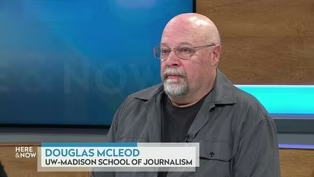
Douglas McLeod on Impacts of Pro-Palestinian Campus Protests
Video has Closed Captions
Clip: S2200 Ep2243 | 6m 21s | Douglas McLeod on media coverage about and political implications of campus protests. (6m 21s)
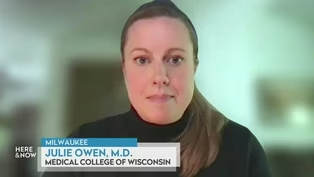
Dr. Julie Owen on Police, Sedatives and 'Excited Delirium'
Video has Closed Captions
Clip: S2200 Ep2243 | 6m 54s | Dr. Julie Owen on the "excited delirium" diagnosis and forcible injection of sedatives. (6m 54s)
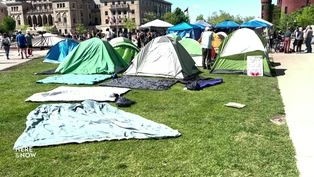
Here & Now opening for May 10, 2024
Video has Closed Captions
Clip: S2200 Ep2243 | 1m 31s | The introduction to the May 10, 2024 episode of Here & Now. (1m 31s)
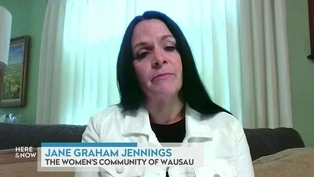
Jane Graham Jennings on Funding for Crime Victim Services
Video has Closed Captions
Clip: S2200 Ep2243 | 5m 48s | Jane Graham Jennings on a funding drop limiting capacity to provide aid to crime victims. (5m 48s)
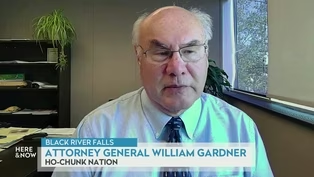
William Gardner on the Ho-Chunk Nation and Cannabis Laws
Video has Closed Captions
Clip: S2200 Ep2243 | 5m 26s | William Gardner on the Ho-Chunk Nation voting to decriminalize cannabis on tribal lands. (5m 26s)
Providing Support for PBS.org
Learn Moreabout PBS online sponsorship
- News and Public Affairs

Top journalists deliver compelling original analysis of the hour's headlines.

- News and Public Affairs

FRONTLINE is investigative journalism that questions, explains and changes our world.












Support for PBS provided by:
Here and Now is a local public television program presented by PBS Wisconsin