Here and Now
Here & Now for May 17, 2024
Season 2200 Episode 2244 | 26m 48sVideo has Closed Captions
Watch the entire episode of Here & Now for May 17.
Watch the entire episode of Here & Now for May 17.
Problems playing video? | Closed Captioning Feedback
Problems playing video? | Closed Captioning Feedback
Here and Now is a local public television program presented by PBS Wisconsin
Here and Now
Here & Now for May 17, 2024
Season 2200 Episode 2244 | 26m 48sVideo has Closed Captions
Watch the entire episode of Here & Now for May 17.
Problems playing video? | Closed Captioning Feedback
How to Watch Here and Now
Here and Now is available to stream on pbs.org and the free PBS App, available on iPhone, Apple TV, Android TV, Android smartphones, Amazon Fire TV, Amazon Fire Tablet, Roku, Samsung Smart TV, and Vizio.
Providing Support for PBS.org
Learn Moreabout PBS online sponsorshipWisconsin.
PBS Wisconsin original production.
>> You're watching "Here& Now" 2024 election coverage.
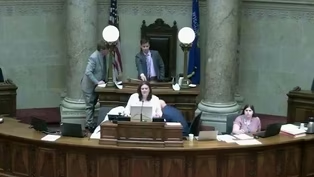
>> You're out of order in my Senate, Republicans tried to undo Governor Evers vetoes in a display of political infighting.
>> And the Wisconsin Supreme Court hears oral arguments on absentee ballot drop boxes.
Again I'm Frederica Freyberg tonight on here.
And now we get a preview of the Republican state convention with the party chair.
Then a look at the absentee ballot drop box case before the high Court.
Climate experts give Madison the moniker of being a climate haven.
But is it?
>> And finally, we speak with an outgoing academic dean whose department got mired in political conflict.
>> It's "Here& Now" for May 17th.
Funding for Here and Now is provided by the Focus Fund for journalism and friends of PBS.
Wisconsin.
In a lead up to the Republican National Convention happening this summer in Milwaukee, the party's state convention is happening this weekend in Appleton.
The chair of the Wisconsin Republican Party says, in this battleground of all battleground states, they're ready and able to win up and down the ballot.
The Wisconsin GOP chair joins us ahead of the state convention.
Bryan Schimming, thanks very much for being here.
>> So great to be here.
Thanks for having me.
>> So we know Wisconsin is important, but just how important is Wisconsin this election?
>> The truth of the matter is in Wisconsin, in the last 24 years, we've had 12 statewide races.
We're about 6 million people, right?
We've had 12 races in the last 25 years that were decided by 30,000 votes or less.
So I'm certainly feeling the attention of nationally, and I like that.
It's good for us.
And frankly, as you know, it's why the Republican National Convention is coming to Milwaukee.
>> What's at stake up and down the ballot here?
>> Just about everything.
It's interesting, I was saying the other day that, you know, here we are, Wisconsin.
Remember, we used to be called flyover country.
Remember those years?
And now we're kind of fly in country.
But there's a reason we have a close presidential race.
I think by anybody's telling, it's a close race here in Wisconsin.
We have a close us Senate race, which six months ago people wouldn't have guessed.
But that we instantly had a close US Senate race to target House races.
Obviously, both houses of the legislature.
So Wisconsin, almost more than usual is really a focus of national attention.
And we feel it at the state party, too.
>> You were just talking with me about money.
Will Republicans in Wisconsin start to see the spigot flow?
>> Yeah, I mean, we're feeling it already in terms of the support nationally.
We, the great thing for us, with the new leadership of the Republican National Committee, Mike Wadley, they are completely focused on not just us, of course, but other target states as well.
So we just hired a new political director this week.
We're hiring, hiring additional field staff.
We're actually one of the more built out states in the country already on field staff opening local offices.
So yeah, I mean, we'll have the resources we need, which voters other than all of them.
>> Will Republicans be specific kind of targeting the president's hurting with a lot of his base groups, young, young people, very, very close between he and President Trump, Hispanics as well.
>> Biden is not doing nearly as well as he did with women when he first ran.
So as you look at those different groups, there are plenty of opportunity for Republicans.
But as I say to Republicans around the state, you have to go get those voters.
You can't count on them not being unhappy with the incumbent or whatever, but they are very, very unhappy with the incumbent.
>> Speaking of voters, you have been pushing early voting for months, which is a total sea change for Republicans.
Yeah but the Republican Party of Wisconsin also officially opposed the use of ballot drop boxes in a case before the state Supreme Court.
Right now, I understand you are in support of those.
What's the actual deal here?
because we feel as though there are that possibly is a subject for some fraud.
But almost more importantly, here we are just a couple of months before the election again, and the state Supreme Court is acting like a second legislature and going in and changing campaign laws.
Frankly, I don't think the drop box issue will be the last one we see from this Supreme Court.
So I think there's a legitimate issue, and I get this from clerks around the state that they don't want all these changes, you know, to the law made in the run up to the election.
But yeah, we've opposed drop boxes.
But to your point, I say to Republicans across the state, I was the first state chairman in the country to push early vote.
And whether it's drop boxes or other potential changes, I have to deal with the laws as they are, and I'm going to.
>> Now, you say that was concerned Republican voters are all in on on Donald Trump.
Does that suggest that Republicans have forgiven and forgotten January 6th and all that happened before and after?
>> Yeah, I don't know.
It's a matter of, you know, all those things that there goofing around with in the courts.
It's not a matter of forgiving or anything.
You know what's interesting about this race?
It's not the typical incumbent challenger race, right?
It's essentially a race between two incumbencies.
And what we see in the polling is that people now know they didn't know four years ago.
Now they know what they were going to get with Joe Biden, which has been high inflation, high interest rates, bad GDP numbers.
Now they know what they're getting between the two.
And that's working for President Trump.
>> As to Wisconsin's key Senate race, other Republicans on our air have said that it would be very, very tough to beat Democratic incumbent Tammy Baldwin.
You obviously don't think that I don't.
>> I mean, Tammy Baldwin's numbers collapsed immediately after she got a tough opponent in the race, and that has turned that into one of the most competitive U.S. Senate races in the country.
Even 4 or 5 months ago, people were saying, Tammy's too tough to beat.
The polling doesn't show that.
And that she's a 95% voter with Joe Biden .
new maps will change the legislature there?
>> Yeah, it's I think it's hard to tell.
I think the Senate seems like it's in a little better position.
Senate position or in an okay position.
The Assembly, I think, is more competitive.
And as you know, I've done a lot of Assembly races around the state.
So I'm familiar with the Assembly.
But I, the Democrats, I feel as though we'll keep both.
And the Democrats are going to have to find another excuse for losing, because I think we will be victorious in both houses.
And I know the state very, very well.
And while you're right, I think the numbers will change, does it automatically flip houses?
I don't think so.
>> We will watch in this pivotal election year, what is it like for Republicans to be hosting the national convention in Milwaukee?
homer, so I'm all about having the convention in Milwaukee.
In fact, when I was doing radio in Milwaukee, when the Democrats announced in Milwaukee I was I was even happy about that because I want it to be good for Milwaukee and for the whole state.
The Republican convention will be, too.
I'm excited, obviously, state chairman to be hosting the national convention, but it's money.
About $200 million spend is 50,000 people coming to the state.
But even more just, you know, for the Wisconsin economy, it's just the country, the whole world will be watching Wisconsin and for Republicans, it's a way to pull our message together in front of a national audience with a five day show that I think is just going to be great for Wisconsin.
I'm so excited.
>> All right, Brian Schimming, thanks very much.
>> We expect to talk with Democratic Party Chair Ben Wikler ahead of their state convention next month on absentee ballot drop boxes.
The Republican Party weighed in against their use in a Wisconsin lawsuit before the state Supreme Court, which heard oral arguments this week.
The case seeks to overturn a ruling made by the court two years ago in a case referred to as Teigen, which barred the use of drop boxes after the 2020 election.
Because law did not expressly allow their use.
>> Teigen, the principle of it, or Teigen is that somehow, if so mething is not explicitly stated in the statute, that it ca n't be done, isn't that that principle?
That's the principle th at turns everything else on its head in Teigen.
>> What if we just got it wrong?
What if we made a mistake?
Are we now supposed to just perpetuate that mistake into the fu ture?
cause Wisconsin argued for their use.
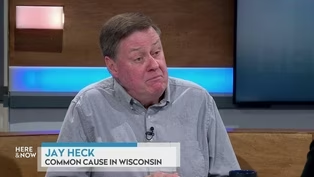
Its executive director, Jay Heck, joins us now.
And Jay, nice to see you.
Great to be with you, Fred, and good to see you again.
So in your mind, should Wisconsin voters expect to see the use of absentee ballot drop boxes for upcoming elections, from what you heard in oral arguments, well, if the oral arguments are any indication about what the court might do, I am very positive or have a very good positive feeling about what the outcome might be.
>> You know, one thing it's important to note is that we have had drop boxes in Wisconsin for a number of years and of course, most famously during 2020, in the pandemic, they were a means for many thousands of Wisconsinites around the state to be able to return their absentee ballots in a safe, secure way.
Rural voters, urban voters, young voters, old voters , people with disabilities, Wisconsin is now the only state in the upper Midwest, only non-red deep red state that doesn't allow the use of them.
>> So but the concern on the part of Republicans is that those boxes could result in fraud with ballot harvesting and the unsecured nature of them.
What about that?
>> Well, those are the those are the suspicions of election deniers and conspiracy theorists during the 2020 election.
Not a single incident of a drop box being tampered with or fraud or any of these things.
This is the specter that is constantly raised to try to reduce the ability of Wisconsinites to be able to vote safely by absentee ballots, or sometimes even at polling places.
So there's nothing behind.
And those fears, and they ought to be available and hopefully will be for 2024, so that we can have more voices and more people's votes counted rather than fewer.
>> So interestingly, the state GOP is now pushing early voting, as we expressed to its chair.
That's a sea change for Republicans.
But now they're trying to figure out how they'll promote or dissuade the use of drop boxes, depending what the Supreme Court does here, it seems like this could be kind of complicated messaging.
>> Well, it will be, although you know, it early or early voting, both early voting and absentee voting, which is the same, is it benefits voters of all persuasions, not just liberals or Democrats.
Everybody benefits by being able to cast their vote when it's convenient for them to do so, and so I think the Republican Party and it sounds like they're wising up even on the drop boxes, is that they will urge their voters to utilize those drop boxes.
They may continue to also raise the specter that there could be fraud in case their side doesn't win.
That's often what happens.
But I am confident that this this will result in safe, secure voting for people all over the state and that we'll have more voices and more votes to be that will be able to be counted after the November election than than fewer.
chickens before they're hatched because the Supreme Court has not yet ruled on this.
But this is the sense of people like yourself and others involved in the case.
And following it closely that that that was what looked like the persuasion out of the oral arguments.
>> Yeah.
You never want to predict for sure what the court will do, but one thing we know about the Wisconsin Supreme Court now is that it's a little easier to predict how they're going to rule on any given issue than it used to be.
>> So also, this week, a near meltdown in the state Senate chambers during override votes on Governor Evers vetoes.
>> So Gaber not veto the senator.
>> You are out of order.
You're required to sit.
You.
You shall care.
You're out of order.
>> You shall care.
The Senate has the Republican votes to override vetoes, but the Assembly, if close, does not in your mind, J given that, why the dramatic effort to override this week?
>> Well, first of all, what a complete and utter waste of the taxpayers, the voters of Wisconsin's time and resources for the majority in the Republican Republican majority to come in and decide that they were once again going to try to override vetoes that have previously been sustained and, you know, put put Wisconsin through this exercise.
Yes, they had the votes in the state Senate, and yes, they were able to vote to override five, five of the governor's bills.
But they knew that the Assembly didn't have the votes to do this .
So it was just an exercise in in political theater.
It was designed to message to their base that they're concerned about issues and they're conservatives, and they're going to fight for this stuff.
But it did nothing to solve the problems that Wisconsin needs to have addressed.
And it's, again, a reason I call it the last gasp of the hyper partizan gerrymandered legislature, where hopefully after the November elections, we'll have a legislature that more what Wisconsin really looks like.
And that would include more bipartisan cooperation and actually working on things Wisconsinites care about than that kind of political theatrics.
very much.
>> Environmental news, smoke from Canadian wildfires drifted down into Wisconsin this week, putting Eau Claire and Marathon counties under unhealthy air quality advisories, droughts, fires, heavy storms and flooding are a daily reminder of how climate change impacts people's lives and where they decide to live.
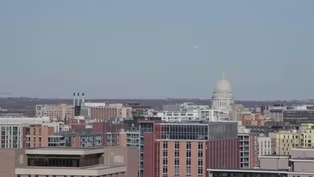
Select cities like Madison have been deemed climate havens because it's believed they'll see less intense effects of climate change.
Here and now.
Next generation intern Hannah Ritvo has this story.
>> The August that we left, it was so dry and so hot that there were wildfires.
Actually encroaching on Austin as we were leaving, as we were driving down the highway, it was literally just scorched black earth.
>> Jessica Mederson left Texas 12 years ago to escape the heat.
>> Everybody in the world wants to be in Austin and I loved it a lot.
But I hated the heat.
>> Mederson is among many who have left their homes to adapt to a changing climate.
Over 3 million Americans have already moved due to climate change.
>> If you look at the US alone last year there had been $1 billion weather disasters almost every two weeks on average.
>> Some of these migrants could be headed to places called climate havens.
>> A climate haven is the idea of a place that's a refuge or a safe spot from the impacts of climate change.
>> Madison is routinely cited as one of six climate havens around the United States.
>> It's been hypothesized that this area of the country could be a climate haven, because it might escape the worst of climate change impacts.
>> Steve Vavrus is the state climatologist and co-director of the Wisconsin Initiative on Climate Change Impacts.
what we don't have.
We don't have hurricanes.
We don't have big wildfires, and we're far away from sea level rise.
So the combination of those things has made a lot of people speculate that our region of the country could be very attractive to so-called climate migrants, but it's not all sunshine and rainbows.
>> Vavrus says potential climate migrants should be aware of Madison's own increasing climate extremes.
>> We get a lot of heavy rainfalls, we get a lot of flooding.
We often get heat waves, too, that are hot and humid and then last summer we had so much wildfire smoke and that caught people off guard.
>> The 20 tens were Wisconsin's wettest decade on record by far.
>> We had a lot of flooding events across the state in that decade, and one of the worst, maybe the worst in that decade was in 2018.
In August in Dane County, where just about a foot of rain fell in 24 hours, which was a statewide record.
And it's an incredible amount of rain.
It's more like Hurricane amounts, and it certainly caused terrible flooding.
It even caused one fatality, he says.
>> The concept of climate havens started about six years ago.
>> This is something that I don't think scientists anticipated would would draw so much public interest.
It's something that that was really kind of a groundswell of interest from the masses.
And that's caught the attention of a lot of climatologists.
>> And it's a debated notion because there are many reasons that people move the cost of living, the quality of education , the availability of housing.
>> This is a big issue in Ma dison with high house prices and rents, and not everyone can es cape disaster.
>> There are communities who are un able to move due to poverty or social norms, or disability or age.
We have a history of locating polluting industries in low income and minority communities.
The environmental justice movement started as a result of that.
So these are the same communities that are disproportionately affected by climate change.
executive director of the Human rights program at UW-Madison >> I look at the link between human rights and environmental issues, especially climate change, Atapattu says.
>> There is anecdotal evidence that individuals are moving to Madison due to the impacts of climate change, but not enough data yet to truly know.
Nonetheless, climate migration is already happening around the world.
relocated as we speak.
Some communities are awaiting relocation in, and people are moving, she says.
>> Climate change is a global problem with local impacts.
>> It's important for us to realize that the decisions we take will have repercussions.
Thousands of miles away, small island states and people who are living there, they will be the ground zero of climate change because they might lose everything they have, including their country.
So we don't really know where those people will go and what will happen to those countries.
>> Atapattu says.
The most important thing we can do is educate ourselves and prepare sufficiently for disasters and migration.
And cities, especially those deemed climate havens, must be ready to accommodate an influx of potential climate migrants.
Experts estimate more than 1 billion people could be displaced in the next 25 years due to changing weather.
>> Can their infrastructure handle a lot more people?
These are things that communities need to be thinking about anyway.
>> Some cities have already begun promoting themselves as climate havens.
>> Lake superior big enough for everyone.
>> Buffalo and Duluth are two communities that have gone all in with advertising and encouraging people to come to their communities, and hopefully they have the ability to take in a lot of residents fairly quickly.
>> Madison hasn't promoted itself that way, but Vavrus says it is important the city gets ready for potential climate migrants, as it's clear the Midwest may be more immune to severe climate impacts than other regions.
>> But again, people need to recognize that we've got our own challenges when it comes to climate and extreme weather here, too, that there's really no safe place from the impacts of climate change.
>> For "Here& Now" I'm Hannah Ritvo in Madison.
>> Hannah Ritvo is graduating from Umms Madison and completes her work with Here and Now this week.
We thank her for her contributions and wish her luck on her next endeavors.
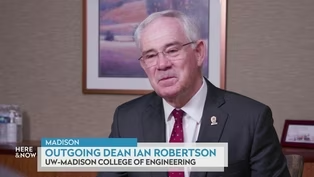
Also in campus news, the Dean of the UW-Madison School of Engineering has announced he is stepping down after 11 years in the role.
The school has been at the center of a political storm over the last year, as Republican legislators held up approval of the new engineering building in a fight over diversity, equity and inclusion programs at the University.
See "Here& Now" Senior political reporter Zac Schultz sat down with Ian Robertson to talk about why he's stepping down now and what the new building means for students and the state.
>> I thought this was a good time because things are the moment are very positive in the college.
The trajectories are all in the right direction.
So this is a good time.
>> Your school is obviously been in the news a lot in the last year, having to do with the new building and some of the talk about the building itself first and what it will mean for the ability to evolve into the future.
What what the education and the research does.
>> Yes.
So the new building did take a little bit longer than we were expecting to get approved.
But the good thing is that did get approved.
What's it going to do for the state of Wisconsin?
We're going to be able to take more students, right?
There is a high demand at the moment from students to get an engineering degree from UW-Madison.
We currently have 4800 undergraduates.
We're going to grow to at least 5500.
That's going to meet some of the student demand.
It's also going to help us meet demand from industries in the state of Wisconsin for more engineers.
As I talked to the companies, they're saying, when will you produce more engineers?
Because we want to hire them and they have jobs for them.
So the new building will enable that part.
It's also going to allow us to actually expand our research.
Right.
We will attract new faculty with the building.
They will bring in new areas and environmental sustainability.
I machine learning, autonomous that are important to Wisconsin based industries and to the nation.
So change our research portfolio.
It's going to allow us to do the growth that's actually needed.
So I think th ese are good things for happening.
It'll be good for the st ate.
>> On the political side, were yo u surprised when the building became kind of a political football in the budget?
>> Yes.
I mean, it took it did take longer.
Right.
And so it was a surprise.
But if we look at what really happened during that whole period, the support we got from companies in Wisconsin, from the people of Wisconsin, was actually just amazing, right?
These weren't all engineering companies.
They weren't all our engineering alum, it was people.
Companies said, we need more engineers.
UW-Madison is a plan to attract more engineering students that will meet demand.
And they actually voiced their support for the building.
So I'd like to just take this opportunity to thank all of them because I can't thank them all in person.
So this is a great opportunity for me to say thank you for all of the support that you gave us to get this new building.
We won't disappoint.
We will live up to our end of the bargain.
We will produce more engineers and we'll develop great research.
>> Some of the things that the UW was asked to give up or to change had to do with DEI.
You have a vice chancellor for DEI.
You have a very diverse student body within the engineering school.
How do those all factor in together in terms of what the students felt about some of those sacrifices, our commitment, the campus commitment to providing an environment that's inclusive and welcoming for all continues.
>> That's not going to change, right?
All of us want to work in an environment that's that we enjoy working in, that we enjoy learning in, and it's absolutely essential that we do that here in the College of Engineering.
When I talked to industries, they tell me that it's important that they hire a diverse workforce, right.
They say that the products that they get at the end are better if they bring in different perspectives.
And so we need to do the same.
The other part, I think that's important is that engineering is facing a challenge in attracting more people.
We currently have shortages in the number of engineers that we produce.
If I think what's coming with the chips or semiconductors coming back in, the manufacturing, come back to the US, the advances in clean energy sustainability, we're going to need more and more engineers than we can produce, not only here in Wisconsin, but nationwide.
So one of the challenges I see, and why the hopes, is that we can get more people excited about being in engineering and saying, this is a great career path, because I can have an impact on society if I take this career.
So we need to do all of these things.
>> For more on this and other issues facing Wisconsin, visit our website at PBS Wisconsin.
Org and then click on the news tab.
That's our program for tonight.
I'm Frederica Freyberg.
Have a good weekend.
>> Funding for Here and Now is provided by the Focus Fund for Jo urnalism and Friends of PBS Wisconsin in
Here & Now opening for May 17, 2024
Video has Closed Captions
Clip: S2200 Ep2244 | 1m 14s | The introduction to the May 17, 2024 episode of Here & Now. (1m 14s)
Ian Robertson on Goals of UW-Madison Engineering Education
Video has Closed Captions
Clip: S2200 Ep2244 | 4m 50s | Ian Robertson on the UW-Madison engineering program's efforts to train more students. (4m 50s)
Jay Heck on Ballot Drop Boxes and Wisconsin Voters in 2024
Video has Closed Captions
Clip: S2200 Ep2244 | 6m 22s | Jay Heck on a lawsuit that seeks to reverse an order barring absentee ballot drop boxes. (6m 22s)
Why Is Madison Considered a Climate Haven Going Forward?
Video has Closed Captions
Clip: S2200 Ep2244 | 6m 52s | Madison and Wisconsin are increasingly touted as a refuge from impacts of climate change. (6m 52s)
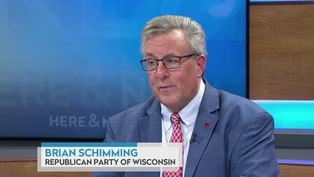
Brian Schimming on Wisconsin Voters and Republicans in 2024
Video has Closed Captions
Clip: S2200 Ep2244 | 9m 21s | Brian Schimming on Wisconsin's importance in the 2024 election and turning out voters. (9m 21s)
Providing Support for PBS.org
Learn Moreabout PBS online sponsorship
- News and Public Affairs

Top journalists deliver compelling original analysis of the hour's headlines.

- News and Public Affairs

FRONTLINE is investigative journalism that questions, explains and changes our world.












Support for PBS provided by:
Here and Now is a local public television program presented by PBS Wisconsin