Here and Now
Here & Now for May 24, 2024
Season 2200 Episode 2245 | 26m 48sVideo has Closed Captions
Watch the entire episode of Here & Now for May 24.
Watch the entire episode of Here & Now for May 24.
Problems playing video? | Closed Captioning Feedback
Problems playing video? | Closed Captioning Feedback
Here and Now is a local public television program presented by PBS Wisconsin
Here and Now
Here & Now for May 24, 2024
Season 2200 Episode 2245 | 26m 48sVideo has Closed Captions
Watch the entire episode of Here & Now for May 24.
Problems playing video? | Closed Captioning Feedback
How to Watch Here and Now
Here and Now is available to stream on pbs.org and the free PBS App, available on iPhone, Apple TV, Android TV, Android smartphones, Amazon Fire TV, Amazon Fire Tablet, Roku, Samsung Smart TV, and Vizio.
Providing Support for PBS.org
Learn Moreabout PBS online sponsorshipWisconsin.
PBS Wisconsin Original production.
2024 election coverage.
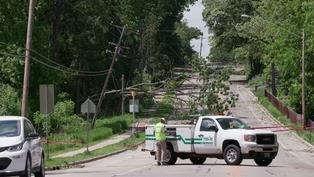
37 tornadoes and historic power outages underscored the extent of the storms across Wisconsin.
And damage they caused.
I'm Frederica Freyberg.
Tonight on "Here& Now, state Attorney General Josh Kaul on the millions in funding from the opioid settlement and outbreak of whooping cough in green Bay could be fatal for exposed infants and the draining reserves of Social Security spells uncertainty for future retirees.
It's "Here& Now" for May 24th.
>> Funding for Here and Now is provided by the Focus Fund for journalism and friends of PBS.
Wi sconsin.
million of Wisconsin's share of th e opioid settlement funds will start to be dispersed for the year.
Wisconsin will receive a total of $750 million over several years from settlements reached in national lawsuits against pharmaceutical companies that made opioid drugs, according to the CDC.
Wisconsin saw a 4% decrease in overdose deaths in 2023, down to a still staggering 1754 deaths.
Fentanyl and drugs laced with it account for most of the deaths.
Here to talk about how the settlement money is being put to work, state Attorney General Josh Collin, thanks very much for being here.
>> So is it too early to say whether programs funded to date with settlement funds are helping drive down these deaths?
>> Well, it's hard to know exactly how they link up to those kinds of numbers, but what I can say with a lot of confidence is that those dollars are making a difference, so when we prepared to get funds allocated for the upcoming fiscal year, the Department of Health Services secretary designee and I met with stakeholders from around the state.
We held roundtable events, and we asked people on the front lines of the fight against the opioid epidemic to tell us what's been working and where do we need more resources.
One of the things we consistently heard from folks is that these funds are making a difference.
They're filling gaps where they're needed, and I'll give you an example, Medicaid reimburses certain aspects of treatment for people who are struggling with substance use disorder, but there are parts that aren't covered that can be critical, like housing.
So getting those kinds of funds can help keep people in treatment and can help make them more successful.
Now let's be clear there are never going to be enough funds to address all the needs that we have.
But the more dollars we can get to communities, the more that we can help keep people safe and save lives.
>> Because how hard is it to release and reverse the grip of the opioid epidemic on this population?
>> It's been an enormous challenge for communities across the country.
There has been some meaningful progress made, and it's important to note that things like the Pdmp and efforts to discourage overprescription of opioids, those have made a difference.
And I think you're seeing a reversal in the trend of opioid prescriptions, which had gone up dramatically over a few decades.
On the other hand, we're dealing with the impacts of the pandemic and social isolation and more concerning, we're dealing with the impacts of fentanyl, which is now laced in all sorts of drugs and is incredibly dangerous.
>> Just the flow of fentanyl just keep coming.
And can law enforcement keep up?
>> Well, right now the volume coming in is enormous and it's mixed in all sorts of different types of drugs.
So we've got to be doing a variety of things to keep people safe.
One is we've got to make sure we are investigating and prosecuting shipping these incredibly communities.
That's one of the things we do at DOJ.
But we've also got to recognize that people are overdosing sometimes not even realizing that they're using opioids.
And so having harm reduction measures in place like fentanyl test strips and like Narcan, which are going to be funded through some of these opioid settlement funds, is also helping to save lives.
>> How angry does the role of opioid manufacturers in this scourge make you?
>> It makes me really upset.
You know, this problem would not have happened if it wasn't for the pumping up of opioid prescriptions through efforts of pharmaceutics companies.
When we filed our suit against Purdue Pharma, just months after I took office as AG, we laid out in our complaint our allegations about how this whole thing started.
You know, if you go back decades.
Opioid prescriptions were incredibly low in Wisconsin, in Wisconsin and nationwide.
But through efforts of companies like Purdue Pharma to really push opioids, to promote studies that were not actually valid, to encourage doctors to prescribe opioids, there's been a major addiction epidemic that's happened.
And the impacts that we're seeing are still to this day in significant part, being driven by that in Wisconsin.
>> Do any of the settlement monies go to individuals impact impacted the way the settlements were structured is that they are focused on abating future harm.
>> So there have been some separate legal actions involving the individuals who were impacted.
But these funds, based on the terms of the settlement, are meant to be forward looking in terms of preventing harm.
So certainly if there are people who are struggling with substance use disorder who were impacted previously, this might help them get the kind of support that they need.
But it's separate from providing the kind of compensation for somebody who is injured on another score.
>> As you well know, Arizona this week arraigned false Republican electors alleged to be part of a falsely electoral, you know, falsifying electoral documents.
What about Wisconsin's false electors who settled a civil suit?
Will you be criminally charging them?
>> Well, I can say a few things.
So first, I think it is vitally important that anybody who committed a crime with the goal of overturning the results of an election be held accountable, and there have been significant steps towards accountability through the federal prosecution of former President Trump.
That's ongoing right now.
A number of states have now brought charges at the Department of Justice.
We don't confirm or deny the existence of ongoing investigations and charging decisions that that Das ultimately make are only announced when they're happening .
But again, it's critical that anybody who committed a crime to overturn an election is held accountable.
heading into the November elections about a repeat of the aftermath of the 2020 election?
>> I think it's something we need to be vigilant about in 2020.
We knew that there were a number of threats to the security of our elections, and so we made sure to make clear to people that if there was voter intimidation at the polls or voter fraud, that people needed to expect to be held accountable.
And fortunately, in 2020, election Day went smoothly, I think a lot more smoothly than people anticipated .
And of course, we then saw significant litigation in the aftermath of that election.
I expect that we will see litigation again in the aftermath of this election in 2020.
We defended the state's voters and their choice for president, and we won every single case.
But one of those cases was 4 to 3 in our state Supreme Court.
Now, this year, I, you know, the composition of the Supreme Court has changed a bit, and we're going to be prepared to defend the results and ensure that the will of the voters is upheld.
We succeeded in 2020, and I'm confident we will again in 2024.
But we're also not going in with with any any misunderstanding that that we're not going to potentially be in for a challenge again.
All right.
>> Attorney General Josh Kaul, thanks very much.
>> Thanks for having me.
>> Storms pummeled the Midwest this week.
The National Weather Service confirmed seven tornadoes in Western, central and northeast Wisconsin with wind speeds ranging from 90 to 105mph statewide.
Severe storms and strong winds left more than 40,000 without power, with the largest number being in Dane County.
Madison Gas and Electric called the outages historic, with hundreds of lines down Madison Public Schools were closed due to unsafe conditions, though quick progress has been made.
Full restoration could take days as cleanup of structural damage, downed lines and uprooted trees continues.
The green Bay area is seeing a whooping cough outbreak, with the county health department investigating more than 65 cases of the bacterial disease pertussis since the beginning of April.
It can be especially dangerous in infants.
Vaccines for pertussis are part of the regular schedule for children, with boosters for adults, but rates for required vaccinations have been dropping, state data shows.
In the last school year, 10% of school students were not meeting requirements.
Joining us with more is Katrina Nordyke, Brown County deputy public health officer.
And thanks very much for being here.
>> Thanks for having me.
>> So what kind of an increase in cases in Brown County is this of pertussis compared to normal years?
>> Well, so for example, here in Brown County we have 13 confirmed cases, mostly situated in the month of April.
And for last year we had one for the entire year.
So we did see an outbreak this season, as you mentioned, we have investigated over 65 cases.
So that means that we reach out to those with suspected cases, and do contact tracing, contact investigation, work with confirmed cases.
And for example institutions to provide education on what to expect and how to encourage people to seek treatment or stay home if they're feeling ill. >> Because how dangerous is whooping cough, especially for babies?
>> Well, Lubar cough is also known as pertussis.
It's caused by the bacteria.
It's very contagious.
It's spread through the air.
When a person with whooping cough coughs, sneezes, talks, sings and, it's especially dangerous for infants as they have underdeveloped airways, potentially haven't been vaccinated, and about a third to a half of those incidents can be hospitalized due to complications from the pertussis, we also see, dangers when you are looking at people who have immunocompromised or pregnant, persons.
>> As we've discussed, vaccinations for whooping cough are required starting in infancy with boosters, even for adults.
What are you seeing in terms of a drop off in people getting these required vaccinations?
>> Well, we have seen a slight, decrease statewide in, vaccine completion and uptake anywhere from around 2 to 5.
But here in Brown County, we are meeting our general benchmarks and also have been across the state strategizing around how to catch people up.
So people may have felt behind in their vaccination during Covid, and so we are strategically planning how to catch people up.
We have targeted vaccination clinics, education and promotion, and we're working with community partners to also have vaccination clinics out in the population.
>> Is there any sense that lower rates of vaccinations follow critical messaging around the Covid vaccine?
In recent years?
>> Well, we have to wonder how much of that, small decline in uptake is due to, the Covid 19 pandemic, people not being able to go in to their providers, people falling behind on just general appointments, and also maybe some questions remaining about the actual Covid 19 vaccination.
But we encourage people, please reach out to your medical provider, and ask any questions you have.
You can ask them where your vaccination status is at for you or your loved ones.
You can also check online on the Wisconsin Immunization Registry to see what vaccines you have, and talk to your provider about vaccines.
You may need.
>> Meanwhile, there are new child vaccine requirements from the state Department of Health for meningitis and chickenpox.
Do you expect that to be controversial, in in any way, those recommendations actually last year by the CDC.
They were suspended until recently.
And those recommendations are for, children entering child care.
They're required to demonstrate that they have had the chicken pox, by a clinical provider.
RFK, Jr.
So it used to be that parents could, could testify that their child had actually had chicken pox.
And now the requirement for child care is that a clinical provider needs to, include that in their statement.
But then when you're talking about the, new school requirements for meningococcal, those require that, students entering the seventh grade receive that vaccination.
And then again, another booster when they're entering the 12th year.
So, CDC has recommended those DHS review those and have implemented those into the requirements for school.
>> So what are other disease outbreaks of concern in unvaccinated or undervaccinated populations right now?
>> Sure.
Well we have recently heard about, some measles concerns and even some cases reported, cases have been reported nationally.
And we did have one case reported in, Wisconsin, what we know about measles is that it's highly, highly contagious.
It's one of the most contagious diseases.
And so therefore we're very concerned about about the spread.
We also know that the vaccine is, highly effective.
So if you don't have the measles vaccine, talk to your health care provider.
If you think you may have symptoms of the measles, reach out to your health care provider immediately.
And if you think you've been in contact, potentially with somebody with measles, you can contact your health provider immediately and they can follow, or they can provide recommendations on next steps for you.
>> All right.
Well, Katrina Nordyke, thank you for your work running all this down and providing the public with the information and education.
>> Thank you.
the solvency of Social Security forecasts, the retirement and disability programs will be involved in 2035.
It's not that the program won't have money to pay any benefits, but it's when the Social Security Trust Fund reserves of $2.78 trillion will be depleted.
What that means is that without action by Congress, the program will only have enough money in 2035 to pay 83% of benefits, not 100.
Now, that eventuality has advocates for seniors sounding the alarm.
Alex Brower is executive director of the Wisconsin Alliance for Retired Americans.
He joins us now.
Thanks a lot for being here.
having me, Frederica.
I appreciate it.
of retirement age in 2035 and beyond, the prospect of paying into Social Security for their whole working lives and not getting their full benefit seems unfair to.
>> It's completely unfair.
Honestly we believe that.
And actually the Wisconsin Alliance and other advocacy not only should people receive the benefits they're entitled to, but they should be receiving more benefits and that Social Security should be expanded and the agency modernized and remain solvent for decades and decades to come.
>> And so you believe that current beneficiaries should be receiving more in their Social Security benefits?
>> That's correct.
Yeah.
Organization is supporting a bill in Congress right now, the Social Security Fairness Act that's been introduced by Senator Sanders and Elizabeth Warren, that actually expands by $200 per month benefits received to benefit Ceres and also protects the solvency of Social Security by eliminating something called the contribution and benefits base, which is basically the cap on which income is taxed for Social Security purposes.
To have the richest Americans pay their fair share to help keep the program solvent.
effectively become a tax increase, though?
And how well would that go over?
>> Well, it is what we're advocating for.
Yes, it will increase taxes on the wealthiest Americans who we, need to have who need to contribute more to pay their fair share.
Basically, millionaires and billionaires in this country exist because of all the work that we've all done to contribute to their success.
Right?
Everybody buys something on Amazon or on Walmart or any of the department stores and our roads that we pay for with taxes contribute to the millionaires and billionaires being able to get their goods to people's homes.
So no millionaire or billionaire is created in a vacuum.
And so those individuals owe to our collective success.
And that means that everybody who is a worker currently has a full and dignified retirement, so we are asking, yes, we are asking the richest Americans to pay their fair share.
But really , it's pennies compared to the wealth that we've created for them by being American consumers, because that cap on the withdrawal of kind of FICA taxes is $168,000 is added.
>> Anything over that those people do not pay in?
>> That's correct.
Yeah.
So when you receive a paycheck like your like your viewers are know when you receive a paycheck, there's a line called FICA and that contribution that deduction stops at $168,600.
So if you make more than that, you don't receive a FICA tax on that money.
So it's pretty much a regressive income tax where the poorest Americans, pay 100% of their income is taxed for that.
And then the richest Americans don't.
The Social Security Fairness Act, keeps that cap in place, but raises it and lifts it for those making above $400,000 a year.
So we know there are also discussions of raising the retirement age to shore up the program.
>> And that's been done once.
I understand.
But doesn't that effectively short people also?
>> That is correct.
Yeah.
And there's a study that just came out that showed that actually the raising of the retirement age back in the 80s and the Reagan presidency actually shortened the life expectancy of seniors.
So not only does that limit the number of years they're eligible to receive benefits, but it actually limits their life expectancy, because, as we all know, you know, there's a point in your life when you should be able to rest and retire from working, right?
And that is and that is a right that every American should have, no matter what kind of job they had or what profession they worked in.
We think everybody is eligible and do that.
So raising the retirement age would only hurt retired Americans and senior Americans.
>> How important is Social Security to the majority of retirees, including all of those in Wisconsin?
>> Extremely important, every single retiree that I personally know depends on their Social Security check every single month and every retired American who's a member of the Wisconsin Alliance for Retired Americans, depends on it fully.
It drives our economy.
It's what keeps so many seniors out of poverty.
We're arguing that Social Security is one of the largest anti-poverty programs that's States, we have a lot of choices in this country.
I mean, all of this is a political choice, right?
We could choose to roll back the clock and go back to the days before Social Security existed.
But we would have seniors in poverty living on the streets.
And we don't want that.
We want everybody who's worked hard and contributed to this country to live a full and dignified retirement.
>> Alex Brower, thanks very much.
Thanks for joining us.
>> Thanks for covering this important issue, Fredricka.
>> This week, a new Amtrak passenger train made its debut in.
Wisconsin.
The Amtrak borealis now runs round trip daily between Chicago and Minneapolis, with eight stops along the way.
In Wisconsin, it joins existing but slower Amtrak Empire Builder along the same route through the state.
>> It's been 22 years since we've expanded passenger rail in Wisconsin, and this long awaited train will provide more convenience and flexibility for commuters, families, students and tourists to get where they need to go.
>> Finally, tonight, we end with an excerpt of an interview.
Special projects journalist Murv Seymour conducted with the famed white House photographer Pete Souza.
Souza lived in Madison following his time covering the Obama administration, and was back in Wisconsin when he sat down in our studio for this in Focus with Murv Seymour interview.
>> This is this is the day of th e bin laden raid, and this would have been when, Seal te am was making the raid on bin Laden's.
>> You've got the most powerful people in the ex ecutive branch of our government decision makers in that room.
But for those 40 minutes, they were, there wa s nothing they could do to affect the outcome.
Right?
It was completely up to those guys on the ground when you're framing this photograph, are you thinking, I'm going to take a photograph that shows how powerless, powerless they are, I mean, I guess I wasn't inherently thinking that thought at the time.
What I was thinking is, what's what's what's the mood that I, I see in front of me?
What's and trying to trying to capture that in a single frame.
period of time, or is that just a moment in that space, no.
That that that mood lasted for the I think the entire 40 minutes we were in that room.
And so when I'm going through my ph otographs, trying to choose the best one, ob viously photography in many ways is subjective me dium, right.
But it was, I think initially myself and a photo editor.
We zeroed in on maybe four frames from the 40 minutes in this room, and we just try to compare one to another.
Tries like, which do you think is the best?
And this just seemed to work the best, the way everybody's faces, sort of expressed what I felt.
I think what they all felt.
>> Yeah.
Next photo here.
I think this gets into the transition, what was that like for you in terms of not, not just a different president coming in, but for your, you know, position to kind of I was concerned that the country had voted this guy in, you know, I didn't feel he understood what it meant to respect the office of the presidency, and so I've got to kind of put those feelings aside.
But I'm also a human being.
And so, I, you know, I tried to, as best I could, take the high road as President Obama had taken by inviting him to the white House two days after the election, because he wanted to try to like, you know, calm people down as best he could.
But it was very unsettling feeling for me that this is the guy that was going to succeed Barack Obama, and this we didn't make this picture public, but I thought it was a good picture to include in my book as, you know, not having to necessarily show his face.
You know who that is?
Just by looking at him?
>> What's he peeking?
What?
>> So this is just, there's a little hallway, off the Oval Office that leads into the private dining room.
And to the left is like what's called the presidential study, which President Obama hardly ever used.
That little room.
So it had mostly mementos in there.
There was a little desk with a computer, but it was mostly pictures of the family on the wall.
And it was a picture of Thurgood Marshall on the wall.
And he was just giving President Obama actually inside the study.
And he's just showing, the president elect, you know, the study, the dining room.
And so this was on their little tour.
>> So President Obama is actually doing the tour.
Yeah, yeah.
>> Now, what's this one here?
>> And then this is on January 20th, 2017, I'm inside the helicopter tour just before President Obama and Michelle board the helicopter, and he's saying goodbye to, to now, President Trump.
This would have been right after the swearing in ceremony.
Wow >> You can find the in focus interviews on our website, along with other issues facing Wisconsin.
Go to PBS Wisconsin org and then click on the news tab.
That's our program for tonight.
I'm Frederica Freyberg.
Have a good weekend.
>> Funding for Here and Now is provided by the Focus is provided by the Focus Fu nd for Journalism and Friends of PBS.
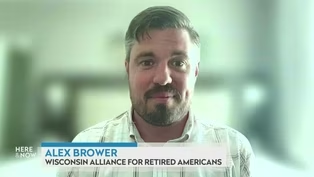
Alex Brower on the Social Security Funding Gap and Solutions
Video has Closed Captions
Clip: S2200 Ep2245 | 5m 41s | Alex Brower on the potential for the Social Security trust fund to be empty by 2035. (5m 41s)
Here & Now opening for May 24, 2024
Video has Closed Captions
Clip: S2200 Ep2245 | 1m 1s | The introduction to the May 24, 2024 episode of Here & Now. (1m 1s)
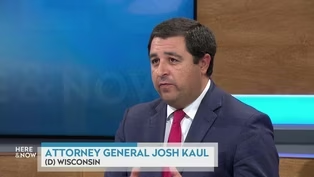
Josh Kaul on the Latest Allotment of Opioid Settlement Money
Video has Closed Captions
Clip: S2200 Ep2245 | 6m 43s | Josh Kaul explains where the next $36 million won in an opioid settlement will go. (6m 43s)
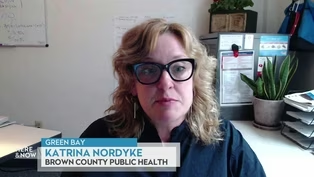
Katrina Nordyke on Whooping Cough Outbreak and Vaccines
Video has Closed Captions
Clip: S2200 Ep2245 | 6m 27s | Katrina Nordyk describes the extent of the Green Bay area's outbreak of whooping cough. (6m 27s)
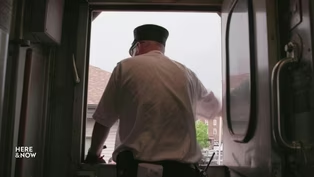
Passenger Rail Expands Across the State with Borealis Train
Video has Closed Captions
Clip: S2200 Ep2245 | 43s | Amtrak expands passenger rail with Borealis trains running between Chicago, Minneapolis. (43s)
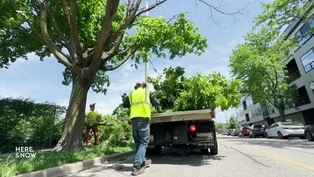
Storms Leave Damage and Power Outages across state, Midwest
Video has Closed Captions
Clip: S2200 Ep2245 | 42s | Severe storms bringing tornados and high wind speeds leave thousands without power. (42s)
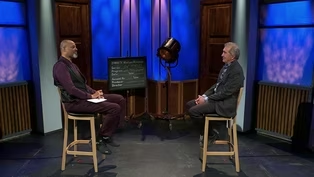
In Focus with Pete Souza: Photographing Presidential History
Video has Closed Captions
Clip: S2200 Ep2245 | 46m 43s | Murv Seymour talks with Pete Souza about documenting history as White House photographer. (46m 43s)
Providing Support for PBS.org
Learn Moreabout PBS online sponsorship
- News and Public Affairs

Top journalists deliver compelling original analysis of the hour's headlines.

- News and Public Affairs

FRONTLINE is investigative journalism that questions, explains and changes our world.












Support for PBS provided by:
Here and Now is a local public television program presented by PBS Wisconsin