Here and Now
Here & Now for May 31, 2024
Season 2200 Episode 2246 | 26m 47sVideo has Closed Captions
Watch the entire episode of Here & Now for May 31.
Watch the entire episode of Here & Now for May 31.
Problems playing video? | Closed Captioning Feedback
Problems playing video? | Closed Captioning Feedback
Here and Now is a local public television program presented by PBS Wisconsin
Here and Now
Here & Now for May 31, 2024
Season 2200 Episode 2246 | 26m 47sVideo has Closed Captions
Watch the entire episode of Here & Now for May 31.
Problems playing video? | Closed Captioning Feedback
How to Watch Here and Now
Here and Now is available to stream on pbs.org and the free PBS App, available on iPhone, Apple TV, Android TV, Android smartphones, Amazon Fire TV, Amazon Fire Tablet, Roku, Samsung Smart TV, and Vizio.
Providing Support for PBS.org
Learn Moreabout PBS online sponsorshipWisconsin.
PBS Wisconsin original production.
2024 election coverage.
>> This is really more of a somber mood than anything else.
I mean, this is the first time in history that we've had a former president convicted of a felony, much less 34 felonies.
>> Donald Trump is convicted of 34 felony charges.
>> Wisconsin weighs in the trouble now, the Democrats will have as they have to go to the people of this country and say, we're willing to weaponize judges, juries, prosecutors because we can't beat Donald Trump otherwise.
>> I'm Frederica Freyberg tonight on "Here& Now" a bipartisan reading law turns partisan once money is involved, a renewed challenge to Governor Walker's Act ten, the state retirement system invests in Bitcoin and barriers to food pantries are lifted, but at a cost.
It's "Here& Now" for May 31st, funding for "Here& Now" is provided by the Focus Fund for Journalism and Friends of PBS.
Wisconsin.
School is not yet out for summer, but starting next fall, the new Wisconsin law mandating how children must be taught to read goes into effect.
The law requires teaching phonics or the relationships between sounds and words instead of the current method widely in use, called three cueing, which uses such things as pictures to solve unknown words.
This comes as the latest statewide third grade reading test scores show fewer than 40% of students are proficient readers.
The reading law is in place, but the legislature is suing over the governor's veto of how $50 million to help fund the change can be used.
We sat down with one of the authors of the reading bill, Representative Joel Kitchens, as his signature legislation is now in the courts.
I know that you have said that this reading bill was the most important thing that you have worked on in the Capitol.
What's your reaction, then, to the governor's veto and the lawsuit over it?
As act 20 is really already being enacted?
>> Yeah, it's frustrating.
You know, it's sort of politics, you know, what the governor did actually with the veto was not that horrible.
It's just the precedent of that of him being able to go in and use a partial line item veto where traditionally he has not been able to use it.
And our lawyers, when they drafted the bill, said he does not have that authority.
So it would set a dangerous precedent.
And it's sort of it's similar to the PFAS problems that we're having with that bill where the governor seems to think that he can change you know, how the how the money is spent.
And that's just going to be a problem.
>> But meanwhile, it kind of catches this whole piece of policy, right?
In the midst of that veto and the lawsuit now.
Right >> So it's unfortunately my bill ends up sort of being a test case on this.
That's really unfortunate.
So hopefully it doesn't slow it down too much.
I know there are portions of it and I've been in touch with DPI about it.
I think, you know, as far as the testing and the assessments, they'll have the money for that.
But hiring the coaches statewide, certainly they do not have that money.
So until this lawsuit is settled, that won't happen.
You know, we are encouraging the schools as far as getting the training for the teachers as buying new that.
You know, we will have the money there.
It's just it's just the lawsuit has to play out.
>> So the governor's veto message also spoke to the idea that he wanted to give DPI the flexibility of where to put this money, do you take exception to that?
much as because I think we're on the same page on it.
It's really, really unfortunate with this.
And again, some other bills that he didn't just talk to us.
You know, because I think we can work out the details of this.
It's just that when you do that in an area that's never where that's never been allowed before, it's a problem.
And I know when he first did that, you know, I talked to the members of JFC and they were back and forth.
Well, you know, should we challenge this?
But I think they decided that, yeah.
The precedent it's too strong to ignore that and let him do that because then it'll continue to escalate from there.
>> Is there anything to the idea that Republicans might have been concerned because he vetoed a part of the appropriation that would have given per pupil increase to private choice schools and independent charter schools?
>> You know, I haven't heard that be part of the concern with it, you know, what I'm hearing from JFC is just that it's the precedent of it.
And, yeah, there's a lot of distrust of DPI, but I think, you know, again, the substance of what that partial veto did is not the big deal.
It's just the precedent.
this act 20 is going into effect in the fall.
Right.
Have you heard from educators about, you know, concerns they might have about being able to be ready to do that?
address some of those.
There were a lot of concerns.
So we made the first assessment which would have taken place in September.
We made that optional.
So they don't have to do that until later because we were trying to, you know, to speak to their fears.
And now with this, of course, everybody's like, what's going on?
So again, we keep telling people and I think DPI is giving them the same message.
Just go ahead, go forward.
You know, you're you're the money's going to be there.
And it's really important that we get this going.
you've done around this important issue for you, how soon do you think these kinds of changes will result in more children being able to read at a proficient level?
pretty rapid.
I think that in two years we will see the difference in those kids.
And again, this is, you know, kids learn to read.
There's not a more important thing in their whole lives than learn to read.
If they don't learn how to read, their chances of success in school and really in life are so diminished that this is really important.
And I was, you know, gratified to hear Speaker Vos when he gave his end of the session, wrap up.
He said this was the most important thing that we passed this session, too.
And I think it really is.
And so, you know, we have to get this going.
And I think, I think we'll see progress pretty quickly because going back to Wisconsin's reading test scores is what is that like for you as someone who works on these issues to see that?
Yeah it's pretty awful.
And you know, our African American students have fallen from where they used to be, kind of middle of the pack.
Now they're dead last in the country.
So we have got to turn that around.
It's just it should really scare people to think of what that means to the future of these kids.
And then you throw the pandemic in on top of it, where some of those kids just and unfortunately, especially in real instruction for a year.
Well, you can't take a year off from school when you're in first, second, third grade and think you're going to make up >> All right, Representative Kitchens, thanks very much.
>> Well, thank you.
>> A lawsuit once again challenging Wisconsin's decade old act ten law heard oral arguments this week in a Dane County court.
The suit is brought by multiple unions and individuals representing public employees, who argue they have been adversely affected by act ten, act ten, or the budget repair bill was signed into law in 2011 by then Republican Governor Scott Walker, prompting weeks of protests that drew as many as 100,000 people to the Capitol.
The law prohibits general public employees from collective bargaining, but like police and firefighters.
The distinctions between these two groups and how they're applied is the basis of the lawsuit.
>> There are simply not substantial distinctions that make the class of general employees, as defined in At ten, differ from the class of public safety employees.
There's no substantial distinction, for example, between on the one hand, the Capitol Police, the UW police and conservation wardens, all of whom are, law enforcement officials with arrest authority who are deemed general employees.
between the classifications here, I think that this court can acquire that, but cannot under rational basis, with respect, get into some of the minutia that my friends have attempted to interject this court into.
>> The Wisconsin pension Fund, ranked as one of the most fiscally sound in the nation, took bold action this year.
It invested in Bitcoin.
Most all government workers are part of the employee Trust fund that pays out retirement benefits.
But for a pension fund widely known for being stable, prudent and smart with investments, is this a departure or right on brand?
Our next guest says it's certainly turning heads.
We should note PBS Wisconsin employees are participants in the Wisconsin Retirement System.
We are joined by David Krause, Marquette University emeritus associate professor of finance.
And thanks very much for being here.
Yes, thank you.
So what is the reaction within the kind of investment industry to this news?
pretty amazed that a pension fund this early in the introduction of the Bitcoin ETF came on board.
They expected it might take several years before there would be institutional involvement with Bitcoin >> So the Bitcoin ETF is different.
>> And apart from the kind of bitcoins that folks might have in their digital wallets.
>> Yeah that's right, it was January of this year that the Spot Bitcoin ETF was approved by the SEC.
That allowed investors like the university systems or Swib, in this case, the Wisconsin Investment Board, to buy directly these securities that are regulated by the SEC, highly liquid and traded on exchanges is still.
>> Was it a surprise to you to see that it was, but Wisconsin's investment board has always been innovative.
pension fund.
So in a way they have the luxury of being able to invest for the long term.
They don't need to worry as much about liquidity as, say, the pension fund for the state of Illinois, which is only funded at 50% of its level.
>> So should it cause pensioners, though, or workers, to worry given the volatility of Bitcoin, a lot of assets are volatile.
look deep down into the portfolio, you would see that a lot of assets, including some stocks as well as some other alternative investments are quite volatile in nature.
Yeah, Bitcoin has moved around a lot, but supply and demand and are starting to balance out.
And I do think the investment community is beginning to understand this more as a viable alternative investment.
>> So how much are they putting into Bitcoin compared to the fund itself?
It's just a toe in the water.
It's one tenth of 1.
Now $180 million is not pocket change.
But this is $180 billion fund.
I think it's just an entry point.
I think they're testing to see the reaction of the public to whether or not there's resistance to owning this, and they're using it as a trial run, because it really is not going to impact the portfolio.
Substantial really, until you get to maybe a 1 or 2% positioning.
>> Because I was going to ask you, what does your expertise tell you about whether this is a good investment for the pension fund?
>> Well, it's a good investment in the sense that it's going to add diversification in the objective of a portfolio manager or a fund is to maximize return while minimizing risk.
Bitcoin like other alternative parallel with stocks and bonds.
So therefore it adds nice diversification effect.
The potential upside returns are high as it could be with any new technology, and finally, because this is a currency with a limited supply, it actually can serve as an inflation hedge.
I don't think very many people talk about the potential for it to remove volatility of government actions.
>> Do you expect other states to follow suit?
Watch this closely and follow.
expect those that are underfunded can afford to do that because this is a long play.
I mean, the state of Wisconsin can afford to go through maybe several cycles.
I think the long term trend of this type of assets is going to be upward slope, but there's going to be dips, there's going to be peaks, but if you're a pension fund with low liquidity, you really can't afford long plaits.
investment in Bitcoin >> The day that it was announced and that's when the SEC 13 F form became available to the public.
That day, Bitcoin went up 1.
Now is it solely attributable to the fact that an institutional investor bought the market did pay attention to that.
And I would not be surprised to see other institutional investors move into this asset category.
>> David Krauss, thanks very much.
Good.
Thank you.
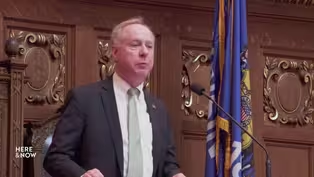
A second attempt to recall Republican Assembly Speaker Robin Vos was set in motion this week with the delivery of 9000 petition signatures to the Wisconsin elections Commission.
Speaker Vos has been the focus of derision from Donald Trump and his supporters.
After refusing to decertify Wisconsin's 2020 election results.
Starting in October, 265 emergency pantries in Wisconsin that accept donations from the Federal Emergency Food Assistance Program can no longer ask visitors to verify their address in order to access free food.
This new state rule comes as food pantries are seeing an explosion in need, and such verification can be a barrier to access.
But could it also result in shortages at popular locations like the Oshkosh Area Community Pantry that saw a 70% increase in usage last year?
We ask its executive director, Ryan Rasmussen, and thanks very much for being here.
Pleasure to be here.
>> So, as we've said, your pantry has seen a major surge in demand in the last few years.
How related is that surge to the end of extra food share benefits available during the Covid pandemic?
>> Absolutely.
Extremely last year around the March time frame, right when food share benefits were starting to go back to pre-pandemic levels and at the exact same time that that was happening, we were also seeing inflation at the highest we've seen in a long time.
Food prices were skyrocketing, groceries and gas, everything was just through the roof.
So all of it culminated in a really perfect storm of a lot of expensive things and folks needing some additional help.
>> So your location also operates more like a regular grocery store where people can choose the food they need or want.
How much does that influence its popularity?
Do you think?
>> I think we're extremely popular because of that.
We are firm believers in in the dignity and respect of all of our guests.
And so we truly believe that there's power in choice.
And so we believe through that choice, folks retain their dignity.
And so rather than getting a pre-loaded box of food, folks are able to come shop our aisles just like they would any other grocery store.
Really providing a dignified shopping experience as opposed to a pre-loaded box of food.
And so for us, we're extremely popular because of that model, because folks are able to shop like us, shop, shop with us like anybody else.
>> So in fact, you see hundreds of people from outside your county visiting your pantry.
Can can you keep up with that demand ?
be interesting, especially as we talk about the new Tefap regulations that are coming in.
I certainly agree that, you know, creating a barrier free opportunity for guests is super important, and we value that.
And we believe that also.
But I think there's some logistical concerns that we really need to think through in order to make this happen.
And obviously ensuring that, you know, there's plenty of food to go around all the pantries that need it is one of them.
And I think one of the things we'll have to look at is how can we redistribute that food in a food system where food is available, you can get it, but how can we allocate it?
The right way to the pantries that need it, that are seeing some major increases?
>> So that's what you mean when you talk about the logistical challenges, potentially like moving it from out of your county into another.
>> Yeah, exactly.
And some of the other pieces that we have to think about too is with these regulations, you know, without being able to verify proof of address for pantries that have service areas like we do at and I assume a lot of other pantries th roughout the state, there's really a couple of ways that we 're thinking about having to, to distribute this product.
We 'll either have to separate the inventory or we're going to have to reduce and eliminate the service areas.
And so with that comes a lot of logistical pieces, especially in our store to model that we have where, you know, being set up like a grocery store, having multiple programs in that store could create some additional confusion for our guests, because how much of the food in your pantry comes from the Federal Emergency Food Assistance Program?
Yeah, right now it's about anywhere from 15 to 20% of the overall food that we get.
And so although that percentage doesn't seem really high, the actual quantity and the quality of the food that we're getting is fantastic, we're taking advantage of a milk program where we're able to get, direct to farmer to pantry milk, for free, a lot of produce comes from, from the Tefap program, as well as some of the high protein rich foods that we look for in canned goods.
So although the overall quantity isn't huge, the quality of it is really good.
So it's something we wouldn't want to sacrifice.
>> Losing how has the clientele of your pantry changed over the past several years?
>> Yeah, we certainly have seen, and a lot of pantries experience this.
The age demographic for pantry users is generally skews a little older, and we've seen that age demographic come down quite significantly for us, especially as we were talking about when food share benefits were rolled back, you know, we were seeing a lot of middle income folks who generally were on the bubble before where they made too much to qualify for services, but but not enough to make ends meet are the ones that are really now the ones that are being affected by what's happening.
And so all that does is we're seeing a lot more families.
We're seeing a lot more children, we're seeing a lot more of that younger demographic of folks that are coming in who are needing the extra help.
>> All right.
Well, Ryan Rasmussen, thanks very much, I appreciate it.
>> Spring storms have pounded Wisconsin in recent weeks, but parts of the state are still experiencing a long term drought that can cause problems for marine life, that need high water levels to survive.
Here and now, reporter Nathan Denzin has more on one species that has been hit particularly hard.
>> We reached peak drought severity in September of last year to just see that crash with almost no rain for a long time was very disturbing.
>> It's been a very dry few years for Wisconsin.
>> I started getting lots of phone calls from people saying the there's all these mussels out there and they're, you know, they're stranded there.
They're dying.
What can we do?
>> It's had a significant impact on a species we hardly think about.
>> I was no longer picking up a mussel and placing it gently in the water.
RFK, Jr, I was throwing them as fast as I could.
has been in a perpetual drought since about 2021, straining aquatic resources despite spring rains.
Drought is still hitting the southwestern part of the state right now near the Wisconsin River.
the fall or usual fall.
Rise did not occur.
And then really, a paucity of snow, especially in northern Wisconsin.
>> Mark Cup is the executive director of the lower Wisconsin State Riverway Board, where he works with the Wisconsin River from Prairie du Sac to the Mississippi.
anything happen with our spring flow that we usually see.
>> Droughts are very stressful to aquatic organisms as well.
>> Ellen Vos is the climate resilience director with the Wisconsin River Alliance.
>> It is average.
>> There's just less space for the things that animals and plants and insects and everything else need to survive.
>> One animal that can be squeezed out by low water is mussels.
>> They're basically just, you know, a mollusk with two shells.
And they live in the rivers and lakes, rivers and streams of Wisconsin.
expert at the Wisconsin DNR.
>> They don't have a brain and they don't have eyes.
So they they you know, they can't just figure out where the deeper water is.
She says there are tens of thousands of mussels on the bed of the Wisconsin River, including 40 different species.
>> They filter as much as ten gallons of water a day per mussel.
and thousands of them, they really help purify the water.
>> But when the drought reached its peak in September, mussels started to wash up on shore banks.
was actually historic artifacts, because the water was so low, I'd never seen it this low in the time I've lived here.
>> Jean Anmuth is a retired DNR scientist who lives near the Wisconsin River in Prairie du Sac.
She was the first person to contact experts when she saw stranded mussels.
>> Mussels are a huge part of the ecology of this river because dams act as a barrier for some aquatic species.
>> Almost all of the mussels in the Wisconsin River can be found be low.
Prairie du Sac back.
>> So I thought, hey, I'd better ring the alarm on the dam.
>> Here is the last of 26 on the waterway because we had such a drought year, the dam did not have water to release many of the dams on the Wisconsin, including Prairie du Sac, have strict federal regulations, while dams keep a reservoir of water on hand to generate electricity.
We federally regulated dams are not allowed to release more water than they receive whatever comes into Lake Wisconsin at the at the very head of the lake comes through the dam.
Those dams are called run of river dams because any water that comes in must go out.
Alliant energy, which owns the Prairie du Sac Dam, in a statement said our license re quires us to maintain the water level.
Therefore we cannot re lease more water during drought conditions.
Not all dams on the Wisconsin River are licensed as run of river fa cilities, and some may manipulate water levels in this sc enario.
wrong.
Everybody was in there in compliance with their license obligations the entire time.
And yet the outcome was thousands or tens of thousands.
We don't know.
Dead mussels on the river.
>> That meant the only solution to save the mussels was to physically walk the shore banks and throw them back into the river.
Just saying.
We know that this is a problem.
If you're able to help, please go out to the river.
spending 3 to 4 hours.
Forget the artifacts.
I was no longer looking at that.
mussels saved.
I mean, individuals were picking up 100 mussels a day, 300 mussels a day.
I mean, it was pretty amazing what people were willing to do.
>> Anmuth saved more than 1200 herself.
a year and just those 1200 mussels, you you're filtering like over 3 million gallons of water.
>> I know that we made a difference.
And that will pay dividends down the road.
>> Extended forecasts for the summer show that for the fourth straight year, drought conditions are likely.
Let's just assume that we run into a similar situation and we don't have rain, particularly in the northeast and central part of the state.
.
And that is yes.
We will need to do muscle rescues again.
>> There is a live, phone tree muscle rescue alert system in place.
>> They can also contact me anytime and I can give them, advice as to what to do until the time comes to walk the shore banks again, experts eyes will be glued to the weather for "Here& Now" >> I'm Nathan Denzin in Prairie du Sac.
>> For more on this and other issues facing Wisconsin, visit our website at PBS Wisconsin.
Or g and then click on the news tab to see all of our election co verage.
Visit Wisconsin vote.
Org That's our program for tonight.
I'm Frederica Freyberg.
Have a good weekend.
>> Funding for "Here& Now" is provided by the Focus Fund for Jo urnalism and Friends of PBS.
9,000 Signatures Submitted in Another Effort to Recall Vos
Video has Closed Captions
Clip: S2200 Ep2246 | 25s | Signatures were submitted in a second attempt to recall Assembly Speaker Robin Vos. (25s)

Could drought strand mussels again?
Video has Closed Captions
Clip: S2200 Ep2246 | 6m 11s | Drought caused thousands of mussel strandings in 2023, could it happen again a year later? (6m 11s)
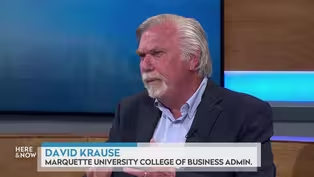
David Krause on WRS Investing Millions into a Bitcoin ETF
Video has Closed Captions
Clip: S2200 Ep2246 | 5m 27s | David Krause on the Wisconsin pension system's $100 million purchase into a Bitcoin ETF. (5m 27s)

Here & Now opening for May 31, 2024
Video has Closed Captions
Clip: S2200 Ep2246 | 1m 21s | The introduction to the May 31, 2024 episode of Here & Now. (1m 21s)

Oral Arguments Over Act 10 Lawsuit in Dane County Court
Video has Closed Captions
Clip: S2200 Ep2246 | 1m 24s | Lawsuit challenging Act 10 heard oral arguments from those representing public employees. (1m 24s)
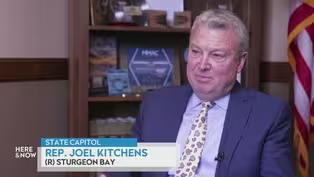
Rep. Joel Kitchens on Bill Requiring Phonics Reading Method
Video has Closed Captions
Clip: S2200 Ep2246 | 6m 5s | Joel Kitchens on a bill that requires the "phonics" method to teach children how to read. (6m 5s)
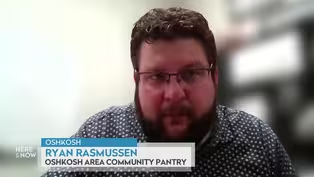
Ryan Rasmussen on New I.D. Requirements for Food Pantries
Video has Closed Captions
Clip: S2200 Ep2246 | 5m 21s | Ryan Rasmussen on new identification rules to access food pantries receiving federal aid. (5m 21s)
Providing Support for PBS.org
Learn Moreabout PBS online sponsorship
- News and Public Affairs

Top journalists deliver compelling original analysis of the hour's headlines.

- News and Public Affairs

FRONTLINE is investigative journalism that questions, explains and changes our world.












Support for PBS provided by:
Here and Now is a local public television program presented by PBS Wisconsin