
Here and Now
Here & Now for September 11, 2026
Season 2500 Episode 2511 | 26m 45sVideo has Closed Captions
Watch the entire episode of Here & Now for September 11.
Watch the entire episode of Here & Now for September 11.
Problems playing video? | Closed Captioning Feedback
Problems playing video? | Closed Captioning Feedback
Here and Now is a local public television program presented by PBS Wisconsin
Here and Now
Here & Now for September 11, 2026
Season 2500 Episode 2511 | 26m 45sVideo has Closed Captions
Watch the entire episode of Here & Now for September 11.
Problems playing video? | Closed Captioning Feedback
Where to Watch Here and Now
Here and Now is available to stream on pbs.org and the PBS app.
Providing Support for PBS.org
Learn Moreabout PBS online sponsorship>> The following program is a PBS Wisconsin Original production.
>> Absentee ballots have started to go out in Wisconsin as the Trump administration pushes for restrictions on who can vote by mail and the state attorney general's race picks up speed.
Good evening.
I'm Zac Schultz filling in for Frederica Freyberg tonight on here.
And now, election officials provide guidance and advice for ensuring mail in ballots reach their destinations.
Attorney general candidates Josh Kaul and Eric Toney make their case to be the state's top cop, and Tommy Thompson, former governor and health and human Services secretary, reflects on the 25th anniversary of terrorist attacks in the U.S.
it's "Here& Now" for September 11th.
>> Funding for "Here& Now" is provided by the Focus Fund for journalism and Friends of PBS Wisconsin.
>> At this hour, we are still waiting to hear if the United States Supreme Court will allow the U.S.
Postal Service to move forward with new rules on how they will handle absentee ballots.
The rules come from the Trump administration and would likely mean millions of mail in ballots would not be processed by the Postal Service and never make it to clerks offices around the country by Election Day.
Currently, a U.S.
federal appeals court has upheld a lower court that blocked the rules from moving forward.
But the final word will come from the Supreme Court.
Meanwhile, clerks in Wisconsin are moving forward with their election plans, and that includes Dunn County Clerk Andrew Mercil, president of the Wisconsin County Clerks Association.
Thanks for >> Thanks for having me.
>> So while we await this ruling from the Supreme Court, is this decision hanging over your head or do you have too much else going on to worry about it for right now?
>> Well, there's quite a bit going on in Wisconsin as it relates to getting ready for the elections this fall, as are all the 72 county clerks.
But we are keeping a close watch on what the Supreme Court might decide to do as it relates to this ruling now, in the state of Wisconsin, there are already 260,000 absentee ballot requests that have been made.
And of those, around 75,000 ballots have already been mailed out.
So they're already in the process in the system.
And we want to ensure that voters feel comfortable making sure that their absentee ballot as of now, will still be processed the normal way it would through the mail system.
>> So what advice have you been given by the Wisconsin Elections Commission on what you would do in case the Supreme Court says, no, these rules can go forward?
>> Yeah, so we have several opportunities in the state of Wisconsin if that were to happen.
So if they want to try to present a portal that the US Postal Service would have to make sure that all the ballots would be processed through that portal, Steil doesn't exist.
So we've gotten indications from the United States Postal Service that even if they still wanted to implement this rule, there's not the resources or ability in which to do what the executive order from this past spring would put in place.
So for now, our Postal service individuals in the state of Wisconsin have assured us that all absentee ballots will still be processed the normal way that they have.
>> So these rules were born out of conspiracy theories that came from the 2020 election.
Despite the where these ideas came from, if there was time to implement it properly, would some of these rules make sense if they were done for future elections?
>> I'm going to say no.
The state of Wisconsin has a really strict system in which that we use to process absentee ballots for individuals.
However, now there's opportunities because the United States Postal Service has changed from local processing to more centralized processing.
Here in western Wisconsin, all of our absentee ballots are actually sent into Minneapolis Saint Paul for processing before they're processed back.
So there's already been a little bit of a delay in making sure that people can get their absentee ballots returned in a timely manner.
So we've encouraged individuals to make sure that they get their absentee ballots.
They have to be mailed out by September 17th, right?
47 days before the election.
And when they received them, to get them back in the mail as soon as possible.
The other options are that a person could take their absentee ballot that they've received in the mail back to their municipal clerk at their town, village or city hall.
They could also return them during what we call in-person absentee voting, which is starting on October 20th.
It's a good opportunity for a person to bring back their absentee ballot to the clerk at that time, or they can always take their absentee ballot and return it to the polling location on Election Day.
So there are many outlets in which individuals and voters can still cast their ballot and make sure that their voice is heard.
>> I know since 2020, drop boxes became unconstitutional or now constitutional again, there were controversial in some areas.
Would you encourage along the same lines of what we were just talking about, clerks to have more drop boxes available as another option?
>> Absolutely.
The most recent court ruling says it's up to the discretion of the municipal clerk on whether they want to use a drop box, but we've seen several municipal clerks across the state of Wisconsin.
There's over 150 of them, right, that are trying to make sure that there's a drop box available.
Some of them had them from before that.
They have been implemented in usage.
Some are ordering new drop boxes here in Dunn County.
We've tried to make sure that if a clerk wants a drop box, that we're helping provide that can feel safe, that their ballot is going to be cast in this election and all future elections.
to the elections, the Department of Homeland Security recently announced Wisconsin is one of a handful of states where they're pursuing investigations into noncitizen voting.
Have you heard of any clerks in Wisconsin being contacted as part of these investigations?
>> We have not yet.
We are mostly anticipating that they will be targeting larger urban areas such as Madison, Milwaukee, but we have not heard of any federal investigators contacting any of the 72 county clerks or municipal clerks as of yet.
Now, I don't know what's going to happen in the next coming weeks, but we're wanting to make sure that everybody is prepared as well as they can be to know their legal rights of what they should be doing.
If an investigator tries to contact them.
And so we're trying to train as best we can across the state of Wisconsin.
>> All right.
Dunn County Clerk Andrew Marshall, thanks for your time today.
>> Thanks for having me.
>> One of the elections that often goes overlooked in Wisconsin is the race for attorney general.
The AG runs the state's Department of Justice, oversees the state crime lab, and has the authority to represent the state in lawsuits in both state and federal court.
The incumbent attorney general is Josh Kaul, a Democrat.
He's opposed by fond du Lac District Attorney Eric Toney, a Republican.
This is a rematch of the election from 2022, when Kohl narrowly defeated Toney.
I sat down with each of the candidates to talk about this race.
We start tonight with the incumbent.
I met with Josh Kaul in Madison, attorney General Carl, thanks for your time today.
>> Thanks for having me.
>> So I think let's start with kind of the the precursor to this race is your decision to stay in this race.
There was a lot of speculation you might run for governor.
How do you feel about your decision to stay in the race for Attorney general now?
decision.
It's something I thought about seriously, but there were a few factors that that weighed on my mind.
One is I'm really committed to having an impact through the work that I do.
And of course, a governor can have a ton of impact, but we're also having a huge impact through the work that we do at Wisconsin DOJ.
And I, I don't think that that the work that I've been doing is, is done yet.
You know, family considerations ultimately, I'm really excited about seeking an additional term and about the work we could do in an additional term.
>> So this is unique in that it is a rematch of the last election.
We don't see that too often.
How do you think that will influence things?
interesting about a rematch is you can look back at what the candidates said in the prior race and see how those things held up, and I think that that's really instructive here.
In the last campaign, it was shortly after Roe v Wade had been overturned.
I had filed a lawsuit seeking to block enforcement of a law that dates back to the mid 1800s.
Eric Toney my opponent had attacked me for that case.
He called it a partisan partisan stunt.
He said it was should be dismissed.
And so we now can look and see how our claims held up.
And what we know now is that the Supreme Court sided with the argument we made in that case, and ultimately we won that case.
And access to abortion is safe and legal in Wisconsin.
>> So will voters separate the attorney general's race, do you think, from the rest of the ballot?
Because we've seen historically, there's usually a few fewer voters for the ag race than for governor, and you've trailed right belong.
You know, we get to go back to 2006, the last time they were AG and governor from separate parties.
So how does that all work together?
>> You know, the results tend to be fairly close.
But in Wisconsin, we have a lot of close elections.
And so sometimes those small differences can can make a big difference in the outcome.
But I'm running based on, on my record and my time as AG.
And, you know, the focus can be different.
My top priority as attorney general has been public safety, and we've made significant progress on really important public safety issues.
One of them is fighting the opioid epidemic.
My administration has helped to secure over $800 million from companies that we've alleged contributed to the opioid epidemic, and from others.
Many of those dollars will be going to communities across the state.
Some already have.
And we are seeing a real impact.
Opioid overdose deaths in Wisconsin from 23 to 24 dropped by over 40%.
That's more than 600 person difference.
We need to keep making progress.
Our work isn't done, but I want to build on the progress we're making.
profile things your office has done is filed lawsuits against the Trump other attorneys general from around the country.
Can you give me maybe your short list of some of the most important cases that maybe the public isn't aware of, the significance of some of those?
>> Well, I think you can look at them by category.
So a lot of these cases involve the Trump administration either putting illegal conditions on or cutting or freezing funding that would otherwise be coming to Wisconsin.
There's a huge amount of money that has been impacted by this, and it's vital programs, things like funding for education or for mental health programs in our schools, funding for disaster relief and mitigation funding for the AmeriCorps program, which the Trump administration tried to cut transportation funding and public health funding.
We have consistently fought back, and we have one case after case, and what that has meant is that those funds either are not illegally conditioned or they're not frozen or ultimately cut, and instead, they can come to our communities and support critical programs in Wisconsin.
There are some of those cases where if only if you're a plaintiff, do you actually get the benefit.
And in some cases, some of the other states have gotten the benefits just because you've won overall, what would the impact have been if Eric Toney had been the attorney general and had discretion on whether to file these cases?
>> Yeah.
Well, of the 60 plus cases that we've been involved in, I don't think any single Republican AG has joined us in challenging the Trump administration in any of those cases.
And I'm not aware of a single case where Eric Toney has said he would have challenged the Trump administration.
What that would mean in some cases is Wisconsin wouldn't get the relief that happens in court, because in a number of these cases, it's only the states that have brought the challenge that get the relief.
And so it could be that we no longer have protection for critical programs.
If an AG is not part of one of those challenges.
understands the stakes there?
huge.
And so I think the more we talk about it, the better.
One thing that is unfortunate, I think, in the Trump administration is we often see the president's actions get understandable.
But what I think there's been less coverage of is the fact that in case after case actions have been blocked and he's been stopped from moving forward, in part because of these suits that we're talking about.
>> For a lot of people that don't follow your office very closely, one of the ways that they hear about the Department of Justice and the AG every four years is crime labs, statistics.
Obviously, that's one of the major things you campaigned on when you first got elected.
It was one of the issues in the last election.
Your crime lab and unfilled positions and slow turnaround.
So defend your record in where the crime lab is.
>> Yeah.
Well, first, I think it's important to separate two things out.
One is one of the issues I talked about back in 2018 was untested sexual assault kits.
And we worked to get legislation passed, which ultimately passed through the Republican led legislature.
That's going to help ensure that Wisconsin never has another backlog of untested sexual assault kits.
Now, in terms of the labs themselves, on a day to day basis, one of the things I've been clear about is where we need resources from the state legislature.
And in the last state budget, my office requested 19 additional positions for the labs.
Eric Toney allies in the state legislature provided zero positions.
And look, that's not an accident.
This is politics being played here.
But the overall picture, I think, is important not to lose sight of Wisconsin last year in 2025, had the lowest number of violent crimes that we have had any year since 2011.
Fond du Lac County, where Eric Toney is Xia last year had the second highest number of violent crimes that the county has had in decades.
And so if you compare our track records overall, there's a clear difference.
It's we need to keep doing what we're doing to keep our communities safe.
>> How do you think that the DOJ gets credit for for lower crime statistics statewide?
>> Well, there are lots of folks who play a role in what we do statewide.
And the Department of Justice is involved in investigating crimes of statewide importance.
We oversee the crime labs.
We work on every felony criminal appeal in the state.
We also work in partnerships with lots of other law enforcement agencies.
What I think is important is that we recognize that lots of folks contribute to overall safety in the state, and that certainly includes local law enforcement and others.
What's notable, I think, though, is fond du Lac County has gone the opposite direction from the rest of the state under the leadership of of Eric Toni that, I think, is not the kind of failure I want to see taken statewide.
>> You brought up abortion earlier, but I want to bring that back as a topic.
How relevant is that still to voters?
Because it's not a constitutional right in either the nation or in Wisconsin, despite lawsuits that have attempted to make it so.
So how important is it who the next attorney general is?
>> It remains to be seen.
One thing we saw, I think, over the last four years is it certainly can have an impact because my administration was fighting to protect access to safe and legal abortion.
And Eric Toni called the case that we brought a farce, among other things.
Now, fortunately, we've got a ruling in place that currently protects access to safe and legal abortion in Wisconsin.
But as you said, there's no state constitutional protection in place right now.
There's no federal constitutional protection specifically for abortion access.
And what that means is that if there were a Tom Tiffany and a Republican legislature, you could have further restrictions put in place, attorney general, Eric Toni, if he were in office, aggressively working with them to restrict access to abortion.
The other thing that's going on right now is the federal government is potentially going to restrict access.
The new attorney general had a meeting with with an anti-abortion group, where he signaled that he wanted to restrict access.
And I think making sure that the states are prepared to fight back where there's a legal basis for doing so is going to be important to protecting people's rights >> Josh Kohl, thanks for your time.
>> Thanks for having me.
>> Earlier this week, I met with Eric Toni in Fond du Lac Eric Toney.
Thanks for joining us.
>> It's great to be with you to talk about the Attorney General's race and the importance of it for Wisconsin.
why you decided to run again.
It's not often we see repeat candidates for these statewide elections.
>> You know, you know, within a week of that race, back in 2022, I had so many people already encouraging sure it was something that I would want to do, because there's a lot of time and energy that goes into these statewide races.
But for me, I really had a clarifying moment in 2023.
I was I ended up in probably August.
What I later learned to have a mini stroke in the office, lost control of my legs for about 20s.
I was inpatient at the hospital here in fond du Lac.
The next day, cardiologist did some testing, came in and said, your aortic valve is destroyed and you need open heart surgery.
I was starting to think about what do I want to continue to do if this surgery goes well?
But I was at that point just trusting God through the hands of my medical team that hoping and praying things would go well and I, as it got closer, knew that I would want to run again.
>> So when we're looking at a rematch in this environment, what what should voters be thinking of in terms of, oh, how did I vote last time?
Or what's different about this matchup this time?
>> You know, one of the things people can look at with me is what I've done since then.
As the president of the District Attorneys Association, I've always talked about putting public safety over politics.
I stood with our attorney general after that 2022 race, helping him get more crime lab positions in that state budget, working with Republican legislators behind the scenes.
I helped get a transformational investment into prosecutors, public defenders in our judicial system, in that budget that the Wisconsin Law Journal awarded me as an unsung hero for what they described as helping end a constitutional crisis.
Those are all things we do together, working with the Democrat governor and the Republican legislature to deliver those results.
And then, in contrast, you see, during the tenure of our attorney general, we've seen periods of record homicides in places like Milwaukee, record drug deaths and other increases in crime.
And I've never been one to say it's one individual person's responsibility when that happens, because there are so many different factors that go into why crime happens in different areas.
But what we have to look at is what are people doing with the resources they have?
And so what we saw our attorney general do during this period is put a hiring freeze in place.
And so I mentioned those crime lab positions.
I helped him get.
Well, over a year later, we saw a nonpartisan audit released of our crime labs.
And they said he hadn't even filled those positions.
We saw that he had less DNA positions filled compared to 2020.
And we see that they're taking for DNA, for example, taking on average over twice as long to test less from when he started to where we are now.
>> So the attorney general points to crime statistics being down in Wisconsin, as they are across the country.
He also singles out that crime statistics in fond du Lac County are up.
Why should either one of you get credit or blame for crime statistics when, as the.
You know, either the prosecutor or the Attorney General, you don't control whether crimes are committed or even how they're investigated.
>> That's a great question to ask the Attorney general, because he's been the one trying to take victory laps when he see crime numbers go with what he thinks is in his favor, despite cherry picking what those stats are, I don't think anybody heard from him when we were seeing record homicides in Milwaukee.
But now, because we're seeing crime down in many areas, including fond du Lac County, crime is down overall, and I've never taken credit for the crime numbers we've seen during my almost 14 years as a district attorney, because I know it's a team effort when we do these things and crime doesn't stop at county lines.
>> When we look at Attorney General's races in the past, historically, they followed right below the gubernatorial election.
The last time there were members of different parties was 2006 to to win these races.
So are you trying to separate yourself from Tom Tiffany in his race for governor, or do you think you're going to follow right along with him?
>> I'm running my own race from when I got into this back in October of 2025, I talked about the forensic testing failures, the fentanyl epidemic, and how partisan, our attorney general, has become.
I mean, we we have driven home issues that affect people in all 72 counties.
And that's what I've been focused on is what our Department of Justice can do to help protect everybody in Wisconsin by putting public safety over politics.
Again, it all comes back to what do you do with the resources you have.
And so what we're seeing is broken promise after broken promise from our attorney general.
He campaigned on the fentanyl and opioid epidemic.
And there is accountability for pharmaceutical manufacturers.
But talk to anybody in law enforcement or public safety, and they will tell you the overdoses that we're seeing, by and large, are coming from fentanyl, which is coming across the border and then here into Wisconsin, and parents are burying their child.
And our attorney general has broken that promise.
He won't even talk about that issue because it doesn't maybe be popular with his liberal base.
We look at the forensic testing he actually promised back in 2020 that we were going to see a dramatic improvement in DNA testing because he had more analysts than his predecessor, and he had improved technology.
And his own policies were the reason that they were testing less, limiting what law enforcement can send in.
And now, on average, he's taking over twice as long.
And he campaigned against all of the political lawsuits when he first ran.
And now that's effectively what he's running his entire campaign on is those lawsuits where he's putting politics over public safety.
>> Well, let's talk about those lawsuits.
Obviously, the Department of Justice has filed and joined a lot of these federal lawsuits against the Trump administration.
If you were the AG, would you have joined any of these?
>> So one of the things I've always talked about is putting public safety over politics.
And when we see the attorney general, he's not filing lawsuits.
What he's doing is called joining them.
So the vast majority of those lawsuits, whether he signs on to that or not, are going to continue to move forward because other attorneys general across the country have actually done the legal work on those.
And so what I will be doing as attorney general is making sure we are prioritizing our resources for public safety, ending the hiring freeze that's been put in place by him to make sure we have those crime lab positions filled, that we're always filling our DEI and other public safety positions, and we'll evaluate any case that's been filed on a case by case basis to make sure that we're following the facts and the law.
>> One more question on the federal lawsuits and some of those cases, if you weren't a member of those, you didn't get the benefits.
And Wisconsin has seen some of those benefits from being a part of those winning cases, as AG.
Would you have joined any of those cases?
>> One of the things that we have to do at our Department of Justice, it can't be who's in the white House or who's in the governor's office.
We have to look at these on a case by case basis.
And unfortunately, we haven't do that.
He's he's talked about joining over 60 of these lawsuits in the last 18 months or so, compared to probably five or less during the four years of the Biden administration and has effectively given a free pass to Tony Evers.
So to me, it's not going to matter who's in the white House or who's in the governor's office, we're decisions based on the facts and the law.
So I would expect, whether it's a Republican or Democrat, governor, president, that lawsuits when it's needed to protect Wisconsin.
>> One of the issues that Josh Kaul says is interesting about this rematch is looking at some of your position statements from the last race, and he brings up abortion specifically.
At that time, he had filed a lawsuit that eventually was passed by the Wisconsin Supreme Court, which guaranteed the right to abortion in Wisconsin.
He at that time, you criticized his part of that lawsuit.
Do you still think that was the wrong choice for him, for the state to file that lawsuit against the 1848 abortion law?
>> Well, the original Dane County judge actually didn't support the ultimate legal finding that was made by the Supreme Court.
But we have to look at where the law is now.
And there are five month protections in place for women.
I have not and am not advocating for any changes to the law in Wisconsin.
And if there is going to be any change, that's something that needs to be voted on by the people of Wisconsin and not decided on by politicians in Madison.
We need to create an environment that supports women and girls in our state, in every corner.
And you look at what our attorney general's comments have been in recent years on this.
He was actually asked about those five month or 20 week protections in 2024 in the fall.
And he said, it's not a protection, it's a restriction.
He said there intervention calling for the legislature to take action, effectively arguing for nine month abortion here in Wisconsin.
>> Eric Toney, thanks for your time.
>> Greatly appreciate it.
Thank you.
>> Today marks 25 years since the terrorist attacks of September 11th, 2001.
In a coordinated attack, terrorists four planes, crashing two into the World Trade Center in New York City, one into the Pentagon in Washington, D.C.
and the final plane crashed in Pennsylvania.
When the passengers on board fought back, former Wisconsin Governor Tommy Thompson was in Washington, DC at the time, serving as the secretary of Health and Human Services in the Bush administration.
Thursday, Thompson shared some of his memories of visiting New York City in the days after the attack.
>> Ladies and gentlemen, it was such a surreal.
Several days.
It's hard to really put it in words.
The feeling, the emotions, the.
The hatred, the sorrow that America was attacked.
It was like a like a pall had set in.
And the whole city, everybody wanted to get along.
Everybody wanted.
We walked down that thing and people were not talking.
They were not smiling.
They were just walking and.
And it was all the debris was, was flying down that beautiful day out there with the sunlight.
You couldn't see it.
It was just all obscure.
But the debris flying all over.
>> Earlier this week, New York City officials released 170,000 documents that were previously hid from the public, detailing their knowledge of how hazardous the air quality was at ground zero for both rescue workers and residents.
We asked former Secretary Thompson his reaction to that news.
>> It had to be obvious to everybody, anybody that was there, you know, during nine over 11, right after it, like I was, the air was so deleterious to a person's health.
I mean, you didn't have to be too smart to realize that some people were going to be adversely impacted.
And, I mean, the amount of debris that was coming out of the sky.
I mean, it was a beautiful day, like today in New York going up there.
But once you got there, it was just dismal because everything that was the sun was blacked out by the debris flying around.
And a lot of that stuff was hazardous.
And so you you can't discount it because I saw it.
I was witness to to that.
So it was obvious that the people were going to be adversely impacted health wise.
>> For more on this and other issues facing Wisconsin, visit our website at PBS wisconsin.org and click on the news tab.
That is our program for tonight.
Frederica Freyberg will be back next weekend.
I'm Zac Schultz have a great weekend.
>> Funding for "Here& Now" is provided by the fund for is provided by the fund for Journalism and Friends of PBS Wisconsin.

Andrew Mercil on Uncertainty Over Mail-in Ballots
Video has Closed Captions
Clip: S2500 Ep2511 | 5m 23s | Andrew Mercil on changing federal policy on mail-in voting for the 2026 election. (5m 23s)

Here & Now opening for September 11, 2026
Video has Closed Captions
Clip: S2500 Ep2511 | 59s | The introduction to the September 11, 2026 episode of Here & Now. (59s)
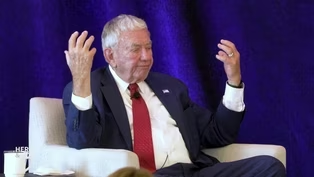
Tommy Thompson Reflects on 9/11 Attacks and Response Efforts
Video has Closed Captions
Clip: S2500 Ep2511 | 2m 39s | Tommy Thompson shared memories of visiting New York City after 9/11. (2m 39s)
Providing Support for PBS.org
Learn Moreabout PBS online sponsorship New Episode
- News and Public Affairs

Top journalists deliver compelling original analysis of the hour's headlines.
 New Episode
- News and Public Affairs

Today's top journalists discuss Washington's current political events and public affairs.
 New Episode
 New Episode

 New Episode


 New Episode
 New Episode

Support for PBS provided by:
Here and Now is a local public television program presented by PBS Wisconsin