Here's the Story
Here's The Story: Hear Their Stories
Season 2023 Episode 5 | 54m 15sVideo has Closed Captions
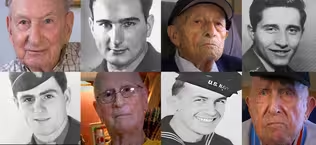
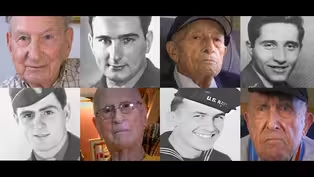
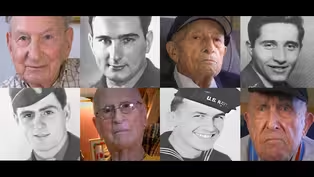
World War II remembered by those who lived through it.
In this poignant episode of Here's The Story, we delve into the profound impact of oral history through the firsthand accounts of four American World War II veterans. Through their vivid recollections, we gain a unique insight into the incommunicable experience of war, as well as the wisdom that comes from a life well-lived.
Problems playing video? | Closed Captioning Feedback
Problems playing video? | Closed Captioning Feedback
Here's the Story is a local public television program presented by NJ PBS
Here's the Story
Here's The Story: Hear Their Stories
Season 2023 Episode 5 | 54m 15sVideo has Closed Captions
In this poignant episode of Here's The Story, we delve into the profound impact of oral history through the firsthand accounts of four American World War II veterans. Through their vivid recollections, we gain a unique insight into the incommunicable experience of war, as well as the wisdom that comes from a life well-lived.
Problems playing video? | Closed Captioning Feedback
How to Watch Here's the Story
Here's the Story is available to stream on pbs.org and the free PBS App, available on iPhone, Apple TV, Android TV, Android smartphones, Amazon Fire TV, Amazon Fire Tablet, Roku, Samsung Smart TV, and Vizio.
Providing Support for PBS.org
Learn Moreabout PBS online sponsorship- [Presenter] "Here's the Story".
[tanks firing] - Every major victory in war is a result of long planning, long preparation, with a loss of often thousands of men.
But when something comes along that is unexpected, and you have this great prize, now there's a great alarm.
In the other cases, you've expected it, you've planned for it.
And here, you come along with something that gives a great lift to the morale of the whole force.
Everybody.
I think, from private up to our bosses in Washington and London, knew that the war was over.
Every one of us realized that if Hitler had the slightest sense, he would immediately surrender.
But it was the gallantry of the men that did it, is something that should never be forgotten.
And their names really ought to be in some, I'd say, permanent place in the niche of fame that the American government should like to keep.
- My name is Frank Petriello, and I'm...
Exactly how old am I?
- [Speaker] A hundred one.
- One... - [Speaker] A hundred one.
- A hundred years old.
- [Speaker] A hundred and one.
- A hundred and one years old.
- [Speaker] And three quarters.
- I was born on March 16th, 1921.
- [Interviewer] What do you think about being 101 years old?
- Well... Actually, I'm not surprised.
Should I tell the story about the doctor?
- [Speaker] Yeah, sure, tell them the story.
Yeah, mhm, sure.
- When I was in the, probably early 40s, I was shamed into going and having a physical.
And so I did, and the doctor that examined me, he gave me a whole physical, which I had never had before.
He says to me...
He says, "Everything was pretty normal, all close to normal."
And he says, "Yeah, no, you're in good shape."
He says, "And you still have that murmur?"
"Murmur?"
I says, "I don't have a murmur."
He says, "Oh, yes, you do have a murmur."
But, he says...
He says, "The kind of murmur you have, is usually connected with people who live long lives."
- [Interviewer] Wow.
- And as I was, like I say, in my forties...
So I guess he was right.
- [Interviewer] Yeah.
- Yeah.
- [Interview] So it doesn't surprise you that you've reached 101.
- Yeah, that's what I meant.
Yeah, it doesn't really surprise me, because ever since I was into my, I suppose in the late 30s, early 40s, I expected that I would reach this age, and here I am.
[lighthearted piano music] - My name is Emanuel Carlo, and my age is 98.
- My name is Edward Forestdale Jr.
I was born June 14th, 1924 in Philadelphia.
- I am proud and honored to be sitting here and to live this long, which I don't know why, but I am trying the best I can to have it worthwhile.
I'm not looking for anything special, but to go walking down the street and say, "Hi, Stew."
That's all I'd like.
[wistful piano music] [crowd cheers] - Well, the first game I learned was playing baseball.
- We never had nothing, but we did have something.
We had each other.
- [Speaker] Those years weren't all smooth sailing by any means.
I've had my share of the breaks, good and bad.
[calming piano music] - Well, what I liked about Jersey City, where I lived, my neighborhood had people from all different countries, and we all got along good.
And they brought a lot to this country.
They brought a lot of the trades.
And the work that they did, they brought up the country.
- [Presenter] These fine old craftsmen have come from 15 plants throughout the country, to take part in the opening ceremonies.
- [Speaker] The spread of respect and power in a community is influenced by certain conditions, which many observers measure by means of the economic distribution and information scales.
- I come home and tell my father, I spent two months in Paris and two days.
"What the hell's the matter with you?
You over here caught in the mine?"
I said, "When am I ever going to get back to Paris again?"
- I missed dancing with Ingrid Bergman by just a few minutes.
- [Interviewer] Wow, so close.
- [Frank] Yeah.
- [Presenter] You're crying.
Well, you may have your reasons, but think of all the fun that lies ahead.
- What else can you think?
You're fighting for yourself more or less, but you still are trying to do a good job.
- Just a few hours of my first battle at 19 years old, I aged 20 years.
20 years after seeing dead soldiers, this and that.
It hits you.
It hits you, yeah.
[mellow piano music] [water splashes] - You know, it's strange.
It is strange.
You can't let it bother you.
- Some of the things you don't like to talk about.
Hit with bombs, you know, people are going to be killed.
Kamikazes, you know, they did kill a lot.
Some people don't want to talk about it.
Maybe yes, maybe no.
Depends on how I felt.
[mellow piano music] [mellow piano music continues] - [Interviewer] These are men who have shared the incommunicable experience of war.
In the words of Oliver Wendell Holmes, they felt, they still feel, the passion of life to its top, because in their youths, their hearts were touched by fire.
And now in their old age, their very old age, having been forged in that furnace and lived that passionate life as long as they have, they offer a rare glimpse and a worthy perspective.
We visited with these four veterans, these four participants of the Rutgers Oral History Archive Project, and asked them a wide range of questions about the project, about themselves, at war and during peace time.
From their childhoods long ago, to their elder stage of wisdom and age, this is about learning from the past.
- Oh, thank you, sir.
- [Interviewer] From those who lived it.
Thank you, sir.
[mellow piano music] What do you think of being a part of projects like this one, where we're filming and interviewing you, and how Rutgers interviewed you some years ago?
What do you think of that?
- No, I think it's a good thing.
It's a good thing that... All I can say, that I'm still around to tell you about these things.
- You mean me talking to the students?
- [Interviewer] Yeah, you talking to students and other veterans.
Why do you think that's an important- - Because they asked me to.
And I want to tell them.
- [Interviewer] Yeah.
- My feelings, with what has been, and what their families have been doing.
I mean, it's not bragging.
- [Interviewer] No, no.
- It's something that you've done that you're proud of.
It hasn't hurt me one bit.
I don't have a big head about it.
Because I've made so many friends.
That school that I was talking to, I knew the teacher.
And when they sent me that material, I fooled him.
I went down to the school and asked the principal, "May I go up to the class?"
"No problem."
And he took me up there personally.
I opened that door, and those kids stood up and clapped.
Yes.
- [Interviewer] They clapped for you.
- They did, yeah.
- [Interviewer] And that felt good.
- Yes.
And I'll tell you...
I am proud.
[wistful string music] - The people who actually live through these events are the only ones who can actually tell us what it's like to feel, you know, fear for a family member going off to war.
What it's like to actually deal with those horrors.
They can tell us things that we'll never get anywhere else, like exchanges between officers that don't get reported in daily reports.
What really happened in a battle.
So, you know, oral histories have to be used in conjunction with other resources, but they're the only one that really gives us too much of an insight into how these people felt, what motivated them, you know, how they overcame obstacles by coming up with new strategies, or in some cases, taking things that they had in the field, and making a new weapon or a new tool out of it.
So a lot of things that don't get recorded in other sources.
So, the oral histories give us that kind of insight.
But then, you know, they also show us the long-term effects of these events.
You know, the impact of what we now call PTSD.
A lot of folks think that was a Vietnam era phenomenon and later, but, you know, every person, going back to that quote from Oliver Wendell Holmes regarding the Civil War, pretty much everyone in any war will have that kind of reaction, that kind of mental stress that they carry with them for the rest of their lives in most cases.
We get to see how that actually shakes out in a person's life, how it affects the people around them, and then how society reacts to it.
So that's something that we can recapture a bit of through the oral history as well, as the archival record in that case.
But you really see that war doesn't just stop when victory's declared or when the person comes home.
It, in some cases, lives with them for the rest of their lives.
- [Interviewer] Tell me about the Rutgers Oral History Archive.
- Originally what they wanted to do was make a room in the library where students would come in, listen to audio, and look at murals on the wall.
That idea quickly got changed into putting this stuff on the internet, 'cause the internet was just coming along to a point where we would be able to post stuff like this.
They started putting up the transcripts, and they found they were getting hits from all over the world.
France, Russia, but particularly across New Jersey and across the US.
People were using it in books, museum exhibits.
Some of it's on display at the Smithsonian's American History Museum.
So it really caught on very quickly.
And, you know, we became known for putting this type of material on our website.
- Those... Another aspect that was important of these original oral histories, was that they were life course interviews.
So all the interviews that we do at the Rutgers Oral History Archives, cover the entire scope of someone's life.
So these original oral histories in Rojas' collection, although they're World War II veterans, and so there's a lot of military history in the interviews, There's also a lot of other historical topics that are covered in the interviews.
- And we looked at it from pretty much every angle.
The military experience, obviously, but looking at all the different theaters, people who were on the front lines, people who were doing supply, doing, you know, stateside work at different bases.
But we also looked at home front experiences.
People working in factories, in research operations, you know, Rosie the Riveters, working in factories across New Jersey.
Home front activities like victory gardens, canning.
But then looking at the human cost of war.
What was it like when somebody on your street was killed or wounded?
What about in your family?
How did that affect the family?
So we tried to incorporate all these different perspectives, look at as many different populations as we could.
You know, not just men, but also a lot of women's perspectives, different ethnic groups, and other groups that were in New Jersey at the time.
And yeah, just tried to make it as complete an archive as possible.
- Those foundational interviews of the Rutgers Oral History Archives are incredibly important at this point, because almost all of those people who were originally interviewed, have passed on at this point.
So their oral histories are preserved in the Rutgers Oral History Archives, so that their family members can access them, so that students and scholars can access those oral histories and learn about their experiences.
[mellow acoustic music] - [Interviewer] You interviewed your grandfather, correct?
- I did.
I interviewed my grandfather, Charles Sedgwick Tracy Sr. in 2001.
I was 21 years old, My grandfather was 89 years old, And I did that for the Rutgers Oral History Archives when I was a public history intern.
We had a close relationship going into the interview, so it was very comfortable for each of us.
And we became even closer after the interview.
My father and I drove up to Syracuse, New York, where my grandfather was living at the time.
We did the interview in the morning.
We met for four hours, recorded for three hours, and back in 2001, we used the analog cassette tapes.
So since then, the oral history's been digitized.
And it was just a wonderful experience to be able to take our shared love of history and family history, and to take it a step further, and to preserve my grandfather's oral history.
What was also a really neat thing that I found out during the interview, was that my grandfather had letters from World War II that he had written to my grandmother, and she saved them.
So he unearthed these letters during the interview, and then he gave them to me, and then that became part of my senior thesis that I worked on as a history major at Rutgers.
- [Interviewer] Wow, what a discovery.
[soft music] - [Charles] We were transferred out from San Diego in September of 1943 to Pearl Harbor.
We'd be planning an attack first in the Gilbert Islands and then the Marshall Islands, and then we go there and come back to Pearl Harbor and plan for the next one.
And... - I've read my grandfather's oral history transcript many, many times.
To hear his voice again is just really reassuring.
We can't talk to those World War II veterans anymore because they've passed, but they can speak to us through their oral history interviews.
[soft music] - [Interviewer] Are there some things that your memory is stronger with?
- Uh... Yeah, I guess when it comes to what happened during and after World War II.
Yes, I do think that it's good, and I think I'm pretty good at remembering that time.
Yes.
- [Interviewer] Interesting.
- Yeah.
- [Interviewer] And movies, right?
- Yeah, oh yeah.
I was always a big movie fan, yes.
- [Interviewer] Were you a movie fan as a child?
Did you get to go to the movies when you were a kid?
- Oh, yes, yes.
Matter of fact, sometimes I tell stories about how I didn't have the 10 cents to get into the movies, and I would sneak in.
- [Interviewer] How did you do that?
- Well, I had several ways of sneaking in.
I would go there a little before the movie started and go into the bathroom and hide in there until the movie started.
- [Interviewer] Are there some things that you remember better than other things?
- Well, I could remember going back to the Depression when I was five years old.
Six, seven.
Well, the Depression was when I was eight, but I remember me growing up even before the Depression.
1929, I have pictures of it.
- [Interviewer] You remember 1929?
- 29, I was five years old.
- [Interviewer] Where did you grow up?
I know you were born in Fishtown, Philadelphia, but where did you grow up?
- Moved over here to Delair section of Pennsauken in 1927.
- [Interviewer] So 27, so you would've been... - Four years old.
Three.
Three or four years old.
- [Interviewer] What do you remember from your childhood?
What is your strongest memories from childhood?
[Edward laughs] - My aunt lived in Tacony section of Philadelphia.
[Edward chuckles] Every Friday, my sister and I used to walk across the bridge.
My mother knew when we weren't home, where we were.
Almost every Friday, we'd do that.
Very enjoyable.
- My mother had eight children, and we all went to school, and times were rough.
My mother had a bad heart.
She was sick.
My father got hit by a car, he couldn't work.
So who's supposed to keep the family going?
The children.
- [Interviewer] Yeah.
- So, I was one of them, I was young, but I thought that was great.
[Interviewer chuckles] Yeah, I thought that was great to go out there and do something that older people were doing with different equipment and stuff.
And we had to work.
And I remember coming home from high school, I went to a spaghetti factory before I went home and had a part-time job.
- [Interviewer] Wow.
- Yeah.
And then on Saturdays, I had a job working at a laundry.
And then I used to go to my father's little business and help out with shining shoes or sell magazines.
And that gave me an incentive to work hard.
And as I grew older, I appreciate what I did when I was young.
- [Interviewer] Stuart, what kind of kid were you growing up?
- A plain kid.
[Interviewer chuckles] A plain and poor kid.
Yes.
- [Interviewer] As a family, you were very tight with your family?
You played with your- - More or less.
Yes.
Again, we didn't live in the home too long.
We were always moving all the time.
And when, I gotta say, once the money had to come up, we'd have to move.
And I think...
I would say we've been at least 12 or 15 different homes.
Yes, yes.
- [Interviewer] Were you outside most of the time as a kid playing?
- Yes.
And you know how we played.
Did you ever hear about when you throw the ball over the roof of a house, and then had to run around and get it?
- [Interviewer] Oh yeah, I did it.
- Yeah.
You did?
- [Interviewer] Yeah.
- That's something, yes.
We used to play horseshoes, we made a scooter-like.
We took roller skates and made one of these they got today.
- [Interviewer] Yeah.
- Nothing like they gut today though.
We had horses up there that gives you horseshoes and all that.
But as far as doing much, we had a good time once together.
We had good friends.
- And then when I went in the Army, most of the guys that I was with all were living during the Depression, and they made very good soldiers.
- [Interviewer] Right.
- They had good discipline, hard workers.
And most of the stories I heard from them was the stories that I went through.
And that's what made very good soldiers, that they worked hard during the Depression.
- [Interviewer] So the struggle of the Great Depression made them stronger to- - Right, right, right.
Mentally and physically.
- [Interviewer] Yeah.
- Yeah.
- [Interviewer] I'm just curious from your perspective, do you think it was the culture they grew up in, the way they were raised, that gave them this sense and aura, Or do you think it was what they went through and had to go through that molded them into what we consider an exemplary a group of people?
- Yeah, the generation that we call the Greatest Generation.
You know, they grew up during the Great Depression, and then they went off to fight in World War II, and support on the home front during World War II.
And so that's what gave them the nickname the "Greatest Generation".
I think what I would take away from knowing my grandparents, they all had so much humility.
I don't think any of my grandparents would've called themselves the "Greatest Generation".
I think they would've laughed at that notion.
- [Interviewer] Can you tell me about where you were and what you thought and felt when you heard that Pearl Harbor had been attacked?
- I said what everybody else said.
Do you know what we said?
"Where's Pearl Harbor?"
- [Reporter] We have witnessed this morning a distant view of the battle of Pearl Harbor, and a severe bombing of Pearl Harbor by enemy planes, undoubtedly Japanese.
This battle has been going on for nearly three hours.
It is no joke, it is a real war.
- [Interviewer] And what were your thoughts the day that Pearl Harbor was attacked?
Do you remember?
- I think I was in a Boy Scout still.
And we were at a camp.
I don't think any of us realized what it was, what's Pearl Harbor?
[Interviewer laughs] I didn't even know where Pearl Harbor was.
- [Interviewer] How did your town, your family and yourself become aware of the war?
- Well, I think it was in our high school.
And we was talking.
That's when we found out that we was at war, yes.
- [Interviewer] Did that scare you?
Do you remember?
- You didn't think about it, really.
You're not involved, so you go along with the flow, yes.
- [Interviewer] I read in your interview with the folks from Rutgers that you said something like, "The war was over there."
- Yes.
- [Interviewer] In another country.
And here in the United States, people never had experience.
- Didn't bother.
Well, it wouldn't... Like now, again, we was on the poor group.
We used to go down and get a couple pounds or sugar or whatever, and we knew that was hurting us also.
But that's about the only thing that the war was for us.
Or we have somebody we knew was going.
We lost a couple of guys that left our school while we were still in school.
- [Interviewer] Did you plan to enter the armed forces or- - Not right away.
Nothing until it got to... See, when Mrs. Roosevelt came up to see us, that was a good thing for her to do to get us interested in our politics.
But I never thought about it.
As soon as I graduated, I got taken.
- [Interviewer] You know, from what I've read, seen in movies, et cetera, when Pearl Harbor was attacked, it was suddenly a wave of patriotism, and an urgency by a lot of men to, "We gotta do this, we have to fight."
Is that how you and your friends- - That's true, that's true.
As a matter of fact, that very next night, we went to a dance, and we started discussing, you know, "I'm gonna go to this."
I told them, "I'm not going in the Army.
It's either the Marines or the Navy.
- Well, first of all, when you do go in, you think you're gung-ho.
You're gonna do everything and nobody's gonna bother you.
You're gonna be up there, you know?
[Emanuel chuckles] And I thought it's not gonna be as bad as it turned out to be.
[dramatic music] [dramatic music continues] And the first person I saw killed, Utah Beach, was an American soldier.
He was from Brooklyn.
They had a tag on him.
You know, they put a tag on you.
And he was from Brooklyn, and the first thing that hit my mind is, "This could've been me."
He was a young guy.
I says, "Hey, this could be me, and I just started."
And I said, "Well, I'm gonna go through."
You know?
And I tried to calm myself.
And like I say, the Bible kept me calm.
- [Interviewer] During the attacks on the Intrepid, were you fearful?
- Oh, you gotta be scared.
Everybody says they're not scared is a damn liar.
[Edward chuckles] Yeah, I was scared.
[dramatic music] [dramatic music continues] [dramatic music continues] [dramatic music continues] One deck below the flight deck was a room.
They were hit, the whole room was burned out.
They wanted volunteers to go in there.
Volunteers to get parts of the mess.
So I went ahead and volunteered.
I picked up a shoe with a partial leg and foot in it.
- [Interviewer] Wow.
- Just come out and put that in a bucket, went back in, I picked up a hat, it was all black.
No more.
I couldn't stand that.
I couldn't stand that at all.
I mean, it had to be done, but I didn't want any more parts of it.
- [Interviewer] And you were able to walk away?
They'd let you walk away?
Hm.
- Well, they had no choice, I wasn't gonna go back in.
- [Interviewer] Right.
Right.
You mentioned in your interview with the folks from Rutgers that the thing that really haunted you- - Yeah.
- [Interviewer] Were the burials at sea.
- Sure.
They didn't have refrigeration or nothin' to bring the men home.
So what they did, they... All the men that were buried at sea, they showed the inside of a canvas thing, and they put a five inch shell in the casket, I mean, the canvas thing.
And they put all holes in it, and slid 'em overboard.
They were slid overboard.
Flowers were sent home.
- [Interviewer] How did you feel watching that?
- Very, very sad.
Some of 'em I know might've been friends.
It's very... Something you didn't want to go to, but you had to.
A lot of times when it's more men at sea too, it's four, we had to go to all, plus you were on duty.
The last couple of times I was on duty, I was glad, because you don't want to cry, but you do.
- [Interviewer] Yeah.
- Because you know, later, some of them were friends of yours, definitely you were friends.
Yeah, it's very harrowing, I don't know what you would call it.
A place you don't want to be, but had to be.
[tense somber music] [tense somber music continues] - You know, I always say that people have asked me, "Were you scared?"
Well, I'll tell you.
And this has always been my answer.
Was I scared?
If somebody's shooting at you, and you say you're not scared, you're either one or two things.
Either you're a liar, or you're too stupid to know that somebody's shooting at you and you're not scared.
[soft dramatic music] [soft dramatic music continues] [soft dramatic music continues] - [Interviewer] As you approached the Front, what were your feelings?
I know you say like, you just did it.
It was just you were told to do something, and you did it.
Was there any sense of apprehension or fear as you were approaching the Front?
- I don't remember that part.
You know, it's something to do, and you have to do it.
And I did something that we got stuck.
We was always in reserve for the riflemen.
We wasn't far behind them.
But one time we got pinned down, and I don't know why I did this.
They needed somebody to go back for reserves, I volunteered.
In the woods, I don't know why I did it, but I made the decision.
I guess I got a medal for it, but that's not what you do it for.
And then we got pinned down, which was bad, because we're on the side of the mountain, and they start throwing the mortars in, like... And one of my guys got hurt, and I wasn't trying to be a hero.
I took the guy and took him down and back to get help.
You don't forget things like that.
No.
I tried to be a good soldier.
[soft dramatic music] [soft dramatic music continues] [soft dramatic music continues] - [Interviewer] When you were heading into battle, did you know what you were fighting for?
What was your sense for what you were fighting for?
- Life.
- [Interviewer] And what do you think the German soldiers were fighting for?
- Life.
What else can you think?
You're fighting for yourself more or less, but you're still trying to do a good job.
I have to be honest.
I can't remember being scared.
Never being scared.
- [Interviewer] Is there no time to be scared?
- No, yeah.
Well, not only that, in the winter time, you're too cold.
[Stuart laughs] It was.
It was crazy.
I just couldn't understand how we were able to do what we did.
And we were a good, solid group together.
We all were good people together.
We were one.
You wasn't better than the other guy, he wasn't better than you.
It's just, you had a good friends you depended on, and that's why I thought about my friend.
Yes.
After we went to a place and took it, and stayed there to protect it... We were like brothers.
- Yes sir, I'm going home.
I guess you think I'm pretty lucky getting back so soon.
Well, I think so too, but I'm not gonna apologize.
I had a low number coming in.
I've been thinking about a lot of things tonight.
I was thinking about how much a guy can learn in four years.
I'm not the same guy that left home four years ago.
I feel like a bigger guy.
I feel that I'm coming back to a bigger kind of home.
And that's a pretty good feeling.
- [Interviewer] What was your life like when you returned from your time in the service?
- When I came back?
- [Interviewer] Yeah.
- I went back to work like there was no interruption.
- When I got back home, there was nothing to do.
There was nothing, nothing, nothing.
There was nothing.
And just by luck, I had a good friend there.
His name, yes, Roland Bearer.
I named my son Roland after him.
And he had a job in the Western Union office.
That's how I got to be my first job, first Western Union.
- I couldn't get a job or nothing, so...
I had in mind, you know what I wanted to do?
- [Interviewer] No.
- I said I always wanted to...
I said when the war ends, I wanted to join the Army again as a medic.
'Cause all my buddies got killed in Europe.
They were only 19, 18, 19, 20, 21 years old.
And when I lost them, they were like brothers, because we went to school in Germany.
They were like brothers to me.
And when I lost them in Germany, and I says, I'm gonna join the Army Medical Corps.
- [Interviewer] Yeah.
- I want to be a combat medic, and go out there and help them.
And that's what I did.
- [Interviewer] How did you feel on VE Day?
- VE Day?
Thank god half of it's over.
- - [Interviewer] And how did you feel on VJ Day?
- I don't know.
There wasn't much celebration there either.
Just saying, "Oh, it's over."
I don't think there was much, so.
Maybe a little bit more than VE Day.
I'd say, five days after VJ Day, we were in Tokyo Harbor.
- [Interviewer] Yeah.
What was that like?
- Scary.
You didn't know how the Japanese were going to operate.
I mean, how the Japanese would receive you.
Now, we're onshore the fifth day, another guy and I were going ashore in Tokyo.
And the boys were playing hardball.
So, we were just watching them.
I wanted to go play hardball.
I hadn't played hardball in a long time.
So I asked them, they didn't know what I was talking about.
So I went to this little young Japanese...
Boy, he could really throw a fastball.
So I went in, I hit maybe one in the outfield.
Zing, zing, zing.
I struck out.
So I give 'em some chewing gum or something, and they were very grateful.
I mean, they were scared of what I would do, and I was scared of what they would do.
And they were very friendly.
- [Interviewer] Baseball was that.
How did your life in the service influence your life after the service?
Did it at all?
- Uh...
I really can't put that into words.
And I wasn't alone.
We all did the same thing.
You know, we went back to work.
Many of them, you know, where they had left off, and then that was it.
- [Hicks] They're shattering production records in peace time, just as they shattered production records in war time.
And they're mighty proud of the fact.
Let's check with one of them.
Oh, Jim!
Robins!
You fellas are pretty proud of your production records, aren't you?
- We sure are, Mr. Hicks.
Of course, you know, I wasn't here during the war.
- [Hicks] I know, you did about a four year hitch, didn't you, Jim?
- Air Force.
- [Hicks] But your dad was here.
- My dad's been here for 35 years.
One of my uncles more than that.
I've got relatives all over the place.
Well, see you later.
[soft piano music] - [Emanuel] Oh, when I came up from North Korea, I told my mother and my oldest sister, I want to get a job right away.
I went to an agency.
And in two weeks, they gave me a job in a laboratory.
- [Interviewer] That's what you did.
- I did qualitative... A proprietary pharmaceutical lab.
- [Interviewer] And did you work in that kind of work the rest of your- - No, I worked at that for eight years, and I got sick from the chemicals.
- [Interviewer] Oh.
- My lungs.
And my doctor, and the company doctor says to get away from it.
'Cause I was only in my early thirties.
- [Interviewer] Yeah.
And I got away from that, and I went to IBM school.
And then I went to the Navy.
The Navy base, they taught me computers.
I worked for the Navy, and I became a computer operator.
And then I went to IBM school up in Poughkeepsie, and took up...
I was an analyst, an analyst for computers.
And I did that work as a computer analyst, and I retired as that.
- What year did you retire?
- 1987.
1987.
- It took me quite a while to get a pretty good job.
I don't know why, because of my education, I guess.
[Stuart chuckles] And I got a good job.
It was a custodian.
And that was Woodbridge High School.
I liked it.
I really liked the job.
- [Interviewer] What did you like about it?
- Hm?
- [Interviewer] What did you like about it?
- I just liked the job.
I was happy I was doing something for the kids.
- [Interviewer] Right.
- And they didn't like me because I was so fussy.
- [Interviewer] Is that because you liked things to be done the right way?
- It's supposed to be.
- [Interviewer] Did you feel a sense of being a bit of a hero when you returned?
Or was it just a commonplace thing so you didn't- - Yeah, yeah.
You know, I suppose I would've felt like a hero if I was the only one that did that.
But everything I went through, the next guy went through, so... [mellow piano music] - [Interviewer] What's your secret to long life?
- For what?
- [Interviewer] I say, what is your secret to long life?
People always say to people who live to be much older, they say, "What is your secret?
How have you lived to be so old and lived so long?"
[Edward chuckles] - I don't know.
I never smoked, I never drank.
I don't know if that had any effect on it or not.
I just don't know.
I just thank the Lord for it every day.
- Do you have any secret, anything that you've done, that you think contributed to that?
- No, I don't, I don't.
I can't.
It's just, the man...
He's got a reason for me to be here.
- [Interviewer] Yeah.
- And I'm trying to make it worthwhile.
I try to be a good guy.
And I do.
I have so many friends.
The cops like me, the policemen, the firemen.
They all say, "Hi, Stu."
- [Interviewer] Last question for you.
What is the question or questions that you get most asked about your age?
- My age?
- [Interviewer] Yeah.
- Well, the first thing is, "What's your secret?"
- [Interviewer] What is your secret?
- You know what I tell 'em?
- [Interviewer] Yeah.
- You're gonna laugh.
I tell 'em, "Join the Army."
[Emanuel laughs] [Frank laughs] - You know... Fran.
- [Fran] What?
- Remember that, that's what the nurse asked me?
- [Fran] Yes.
Go ahead.
- No, when was that?
A year ago?
A couple of years ago?
- [Frank] A couple of years ago maybe, yeah.
- Right?
- [Frank] Mhm, yes.
- When I went for my... We were going for the shots, right?
- [Frank] Yes.
- We were going for the shots.
And when the nurse heard that I was a 100 years old, she said, "What's your secret?"
And I says, "Well..." I looked around and I says, "Red wine.
Red wine.
And wild women.
[people laughing] - [Interviewer] Really?
- She was there.
I says, "And wild women."
Well, of course, the nurses laughed.
So, you know, they quoted me in the newspaper.
'Cause it was a newspaper report, they put it there.
But they put the red wine, but they left out the wild woman.
Why did they leave out the wild woman?
- [Interviewer] Well, I can promise you, Frank, I'll leave the wild women in this interview.
[Frank laughs] And I see in the corner of your dining room, quite a few bottles of red wine.
[family laughs] - Have a glass on me before you leave.
[lighthearted piano music] - [Speaker] Dad, I think that's okay.
Here.
- [Interviewer] I understand that when you drink wine together as a family, you all toast to something.
Can you tell us what the family toasts to?
- The toast?
- [Interviewer] The toast.
- Cent'anni.
Cent'anni.
- [Interviewer] And what is that?
- [Frank] That means, "May you live to be a hundred."
- [Interviewer] Thanks, Frank.
- And I've drank a lot of toasts.
[family chuckles] [glasses clinking] - Yeah.
- [Speaker] There we go.
- It took me a long time to discover America.
Longer than it took Columbus, I guess, and I had to make a long trip too.
I found out that it belongs to me.
It belongs to me and you, and all the rest of the people back home.
We lick the Nazis together, and we're going to lick the future together.
That's a thing you learn in the Army.
That a bunch of guys can do anything if they work together.
That's the way democracy works, and that's why democracy works.
I wanna go back and help run our country, and that's a big job.
It's a job that'll take 130 million of us all working hard.
You see, I wanna make damn sure that we don't lose the things that I've been fighting for and learning about, because we've really got something, brother, I found that out.
And I want to hang onto it.
Together, we killed the Nazi idea.
Well, together we're going to keep on building the American idea.
We're gonna make sure we've got a place where free kids can grow up into free men.
Where every man is free and strong and equal.
And where everything is run according to Lincoln.
That this nation, under God, shall have a new birth of freedom.
And the government of the people, by the people, for the people, shall not perish from the earth.
That was Lincoln's America, and it's my America, and it's your America.
[patriotic music] ♪ Glory, glory Hallelujah ♪ - How about it, soldier?
A penny for your thoughts.
♪ Glory, glory Hallelujah ♪ ♪ His truth is marching on ♪ [mellow music] [mellow music continues] ♪ Oh, we have what exactly you'll see ♪ ♪ Bruised and scraped up knees ♪ ♪ Still, we find our way ♪ ♪ I say them come ♪ ♪ As quickly as they go ♪ ♪ Some choose their own roads ♪ ♪ Still they find their way ♪ ♪ And God knows how hard it is to lose ♪ ♪ Pray too much ammo what you choose ♪ ♪ But you will find your way ♪ ♪ Na, na, na, we'll find our way ♪ - [Presenter] If you'd like more information about the Rutgers Oral History Archives, or to find out more about the four veterans featured in this episode of "Here's the Story", go to www.oralhistory.rutgers.edu.
[mellow music] [kid shouts]
Here's The Story: Hear Their Stories
Preview: S2023 Ep5 | 30s | World War II remembered by those who lived through it. (30s)
Here's The Story: Hear Their Stories Extended Trailer
Clip: S2023 Ep5 | 6m 9s | World War II remembered by those who lived through it. (6m 9s)
Here's The Story: Hear Their Stories Preview
Preview: S2023 Ep5 | 1m 1s | World War II remembered by those who lived through it. (1m 1s)
Providing Support for PBS.org
Learn Moreabout PBS online sponsorship













Support for PBS provided by:
Here's the Story is a local public television program presented by NJ PBS