Here's the Story
Here's The Story: Way To Connect
Season 2021 Episode 5 | 29m 26sVideo has Closed Captions
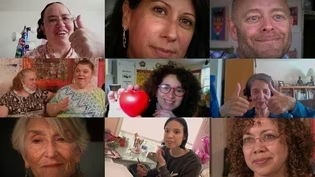
Way to Connect follows the story of one organization's inspiring response to Covid 19.
Here's The Story: Way To Connect follows the story of one New Jersey organization's inspiring and heart-warming response to Covid 19, a virtual learning and community enhancing pivot for the developmentally disabled, that led to surprising results and lessons for all.
Problems playing video? | Closed Captioning Feedback
Problems playing video? | Closed Captioning Feedback
Here's the Story is a local public television program presented by NJ PBS
Here's the Story
Here's The Story: Way To Connect
Season 2021 Episode 5 | 29m 26sVideo has Closed Captions
Here's The Story: Way To Connect follows the story of one New Jersey organization's inspiring and heart-warming response to Covid 19, a virtual learning and community enhancing pivot for the developmentally disabled, that led to surprising results and lessons for all.
Problems playing video? | Closed Captioning Feedback
How to Watch Here's the Story
Here's the Story is available to stream on pbs.org and the free PBS App, available on iPhone, Apple TV, Android TV, Android smartphones, Amazon Fire TV, Amazon Fire Tablet, Roku, Samsung Smart TV, and Vizio.
Providing Support for PBS.org
Learn Moreabout PBS online sponsorship- [Narrator] Here's the story.
[upbeat music] Since 2004, Jewish service for the developmentally disabled or JSDD, has provided wellness, arts and enrichment programming to adults with developmental disabilities through their Wae Center.
- It is an immersive in-person experience for people to explore creativity in a safe space.
It is a fine arts based organization that's holistic in nature.
So we are addressing the whole person, not just focusing on art, but wellness and enrichment as well.
It was magical.
Wild things happened every day and truly unique.
- I think it was more about providing peace of mind for parents whose adult children with developmental disabilities would outlive them.
So it was about what the family wanted, what the parents wanted for their adult child with a disability.
Now it's, the focus has shifted to what does the person with the disability want?
How did they wanna live their life?
[upbeat music] - I've done art my whole life, but I done much better since I came here.
[upbeat music] - I can't imagine life from a family's perspective without the Wae Center, like i try to think of 10 years ago what it was like without it, and just knowing how much Kevin has grown both as a sibling, as a human, and also just this new found love and appreciation for art.
And so now he's described as an artist, both here at the Wae Center and throughout the community and in our household.
So, that was something that was really magical to see throughout the last decade with his growth in that way.
- [Narrator] JSSD's members attend the Wae Center with a variety of interests in different art forms.
But what they may not count on, is the rich community they discover and become a part of.
- I know it sounds like a cliche but, it really feels like a family, it is a family.
You know we come here every day and we all take care of each other.
And that's not just staff taking care of members, it's everyone taking care of everyone.
[upbeat music] - [Narrator] That family forms amongst members, staff, visiting artists and facilitators.
- The great thing about the Wae Centers is they're in the process with other people.
It is the constant support, being there and supporting people and respecting their space and what they have to say and including them in the process.
People come as they are, from the environment they've grown up with their own DNA, right?
And they adjust, they adapt they find the resources here that suit them initially, and within that they then begin to stretch.
That's, I guess that's how dreams are made.
[upbeat music] - [Narrator] There are celebrations holidays, poetry, theater performances, music, outings and adventures, individual and group classes, all of which draws people closer together and help people to determine their interests and talents as they discover the spark within.
[upbeat music] This vibrant community, of perpetual motion and instruction was stopped in its tracks in March of 2020, when all day programs were required to close due to the COVID-19 pandemic and quarantine.
- Well, the whole thing of course was shocking and, you know, one day you're open and the next day you're closed because that was what we were told we needed to do and we did.
And I felt very strongly, for a long time that we should be doing something that would really help home-bound people.
And of course, that flashed through my mind at that time.
But also at that time, the Health Care Foundation decided they were gonna give a grant to set up some, you know, remote classes.
And, we had a very short timeframe from the moment they said they were doing this and sent out information and so on to the time that we had to write a grant and get it all together.
And so, Aubrey and Monica and I, set to putting this together and there may have been other staff that came in on it as well as we were doing it.
And we quickly put something together.
We had a vision because we also had our Wae Center.
So we knew what we did here.
So the question was how to replicate it and draw people in from their own homes, that was the critical piece that was so essential.
- I remember Maryland from the very beginning saying this is something we have to do.
You know, it wasn't so foreign to us that we didn't know about it.
So we knew what we had to do.
We just didn't quite know how to make it happen.
- You know, you come to a point where you say, okay, we just have to have classes.
We have to have our people.
And we had a lot of people who were, who were our clients, who wanted to do something like this.
And we opened on time with a few classes and you know, kind of a like, how will we get through this?
It was like, oh, what's gonna happen, you know.
And everybody, you know, put their head together, everybody put their body into it, their soul into it and made it happen.
- [Narrator] What followed was a complicated pivot that allowed members and staff to reconnect, to see one another and eventually to restore their daily activities and sense of community.
This is the place and time, where the program, Wae To Connect, was born.
- We were so ecstatic when we learned that there was virtual classes available.
And I think it started off with one class and Kevin was a little anxious about it I'm pretty sure if I remember, about Dean on, you know, a virtual setting versus in person 'cause he's such a social butterfly.
So the loss of that daily in-person chatter, even, it's a little different than the virtual setting.
There's this thing, you know everyone talks about zoom fatigue and work, but this was something I think for Kevin, too, over time.
But in the very beginning, I think there was just some hesitancy about how it connected people would feel if the classes would translate well over zoom.
And over about like, I think the hesitation went away after the first class, I think, its probably his music class at the time with Dean that really convinced us and convinced Kevin that this is something that could be a really great way to stay connected and stay safe and keep everyone in your community safe while, while we get through the pandemic together.
- All right so, I'm gonna try one more Darius Rucker impression and lemme know how the sound is, okay?
[soft guitar music] ♪ I only wanna be with you ♪ [soft guitar music] Is that better?
- So much better - All right - Yeah - I was told that, well, we've gotta do something if we wanna engage our members, we wanna, you know, reach out to them.
And he first thing that we did was to make phone calls and to see how people were doing.
It's a very person to person role.
And then all of a sudden you're going to be removed and on the screen with someone and how do you make that work?
- [Narrator] Wae To Connect shifted JSDD staff members and residents to an online only platform via zoom in order to keep everyone safe and engaged.
- [Narrator] How familiar were you with zoom before the pandemic?
- Not at all.
[laughs] - I had never heard of it, honestly.
- I had never heard of zoom before the prior to the pandemic [laughs] It was totally new experience.
- [Narrator] How familiar were you with zoom before the pandemic began?
- Nothing.
Nothing, I think I had heard of it.
That's about it.
- It's really important to connect with human, the human to human contact with people, but the pandemic really didn't allow for that anymore.
So trying to figure out a new way of doing it and to do it quickly, so it was out of necessity more than anything.
- We knew that we'd start small 'cause we couldn't account for everybody and every parent wasn't sure, and how would it be?
And what would, what was happening in their lives too.
Were they gonna be home?
Would somebody be there with their family member?
Would they have an aid in the household?
All those different things were taken into consideration as much as they could be, you know, we're problem solvers.
[laughs] That's what we do regularly, problem solve.
Find an answer to it, whether it's the perfect answer or not, let's try it and see, that's all we can do, if it's not, we'll figure out something else.
And yes, they were doing it differently.
And everything about that would be different.
I also think that staff grew tremendously in that process because you had to turn everything around and figure out, oh gee, how am I gonna do this on camera with somebody?
I'm gonna turn on zoom and now I've got to talk to everybody as if they're like sitting in front of me and I have to reach out to everyone.
Some challenges are great.
And I do believe that everybody figured it out.
They figured it out together.
They figured it out for themselves.
It was important to everyone at the Wae Center, the staff and everybody's assisting in administration.
It was important that it be successful.
- [Narrator] There was a steep learning curve and still the gains were consistent and the rewards were evident.
- Look, I like your art class.
I like art class.
I came to art class a lot.
It's inspired me today.
So, the reason why I'm here.
And I love zoom.
- Jamal that's great.
Thank you, Jamal - That's how I feel, that's how I feel at my heart, peace.
- Thank you for sharing that Jamal, that helps make my day a little better hearing that.
- Applause and, [crowd applauds] Thank you Adam.
- Thank you.
- And so it was a challenge, but we figured it out.
- And nobody really knew, what we were doing or what was gonna happen.
You know, questions constantly came up and why did this happen?
How do we fix this for so and so?
We just kinda try to improve the whole experience and till we got the hang of it - There was a lot of, turn your, we can't see you.
Can you adjust your lighting?
Can you sit with the lighting in front of you because the lighting behind you is blinding us?
Can you turn the TV down in the background?
- Yeah - I mean there was, it was all of it It was, the conversations were endless.
We spent a lot of time working on the technology end of it.
- Mostly it's intimidating.
You know I always say, we are Flintstones in a Jetson world.
But, as soon as it was there, we found out how easy it was, so we were good.
We've grown a tremendous amount since that part.
And we've had to develop ways of working together.
You know, our staff were working remotely.
Our members were at home with their families.
Did they have people who were gonna support them?
So that was just constant conversations about what do we need to do to make it different and there was a lot of learning on the go.
- You have a beginning point, and then you discover whether or not it works, you know?
So I always believe that it can happen.
And of course that, in that situation, it's also about, not convincing but supporting my staff to understand that we're going to do this.
But just keep breathing, keep breathing, because we're going to get through this.
It's going to happen.
And it did.
[upbeat music] - So I thought we'd take a look right now at my seedlings and I can show you what's going on with mine.
- This project is so cool because it's, you had the whole part before about learning about roots and blobs and leaves, and now you're really seeing it, everyone, like you're seeing things grow.
I think this is just such a neat thing, Bill.
I'm really happy that you thought of doing this, [upbeat music] - There were some moments that are just like, [laughs] you know like whoa!
I didn't, this just came together.
I had no way to plan this.
I feel their hunger and their thirst for interaction.
And it's important for their mind, for their soul to just interact it's as if they were here.
It's nurturing, we are human, you know.
[laughs] [upbeat music] - There's just a lot of magic percolating in my view for the whole session.
And the smiles and laughing and excitement and members stepping up to be leaders.
That's something that I working on a lot to have them lead a song or a chant or a pattern for us to play.
I love those moments.
You know there's certain members that every time they're gonna raise their hand or want to step up and some are more reluctant and then they take a chance, they push the envelope.
I think it's a really safe space for a lot of magic to happen.
[upbeat music] - And its most ideal, it communicates common humanity.
It expresses something that perhaps only that one individual could express, but that thousands or maybe millions of others can relate to.
It is communication without language.
- What's exciting is to see them hold up their work and share it, which normally didn't happen in the classroom.
So you checking in and saying, okay, let's see what you've done.
And they hold it up and now people are very excited to show their work and even talk about their work, which we didn't really do as much before.
You know and you get that feedback and that appreciation, and they all love getting that, you know attention from their classmates because it's, you know, its a different interaction.
You know, a lot of times in the classroom, they focused on you and here it gives them the chance to focus on each other.
[upbeat music] - I think the nature of what we do, allows for magic, all the time.
So, and they're often small moments.
And so it's just about being open to those moments.
- I did a good job I did a good job on one, two, three, four.
- [Man] I say so they all look great.
[upbeat music] - Yes - Being able to log in and know that, this small thing lifted me up and out of COVID and out of, you know, being stuck at home, to for that moment have that joy, that was magical.
So, magic was happening all the time throughout this experience.
[upbeat music] - And by the way, when I get the report, I'm going to get an A I get two As - [Woman] You get an A [laughing] - [Man] Four As Erin, four As one for each of your project, okay?
- My God!
Isn't that something Papa Bear?
[laughing] - Its amazing Erin.
- [Man] Okay, thank you for sharing City Wawa.
- You're welcome.
[laughing] - [Narrator] In teaching via zoom, new skills group, learning how to share space and time in a completely new way.
And members and staff had to learn this together.
[upbeat music] What started with just a few hours a week, grew to a few hours a day, then eventually full days of programming.
Wae To Connect proved to be an effective and compelling way to bring people together to learn, laugh, and live their best possible lives.
- There were so many concerns.
I think that people experienced during this time.
We understood that we had to kind of shift and the community did it together, and it was stressful and scary that having something that was a little bit of familiar was really really important.
Just was certainly something we're gonna always remember.
[upbeat music] [laughing] - [Woman] Today is her day [laughing] - [Woman] Oh, that's so sweet I love how you guys encourage each other.
It's so lovely.
[upbeat music] - [Narrator] In the fall of 2021, hopeful that COVID-19 is slowly ebbing away from our lives.
JSDD moved into a new facility, creating a state of the art program space for the Wae Center, as members and facilitators return to in-person daily classes and activities.
It will be a whole new world they come to, literally and figuratively.
- Well this, you know, this is like 20 years of work, you know This is building something and believing no matter what that it will happen.
I guess it's believing.
Or, I shouldn't say I guess, I believe.
And we are really blessed to have this amazing, amazing building.
This is, you know, truly a dream come true.
And the hard work that made it happen is greatly appreciated.
I think that our members will kind of puff up.
[laughs] I think that we will see them want to add to it through their art, through their writings, through their reading or theater that they're doing, whatever it is that they're working on.
And I also think that this is happening in the world.
I do think it's happening in the world.
I think that we have colleagues who are building spaces for people with disabilities, knowing that they can learn, and they should have the opportunity as anyone else should to move forward, to potentially go to college if that's, a possibility for them to have jobs to be out in the world.
So I, and it's been a long hard road I think, certainly.
But I believe that there are more people who understand that everyone has potential and that we have to see to it that they have the opportunity to grow that potential.
That's our responsibility.
I don't have a child with a disability personally.
That wasn't my calling in life.
But I have been with my people here at JSDD for a long time now.
And I never looked at them as different.
I knew they had disabilities, but that wasn't what I cared about.
I cared about who they were.
That's that's the whole place, the whole heart of where the Wae Center begins.
I cared about who they were.
What were they interested in?
Did they have any interests?
And so that learning we talked about at the very beginning of this, when I saw that they were in sheltered workshops and what they did in sheltered workshops, and there was no conversation, there was nobody asking them, hey, how are you doing today?
And did you have supper last night?
What did you eat?
You know, kind of stuff that didn't happen, that I felt we had to do something different.
We as JSDD needed to give back in our community and beyond that community, by creating something that was strong and powerful and would enable people to be more present in the world with us.
- It bears noting that this building was designed for us, by us, for our members.
We finally have a building that is worthy of the population we serve.
There is a reason why there are so many windows.
It is to promote transparency and to promote inclusion.
We are on Eisenhower Parkway, one of the busiest streets in Livingston, in Essex county.
And you drive by and you can't not see into this building.
And so our community is interacting with the outside community.
It speaks to, you know, to our mission.
And so it's important.
It will be fascinating to see what comes out of this building.
We don't know.
And that's kind of what makes this place so amazing.
You know, we trust in the good and magical things happen.
[upbeat music] - [Narrator] In June of 2020, after nearly two decades and a lifetime of searching for, finding and nurturing the spark within herself and those around her, Wae Center founding director, Marilyn Schneider, retired from JSDD.
Visiting the new Wae Center was a perfect time and place to reflect, not only on the last year and a half, but on all her years of serving this community.
- I feel very blessed that this was, this opportunity was given to me.
Much of the work that I've done throughout my life has been what I call God directed, whatever God is and why me?
You know it's like, why me?
Why, not and not why me with fear, but why me?
This is amazing that this has happening.
I felt very blessed that Linda Press who I don't think was like really, you know kind of really I said yeah, let's yeah, let's go ahead and try it.
Let's see what happens, you know, let's and we worked very closely together to bring people in, people being our JSDD residents and so.
But I feel, personally I feel very blessed that I was given this opportunity to create something that impacts on people's lives and on the lives I believe in.
And when I was creating the Wae Center, the idea, it wasn't only for our clients, but it was for our staff and anybody else who came in and wanted to participate with us.
It was really, we would all learn.
We would all grow from this process.
We would learn about our similarities and our differences.
We would learn that we could love each other, even when we got angry with each other.
We would learn that life as hard as it might be for some people, could be better and that we could be a part of that.
And, you know, there's never a day that I'm not grateful.
I'm grateful for it.
[soft piano music] [upbeat music] ♪ Oh we are ♪ ♪ Exactly what you see ♪ ♪ Bruised and spread the needs ♪ ♪ Still we find our way ♪ [upbeat music] ♪ And some come as quickly as they go ♪ ♪ Some choose their own roads ♪ ♪ Still they find their way ♪ [upbeat music] ♪ And God knows our heart is true ♪ ♪ They do whichever one you choose ♪ ♪ That you will find your way ♪
Here's The Story: Way To Connect
Preview: S2021 Ep5 | 30s | Way to Connect follows the story of one organization's inspiring response to Covid 19. (30s)
Providing Support for PBS.org
Learn Moreabout PBS online sponsorship












Support for PBS provided by:
Here's the Story is a local public television program presented by NJ PBS