
Hernandez; Dr. Israel; Tavormina; Mullaney
6/26/2021 | 26m 58sVideo has Closed Captions
Vicky Hernandez; Dr. Jessica Israel; Meghan Tavormina; Marie Mullaney
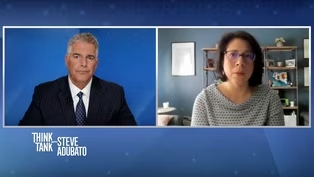
Vicky Hernandez talks about the issues surrounding child care in Newark; Dr. Jessica Israel discusses the ways COVID disproportionately impacts the elderly community; Meghan Tavormina shares the impact of affordable, quality, accessible child care on New Jersey’s economy; Dr. Marie Mullaney shares why women’s history should be implemented into regular history lessons.
Problems playing video? | Closed Captioning Feedback
Problems playing video? | Closed Captioning Feedback
Think Tank with Steve Adubato is a local public television program presented by NJ PBS
Hernandez; Dr. Israel; Tavormina; Mullaney
6/26/2021 | 26m 58sVideo has Closed Captions
Vicky Hernandez talks about the issues surrounding child care in Newark; Dr. Jessica Israel discusses the ways COVID disproportionately impacts the elderly community; Meghan Tavormina shares the impact of affordable, quality, accessible child care on New Jersey’s economy; Dr. Marie Mullaney shares why women’s history should be implemented into regular history lessons.
Problems playing video? | Closed Captioning Feedback
How to Watch Think Tank with Steve Adubato
Think Tank with Steve Adubato is available to stream on pbs.org and the free PBS App, available on iPhone, Apple TV, Android TV, Android smartphones, Amazon Fire TV, Amazon Fire Tablet, Roku, Samsung Smart TV, and Vizio.
Providing Support for PBS.org
Learn Moreabout PBS online sponsorship- [Narrator] Funding for this edition of Think Tank with Steve Adubato has been provided by The Turrell Fund, supporting Reimagine Childcare.
The Healthcare Foundation of New Jersey.
PNC, Grow Up Great.
The New Jersey Economic Development Authority.
Summit Health a provider of primary, specialty, and urgent care.
United Airlines.
The New Jersey Education Association.
NJM Insurance Group.
Serving New Jersey's drivers, homeowners and business owners for more than 100 years.
And by Choose New Jersey.
Promotional support provided by New Jersey Family A resource for New Jersey parents.
And by BestofNJ.com, all New Jersey in one place.
[MOTIVATIONAL MUSIC] - Hi, I'm Steve Adubato Welcome to another compelling important program that looks at whole range of issues.
And we kick off with Vicky Hernandez Executive Director of Ironbound Community Corporation based in beautiful brick city, Newark, New Jersey.
Vicky, great to have you with us.
- Thank you, Steve.
Vicky, could you let everyone know what the Ironbound Community Corporation is and why it matters now more than ever?
- Yeah, I'm happy to.
So Ironbound Community Corporation is a community-based grassroots organization that has been based in the Ironbound for 52 years.
And we do a combination of advocacy and organizing work that has been at the core of who we are since the very start.
And a range of social services and youth and family programming that spans from serving children, infants, and toddlers to to adults.
- So let's try this.
Obviously COVID has impacted all of our lives.
What can, and what can't you do remotely?
- Well, there's some things we can do remotely.
So our finance team, for example, is remote.
A lot of our back offices are still remote but absolutely, we are a community-based organization and we have to be on the ground serving our community members.
And so there is a lot of work that we do in-person and have been doing in-person since the start of the pandemic, really, since April.
One of those things has been emergency food relief which we do extensively, but a lot of our work is in-person.
We have to do it very carefully and try to protect the safety of our community members and our staff, but we really have no other choice.
That's how our community members connect with us and we have to be there for them.
And so we are, we find ways to do that.
- You know, we're involved, as you well know with an initiative called Reimagine Childcare.
Affordable, accessible childcare, particularly in urban underserved communities.
You're in the Ironbound section of Newark.
You and your team have been involved in childcare for many years.
What does the childcare situation look like in the Ironbound?
- Well, it's incredibly difficult.
You know, we began to see this really early on in the pandemic where, you know, many of our community members don't have the luxury of doing remote work.
The way that, you know, many people in suburban communities might be able to do it.
They are frontline workers.
They are, you know, do day labor jobs.
And so the option to work from home does not exist for them.
And so childcare has been a huge need for them, right?
Schools have been remote in Newark until recently, right?
And they're not entirely in-person now they're still operating on a hybrid model.
And so, you know, one of the things that we've done is we opened a remote learning site where parents can bring their kids to our site and they come to us and do remote schooling from our Lafayette avenue location.
But it's been incredibly hard.
I think that, you know, in addition to the need for parents to be, you know, out and working and need a safe place for childcare.
Our families have faced a lot of other challenges in the pandemic.
So the ability to navigate this virtual world has been really, really, really challenging for a lot of folks, whether it's been access to the internet or just the ability to navigate the virtual world has really been detrimental to them and detrimental to our kids as well.
- You know, Vicky, so much of our work since March of 2020 has been focusing on the work of not-for-profits, like yours.
Making a huge difference, particularly in these difficult times but one of the areas that has been so critically important is vaccine resistance, vaccine acceptance.
What are you finding in the community you serve particularly as it relates to those who are either hesitant or all-out resistant to the vaccine.
- Yeah you know, I'm happy to answer that.
You know, I think that we saw very early on in December when the vaccines were originally approved that there was more resistance then and I think that's understandable, you know, it was new.
We don't see the same kind of resistance now.
- You don't?
- The biggest.
Yeah.
I would say that the biggest barrier that we see right now is ease of access, not even access, but ease of access, right?
So, you know, many of the ways that that folks register to get the vaccine, they have to go online, they have to provide a lot of information.
You know, there's a hesitancy around that or an inability to navigate that environment in order to be able to do that.
So recently, two Saturdays ago, we hosted a a pop-up vaccination site with the Newark department of health.
And we had an unbelievable turnout.
575 people came out to get vaccinated on that day.
And that was just a week's worth of registering people, right?
Talking to folks on the phone helping them to fill out their forms, right?
The online piece was not a barrier.
The appointment was not a barrier.
We had slots available that day.
So even if folks weren't registered, they could come up and do it.
And so that ease of access really is critical.
We could have stayed open for hours and hours longer, but you know, just couldn't keep going that day but plan to do more of these pop-up vaccination days in our community because we really feel that that is the best way to reach people in our community.
- Vicky, as difficult as this pandemic has been for so many if it were not for non-profits like yours, making a difference, particularly in underserved communities.
it would be that much worse.
Vicky Hernandez, Executive Director, Ironbound Community Corporation.
I want to thank you so much for joining us.
- Thank you Steve.
- Thank you.
I'm Steve Adubato, stay with us.
We'll be right back.
To watch more Think Tank with Steve Adubato, find us online and follow us on social media.
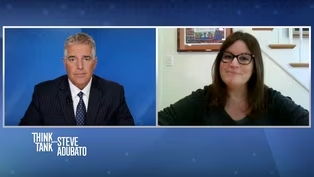
- We're now joined by Dr. Jessica Israel, who is Senior Vice President of Geriatrics and Palliative Care at RWJ Barnabas Health.
Doctor, good to have you with us.
- Thanks for having me, excited to be here.
- Let me ask you this.
How, in your view, geriatrics and palliative care - first of all, could you define palliative care and how is it different from hospice?
- So that is, that's a great question, and one that a lot of people ask.
I'm going to start with the definition that I, that I came to New Jersey with when I left New York.
I was early into palliative care and a mentor of mine said, "when you come to Jersey, how are you gonna explain to people what palliative care is?"
And she told me to say it's good medical care for patients with serious medical illness.
And that - that's the way that I think about it.
But essentially it is for patients with serious medical illness.
It is impeccable treat-, um, early recognition and careful treatment of symptoms, as well as expert communication about goals of care and medical decision-making.
And it looks at, not just the physical sense, but someone's spiritual sense of wellbeing, their emotional sense of wellbeing, the world outside them, their families, people that they love, and how a serious medical illness fits in or doesn't fit in with all of that.
- Palliative care has changed, in one way, a very significant way, it's changed in the face of COVID is?
- Well, I would say that the difference is executives at hospitals understand what palliative care is all about now.
And so do patients, because very, very quickly this field and the expertise got pushed to the forefront.
We really needed expert communication, um, especially, and expert symptom management early in the surge of the disease, and now, especially when patients and families are separated because of visitor restrictions.
There needs to be someone who can communicate exactly what's happening and talk about goals of care with families and patients.
And, in this case, across significant borders.
- Doctor, you know, the whole idea of geriatrics, you know, and I know this because my dad was sick for a very long time, treated by folks at your place, um, and then died in the, passed in the, in the fall of 2020 after a long illness.
And so we're very connected to, not just geriatrics, but you know, palliative care and hospice, as well.
But the reason I'm raising this is that, it seems to me with COVID disproportionately affecting older people, that palliative care becomes even more important than ever before.
Correct?
- I think it's such a great point, Steve, I'm glad you brought it up.
I think in the beginning of palliative care, and in some cases, this even happens in hospital, in hospitals now, the crisis of hospitalization brings, brings up the need for this kind of communication.
But really, patients are much better served if we can take the communication part out of a crisis and move it upstream.
Everyone with a serious medical illness has an opportunity to talk about their goals of care before moments of pressure.
And in many cases, this prevents moments of pressure.
So, especially the communication piece belongs way upstream of an emergency.
- What is, in fact, the palliative care collaborative?
What is it exactly?
- So, that's something particular to RWJ Barnabas Health.
So, the palliative care collaborative is our system's approach to bringing together the teams across our 12 different hospitals.
So, palliative care teams can range in size.
Sometimes it's one or two professionals, uh, maybe a nurse practitioner or a physician, and sometimes it's a team of, you know, six to eight people including social work support and different, uh, different para-professionals.
So the palliative care collaborative in the system is the leaders in palliative care on these teams coming together on a regular basis to learn from each other.
And I would say, even more importantly, to support each other.
This is a, it's a tough thing to face serious medical illness every day.
And sometimes people need mentorship and support.
And when teams are small, that's hard to find at your home site.
So this sort of extends that network to, to really make us all practice better.
Something I'm really proud of.
And during the pandemic, it was the palliative care collaborative that, that really very, very quickly put together 24/7 access for every provider in our systems of palliative care.
Through a telephone hotline we made phone calls to families at home on behalf of the physicians because of the workload to, to help along the way.
We've written standardized order sets so that we can teach through the way that we recommend prescription, uh, physicians and providers prescribe.
So super proud of our effort in that.
- Final question, support for caregivers is critically important, correct?
- I think it is, um, one of the most important things we can think about.
You know, in palliative care, we think a lot about, about emotional support for providers who work in different spaces.
But I would say even in that field, it's the kind of thing we talk about at the end of the meeting or it's the last hour of a, of a weekend thing.
But something that I really think we need to move forward.
And the, the pandemic has taught us a lot about that.
Being in these spaces is difficult and physicians in particular, we're not really great at talking about that difficulty.
And sometimes you have to push it for that to come out a little bit.
- Important work, Dr. Jessa - Jessica Israel, Senior Vice President of Geriatrics and Palliative Care at RWJ Barnabas Health.
And they are, in fact, a signif- significant supporter of public broadcasting on the work we do.
Doctor, thank you so much.
- Thank you so much for having me.
- You got it.
We'll be right back.
To watch more Think Tank with Steve Adubato, find us online and follow us on social media.
- We're honored to be joined by Meghan Tavormina, who is President of the New Jersey Association for the Education of Young Children.
Meghan, good to have you with us.
- Thank you.
It's nice to be here.
- Meghan, part of our conversation, ongoing conversation, Reimagine Child Care.
There are so many aspects of this to this, but the one I want to get to that you've been telling our producers about, childcare workers are incredibly underpaid, right?
Which creates this massive staffing crisis.
Talk about it.
- Absolutely.
So, we have seen so much highlight around childcare in the wake of the COVID pandemic, but the reality of it is is that the workforce issues had started well before COVID came along and now as the pandemic has come in, it has exasperated these issues.
And so, there is a compounding thing that is happening where we don't have anybody interested in joining the industry because the pay is so terrible.
And the qualified people that we do have are leaving the industry for better paying jobs in the public school, if they're qualified.
And then we have this whole new sector that has come out with warehouses, such like Costco and Amazon, offering $18 an hour with great benefit packages that we are pulling for the same employees, which just shouldn't be, because we are looking to develop a high-quality early learning system here in New Jersey.
And, unless we fix this problem, we will never achieve that.
- (sighs) So, here's the thing I keep wondering about.
In the American Rescue Plan, right?
If there's $700 million dedicated to childcare, how much of that is going to pay childcare professionals and workers more?
- We still don't have the answer to that, but we're hoping that this is an opportunity.
That right now is a moment in time where we can change the dialogue for the early learning industry, not just here in New Jersey, but really across the country, and the best way to do that is to invest in our teachers.
If we invest in our teachers, in our early learning teachers, they will invest in New Jersey's children.
And that has to be the core of how we step forward with this funding.
It is an industry-changing opportunity that we are looking at, and it is so important that we address the workforce compensation with this funding that is coming through.
And that is our hopes that this will be at the top of the priority list as the funds are allocated.
- So, let me try this one.
The term Reimagine Child Care means different things to different people.
What does it mean to you?
- To me, it really means rethinking the way that we prioritize childcare in the industry.
And so that means recognizing that it is a pivotal part of our economic recovery, but at same time, it is an even more important piece of a child's long-term development and their school success.
So we have to be able to reimagine the importance that it has in the economic sphere, as well as the importance that it has in our children's education.
And we have to do those two things alongside one another, not in separate directions.
- In the time we have left, help folks understand why affordable, quality, accessible childcare is not simply an issue for the family members and professionals in the field, but for all of us.
- You know, the one thing that's so important for people in the field that we want everyone else to understand is that these are issues for us that were well before COVID-19.
But the one thing that COVID-19 highlighted, was the direct connection between childcare and the economic recovery.
And so, that really says it all right there.
- And real quick, your direct connection to Reimagine Child Care, the initiative, please share with everyone.
- So, I've been fortunate enough to represent NJAEYC as one of the partners, alongside ACNJ to represent the work- - The Advocates for Children of New Jersey.
Our great friend, Cecilia Zalkind and her team.
Go ahead.
- Absolutely.
And we were brought on, and I'm so thankful for, to recognize that the workforce is one of the legs that stands up this industry.
- Meghan, I want to thank you so much for joining us, and to you and the team at the New Jersey Association for the Education of Young Children, we thank you for the work you're doing every day.
And we look forward to continuing the conversation.
By the way, real quick.
I've said three times before I let you go, but I'm curious about this.
How did you get connected to this, and why do you care so much?
- I am a passionate advocate for the early learning profession.
I've been in it for 20 years.
And for 20 years, you constantly feel like a second-rate career.
And you know, so it's always been a passion of mine to build up myself and my colleagues to the important essential work that we do.
And so, that drove me into becoming, you know, a part of our professional organization, which is NJAEYC, and through advocacy, and have been fortunate enough to serve as president over the past year and a half.
- Well said, Meghan, thanks so much.
- Thank you.
- Stay with us.
We'll be right back.
To watch more Think Tank with Steve Adubato, find us online and follow us on social media.
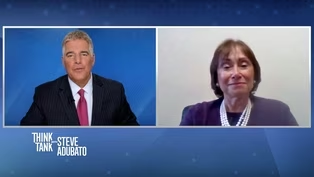
- We're now joined by Dr. Marie Mullaney, who is a professor of history, and specialist in women's history at Caldwell University.
Good to see you professor.
- Oh, it was great to see you too Steve.
- So let's do this, you're not a fan of the way women's history is taught right now, and the way we talk about it.
Because?
- Well, it depends on where it is being taught.
If you're talking about the traditional Women's History Month, that's celebrated in the public schools, I'm not a big fan of that.
Certainly on the college level, I know that it's taught much much differently.
So we're not talking about the college level.
We're talking about, ya know, every March we, tried out these women and we do this little biographies, and the students probably hear about the same women over and over and over again until they get sick of hearing about the same women over and over again.
So it's a problem.
Ya know.
We're glad and certainly happy that there was some learning taking place, but there's so much more to the history of women than that kind of biographical approach.
- And from your view, and by the way let me disclose that I've done some teaching and continue to teach at the doctoral level at Caldwell university, a terrific place.
Let me ask you this.
What should we be focusing on?
Not just national leaders who happened to be women but also in New Jersey.
Please share doctor.
- Well, what we should be focusing on in all of our classes is an inclusive approach to history.
And that is what I don't even know how I got that idea 45 years ago when I decided to go into this profession.
But even when I was in college I realized that history is stories of everyone.
It's not just white men.
It's not just white politicized women.
In every one of our classes, we need to be inclusive and tell all different sorts of stories.
So I teach about African-American history in every one of my American history courses.
And I teach about women I think in every single course that I teach.
So I'm teaching Western civilization.
Now I teach about women wherever it is possible whether it's talking about the Greek ideas about women or why women were excluded from politics for so many years.
I mean, there just has to be a natural fit.
And I also teach history of New Jersey.
I mean, I'm constantly talking about women who went in when and where it is appropriate.
So I'm not saying we make these things up just to be condescending, not, not at all, but I've been teaching a very long time.
And I understand that what I am suggesting might not be possible for somebody right out of graduate school.
Who's starting to teach, you know, but the more you learn about your discipline, you know, how to interweave these stories, to get your students interested whether it's women's history or African-American history or right now I'm teaching a brand new course in the history of Hispanics in America.
And it is just great.
And yesterday I talked about Dolores Huerta.
Who's not as well-known as Cesar Chavez.
- That's right.
- So, you know, so you do it everywhere.
You can.
I teach courses on the history of the Catholic church and wherever possible, I integrate the stories of Catholic women, Catholic saints, Catholic sisters.
That's just the way I approach history.
- And excuse me.
There are some religious women who don't get enough attention.
- Most religious women don't get any attention whatsoever.
And that's really unfortunate.
I teach the history of American women.
And one of the textbooks that I use is about 600 pages long.
So it covers the whole gamut of women in America.
I think there are two pages that talk about Catholic religious systems, which is appalling.
Absolutely appalling.
and why that is the case we can discuss but Catholic religious women have done so much.
So whenever I teach the civil war I make sure to talk about sisters, the women who are on the battlefield and served as nurses at that time.
And when you talk about American holidays and why we have certain American holidays and be the role that women women played in that whether it's Thanksgiving or Mother's Day or commemorate Memorial Day believe it or not Memorial Day was started by women in the American south.
- What year?
- Oh my goodness.
It was shortly after the civil war.
Shortly after the civil war and it was called Decoration Day, for decades.
- And women drove that?
- Excuse me?
- Women pushed?
that women led?
- Women pushed that.
Women pushed that because they had lost so much.
I mean, certainly north and south but Southern women, especially.
Especially lost so much of their lives.
They lost their farms.
They lost the plantations.
They've lost their status.
They lost their workforce.
And, and it was a way of remembering.
So I think we are wrong to focus on women in history from a political point of view and only a political point of view that there's so many other women activists who serve, who come out, come to their contributions and their activism from this ethos of serving, which is what women traditionally have been taught to do.
So you can poo poo that, but it is greatly responsible for their contributions over the centuries.
- Professor, by the way, beyond Susan B. Anthony who matters so much in our history as Dr. Mullaney has said, so many other women a compelling, important conversation.
Dr. Marie Mullaney, I want to thank you.
We wish you all the best.
You just taught us a lot.
Thank you, professor.
- There's a lot.
Pleasure to be here.
- You got it.
I'm Steve Adubato.
Thank you so much for watching, you know more about women's history right now, because of Dr. Mullaney.
We'll catch you next time.
- [Narrator] Think Tank with Steve Adubato has been a production of the Caucus Educational Corporation.
Funding has been provided by The Turrell Fund, supporting Reimagine Childcare.
The Healthcare Foundation of New Jersey.
PNC, Grow Up Great.
The New Jersey Economic Development Authority.
Summit Health United Airlines.
The New Jersey Education Association.
NJM Insurance Group.
And by Choose New Jersey.
Promotional support provided by New Jersey Family Magazine and by BestofNJ.com.
- I'm Tim Sullivan, CEO of the New Jersey Economic Development Authority.
Since joining the NJEDA, I've been struck by the incredible assets and resources that New Jersey has to offer.
The NJEDA is working every day to grow New Jersey's economy in a way that maximizes the values of those assets to benefit every single New Jersey resident.
This includes more support for small businesses and a focus on reclaiming New Jersey's position as a leader in the innovation economy.
Visit njeda.com to learn more about how NJEDA is building a stronger and fairer New Jersey economy.
COVID's Impact on Child Care in Newark
Video has Closed Captions
Clip: 6/26/2021 | 7m 35s | COVID's Impact on Child Care in Newark (7m 35s)
The Importance of Communication in Palliative Care
Video has Closed Captions
Clip: 6/26/2021 | 7m 14s | The Importance of Communication in Palliative Care (7m 14s)
Incorporating Women's History Into All History Lessons
Video has Closed Captions
Clip: 6/26/2021 | 7m 13s | Incorporating Women's History Into All History Lessons (7m 13s)

New Jersey's Child Care Staffing Crisis
Video has Closed Captions
Clip: 6/26/2021 | 6m 50s | New Jersey's Child Care Staffing Crisis (6m 50s)
Providing Support for PBS.org
Learn Moreabout PBS online sponsorship
- News and Public Affairs

Top journalists deliver compelling original analysis of the hour's headlines.

- News and Public Affairs

FRONTLINE is investigative journalism that questions, explains and changes our world.












Support for PBS provided by:
Think Tank with Steve Adubato is a local public television program presented by NJ PBS