
Higher Ed Impact
4/13/2023 | 26m 46sVideo has Closed Captions
Higher Ed Impact
The impact of Higher Education on Illinois is more than many may realize. In this episode, we’ll take a closer look at Higher Ed funding, how research stretches beyond the state’s borders, how technology is changing how students learn, and how universities can bring history to the community.
Problems playing video? | Closed Captioning Feedback
Problems playing video? | Closed Captioning Feedback
InFocus is a local public television program presented by WSIU
Support provided by:

Higher Ed Impact
4/13/2023 | 26m 46sVideo has Closed Captions
The impact of Higher Education on Illinois is more than many may realize. In this episode, we’ll take a closer look at Higher Ed funding, how research stretches beyond the state’s borders, how technology is changing how students learn, and how universities can bring history to the community.
Problems playing video? | Closed Captioning Feedback
How to Watch InFocus
InFocus is available to stream on pbs.org and the free PBS App, available on iPhone, Apple TV, Android TV, Android smartphones, Amazon Fire TV, Amazon Fire Tablet, Roku, Samsung Smart TV, and Vizio.
InFocus
Join our award-winning team of reporters as we explore the major issues effecting the region and beyond, and meet the people and organizations hoping to make an impact. The series is produced in partnership with Julie Staley of the Staley Family Foundation and sponsored locally.Providing Support for PBS.org
Learn Moreabout PBS online sponsorship(energetic music) (exciting music) - Welcome to In Focus.
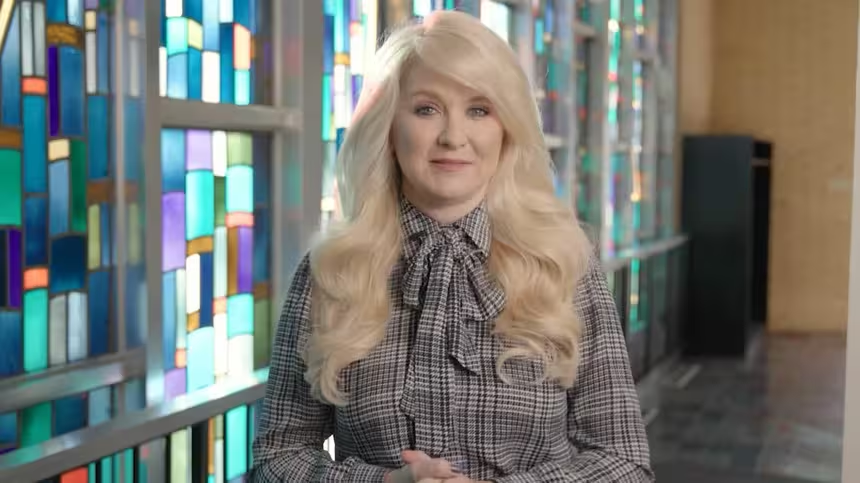
I'm Jennifer Fuller.
In this episode, we're taking a look at the work and the impact of higher education.
From research to teaching, community involvement and more, colleges and universities leave a big imprint on the cities and towns they serve.
We start though with a look at how dramatic changes in state support over the last 20 years have had quite an impact on Illinois higher education.
Ralph Martire is the Executive Director of the Center for Tax and Budget Accountability.
Thank you so much for joining us.
- Well, thanks for having me on the program.
- Your organization has a new report out that looks specifically at the investment of state funds into higher education, and in many cases, the lack of investment.
Can you tell us a little bit about what the study found and what you hope that it'll achieve with lawmakers working on a budget for this year?
- Yeah.
Basically everyone knows who lives in the state that the state of Illinois has had some severe fiscal problems for quite a period of time.
Really what they've had in Illinois is structural imbalance, where revenue growth didn't keep up with cost growth year to year.
So what state elected officials have done is generally cut investments in certain areas of public services, but one of the biggest cuts over the last 20 years, in fact by far and away the biggest cut, was made to higher education.
When you compare how much we are investing in higher education in the current FY 2023 budget versus what the state invested in 2000, after you adjust for inflation, we've cut that by 46%, almost in half.
That's a $1.8 billion real cut in funding.
Now the reason for that is when it comes to fiscal matters and you need to cut something, higher ed is kind of the low hanging fruit, right?
Because the state spends nine out of 10 dollars on four things, education, healthcare, social services and public safety.
You can't really cut K-12.
It doesn't really have independent funding sources.
Maybe property taxes.
That annoys everybody.
No independent funding sources for human services, public safety, no independent funding sources, oh, higher ed.
They could pass it on in tuition.
And so that's really been one of the reasons why we've seen this major disinvestment.
In fact, our disinvestment in Illinois has been much worse than the national one.
If you can compare us to the national average, we have cut our funding for higher ed by well beyond what the national average is.
That's had consequences for tuition, for the capacity of universities to maintain programs, to fund salary increases for faculty, et cetera.
- Sure, and you bring up a good point, because so often a cut to a budget has an equal and opposite reaction somewhere.
Higher education institutions across Illinois have seen dramatic increases in tuition and particularly in fees.
Parents of college students and college students themselves that are trying to pay for higher education would say this is a lot more than we saw 20 years ago.
The portion of someone's income is dramatically higher.
- Yeah, well I have some numbers on that, actually.
Back in the year 2002, the state of Illinois covered 72% of the cost of attending a public university in our state, and tuition and fees only covered 28%, so that's a nice balance, right?
Two thirds pretty much on the state, or three quarters.
Then you fast forward to 2023.
State share dropped down to 35% and tuition and fees rocketed up by 64%.
In real terms, they grew by 129% over the sequence.
You compare us to the national average, national average tuition and fees at public universities only went up by 36%, so way beyond the national average, and our disinvestment, our 51% cut, way outstripped the national average 16%.
So what has that meant for families?
Well, right now, the average cost of attending a public university in Illinois will take 20% of the income of a middle income family.
That's not insignificant.
If you're low income, it takes 63% of your annual earnings.
If you're in the bottom quintile of earnings, 101%, more than all what you earn.
We frequently silo these policy discussions on fiscal systems.
Oh, we need to save taxpayers money, we need to cut spending.
We don't think about their real world implications.
Well, the real world implication of disinvesting in higher education has been to shift a significant portion of the responsibility to pay for higher education onto family incomes, and families need to do this, because what the modern economy is telling us is you need some sort of post-secondary degree to be competitive.
In fact, according to the Department of Labor, 63% of all job openings right now require some form of college degree.
That's significant.
That would be the vast majority of them.
And really, if you look at the differential and potential earnings, it has become huge.
Way back in 1979, someone with a college degree earned about 38% more than someone with a high school degree.
Today that's up to 85% more.
You really have to invest in getting a college education for your kids if you want them to be competitive in the modern economy, and unfortunately, if you're sending them to a public university in Illinois, a lot more of the cost is falling on your family income than did 20 years ago.
- I'll ask you the question that a lot of people are asking, particularly if they're paying for higher education.
Where should the money come from out of the state budget?
You mentioned earlier the vast majority of Illinois spending goes into places that we really can't cut the funding for.
- Yeah, that's exactly right.
It begs a different question.
The different question is, does Illinois have adequate fiscal capacity at the state level to invest in core services to the level necessary to satisfy demographically-driven demand?
Let me think about that question.
No, no, it does not.
We really have to have a more honest discussion in Illinois about tax policy and revenue.
When you look at total state and local tax burden as a percentage of income in the state of Illinois, we are always bottom third, and I'm talking every tax and every fee charged by any unit of state or local government as a percentage of our income, we're really in the bottom third in the nation.
We have the fifth largest economy and sixth largest population of any state.
We're low tax.
If we were to raise adequate revenue to let's say shift the primary burden for funding higher education on up to the state like it used to be 20 years ago and be able to invest better in our K-12 education systems, et cetera, et cetera, our total tax increase would need to be somewhere in the, I don't know, three to $5 billion range.
That sounds like a lot of money.
When I was a kid growing up in the Paleozoic era, that was a lot of money, but it's really not in context of the Illinois economy.
We have a $1 trillion state economy, $1 trillion, less than 1% of our economic activity.
I think what voters and taxpayers need to understand is a very modest tax increase is needed to give the state the capacity it needs to make these investments they demand.
- It's a complicated issue and complicated questions, and we'll certainly be back in touch to talk with you about this.
I really appreciate it.
Ralph Martire is the Executive Director for the Center for Budget, for Tax and Budget Accountability, excuse me, and you can find the report online as well.
Thank you so much.
- Thank you.
- When it comes to higher education, research is typically at the top of the priority list, along with student training and development.
Research can sometimes lead in unexpected directions.
Burmese pythons have devastated the small mammal population in the Everglades National Park in southern Florida.
They're native to Southeast Asia and were brought to the United States as pets, but some owners abandoned the snakes over time, and they established a breeding population in the park.
Now, an SIU graduate student's research recently helped remove two of those big pythons.
They measured over 12 feet in length each.
Benjy Jeffords has more.
- [Benjy] When Kelly Crandall was younger, she had dreams of becoming a veterinarian, but a study abroad opportunity as an undergrad changed all that.
- After I graduated in 2018, I've just done a couple internships and technician jobs on different wildlife projects, and I've really enjoyed the animal movement sphere, especially with mesopredators like raccoons and possums.
I've always kind of had an affinity for those guys.
- [Benjy] After coming to SIU, Crandall's research on medium-sized mammals took her to Key Largo, Florida.
- [Kelly] My project is really focusing on how raccoons and possums specifically are moving throughout that landscape.
How are they utilizing natural areas?
Are they going into these urban areas and are they foraging there?
A lot of our questions are, how do these movements affect the ecosystem?
- [Benjy] Some possums and raccoons were fitted with tracking collars and released back where they were caught so their movement could be monitored.
- If you're a raccoon, you're a native animal in the Keys, you have a role in that ecosystem, so you're eating native fruits and spreading seeds and helping plants propagate, or you're eating eggs from nests and you're having effects on population control.
But if there's a nice dumpster or some cat food or bird feeders, it might be easier to just go there and take advantage of those food sources, and so they're being drawn away from their natural areas into these urban spaces.
(equipment beeping) - [Benjy] Crandall uses an antenna and receiver to hear if she's in close range to an animal, (equipment beeping) but different sounds can mean different situations.
- We hear the collar and it's giving out a mortality beacon.
That indicates to us that the collar hasn't moved in at least four hours.
Regardless, you're gonna go check out, see what's happening.
Sometimes one of our animals has just expired naturally.
Sometimes they've gotten hit by cars.
Sometimes it's just a possum taking a really long nap and is totally okay.
We detected it on mortality in early September, but the collar was underground, which isn't totally unusual in the Keys.
They're ancient coral structures, and so there was all these cavernous tunnels underneath a pretty thin layer of topsoil, and the animals definitely utilize those underground areas.
(equipment beeping) - [Benjy] But then the collar started moving again and recorded more than 30 mortality events.
- That's when we were really thinking, we think it's in a python.
One day in early November, he went out to go look, and she was finally on the surface and he got a good look at her, and he could tell that the beacon was coming from this snake.
And so then it was just like all hands on deck.
All the staff members down in the Keys got together and they had to excavate this python.
They spent a long time kind of digging her out, but they were able to remove her, confirmed that the collar was in her system, and it was really great to get that snake out of the system.
- [Benjy] The 12 foot, 62 pound python was also full of egg follicles, and two weeks later, another raccoon was eaten by a 77 pound python and removed from Key Largo, Florida, preventing dozens of future pythons from destroying the ecosystem.
- These females are the real key to fighting this invasive species, because they're the ones laying huge clutches of eggs.
They're the ones that are growing really big.
They're the ones that are eating a ton of animals, and so removing any snake from the system is always a good thing, but when you're able to get one of these big pythons, it's especially meaningful, and it's a great feeling knowing that my research has resulted in this.
I think there are a lot of opportunities to expand upon the project and hopefully keep it going even after my time here at SIU to keep on getting these big snakes out.
- [Benjy] This discovery could give wildlife officials a new tool to help remove pythons by tracking their prey.
- I think it's gonna just see what different agencies do with this data and how it works into their current management plans.
There are a lot of different tools that scientists are currently using down in southern Florida.
They're using scout snakes, which means they're putting transmitters in adult pythons that hopefully will lead researchers to breeding aggregations, and then they can remove those breeding pythons from the environment and keep tracking their scouts.
There's a ton of road cruising going on with contractors who are cruising roads at night hoping to pick up snakes, which is, they pick up a lot of snakes.
- [Benjy] Crandall plans to return to Key Largo later this summer and continue her research.
- We're in the process of looking to secure more grant funding to buy more collars.
I think right now the future plan is to deploy more raccoons and possums, but if the technology allows us and everything comes together, we would love to put transmitters on smaller animals and possibly use that to find snakes.
- [Benjy] Crandall says as the climate changes and warmer temperatures head north, the pythons could expand their area as well.
- They could be potentially moving northward, colonizing the rest of Florida and going into Georgia, Alabama, Louisiana, even as far as North Carolina.
While it seems right now like a south Florida problem, it's going to be a much bigger problem if we don't get a handle on it.
I think that just means putting a lot of time, money and research into figuring out what we can do to remove these snakes from the ecosystem.
- [Benjy] For In Focus, I'm Benjy Jeffords.
- Student career training doesn't always start at a four year institution.
Sometimes it's at a community college, sometimes even before that.
Students have new tools now to help learn about human and animal anatomy in a way they couldn't do in the past.
Synthetic products are popping up at educational institutions across the country, and Benjy Jeffords has this as well.
- We're gonna find some of our major blood vessels today.
- [Benjy] Students enrolled in biology and the emergency medical service program at Johnny Logan College will begin to learn from the SynDaver synthetic surgical model.
The synthetic cadaver looks and feels like a real human and is anatomically correct.
Professor of Biology and Life and Physical Science Department Chair Cheryl Thomas says the school started looking for a new way for students to learn for just over a year.
- We started the process of trying to find something that better suited our students in their quest for learning human anatomy.
Up to this point, we had always used small mammal dissections and things like that.
We oftentimes will use cats for dissection, and it doesn't always translate well for learning human anatomy.
Gather around.
- [Benjy] With the help of the Delta Regional Authority and the state's Economic Development Assistance Program, the college received a grant to purchase two synthetic cadavers.
- What is this longest vein right here in the body?
- [Benjy] Thomas says after considering the options for their SynDaver, they wanted something that could be used long term.
- They have one option that is even more lifelike, feels like skin, looks like skin, but you have to store that in a water tank, and then there's annual upkeep that you have to do.
- [Benjy] Thomas says these products will get a lot of use in multiple classes.
- Annually, probably between 500 and 750 students will run through our classes and use this.
- The SynDaver Company held an education giveaway that chose eight entries at random.
Now there's more than 2,200 entries.
Two winners were in Paducah, Kentucky.
The West Kentucky Community and Technical College won a G2 Anatomy Model, and Paducah Tillman High School won 30 SynFrogs and a CopyCat.
Biology teacher Nancy Broyles recently received her products and can't wait for her students to use them.
- It's a great way for the students to learn without having to deal with the formalin and the smell.
The realistic touch for the students is going to be great.
- [Benjy] Broyles says some students have difficulties when it comes to dissecting mammals.
- Especially with the cats.
That was always something that was a little difficult for people to get past, because they were real cats, and that was always something that just turned a lot of people off of anatomy.
And now with the Syn cat, that makes it a whole lot more interesting.
They can do the dissection and it doesn't look as realistic.
- [Benjy] Both teachers believe these products will fix a solution that everyone remembers about biology class.
- Smells a lot better, yes.
- You also had the problem with kids smelling that formalin smell.
A lot of times that made kids really uncomfortable, and it was something that became a real problem as time went on.
- [Benjy] Broyles says the frogs and cats can have their stomachs replaced with what the company calls a puck after each dissection.
- The fact that we can use these over and over without having to worry about the cost of replacing them every year, just having to replace the pucks in the frogs and just having to sew up the cat is going to be fantastic.
- These are supposed to be the femoral arteries.
They are, I think, a little bit oversized, but still a great representation.
- [Benjy] Thomas says there's a lot of regulations where providing real cadavers for students that many community colleges just can't afford, but this option has less rules and costs.
- This SynDaver was very expensive.
Again, thanks to the grant, we were able to acquire two, but because we will use this semester after semester, it was really one upfront cost.
Even comparing it to purchasing our small mammal specimens, we will eventually save money, because we just reuse this over and over.
Wait until I show you in here.
- [Benjy] And their model does not require a lot of maintenance after it's used.
- Because it's silicone, it can wipe clean.
The other exciting thing is when we do a lab exam, we call them lab practicals, we will often stick pins in things, and the silicone is forgiving, that you can stick a pin in and when you pull it out, it sort of self-seals.
But we could also use reusable adhesive and it comes right off.
If we get anything on the SynDaver, we just wipe it clean, soap and water, or just a soft, wet cloth.
Brachial vein.
- [Benjy] Thomas says giving students access to a learning tool like this will make them prepared for the career they choose.
- I think it's going to be a better translation between this and nursing or this and medical class, pre-med classes, and many of our students will go on to SIU or another university where they will take an actual class with a cadaver.
They'll have a leg up having used this.
It will definitely help them.
- [Benjy] Broyles says she's amazed how realistic the SynFrogs are.
- In 20 years of me teaching, I've never seen anything like this.
I think this is gonna be revolutionary for our anatomy program and for the biology program.
I think a lot of teachers are going to be very excited about this.
- [Benjy] Thomas says she's never seen her students this excited about anatomy class during her career.
- [Cheryl] Every time I pull her out, I just get the biggest smile on my face, and then when I get to see students in there, it's just so good.
I'm so happy for the students and their opportunity.
- [Benjy] For In Focus, I'm Benjy Jeffords.
- We'll close this episode with an opportunity to dive first hand into history at Southern Illinois University earlier this spring.
It's been nearly 60 years now that an explosion ripped through the 16th Street Baptist Church in Birmingham, Alabama.
Four young girls were killed as the blast ripped through a bathroom where they were.
A fifth girl, Sarah Collins Rudolph, survived, and continues to travel the country today telling her story.
- When we arrived at church, we went into the basement just to freshen up.
Janie's class was upstairs, so she left Addie and I in the basement, and she told us to go to our class, but we didn't go that Sunday morning because we was late anyway.
So while we was in the ladies lounge, Denise McNair, Cynthia Wesley and Carole Robinson, they came to the door and they spoke to us and went on to the other side to use the restroom.
So when she came out, she walked up to her and said, "Addie, tie my sash."
So when she reached her hands out to tie it, that's when I heard this loud noise, boom.
And it scared me so bad.
All I could do was say "Jesus."
And I said, "Addie, Addie, Addie."
But she didn't answer.
So I thought the debris came in on me and I was blinded from the debris, so I didn't know which way they went.
I thought they went back where the Sunday school area was.
Well anyway, all of a sudden I heard someone hollering, "Somebody bombed the 16th Street Church," and his voice was so clear as though he was in there with us, but right where the girls were standing, it blew a big crater in the church.
I found out later on that year who that person was.
He was one of the deacons upstairs in his class.
He told me that when he heard the noise downstairs, he decided to come down to the basement and see what it was, and when he began to take the steps, he learned that the steps was blown away.
So what he did, he jumped down and he looked into the crater and seen me standing.
He went on the inside, he brought me out, and the ambulance was already out waiting, so they rushed me to the hospital.
They operated on my eyes and I went to my room.
My mother was there waiting.
That's when I found out that all the girls that was in it, in the ladies lounge with me, they was all killed, and I was the only survivor.
All I could wonder, why did they kill those girls?
Sweet, beautiful girls never hurt anyone.
I just cried all night long for them, because I loved them, especially my sister was killed.
So I never did understand.
I was just 12 years old at that time and I just couldn't understand why they killed those girls.
I found out later it was because of our race.
I was in the hospital two months.
That's one of my nurses, Rosetta Hughes.
She's the one that really took care of me.
Whatever I needed, she was there.
I remember she told me that when I arrived at the hospital, she said I was full of dirt, and she took care of me and cleaned me up and everything.
She was really nice, and I got a chance to meet her.
I got a chance to meet her last year.
I was treated real nice.
They used to call me their little girl.
I remember how they would give me ice cream at night, and they just really spoiled me.
I was really traumatized.
Back then, during that time, they would not counsel young people when they come back to school.
I went to school.
I was in a very nervous condition, because every time I would hear a loud sound, it just made me think about the bomb.
I would just jump all the time.
At that time there was a lot of cars backfiring.
Every time I would hear it, I would jump.
I would always just come back to that noise that the bomb made.
I remember everything that happened, because something like that, you don't forget that.
It was always in my spirit of what had happened.
Like I said, I just cried all night long thinking about what had happened.
And that bomb, it was so loud.
The bomb was in North Birmingham, but people heard the sound of it all the way on the south side.
That's just how loud it was.
So it did, it traumatized me a whole lot.
I was about 40 some years old, about 46 years old, before I really talked about it because I was so fearful.
After prayer, one day a pastor prayed for me, and that's when I really began to go around the United States talking about it.
I am better now.
- Thank you for joining us on this episode of In Focus.
I'm Jennifer Fuller.
You can find all of our episodes online at wsiu.org and at our YouTube channel.
We'll see you next time.
(energetic music)

- News and Public Affairs

Top journalists deliver compelling original analysis of the hour's headlines.

- News and Public Affairs

FRONTLINE is investigative journalism that questions, explains and changes our world.












Support for PBS provided by:
InFocus is a local public television program presented by WSIU