
Highlights Around Illinois
2/23/2023 | 26m 46sVideo has Closed Captions
A Conversation on Poetry, Negro Baseball League Exhibit, Monopoly, and a Gen X Exhibit.
Central and Southern Illinois feature a wealth of history and stories. A conversation with award-winning poet Allison Joseph, a look back at a special exhibit on the Negro Baseball League, a glimpse at the birthplace of Monopoly, and a step back in time to Generation X. We feature a little bit of everything in this episode.
Problems playing video? | Closed Captioning Feedback
Problems playing video? | Closed Captioning Feedback
InFocus is a local public television program presented by WSIU
Support provided by:

Highlights Around Illinois
2/23/2023 | 26m 46sVideo has Closed Captions
Central and Southern Illinois feature a wealth of history and stories. A conversation with award-winning poet Allison Joseph, a look back at a special exhibit on the Negro Baseball League, a glimpse at the birthplace of Monopoly, and a step back in time to Generation X. We feature a little bit of everything in this episode.
Problems playing video? | Closed Captioning Feedback
How to Watch InFocus
InFocus is available to stream on pbs.org and the free PBS App, available on iPhone, Apple TV, Android TV, Android smartphones, Amazon Fire TV, Amazon Fire Tablet, Roku, Samsung Smart TV, and Vizio.
InFocus
Join our award-winning team of reporters as we explore the major issues effecting the region and beyond, and meet the people and organizations hoping to make an impact. The series is produced in partnership with Julie Staley of the Staley Family Foundation and sponsored locally.Providing Support for PBS.org
Learn Moreabout PBS online sponsorship(gentle music) (upbeat music) - Welcome to another edition of "InFocus."
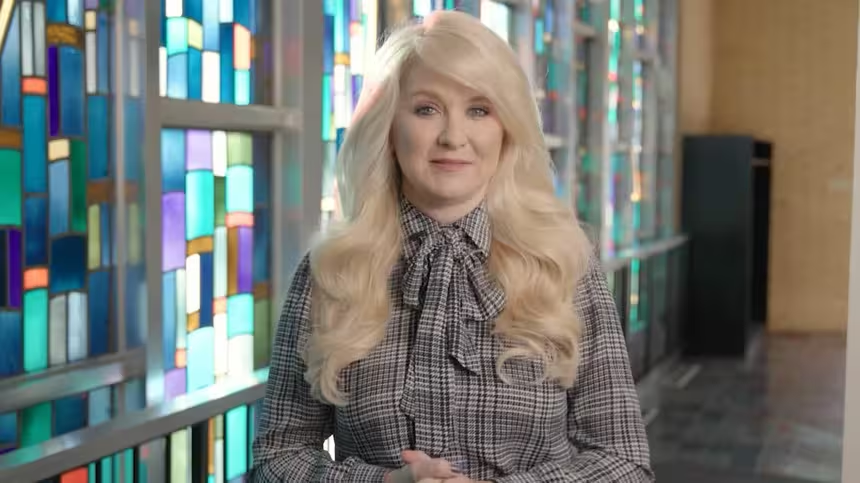
I'm Jennifer Fuller.
We have a wide variety of segments to bring you in this program, looking at important parts of Illinois' culture and history.
We're starting with a conversation from the Paul Simon Public Policy Institute at SIU Carbondale.
Director John Shaw hosts a special Illinois authors series where he speaks with authors from across Illinois to learn more about their own stories, inspirations, and aspirations.
He recently joined poet Allison Joseph, and among the topics that they discussed was the struggle that some poets and even teachers face in how to get started.
- I think that poetry sometimes gets shoehorned alongside other things like, "Oh, okay, this is."
Particularly coming up, in April, we have National Poetry Month, which is great.
I'm glad that we finally at least got a month.
But some people feel intimidated by language being used in a figurative way.
Some people get intimidated by language that, particularly if we're looking at poetry of previous centuries, language is constantly evolving and changing.
And if you're reading Shakespeare, or if you're reading even Chaucer, and I have great colleagues that can teach you Shakespeare and Chaucer from a literary point of view, or John Milton or Emily Dickinson.
Sometimes people who didn't take English at all, like English literature, they didn't take English beyond, say, a composition course.
They get intimidated by the range and depth of American, British world literature.
So I've been kind of a evangelist for not just reading American authors or British authors, but also authors from around the world.
So in my classes, as examples for students to imitate, because art begins in imitation, I'll teach people like Akhmatova.
And of course, these are in translation.
Pablo Neruda, poets from Ireland and England and the Caribbean, so that people know that poetry has been with us for so, so long.
Parts of the Bible are poetry.
So, I like to sort of hook 'em with this world angle.
And I've taught classes for graduate students in our MFA program called "Poetry as World Figure," where we look at poets from around the globe and the intersection of their poetic lives with politics.
So, looking at a figure like Gabriela Mistral, for example.
The Négritude poets.
So, poetry has this interesting way of interacting with other art forms that, if people are intimidated by poetry itself, but they're not intimidated, say, by the blues as a musical form, I can find a way from Robert Johnson to Langston Hughes to contemporary poet Kim Addonizio.
So I can show people a way into poetry through other means that's less intimidating.
But yes, I think that poetry gets short shrift, and that when people get exposed to poetry, sometimes they're very critical of it because all they've learned about it is to criticize it.
So, the few occasions in public life where we do get poetry, say, some of our presidential inaugurations and we've had poetry by Elizabeth Alexander, Richard Blanco, and now Amanda Gorman.
People get those poems and they're like, "This isn't what I was taught poetry is in school," because they've had so little exposure to it.
So the more people get exposed to different kinds of poetry and the more they feel comfortable expressing themselves through poetry, the better it becomes for them and the more part of daily life it becomes for people.
But yeah, I meet a lot of people when I teach adult workshops as opposed to my college classes when I teach at workshops.
I met a lot of people who, in their daily lives, have decided that there's something missing and that poetry can fill that void and fill that gap for them.
- Well, you did an interview some years ago and you said this, which I'd like you to maybe play off if you said, "I write to be a recorder, observer, participant, and sometimes even judge.
I wanna engage the world as I see it with my whole self.
All of those different aspects of it.
I need sometimes to hang back in the shadows with my pen and paper, and then other times, I need to take center stage with my own creations.
The trick is to know when to hang back and when to step forward.
It's a perpetual ongoing balance."
Talk to us about writing, your writing process, and what propels you to sit down and write a poem in the course of a day or week?
- I write all the time.
Anyone who knows me knows that if they say something clever, it may end up in a poem of mine.
(Allison chuckling) And because I was married to another poet, there were constant discussions about poetry in my household.
I love using language that comes to me from other sources.
Something, a scrap I'll hear on while riding on a train, or a scrap I'll hear, just something I'll overhear.
I'm also very much inspired by other art forms, as I mentioned before.
So, sometimes I'll listen to some music or watch a documentary or just play off of language itself.
And I'm constantly looking for poems to teach to my own students.
So, if I happen upon a poem that I like, I'll use it in class, and I'll create an assignment for my students to do.
And I tend to do the assignments that my students do.
If you take a class from me, you'll sit in class and I will challenge you to write to that moment.
Because so many of us put barriers in front of our own creativity, and that creativity itself is reserved for special occasions.
I love writing something that I may not ever do anything with.
I have loads of notebooks that are filled with poems, and sometimes I go back in those notebooks and harvest what's there.
So, the process of writing a poem is multifaceted and has many stages.
- Allison Joseph is an award-winning poet and professor of creative writing at SIU Carbondale.
You can learn more about her by visiting her website, allisonjosephpoet.com.
And her interview with John Shaw is on the Paul Simon Public Policy Institute's YouTube channel.
You can find more author interviews at paulsimoninstitute.siu.edu.
We're coming to the end of Black History Month for this year, and as a special treat, we thought we'd take a look back at a special project we showed you previously here on "InFocus", looking at an exhibit at the Springfield and Central Illinois African American Museum.
It was part of a traveling showcase of photos, stories, and other items from America's Negro baseball leagues.
Here's this from Julie Staley.
- Baseball is America's pastime, but its history isn't complete until you include the history of the Negro Leagues of baseball.
(baseball hitting) (audience cheering) - It's a fascinating array and an unbelievable history, not just about baseball, but about civil rights, about social issues, just about the time starting in 1920 when Rube Foster organized all of the various teams.
- [Julie Staley] By the 1920s, baseball had legendary talent like Babe Ruth, Ty Cobb, Lou Gehrig.
They represented some of the best of America's pastime, but they didn't represent every American.
- [Carolyn] Back in the 1800s, believe it or not, there was some integration in baseball play.
But then, again, with the change in America, Reconstruction, the early part of the 20th century, which was the emergence of Jim Crow in the color line, African Americans were not allowed to play again with whites, as they did, say, early on.
- [Julie Staley] The history of Black baseball goes back almost as far as baseball itself with Black teams organizing after the Civil War.
The reach went international to countries like Venezuela, Puerto Rico, The Dominican Republic, and Mexico.
But the father of Black baseball is regarded as Andrew "Rube" Foster.
He came from Cuba and started the Chicago American Giants.
In February of 1920, he formed the Negro Baseball League.
- And these were teams from cities, from work situations, from colleges, just teams that barnstormed across America.
So, he thought, "Why don't we organize them into a financial structure?"
And that ended up putting together the Negro Leagues, which was American league and a national league.
Very similar to what the MLB is like today.
But they were passionate about playing ball.
They wanted to play ball and they wanted to play it with the best talent.
I mean, if you're a talented athlete, you wanna play with talented athlete, you wanna be around them.
- [Julie Staley] Negro Baseball League teams played the first games at night.
They had to play at ballparks when the Major League teams were not on the field.
- [Crolyn] Many of them rented their stadiums when their teams were away to the Negro League teams.
They packed them, they made a lot of money on what would've been a closed venue.
You had to keep the game cheap enough so that the working class Black citizen could pay for it.
So, they didn't charge top dollar, but they would pack them in.
They had baseball cards, they signed autographs, they had programs, they had the whole nine yards.
It was almost a mirror image many cases of what was actually going on in the MLBs.
- [Julie Staley] Even though their money was welcome at the stadium, players were not always welcome at businesses outside of the stadium.
- They could not go to any of most of the restaurants along the way.
But what was very interesting was, because they couldn't, it also caused many Black enterprises to develop.
You had hotels that would take them in cities where they could stay.
So they were African American hotels that blossomed, we call 'em bed and breakfasts, but they had places like that.
Restaurants were piped up that they went in and ate in.
Of course, they were celebrities.
So, these restaurants really gained economically.
So they had a great impact on the economics of the time.
- [Julie Staley] It all changed with one player.
In 1945, Kansas City Monarchs Jackie Robinson was signed to play with the Brooklyn Dodgers.
- And they were excited about Jackie Robinson making the break.
But the unfortunate thing when Jackie, well, unfortunate in a sense, when he broke into the majors was the demise of the Negro Leagues.
Because again, you could go to the Major League ballparks.
African Americans were so excited when he made that plunge that they, of course, wanted to follow those teams.
- [Julie Staley] Now, Major League Baseball had a new following.
More minority players were signed on away from the Negro League.
The revenue that supported those teams faded away.
Today, there is a long legacy of players in the Negro Leagues, including several with connections to Central Illinois.
- I think most folks have heard about Satchel Paige, but he has a Springfield connection also.
He was the vice president for the Springfield Redbirds, which was a minor league team.
Not only was he a player, but baseball was really his life, so to speak.
- [Julie Staley] Springfield's Comer Cox Park was named for one of the Negro League players.
He eventually was president of the Springfield Urban League.
- [Kathryn] Comer Cox was born in 1905 in Georgia.
He played with the Cleveland Cubs and the Nashville Elite Giants in 1930 and 1931.
(audience cheering) We had a player whose name was George Neal, and he was an infielder.
He played for the Buxton Wonders.
The Buxton Wonders was not probably one of your more noted teams in the Negro League, but it did give fame and glory to Buxton, Iowa, thanks to George Neal, who was born right here in Springfield.
- [Julie Staley] In December of last year, Major League Baseball officially incorporated the stats of Negro League players into their records.
Every Negro League player since 1920 is now considered part of Major League Baseball.
The complete exhibit ends October 30th, but the local items will remain here on display indefinitely.
For "InFocus", I'm Julie Staley.
- Julie and her production team, Spencer Films, were the recipients of an Emmy award for this piece.
It was produced in partnership with the Springfield and Central Illinois African American History Museum.
And while this exhibit has since closed, you can find much more by visiting the museum on Monument Avenue in Springfield, just at the entrance to Oak Ridge Cemetery.
Or you can go to their website at spiaahm.org.
Perhaps you caught the recent American Masters program, highlighting the tale of the Monopoly board game.
Did you know it has ties to Illinois?
We learn more about it from our partners at WTVP Public Television in Peoria.
The story of Lizzie Magie.
Here's Julie Sanders of "You Gotta See This."
- [Julie Sanders] Monopoly, it's considered the bestselling board game of all times.
But did you know that the inventor of this game comes from Illinois just right down the road in Macomb?
In 1866, Lizzie Magie was born to James K. and Mary Jane Magie of Macomb.
And from the start, she was an unusual woman who was ahead of her time.
- Well, it was unusual because of what the times were like.
Lizzie was a very independent woman.
She was a woman who didn't get married until she was in her forties, which is, I mean, in Victorian times, that didn't happen.
She was very outspoken as a feminist.
In fact, put an ad in the papers about how she could be basically used as a slave to be a secretary.
It was a bit tongue in cheek, but it was her pointing out the work conditions for women that worked in offices.
It made national news because it was shocking at the time.
- What we've got here is where it all began.
There's the story, of course, but there's The Landlord's Game patent.
The original design.
As the executive director pointed out, a very small number of women at that time had patents.
- [Julie Sanders] And this is how you found out that she was from Macomb.
- [Dave] This is the one where it actually says so.
- [Jock] It was a surprise to everybody in the community.
Nobody knew about this.
So, when I got in here, I thought, "Well, this is something that we need to figure out how to capitalize on."
And so we've been working ever since then to bring awareness to the fact that she's from here and tell that story.
- [Julie Sanders] Just like the game of Monopoly, it wouldn't be a good story without a few twists, turns, and rolls of the dice.
Lizzie created The Landlord's Game based on her beliefs stemming from an antimonopolis book by Henry George called "Progress and Poverty."
- [Jock] She created this game initially as a monopoly type of a game to show the evils of monopoly.
When that wasn't working quite as well, she revamped it so you could play it two ways.
So you could play it as a monopolist or you could play it as an anti-monopolist.
- [Julie Sanders] In 1903, she got a patent on her landlord's game.
The original game board has striking similarities to the city of Macomb.
At one time, Macomb's Downtown Square had a poor house and a public park, and across the board was the jail.
Also included in the original game board were three words which stand today, "Go to jail."
- [Jock] During this time when people were making games around the turn of the last century, they weren't as common as they are now, right?
And people didn't have money.
And if you got a game, it was kind of expensive for the time.
So what happened very often was that people would play this game somewhere and then they would go make their own version of it.
They'd write it on oil cloth or they'd find some way to create the game themselves.
Because of that, there was a bit of morphing going on.
The Quakers in Atlantic City do a version of it.
And this is where the theme, the Atlantic City theme came in.
The reason why that happened was, a man named Charles Darrow found this game.
It was during the early part of The Depression.
He was looking for some ways to make money.
He didn't know where this came from.
He played it, he did his own kind of versions to it.
He made it more of a circular game, other than Lizzie's square game.
- [Julie Sanders] Charles Darrow began to sell the game in 1932 under the name of Monopoly.
A few years later, Darrow sold the rights of the game to Parker Brothers, where the corporation found out that Lizzie Magie was the inventor through her patent.
- [Dave] Landlord's Game had been updated and then taken over to Parker Brothers where the money started flowing.
- But it looks like she did get some credit from Parker Brothers.
- She did indeed.
Indeed got one of her older pictures.
You see a lot of those, you see very few of them from when she was a young woman.
But this was when she was getting a little bit of her due at that time.
- [Julie Sanders] She did receive some credit, but not much cash, receiving just $500 for the rights to her game.
- [Jock] Part of the reason why Lizzie did that was, is that she couldn't have known that it was gonna take off either, and she just really wanted to get the game out there that it would teach people about the evils of monopoly.
And so she was happy just to have the game out there.
Because she was at Georgia's as they say, the profiteering wasn't of great interest to her.
- [Julie Sanders] Who could have known that more than a hundred years later, this anti-monopoly game would be played in homes all over the world as a lesson in ruthlessness and greed.
- [Jock] I think that's why it has endured.
It's something that's so absolutely relatable.
And let's face it, it's fun.
It's a fun game to play, but it's remarkable of the amount of games that have been invented even in the last a hundred years, how this one is, and it just keeps morphing.
There's every different version you can, there's a Star Wars version, there's a this version, there's that.
And it just keeps selling.
It's pretty amazing.
And we're very, very proud of it.
- Our thanks to WTVP in Peoria for sharing that story.
You can get more about this special at the Macomb Area Convention and Visitors Bureau website, visitforgottonia.com.
Finally, another look inside our history and culture from correspondent Julie Staley.
Those born between 1965 and 1980 know that being a part of Generation X is a unique experience in a timeframe that saw the world go from analog to digital, from rotary phones to cell phones, and from handwriting notes to personal computers.
Now you can experience all those years all over again by visiting the Illinois State Museum in Springfield through their exhibit, "Growing Up X."
- If this looks like a step back in time, well, that's exactly what they've created here at the Illinois State Museum.
This Generation X exhibit allows you to relive the 1970s and eighties all over again.
("Whip It") Kids growing up in this era lived in the shadow of baby boomers, but Generation X lived in the light of unforgettable culture.
Now you can relive your favorite moments at the Illinois State Museum's Generation X exhibit.
Gen Xers grew up in the 1970s, eighties, and early nineties.
This exhibit goes back to the groundbreaking technology, fashion dos and don'ts, and toys that shape new adventure.
All surrounding a nostalgic rec room that will make you feel like a kid again.
- People think growing up in the eighties meant, and it's like big bright colors and Rubik's Cube and everything in your house, and nope, this is what the eighties look like in people's houses.
And this is a place where people can come and we want them to sit down, we want them to throw a record on the stereo, we want them to pop a VHS into the tape recorder and play a movie, we want them to play Atari, really live the eighties in here.
(Pac-Man theme song playing) - [Julie Staley] The museum brought this exhibit to life through a survey that had more than a thousand responses about what was important growing up Generation X.
- And so we put out these surveys just asking what it was like to grow up as part of Generation X and got more than a thousand responses.
And it was amazing, so many insights.
People shared photos, people offered to lend objects.
And so it really is like this huge collaborative crowdsourced exhibit.
- [Julie Staley] Some of the most emphatic responses from Generation X were about music.
("Billie Jean") - [Erika] It was just more than something you listened to, it was like an expression of our generation.
And then we are the mixtape generation, so it's like your language.
You make a mixtape for the person that you like or your best friend or to wallow in your feelings if you've been broken up to.
We literally created soundtracks to our lives.
And so that music is so powerful to us still.
(rocket launching) - [Neil] That's one small step- - [Julie Staley] MTV launched a completely new kind of entertainment, the music video.
(upbeat music) This generation also saw world headlines that moved the culture.
Many of them featured in this exhibit on a television you can tune by turning the dial.
- [Erika] There's the fun clothes and the music and everything, but we have it bookended between the AIDS crisis and the Cold War.
I think the Challenger explosion is such a defining thing of our era.
But then there were things that happened but had these lasting impacts, like the end of the Vietnam War or Watergate.
And we grew up in the shadow of that.
- President Nixon reportedly will announce his resignation tonight and Vice President Ford will become the nation's 38th president tomorrow.
- There was a lot of reflecting on what it meant to be an analog child who got this technology.
So we're not digital natives, but we were young when it came into being, so we adapted to it.
So, we were the ones who could program the VCR to show the right time, or we're the ones who learned computer in school when our parents didn't learn it.
And we watched technology change underneath of us so rapidly.
Like one person said, "Being Gen X means that you bought your favorite album on vinyl, cassette, CD and MP3."
And it's true.
We watched all those styles of technology cycle through.
♪ I, I've been watching you ♪ ♪ I think I wanna know ya ♪ ♪ Know ya ♪ - [Julie Staley] The time will run out to relive these memories.
This exhibit runs until September the fourth.
For "InFocus", I'm Julie Staley.
- There's a special part of this exhibit dedicated to the Gen X high school experience, and one Illinois school in particular.
It looks at memories through the lens of students who went to what was then Chicago's Robert Lindblom Technical High School.
This was a selective enrollment high school and their students were the first generation born after the Civil Rights Movement.
It's now called the Robert Lindblom Math and Science Academy.
Photos and memorabilia from the Lindblom High School experience are highlighted in its own display room.
Thanks for joining us on "InFocus."
You can find these episodes and more by visiting our website, wsiu.org.
You can also like and subscribe to the InFocus channel on our WSIU Public Television YouTube page.
I'm Jennifer Fuller, we'll see you next time.

- News and Public Affairs

Top journalists deliver compelling original analysis of the hour's headlines.

- News and Public Affairs

FRONTLINE is investigative journalism that questions, explains and changes our world.












Support for PBS provided by:
InFocus is a local public television program presented by WSIU