
The Highway Toll on People of Color
Clip: Season 5 Episode 50 | 7m 40sVideo has Closed Captions
The Highway Toll on People of Color | Episode 550/Segment 1
Are Detroit’s highways relics of structural racism from the past? As the country sees a new wave of conversations around racial equality enter the mainstream headlines, One Detroit Associate Producer Will Glover talks with freelance writer Nithin Vejendla, whose article sparked the story and Wayne State law professor and Director of the Damon J. Keith Center for Civil Rights Peter Hammer.
Problems playing video? | Closed Captioning Feedback
Problems playing video? | Closed Captioning Feedback
One Detroit is a local public television program presented by Detroit PBS
The Highway Toll on People of Color
Clip: Season 5 Episode 50 | 7m 40sVideo has Closed Captions
Are Detroit’s highways relics of structural racism from the past? As the country sees a new wave of conversations around racial equality enter the mainstream headlines, One Detroit Associate Producer Will Glover talks with freelance writer Nithin Vejendla, whose article sparked the story and Wayne State law professor and Director of the Damon J. Keith Center for Civil Rights Peter Hammer.
Problems playing video? | Closed Captioning Feedback
How to Watch One Detroit
One Detroit is available to stream on pbs.org and the free PBS App, available on iPhone, Apple TV, Android TV, Android smartphones, Amazon Fire TV, Amazon Fire Tablet, Roku, Samsung Smart TV, LG TV, and Vizio.
Providing Support for PBS.org
Learn Moreabout PBS online sponsorship(soft music) - You could look at any other part of the country and you would say you can't have a strong region without a strong city.
I would say racism here was so deep that they were willing to kill the city in spite of themselves.
- [Reporter] Detroit, the crossroads of half the population of the United States is, but minutes away.
- Starting in the late 1950s, construction on the I-75 and I-375 highways cut through some of Detroit's most prosperous black neighborhoods of Black Bottom and Paradise Valley, which rivaled New York's, Harlem and Tulsa Oklahoma's, Black Wall Street.
Thousands were displaced erasing generations of wealth.
Some call these highways Detroit's largest monument to racism.
This is Detroit historian, Jamon Jordan.
- Historically the building of these freeways affected the whole country.
It didn't just affect Detroit.
But largely one of the major areas that they affected almost everywhere they went was African-American communities.
- [Will] But could there be a way to rebuild the wealth and opportunity for the next generation of black Detroiters?
I spoke with freelance writer, Nithin Vejendla, whose recent article on Detroit highways being racist appeared in the Detroit Free Press.
- Start with how a freeway could possibly be a symbol of racism.
- So you look at the construction of freeways, and they were rather primarily through black neighborhoods.
'Cause at that time, and still even now black communities had less power, had less political power to be able to resist these kind of really disruptive changes.
And because of racist redlining policies, land and houses and homes in black neighborhoods were worth far less than homes in white neighborhoods.
- The winner of the- - [Will] Detroit, wasn't the only city being dissected by highways.
In fact, the man who set the national trend for city planning started in New York city.
His name was Robert Moses.
(audience clapping) - [Reporter] Robert Moses, New York city construction coordinator is a world famous highway planner, a man who knows his business.
(audience clapping) - [Will] In a 1974 biography, it was said Moses suggested suburbs make the water in their community pools colder to keep black people from swimming with whites.
Closer to home, it was Detroit mayor, Albert Cobo, who put together the plans to build the freeways that in 1956 would decimate Black Bottom and Paradise Valley.
- And there are arguments, did he do it because he's a racist and Detroit's black, then what was left of a black community or did he do it because it was the most feasible place to put a freeway.
And so arguments go both ways.
But looking at the history of Cobo, his acts, his policies and his ideas about the African-American community, it's pretty clear that this was not a coincidence.
- [Will] This is Wayne State University law professor and director of the Damon J. Keith Center for Civil Rights, Peter Hammer.
- Think about structural racism and think about how structural racism is defined at Keith Center.
We're looking at the inter-institutional dynamics that produce and reproduce racially disparate outcomes over time.
when the freeways were started everybody thought this, white people particularly, thought this is development.
And it was also thought of necessary for part of a nationaL plan of interstate networks and also for the creation and cohesion of the suburbs.
Now you have to sort of imagine that thats the city underwriting its own demise, right?
So the expressways were thought, well, these are easy ways for Detroiters to go out to the suburbs and come back.
They were also easy ways for Detroiters to go out in the suburbs and never come back.
- [Reporter] Sleeves rolled up, Detroit levels and shifts and carves the contours of a new city.
And a new spirit of progress matches the vision of its people.
- What was I-75 before it was I-75, right?
And it was Hasting Street.
And Hasting street ran up and down Paradise Valley, which was the most important and most concentrated African-American business district and living district anywhere in the city.
So Tulsa has got a lot of attention lately for very legitimate reasons.
And they called that the Black Wall Street, and that was destroyed by a race riot.
Detroit's Black Wall Street was destroyed by, "development and the construction of the expressways and the destruction of Paradise Valley."
And people who run up and down I-75 today have no clue.
- [Reporter] Detroit is borrowing funds to build more miles of expressway and build them today instead of years from now.
- [Will] The question now, can Detroit reverse the process?
That is, remove freeways.
Cities like Milwaukee and San Francisco already have.
- You look at San Francisco, San Francisco's Embarcadero Freeway was heavily damaged in an earthquake in 1970.
Instead of repairing it they simply just removed it.
And when they did that, you know, traffic didn't significantly increase.
It didn't cause massive traffic jams and it significantly improved quality of life for a lot of people.
- [Will] I spoke with civic engagement, expert and Dean of the school of architecture at the University of Detroit Mercy, Dan Pitara.
- What is the economic impact, you know, to the extent that you can speak on it, of undertaking such a project?
- Think about what a scale of a project like this would do.
And think about the numbers, the thousands of jobs that could truly be generated across the decade of time from planning, engineering, survey.
It really is, we're talking thousands upon thousands of jobs that are possible.
Which then means that we have to then not just plan for the jobs, but plan for the preparing and working with people to be ready for those jobs.
- The Michigan department of transportation was to soon start the removal of I-375 in downtown Detroit, but the project was delayed because of the pandemic.
Do you think that removing the highways is an opportunity to address some of these, you know, historically, you know, systemically racist issues?
- No, I don't think you could make any credible connection to removing highways today and undoing, the harm that was done.
- The fielding in of I-375 is not harming the African-American community, but it won't bring Black Bottom back.
- [Will] Many believe that undoing the damage to black American communities in cities like Detroit means investing in black neighborhoods at the same scale and with the same resolve white suburbs received during urban renewal.
- Its just a matter of who has the power, all right?
- Right.
- Which means that at the end of the day, if you're not changing the belief system, right, the sort of highly racialized belief system that have created this history, then you have no chance of digging yourself out of the hole.
So a lot of effort has to be of really intentionally reshaping the white mind, right?
In a way that can transcend the sort of white supremacist heritage that we have received.
- [Will] Regarding that stretch of freeway, connecting the Chrysler Freeway to the Downtown Riverfront, I-375, what some can't help but see as a major symbol of racism will remain for a few more years.
Maybe then the many millions of dollars needed will return to state coffers, allowing for it to be filled in and receive a proper burial.
(soft music)
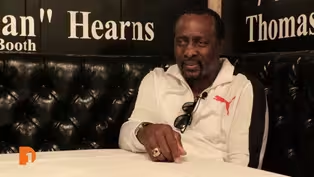
The History of Detroit’s Celebrated Boxing Scene
Video has Closed Captions
Clip: S5 Ep50 | 7m 55s | The History of Detroit’s Celebrated Boxing Scene | Episode 550/Segment 3 (7m 55s)
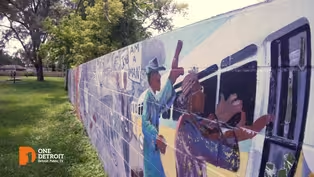
A Symbol of Racial Divide: The Legacy of the Birwood Wall
Video has Closed Captions
Clip: S5 Ep50 | 7m 15s | A Symbol of Racial Divide: The Legacy of Detroit’s Birwood Wall | Episode 550/Segment 2 (7m 15s)
Providing Support for PBS.org
Learn Moreabout PBS online sponsorship
- News and Public Affairs

Top journalists deliver compelling original analysis of the hour's headlines.

- News and Public Affairs

Today's top journalists discuss Washington's current political events and public affairs.










 New Season
Support for PBS provided by:
One Detroit is a local public television program presented by Detroit PBS