Alice's Adventures on Earth
Hiking the Stockholm Archipelago Trail
Season 3 Episode 1 | 26m 46sVideo has Closed Captions
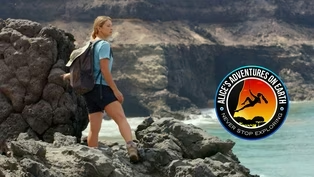
Alice travels to Sweden to solo hike one of Europe’s newest long-distance trails.
Alice travels to Sweden to solo hike one of Europe’s newest long-distance trails. Over 10 days, she journeys through the Baltic Sea’s island-studded landscape, connecting with local residents, discovering coastal traditions, and experiencing life in one of the world’s largest archipelagos.
Problems playing video? | Closed Captioning Feedback
Problems playing video? | Closed Captioning Feedback
Alice's Adventures on Earth is a local public television program presented by KSPS PBS
Alice's Adventures on Earth
Hiking the Stockholm Archipelago Trail
Season 3 Episode 1 | 26m 46sVideo has Closed Captions
Alice travels to Sweden to solo hike one of Europe’s newest long-distance trails. Over 10 days, she journeys through the Baltic Sea’s island-studded landscape, connecting with local residents, discovering coastal traditions, and experiencing life in one of the world’s largest archipelagos.
Problems playing video? | Closed Captioning Feedback
Where to Watch Alice's Adventures on Earth
Alice's Adventures on Earth is available to stream on pbs.org and the PBS app.
Providing Support for PBS.org
Learn Moreabout PBS online sponsorshipOut here.
The Baltic Sea splinters into thousands of islands, small farms, rocky coastlines, quiet forests and little communities that live in perfect rhythm with the water.
This is the Stockholm archipelago.
And I'm here to hike the newest long distance trail in Europe.
The Stockholm Archipelago trail.
Now there are 30,000 islands in this archipelago.
Yes, you heard that right.
30,000.
Sweden actually has more islands than any other nation in the world.
And this brand new long distance trail spans 270km across 20 islands, connected by ferries.
It's a place that I just had to check out.
So I am here for about ten days.
We'll be hiking across about six of the islands, staying with some locals and getting a taste of not only what this trail is like, but what it's like to live here in this remote archipelago off the coast of Sweden.
I'm Alice Ford, and we're back in northern Norway.
This is the Garden Island, Kauai, Hawaii.
As you guys can see, it is absolutely beautiful down here.
The views are just already stunning.
And.
We are on our way to Antarctica.
So right now we're having a traditional tea here.
Wow.
This is where this adventure begins.
On the island of Nattaro.
This is one of the most secluded islands here in the archipelago, and there are actually no full time residents here.
Just a scattering of summer houses, some old historic buildings.
And there's one family that is keeping this island alive.
Running the local restaurant here, and some summer cabins that you can rent too.
And the kids are still working with us.
We have four kids.
It's a challenge to run a business with no other colleagues.
But on top of this, these colleagues are our family.
So it's a sometimes we call it a living circus.
You are your own boss, but at the same time, you live with it 24/7.
It's a business.
You must make money to pay the rent to put the food on the table.
But we handle that.
And that's also a nice insight and creates some kind of satisfaction.
So we keep it simple.
It's a special life when you you.
We have no water in the cabins.
So when you should make you clean your dish, you must walk away.
And on the way to the top, maybe you meet the guy in the cabin next to you can understand that he's a friendly guy from from Barcelona, and you start talking and perhaps you have a new friend from Barcelona.
This is the kind of life.
Before the hiking begins.
I'm grabbing lunch at the family restaurant.
And for lunch, I'm actually being served a very traditional Swedish dish that you're supposed to have here in the archipelago, which is a shrimp toast.
And I can't wait to dig in.
Once we eat this, we're going to gear up for the trail and then explore this island in full.
All right.
We are hitting the trail here on the island.
This section is about 13km.
Now, the Stockholm Archipelago Trail just opened last year in 2024.
So this is the first summer of this trail being fully connected by ferries and available for hikers and explorers to come and check out.
So really amazing to be here during its first ever season.
I mean, we stay in cabins like the one I'm staying at here on this island and at small bed and breakfasts and inns and some of the other islands.
So it's going to be just a fantastic, quiet, peaceful experience.
Spending time in nature and with many of the locals that call these islands home.
Sweden has something called the right to roam or Allemansrätten, and this allows people to hike and to camp anywhere, even on private property, as long as you're treading lightly and respecting the land.
On this island, there are many places to camp.
There are many established places.
Right now.
I'm sitting at one of them here on the western side of the island.
There is a cooking area here, also a campfire area and plenty of places to pitch a tent as well.
So if you're coming here, know that yes, you can rent a little cabin or stay at inn or a BnB.
You can also just grab your tent and hang out here along the beach.
My first day on the trail led me across, Nattaro in complete solitude.
Just me, the deer and the sound of swans gliding across the water.
I rested beneath the pines, tasted wild berries along the way, and felt the rhythm of simple island life all around me.
We are about halfway around the island now, and I think the nickname that I'm going to give this island is Spiderweb Island, because in the last, you know, half a mile or so, I have just been collecting spider webs on my hat.
I'm in an area right now that is full of blueberry and cranberry bushes, and it is pretty late in the season.
However, there are still quite a few, berries.
They're not very flavorful.
Unfortunately, I think they've been out on the vine a little long, but as you guys may know, I am a berry picking addict, so, a little bit end of the season or not.
Delicious.
That night, I dined with some of the staff and the owners as a sunset over the Baltic Sea.
It's a new day here, which means I'm on a brand new island.
This one is called Alo.
It's just a couple of ferry stops over from the last island.
And so far, I'm just loving that.
It's so easy to get around.
You know, I had breakfast, with the Llung family this morning, and here I am.
Not even lunchtime.
Already on another island ready to hit the trail here?
Now, this island, completely unique from the last island.
There are some farms here, some full time residents.
As well.
And the trail today is about 13km.
Should be a mix of rocky coastlines and forests.
And I've got a couple of treats for you today.
We're going to meet some locals later.
Get a tour of the wetlands here.
And something really unique that they do with the cattails that grow there.
So I'm excited for the day.
It's very nice weather today.
I also haven't seen anyone else, so it's kind of like having my own island chain.
I'm loving the peacefulness and, the beautiful nature.
Here on Alo The forest meets open water, the rocky slopes and sandy beaches bearing silent witness to a longstanding fishing tradition.
Here, once the backbone of this archipelago's life, now replaced by the hush of wilderness and the chance to walk a trail almost alone.
This place really does remind me of hiking in New England as a kid.
Super similar to Acadia National Park and this island with all the rocky coastlines and walking through the forest there, just reminded me so much of being a little kid.
In the forest near my house.
And as you can see, I've, I've got some blue fingers this morning from, picking blueberries.
But, something that I did often as a kid.
You know, these forests are full of blueberries and blackberries and raspberries and pine trees and rocks covered in moss and lichen, just like the forests of New England.
So it really does remind me of home.
The big difference is that here, instead of juniper bushes like we had in New Hampshire and Maine, you have heather here, which are those bushes we've seen everywhere with the pinkish purple flowers.
It's just super beautiful.
And now we're back here on the coastline.
Hearing the waves crash against the shore.
It's just a beautiful day.
One of the things I've seen a lot of so far these last two days are swans.
They are a bird I rarely see in America, so it's really cool to see them when I'm coming into these different bays.
Now, this one has at least a dozen swans.
I can see them kind of in all directions, and these ones behind me, which I'll get a closer look at here.
I actually have about four adolescent swans.
They're a little bit of a different color.
They'll be a little bit more gray.
Smaller in size.
You've got mama swan out there.
Looks like she's about to meet up with, another mom and her two swan babies.
So really cool.
Really peaceful out here.
Definitely enjoying the beautiful weather today.
No matter where the trail takes you, if you're here in the archipelago, there's one thing that's a constant, and that is the Baltic Sea.
This is a very important body of water for millions of people that live throughout Scandinavia and the other countries in which the Baltic Sea touches.
Now, this is a brackish water body, a mixture of salt and fresh water.
So it's extremely sensitive to pollution and habitat degradation takes about 30 years for the water in the Baltic to replenish.
So people all over this region are fighting hard to make sure it stays protected.
I set off next to interview Thomas, a local man that moved to the island years before, and when he got here, he realized that the Bay near his house was nearly lifeless.
So he helped create a manmade wetland to filter pollutants from the water.
Each year, cattails are planted to absorb phosphorus and nitrogen, then removed and reused as compost, completing a natural cycle of renewal.
Today, fish have returned and the bay is alive once again.
Everybody says it's a problem in the sea, but I say the problem often, often comes from land.
Yes.
We human beings are creating problems there, which we are selling out.
We had a lot of phosphorus and nitrogen run in the ditches here, and also that there was no fish.
So we said we can be a little better so we can do something.
And we know that the Baltic Sea has a huge bottom.
So dead bottom you could say we cannot do anything about that, but we can do it here locally.
We started really to take some pike, some perches and lifted them into this area the first year and the second year and the third season we started to do that, but we saw out in the water it was boiling.
So they started to learn.
They were sexually matured.
Yeah.
So they would like to go up.
And they called homing and we had 350 pikes went up and there were 46cm.
That was fantastic.
So what we say we are preaching that everybody can do it.
This bay here we can fix.
But if everybody does their own bay, there is an effect.
Well, bravo, I mean, it's amazing to see conservation success stories.
Its fantastic, really, to see how you can start something and then you can leave and just the fish fix itself.
Next step is to learn even more.
All right.
I've arrived on the island of sand, sun, sailors, surly times and hopefully some fun.
This is the island of Sandhamn.
I just made all that up.
But I have heard that this island is a little bit more lively.
Bigger community here.
Lots more restaurants, hotels and tons of sailboats.
So I just arrived on the island and I'm going to go find my hotel, grab some food, and then we're off to explore.
This island is adorable, I love it.
There's all these red houses, all these little meandering streets.
Obviously, you're right on the water, but lots of people.
Here, it's Sunday, so lots of sailboats out in the water.
Lots of people heading back to Stockholm and other parts of Sweden today.
Enjoying the last of summer here, but ,so far, loving this.
Doing a little exploration here.
Taking a rest day today.
Might go jump in the Baltic Sea too.
Sailors have been using this island as a stopover for more than 400 years.
Back when this was one of the royal routes for trade.
During the Swedish crowns era, 1600s and thereafter.
This was actually the last stop for ships traveling out into the Baltic Sea, and the first stop for those heading off to Stockholm.
Sometimes I just have to pinch myself because the things I get to experience hosting this show, traveling the world, are just so special, so unique.
Pele, the owner of the hotel that I'm staying in, this morning actually invited me to come to a small island about ten minutes from Sandhamn, where he has a small, off grid home.
He's also the keeper of the lighthouse here on the island, which was built in 1770.
And there are a couple of other small cabins here.
No running water.
Basic provisions here, but it is absolutely beautiful.
It's a place that he comes when he just needs to relax.
And he says as soon as he lands here, he just has a sense of peace.
So I've had a little tour of the island, and now I'm going to go off here to one of the edges of the island and just find a little Zen myself.
I think, this trip has really been such a good reminder of just trying to relax a little bit more.
You know, as Americans, we are very much so overworked and in the hustle and the grind, it's trips like this to places that are just fully immersed in nature, where you really have no other choice but to disconnect and to listen to the world around you, in the tiny little area that you are.
And it's just beautiful.
After a few relaxing days on Sandhamn, I was off to Namdo to hike with Michael, the very man that started the trail.
I realized that every island was so different both from nature and from culturally.
Each island is different, and to be able to show other people, if you, for example, don't know about something, you don't care about it.
But if you get to learn about something and understand and say, “Oh, this is really interesting,” then all of a sudden becomes top of mind and it becomes important to you.
So the reason is threefold.
One is to get more people to experience the archipelago, because that will make them more engaged in trying to preserve the archipelago as it is.
Two, I mean, if we can generate business for the business owners, because at the moment they are making the majority of their money during the six weeks of summer.
So we wanted to be able to create reasons for them to be open longer.
And last but not least, we want to create a platform for information.
We can use the trail to talk about what is important from an ecological aspect in the archipelago.
Isnt this beautiful.
It's just so nice in a place where you can hear any electronical sounds or mechanical sounds.
Yeah.
Hiking certainly isn't the only way to explore this archipelago.
You can sail, you can bike.
And today Im going to be kayaking around some of the islands here outside of Idoborg.
Local guide here named Jonas is going to be taking me out, and I'm hoping that we can see some seals and some of the other wildlife that lives here in the Baltic.
Good morning.
I am on my second to last island today.
For my last hike.
This is an island called Ingmarso, I think, is how you pronounce it.
And I'm going to be hiking across this island.
And then we have one more, later today for kind of my last day on the trail.
So far, its just been so wonderful over the last few days, have been relaxing, kayaking yesterday and kind of getting some different scenery on the trail.
So looking forward today to get some more miles under my feet.
So I just stopped here at the trail map.
I'm here.
If I go left here, I go kind of all the way around the island.
However, if I go right, there's a bakery and, I'm pretty sure they're open, so we're going right.
A little Swedish pastry.
Well, it's gotten quite windy.
I have, I've made it to one of the most unique parts of this trail, where there is a rowboat.
I'm going to be actually rowing across to the next island which is called Finnhamn.
That's where Im staying tonight.
Now, there always has to be a boat, left on the shore on these islands, there are three boats.
Unfortunately, there's only one here today, which means I will row across.
I will grab one of the other boats on the other side, row back, leave that boat here, and then row back again.
So we'll see how that goes because it is quite gusty Am I meant, Am I meant to sit here?
Okay, wait.
Okay, everyone, full disclosure, I have rowed a lot of boats, but never a real rowboat, so there was definitely a learning curve here.
All right, I'm figuring it out.
Turns out I went the wrong direction.
Both physically and also in how to row a boat.
Turns out you got to go backwards.
I'm figuring it out.
We're learning.
Now I have to go back past where I started.
Sorry for the squeaky oar.
And, around.
See how that goes.
Oh, my God, we made it.
And there's only one boat here.
Interesting.
Oh, I see, guys, so there are actually only two boats, so I have to row one boat back now, leave it and then come back.
So here we go again.
Gosh, that other boat is heavy.
Oh, and as if that paddle couldn't get any worse, my visor just flew off and sunk into the Baltic Sea.
So, that's great.
One more time.
Oh, let's do it again.
Good lord!
Wow.
I'm exhausted.
These have been an incredible last ten days, hiking across so many of the islands on the Archipelago Trail and really getting an inside look into the tight knit communities here.
The shared respect for the land and the sea.
And there's just something about this place that seems to take a little piece of every traveler's soul.
Walking here hasn't just been a journey.
It's been an invitation to slow down a little, to notice more.
And I have absolutely loved it.
If you're unsure about whether or not you want to come here, if you're not a big backpacker, or maybe you're just a walker, or maybe you love to hike and you want to do it all, I highly recommend coming here and checking it out.
It is absolutely beautiful and it may just change your lives.
So thank you all so much for watching.
As always, I'm Alice Ford.
I'll see you in the next adventure.
And until then, never stop exploring.
Alice's Adventures on Earth Season 3
Video has Closed Captions
Preview: S3 Ep1 | 27s | Alice journeys across the globe, hiking iconic trails, and connecting with local cultures. (27s)
Providing Support for PBS.org
Learn Moreabout PBS online sponsorship













Support for PBS provided by:
Alice's Adventures on Earth is a local public television program presented by KSPS PBS