
Hiking Trailblazers
Season 6 Episode 3 | 26m 40sVideo has Closed Captions
The hiker-activists who led Angelenos into their hills and onto the trails.
Meet the hikers who led Angelenos onto their local trails, including early wellness guru Paul Bragg. In this episode, Lost LA host Nathan Masters explores the origins of Los Angeles hiking, from the Indigenous people who first walked the land to activists like WalkGood LA’s Etienne Maurice, who blaze new paths over familiar terrain. Featured interviews will include Modern Hiker’s Casey Schreiner.
Problems playing video? | Closed Captioning Feedback
Problems playing video? | Closed Captioning Feedback
Lost LA is a local public television program presented by PBS SoCal
Hiking Trailblazers
Season 6 Episode 3 | 26m 40sVideo has Closed Captions
Meet the hikers who led Angelenos onto their local trails, including early wellness guru Paul Bragg. In this episode, Lost LA host Nathan Masters explores the origins of Los Angeles hiking, from the Indigenous people who first walked the land to activists like WalkGood LA’s Etienne Maurice, who blaze new paths over familiar terrain. Featured interviews will include Modern Hiker’s Casey Schreiner.
Problems playing video? | Closed Captioning Feedback
How to Watch Lost LA
Lost LA is available to stream on pbs.org and the free PBS App, available on iPhone, Apple TV, Android TV, Android smartphones, Amazon Fire TV, Amazon Fire Tablet, Roku, Samsung Smart TV, and Vizio.
Providing Support for PBS.org
Learn Moreabout PBS online sponsorshipNathan Masters: Visit Runyon Canyon on a weekend, and you'll see what's become a Hollywood Hills cliche, people decked out in athleisure, walking dogs, snapping selfies.
You might even spy a celebrity or two.
It's more Lululemon than REI, more Jane Fonda than John Muir, but it's what we in L.A. call hiking, and we've been doing it for at least a century.
In 1924, a health guru named Paul Bragg founded the Wanderlusters Hiking Club and summoned Angelenos to their local trails.
Proclaiming the health benefits of sunshine and sweat, he led huge groups up Griffith Park's Mount Hollywood.
People have been walking through hilly terrain from time immemorial, but we might call Bragg the first influencer to sell this age-old act as a fitness activity.
"Hiking," he wrote for his readers in the "L.A. Times," "is a wonderful sport to keep you young and fit and recharge your physical battery from the sun's rays."
Angelenos still heed his call today.
[music } Announcer: This program was made possible in part by: a grant from Anne Ray foundation, a Margaret A. Cargill philanthropy; the Ralph M. Parsons Foundation; and the Los Angeles County Department of Arts and Culture and Creative Recovery, L.A. Masters: I first learned of Paul Bragg after stumbling across some photos of his group hikes in the USC Digital Library.
Man: He was into outdoor exercise, healthy foods.
Masters: To learn more about him and how these photos were saved for posterity, I met up with Bill Cunningham at the library's digital imaging lab.
So how did Bragg's photos wind up at the USC libraries?
Cunningham: We did a project for the Dick Whittington Studios.
Dick Whittington was a photographer in L.A. from the twenties through the eighties.
He was a commercial photographer, and he did a lot of advertising, a lot of product photography.
He also photographed people, photographed models, and one of his clients was Paul Bragg.
He did composite photographs of him over products.
If you're in the grocery store and see Bragg's Cider Vinegar, that's Paul Bragg's product.
Masters: I've used that to catch fruit flies.
It's really good.
Yeah.
I think a little bit of soap on top, and the fruit flies can't fly away once they land.
It's excellent for that.
Cunningham: I'll have to try that.
Masters: Yes.
How many Bragg photos have you gone through?
Cunningham: Probably hundreds, if not thousands.
The Whittington collection that I digitized was 37,000 negatives.
Masters: And you did that all yourself, 37,000 negatives?
Cunningham: Yes.
Masters: Wow.
Do you feel like you kind of know the man a little bit?
Cunningham: I did a lot of research on him as I was seeing him more and more frequently.
I know that there's kind of a shady side to him.
Masters: A little bit.
I mean, he was banned from using the U.S. mails because of fraudulent claims, advertising claims that he made, and I know the American Medical Association denounced him as essentially a snake oil salesman.
He famously sold this salt substitute for people who were trying to avoid salt called Live Sprinkle.
The top ingredient--it was listed right there on the packaging--is sodium chloride, salt, right?
Cunningham: Interesting.
Masters: Bit of a charlatan, and I think he also, towards the end of his career, he was selling longevity cures--live old, stay strong--and so he of course exaggerated his age by 14 years.
So when he was claiming to be 80 years old, you know, he was really only in his mid-60s, but, you know, for me, I mean, I just fell in love with those photos when I saw them, and he was apparently like a pretty inspirational leader.
I mean, look at how many people he got to climb up Mount Hollywood here.
Cunningham: Oh, yeah.
Masters: That's well over 100 people, and I think he led these hikes first and third Sunday of every month starting around 1924.
Cunningham: He did have a huge following, and I think a lot of it was because the advertising he did.
Masters: He claimed to have opened the first health food store in Los Angeles when he came here in 1921, and you've digitized a lot of his photographs.
Cunningham: Hundreds and hundreds.
I've seen him in pictures like the hiking club.
I've seen him with a farm showing growing live foods and bowls full of fruits and vegetables and his different products, and a lot of the photographs that I've digitized are studio shots like this for advertising.
Masters: It seems like he's always shirtless.
Cunningham: He's always shirtless.
Masters: Ha ha ha!
I don't know what's up with that, but he really encouraged Angelenos to embrace the mountains as a way to get fit or stay fit, and you see--I mean, that happened.
Like, go out to Runyon Canyon or the Baldwin Hills any weekend.
Cunningham: Oh, yeah.
Masters: You'll see thousands of people doing this.
Man: Good morning, Walkgood LA family.
How we feeling this morning?
[Cheering] I think we can do a little bit better than that.
Good morning, Walkgood LA family.
How are we feeling this morning?
[Louder cheering] That's right.
Masters: If anyone carries Bragg's torch today, it might be Etienne Maurice.
As the founder of Walkgood LA, Etienne leads a growing entourage of Black Angelenos out into nature.
Unlike Bragg, though, Etienne leads with a greater sense of purpose.
Maurice: I invite you to close your eyes.
I just want you to release everything from the past moment.
Masters: He founded Walkgood LA in the middle of 2020 amid the COVID shutdowns and in the wake of the murder of George Floyd.
Maurice: The intention is for us to come together collectively to heal as not just a community but as a family.
Masters: For him, hiking and other outdoor activities are more than just a way to heal the body and mind.
Before hitting the trails of the Baldwin Hills, I joined Etienne for one of his popular group yoga sessions at Kenneth Hahn State Recreation Area.
Maurice: So step it all the way.
Palms up towards the sky.
Crested lunge.
That right side body bringing that right hand up towards the sky.
Masters: So Kenneth Hahn, it's just like... Maurice: Yeah.
Masters: It's a special place.
Maurice: It really is.
You know, we started over at L.A. High Memorial Park when we first started walking, and L.A. County Supervisor Holly J. Mitchell was a big part in making sure that we were able to hold space here at Kenneth Hahn, and it's very full circle because Kenneth Hahn back in the sixties, you know, being that he was a part of the board of the L.A. supervisor committee, you know, he was the only government official to welcome Martin Luther King to Los Angeles.
Masters: Nobody else would.
Maurice: Nobody else would, and so in the 1960s, Kenneth Hahn was really a pioneer in supporting the civil rights movement, so, you know, what a way to honor his legacy by being here, doing the work that we do.
Masters: Right, and he represented South L.A. Maurice: Yes.
Masters: So--and he actually stood up for his constituents.
Maurice: Yes, he did.
Masters: So obviously when you do yoga, when you go for runs, when you lead hikes, you're doing that for your own good... Maurice: Yeah.
Masters: but are you also trying to say something?
Maurice: Yeah.
I think for a long time, you know, people of color have always been, uh, ostracized or pushed away from doing outdoor activities and wellness activities, and so many of these people have yet to experience it.
Masters: Mm-hmm.
What are some of the hurdles to that?
Maurice: I think what it really comes down to is just exposure and seeing other Black men and women experiencing these activities, and that's, like, representation in its purest form.
You really can't be what you can't see.
Masters: Yeah.
Maurice: And this is something that I always was doing growing up.
You know, my dad would take me on hikes and runs, and my father was the one that really kept me active, and I think after I'd gone through my own traumas and my own experiences, I realized that it was helping me, and then during COVID and during the Black Lives Matter protests, I felt like I needed to share my passion to my community.
Hiking gives me a peace of mind like yoga.
Sometimes, you get so bombarded with the busyness of the city, but then you can just go a few miles outside and find something beautiful.
Masters: So have you ever heard of a man named Paul Bragg?
Maurice: No.
Who's Paul Bragg?
Masters: So he was--way back 100 years ago, he was a L.A. fitness advocate, and he led these giant group hikes into, like, Griffith Park.
He'd lead massive calisthenics sessions.
Maurice: Sounds like a more extreme version of Walkgood.
Masters: I mean, you're part of this tradition of people who are encouraging people to go out into nature, into just, like, the nature around the city, right?
You don't have to go to Yosemite... Maurice: True.
Masters: to get out there.
Maurice: It's right in your backyard, and I think the most important thing about what we do is that people have access to wellness and spaces of healing.
In essence, like, us hiking right now is a practice of healing.
Masters: Mm-hmm.
So you're from Jamaica.
Maurice: My family's from Jamaica.
I was raised in Jamaica.
I spent a lot of my summers in Jamaica with my grandmother.
My grandmother, may she rest in peace, Ivy Ralph--I spent so much time with her during those summers as a kid with my sister, and she would remind us to walk good.
Anytime we left the house, she'd be like, "Walk good, Etienne, walk good, Coco," and, you know, that always stuck with me.
It's so amazing to be able to honor my grandmother's legacy and my Jamaican heritage by reminding my community to walk good when they leave out into the world.
Masters: Yeah.
It comes from your childhood.
Maurice: Yeah, it does, it does, and it's very special to me, you know.
Family is important.
That's the fuel that keeps me going, and my grandmother was a huge part of that.
We made it to the top.
Masters: We sure did.
Ha ha ha!
Maurice: I love this view just because every time I see my skyline--I'm calling it my skyline.
Masters: Sure.
Maurice: Ha ha ha!
Masters: Yours and 3 million others.'
Maurice: Yes, and 3 million others'.
Sure.
It's just so beautiful just to see out of so many people there's this one community.
Just to say that you're from L.A. is a--it's a beautiful thing.
You know, not a lot of people can say they're from the City of Angels, you know?
Masters: Certainly not.
Maurice: Yeah.
Masters: For Etienne, hiking is more than just a way to keep the body and mind healthy.
It's a way to make a statement to the world, and in that sense, Walkgood is carrying on another time-honored tradition, hiking as activism.
In the early 1970s, plans to build a 4-lane highway through the heart of the Santa Monica mountains threatened the landscape that teacher and environmentalist Jill Swift loved.
In protest and to build awareness, Swift organized massive group hikes through the mountains.
One, the 1971 march on Mulholland Drive, drew 5,000 participants.
The activism of women like Jill Swift, her comrade Susan Nelson, and so many others helped save her beloved mountains from extensive development.
Today, much of the range is preserved as a unit of the National Park Service, but the work of protecting the land and expanding the park's boundaries continues.
Rorie Skei orchestrates those efforts as chief deputy director for the Santa Monica Mountains Conservancy.
I think in Los Angeles we tend to take it for granted that this range is here.
If you think about it, it's really unusual for an American city or really any city in the world, for that matter, to be bisected by a mountain range.
Skei: Absolutely.
It is a unique physical anomaly for Southern California.
Masters: Another thing we take for granted is just all this public parkland.
There was a lot of activism and organization that went behind that.
Skei: That's right.
I mean, just looking at this site is sort of a microcosm of the development fight in Southern California.
All of the environmentalists were basically one step ahead of the bulldozers, and there was a real movement in the 1960s to try and create a park in the Santa Monica Mountains.
Marvin Braude, who became a city councilman, really led the charge, but there were others-- Masters: We're at the park named after him right here.
Skei: Exactly.
Yeah.
Originally, I think Marvin wanted it to be called Toyon National Park.
Masters: After the native plant... Skei: Yes, exactly.
Masters: that grows out here.
Yeah.
Skei: You might wonder why there's a 4-lane road coming up to the top of the park, and that was going to be the Reseda to the Sea Highway.
Masters: It wasn't for the hikers.
It was for cars.
Skei: Yeah, and the top, Mulholland, was also approved for a tract, and there was gonna be a highway along Mulholland.
Masters: So all this land back here, this would have been housing developments.
Skei: Would have been housing.
Masters: Highways going through it.
Skei: Right.
Masters: Just like the rest of Los Angeles.
So who organized to stop this?
Skei: A big coalition of folks.
There was the Friends of the Santa Monica Mountains.
Marvin Braude really led a charge to that.
We had then assembly member Howard Berman, who had the legislation to create the Santa Monica Mountains Comprehensive Planning Commission.
Masters: And all these efforts also culminated in the creation of an urban national park, too.
Skei: Yes, that was part and parcel.
Masters: But there's so much more land to protect.
Skei: Oh, yes.
Masters: And you're working to expand... Skei: Exactly.
Masters: the Santa Monica Mountains National Recreation Area.
Skei: Exactly.
The Conservancy had a bill in the early 1980s that was sponsored by Marge Feinberg, another citizen activist, and that created the Rim of the Valley Trail Corridor, so since then, Congressman Adam Schiff--gosh, it's been so many years now--introduced the National Rim of the Valley legislation.
Masters: And it's got a great name, Rim of the Valley.
So it's, I guess, a network of public land that would encircle the San Fernando Valley.
Skei: True, and a trail.
Yeah, and that was Marge Feinberg's great contribution.
Masters: So that reminds me a little of Jill Swift, who was one member of this coalition that helped protect this land.
She organized these hikes that brought thousands of people into the mountains to raise awareness.
Skei: She did.
She and the Sierra Club.
The Sierra Club Task Force of the Santa Monica Mountains had lots of public hikes.
It was part of the education effort for Los Angeles to say, "Hey.
We have this fantastic resource.
Let's protect it."
Masters: Does hiking still play a role in activism today?
Skei: Oh, no question, and it's not just hiking.
The mountain bike associations have been really key and obviously the equestrian community.
There's the Santa Monica Mountains Trails Council, which has been a real stalwart partner in manicuring trails, clearing trails.
Ron Webster and his wife Mary Ann Webster were with the Sierra Club, and they were master trail builders.
They created a lot of the trails in the mountains... Masters: Themselves with shovels and picks?
Skei: Yes, and with volunteers and youth groups.
Masters: So this sort of patchwork quilt work of public lands and parkland, it reminds me a little bit of the Olmsted-Bartholomew proposal from the 1920s, right, this grand vision for preserving open space, public lands in Los Angeles County.
Of course, the report was buried by the powers that be, but it seems today, especially because the report was rediscovered by historians not too long ago, it seems to have a lot of power still.
Skei: It's a great, great document, and in fact, it was actually commissioned by the Los Angeles Chamber of Commerce, interestingly enough, because they were looking at, you know, "Oh, we need to make L.A. more appealing, and we need more parks," and then it eventually did get buried.
It never was officially adopted by the city.
Masters: So wild spaces like this, they really are an essential part of Los Angeles today.
They're part of the L.A. identity, right, places to hike, places to have a picnic.
Skei: Yes, and just even having the scenic backdrop of these undiminished mountains, you know, it's a big psychic relief for a lot of people.
Having this undisturbed ecosystem really enhances everyone's life in the basin, downtown, in the suburbs and the exurbs.
It's an essential part of Los Angeles for sure.
Masters: People like Paul Bragg and Jill Swift called others to the trails and challenged our ideas about what it means to hike... but we can't forget that they followed in the footsteps of earlier trailblazers, going back to the first inhabitants of the L.A. area.
Woman: Looks like we got some acorns over here by the poison oak.
Masters: I met up with Samantha Johnson, a Tongva artist and scientist, as well as trail guide writer Casey Schreiner, along the Gabrielino Trail to explore the origins of L.A. hiking.
[Water flowing] So when you think about hiking today in the San Gabriel Mountains, you have to think about the Angeles Crest Highway.
It's one of the only ways to get up here, but there was this great hiking area that predated the construction of that highway.
Schreiner: Yes.
What we call kind of the great hiking era for Southern California was that very late 1800s, early 1910s, 1920s before the Angeles Crest Highway was built, and people were up here.
This was actually a very popular thing for people in Southern California to do, and they got in here through footpaths, through mule trains, through all sorts of other slower ways of entry, which necessitated these things like camps along the way.
Masters: So a completely different experience from a typical day hike today.
Now, during this great hiking era, there were a lot of trails built, but there were also trails that predated, including the one that we're on, right?
Johnson: This trail was named the Gabrielino Trail after my tribe, the Gabrielino Tongva.
This probably would have crossed over into some other neighboring territories that we have with the Serrano and the Kaweah.
This probably was a trading route that was used not only for us to maybe move over some fish and game that we might have gathered from the oceans but also the acorns that are here, the really big black oak acorns.
Because they're so big and they're a sweeter acorn, they would have been really good for making our acorn meal.
Masters: Different acorns have different flavors?
Johnson: Kind of like different grains of rice or different wheat.
They all have different flavors, and some even have different textures.
Masters: Beautiful oak trees here.
So what's really cool about the San Gabriel Mountains is if you know where to look there are all these remnants of that great hiking era.
Schreiner: We're here at one of them.
This is Switzer Camp, which was one of the earlier kind of great hiking era hiking resorts, and this facility kind of sprawls throughout this canyon here.
We're in the Arroyo Seco in Bear Canyon.
There was a chapel that was built here.
They used to have Easter services, and a lot of these remnants are still here.
There's only one surviving wilderness resort still in the San Gabriels, but most of them, you can still find these fun old stone walls, and you might see some plumbing or chimneys or stuff like that along the way, as well.
Masters: Yeah, you got to watch your step.
There's plumbing sticking up out of the ground, yeah, but there's also a lot more than just architectural ruins hiding in plain sight.
Johnson: Oh, yeah.
This is a beautiful area that's just filled with a lot of biodiversity, and a lot of it probably is contributed to my ancestors and the ancestors of the other Native people around here because I think there's a misconception in hunter-gathering that we just kind of picked things and let them alone, but we really cultivated and cared for the plants because in return they were taking care of us.
So I picked something to kind of show you all that I think people should grow more often in their own yards, and this is California bay laurel.
It's of, like, the bay leaf plant, similar to the stuff that you, you know, put in your beans and your stews and stuff, but this one is a lot more floral, and it's a great insecticide.
Mosquitoes, flies, like all those annoying, pesky, little bugs, you can actually take the leaves and put them on a tray, and before you step into your house, you can step onto those leaves and release the smell, and that will help keep bugs out of your house, and so if you grow a bay laurel plant, then you have an abundance of these beautiful leaves keeping the bugs away.
I don't recommend that anyone gathers them now because we don't have access to caring for the land like we used to, and so I really want people to care for their own plants in their own yards, and so if you'd like to smell it.
Masters: Oh, I'd love to, yeah, yeah.
Especially with the rain, it's like... Johnson: Oh, yeah.
Masters: Oh, wow.
Casey, you got to... Schreiner: This is my jam right here.
Johnson: Yeah.
Ha ha ha!
Mine, too.
Schreiner: I love that stuff, yeah.
Johnson: Yeah, and you can cook with it, but it is really strong.
If everyone picked a bay laurel tree, then the tree would be bare.
Masters: Yeah.
Plant it in your backyard.
Johnson: Plant it in your backyard, but what I would love to see is hiking enthusiasts and people who are interested in plants looking up their invasive plants in the area.
Find your invasives and find what they're useful for.
Masters: And so in historical times, these trails, including possibly the Gabrielino Trail, would lead you up to, well, to your friends, your-- Johnson: Yeah, yeah.
Part of the hunter-gatherer, nomadic lifestyle is that you meet the plants where they're at, and so there's an abundance of beautiful medicines that are by the coast, that are up here in the mountains.
There's lots of food up here, and there's lots of food down there.
Masters: You literally had to hike, but that's like a completely different concept of hiking than we have today, and one of the people who really helped popularize that concept was Will Thrall?
Schreiner: Yes.
Will Thrall came out here from Connecticut late 1800s, kind of a sickly kid, but really wanted to be out in nature because that was sort of the dominant philosophy at the time.
Like, if you got out in the fresh air, if you had a physical activity, you were in good spirits, and you were a healthy, good person.
Masters: I mean, there's some truth to that, right?
Schreiner: There was some truth to that, but he hiked these mountains with the early settlers and homesteaders who were up here and got to know all of them personally.
He wasn't necessarily, like, a professional doing this.
He was just the guy who knew a guy.
Ended up getting a career with the L.A. County Department of Recreation and Parks once they started kind of promoting outdoor recreation in all these great hiking resorts during the hiking era.
Masters: So he helped drive people up into the mountains onto these older indigenous trails.
Was he aware of this indigenous knowledge about the use of plants?
Schreiner: He formed a group called the San Antonio Club, which is kind of an early Boy Scout, Sierra Club style hiking group, and he was up here, and he admitted that he didn't really know much about what was here.
A lot of the writing you can tell he's sort of, like, making things up as he goes, but he did try to search out experts, which included the indigenous folks who were up here, and let them tell their stories in their way.
So the public was better informed by these experts.
He wanted other people to get up here and enjoy these places.
He was an early booster and early driver for outdoor recreation and hiking as we know it.
Masters: So Thrall advocated hiking as a form of physical exercise, but as you're saying, it's more than just that, right?
He wanted you to commune with the surrounding landscape.
Schreiner: Exactly.
Masters: So Thrall was well aware of the--you know, the indigenous history here, but a lot of the hikers who come up here today, the landscape they enjoy is really the product of thousands of years of indigenous cultivation.
Johnson: Yeah, absolutely.
Masters: Samantha, what do you hope people who hike up here take away from this landscape that your ancestors have been in for so long?
Johnson: I think there's this really interesting and heartbreaking rhetoric in California that this pristine land that we all live on and love just kind of happened, and, you know, that no one was here before, and all of a sudden, these people found it and it was discovered, and no one had ever existed here before, but really, what happened is that my people and many other Tongva and many other native tribes survived multiple waves of genocide, and so you know what I would love to see more often is just recognizing that there were people who were here before and there are people who still are here trying to live and trying to survive in our ancestral home.
Schreiner: It is really interesting, too, because the San Gabriel Mountains had some of the first federally designated wilderness areas, and when the Wilderness Act was passed, we got some of the first ones here, and there's this concept of wilderness, especially in that federal form of untouched, pristine land, but you're 100% right.
There were people here cultivating that land, and you even see that in the fire policy here in California, where we sort of said, "Stop, don't touch these forests," for a long time, and then they ended up burning even worse than they would before, and it was because people were here tending them and taking care of them that they were in a balanced ecosystem before that.
We have a lot to learn from the things that we've forgotten in the past.
Johnson: Yes, absolutely.
Masters: Southern California's so-called great hiking era was already fading in 1929 when work crews broke ground on the Angeles Crest Highway through the San Gabriel Mountains.
The mule trains came to a halt, and wilderness camps crumbled into ruins, but Los Angeles never abandoned its trails.
It just found new ways to use them, new reasons to lace up and pound the dirt.
Outdoor enthusiasts continue to flock to the hills and mountains surrounding the metropolis.
Some do it for the reasons given by Paul Bragg or Will Thrall or Samantha's Tongva ancestors.
Maurice: Wellness is available.
Wellness is here.
Nature is here.
Just get out there and just go for it.
Masters: And some, like Etienne and Walkgood LA, blaze new trails over familiar terrain.
Announcer: This program was made possible in part by: a grant from Anne Ray foundation, a Margaret A. Cargill philanthropy; the Ralph M. Parsons Foundation; and the Los Angeles County Department of Arts and Culture and Creative Recovery, L.A.
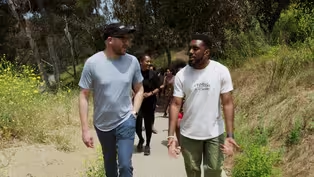
Helping Create Safe Spaces Outdoors for People of Color
Video has Closed Captions
Clip: S6 Ep3 | 5m 33s | WalkGood LA founder Etienne Maurice leads Black Angelenos on hikes for wellness & healing. (5m 33s)
Video has Closed Captions
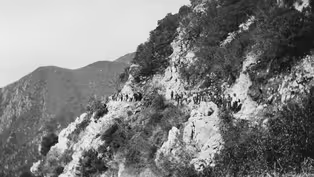
Preview: S6 Ep3 | 30s | The hiker-activists who led Angelenos into their hills and onto the trails. (30s)
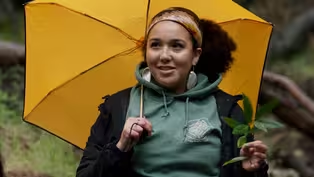
Native Ancestors Helped Cultivate Today's Hiking Trails
Video has Closed Captions
Clip: S6 Ep3 | 5m 19s | Explore L.A. hiking origins with Tongva artist Samantha Johnson on the Gabrielino Trail. (5m 19s)
Providing Support for PBS.org
Learn Moreabout PBS online sponsorship














Support for PBS provided by:
Lost LA is a local public television program presented by PBS SoCal