
Historic Jackson Home opens at The Henry Ford in Dearborn
Clip: Season 10 Episode 50 | 8m 1sVideo has Closed Captions
The home is the newest addition to the museum’s exhibits showcasing important moments in history.
The home that served as a sanctuary and strategic hub for Dr. Martin Luther King Jr. and other civil rights leaders will be open to visitors at The Henry Ford’s Greenfield Village in Dearborn beginning June 12. The Henry Ford President and CEO Patricia Mooradian and Curator of Black History Amber Mitchell spoke with BridgeDetroit reporter Micah Walker about restoring the Jackson Home and more.
Problems playing video? | Closed Captioning Feedback
Problems playing video? | Closed Captioning Feedback
One Detroit is a local public television program presented by Detroit PBS
Historic Jackson Home opens at The Henry Ford in Dearborn
Clip: Season 10 Episode 50 | 8m 1sVideo has Closed Captions
The home that served as a sanctuary and strategic hub for Dr. Martin Luther King Jr. and other civil rights leaders will be open to visitors at The Henry Ford’s Greenfield Village in Dearborn beginning June 12. The Henry Ford President and CEO Patricia Mooradian and Curator of Black History Amber Mitchell spoke with BridgeDetroit reporter Micah Walker about restoring the Jackson Home and more.
Problems playing video? | Closed Captioning Feedback
Where to Watch One Detroit
One Detroit is available to stream on pbs.org and the PBS app.
Providing Support for PBS.org
Learn Moreabout PBS online sponsorshipHello I'm Zosette Guir and this is one Detroit, the Selma, Alabama home that served as a sanctuary and strategic hub for doctor Martin Luther King Jr and other civil rights leaders during the 1960s, will be open to visitors at the Henry Ford's Greenfield Village beginning this weekend.
The Jackson home is the newest addition to the Henry Ford's collection of exhibits showcasing important moments in history.
Bridge Detroit's Michael Walker spoke with the president and CEO of the Henry Ford, Patricia Mooradian, and the curator of black history, Amber Mitchell, about acquiring and restoring the home.
The Henry Ford in Dearborn will soon debut a new piece of history.
The Jackson home opens June 12th inside Greenfield Village with a weekend long block party.
The home was a planning site for the 1965 Selma to Montgomery marchers leaders, including Martin Luther King Jr.
Visited the home in Selma, Alabama, organizing the fight for voting rights.
Doctor Sullivan and his wife, Mrs.
Richard Jean, share a Jackson opened up the doors to their home in 65.
For the movement, towards voting rights in the United States.
And so the work that they did in 65 really providing, a place of respite, hospitality, a safe place for movement makers to lay their hand.
The Jacksons have been longtime friends with Reverend Doctor King, since, their wives were childhood friends.
But they had also been an undercurrent of movement making all throughout Selma and really across the South, really starting, in the early 1900s and leading up to a really more intense time in the 1960s.
And so as the Jacksons, became closer to understanding what was going on and how their role needed to play out, they decided that they would take a great personal risk.
And that is welcoming Doctor Martin Luther King Jr into their home, as well as other members of the movement.
The Jackson's home is one of many epicenters in the city of Selma, and across the Alabama black belt of folks who took on great personal risk to make sure that all of us had access to the voting, voting rights that are promised to us as American citizens.
The Henry Ford President and CEO, Patricia Mooradian, shares why Jackson's daughter reached out to the museum.
In February of 2022.
Jawana approached us, pretty much out of the blue and asked if she could explain to us why this house was so significant.
And so she told us, the importance of this house.
On a virtual call.
She had had this house, in her own possession since her parents passed away, and she was trying to run it as a museum for about ten years.
And, you know, as she started to think about the future, the significance of this home, she was concerned about where it would end up since she was an only child and she has no heirs of her own.
And so she was looking for a place for the house to go and exist and be cared for in perpetuity.
So she did a lot of research and a lot of homework.
She knew that we had Greenfield Village, and that Greenfield Village was a place where we preserved and restored, significant structures that tell stories that people can immerse themselves in.
And so at the end of that call, she basically said, Patricia, this house belongs in Greenfield Village.
And that's when all our work began.
Amber Mitchell, the museum's curator of black history, work closely with Jawana Jackson throughout the project, hearing stories about her childhood home and the people who would visit.
I always sit in awe of Miss Jawana as I work with her work in consultation with her, have gotten to know her very closely over the last several years.
Over the course of this project is, you know, always understanding there is something new to learn.
I think one of my favorite aspects of working with Miss Jawana is thinking about a person like Doctor Martin Luther King Junior, who for me, you know, it's this big, 3000ft tall figure.
He's larger than life, right?
But for her, that's her Uncle Martin, right?
That's her Uncle Martin that shared cookies and bribed her with cookies and had tea parties with her.
And was really this human being.
And so what I'm really excited to be able to bring out in this exhibition is the humanity of our movement makers.
That these are not only just folks who, took on a role that was necessary, but they were also, parents, siblings, children themselves.
Who also process like of transporting Jackson home from Selma.
Oh my.
Gosh, the process of of restoring this home, the process of deciding whether it could be moved, took us about 14 months from that call.
We had to see if it was structurally sound, if it could withstand a move, then we had to figure out how to move it.
The house came with all of its contents, and those contents were significant.
The family saved everything that Doctor Martin Luther King touched.
The cherry sat in the dining room table.
He ate in the beds.
He slept in the pajamas he wore.
They saved it all.
And so that was that was going to be moved with the house.
What was determined is that the house, all the the extraneous parts, the roof, the chimney, the porch would all be taken off so that it was down to a core box.
That box of the home would be cut in half and basically wrapped and put on to a specially built cradle on the back of a wide load flatbed.
And we took it up to Michigan and to two trips.
And then, of course, the roof and the chimney and and the porch all went separately.
This is the Henry Ford's first major acquisition in 40 years.
Why was it so important to bring the Jackson home here to the museum?
The idea of moving a home or moving a building.
It's not really, best practice anymore as far as historic preservation goes.
However, in our case, in working closely with Joanna Jackson, we realized that we had an opportunity to help preserve an important piece of American history, one that could potentially have been lost to, environmental or financial or economic, other, outcomes.
And so for us, it was critically important to not only just bring this home here, but to have it into perpetuity, meaning that, forever, as long as the Henry Ford exists, that home will be taken care of and and, protected.
I think, as an organization, it was also really important for us to, to put our money where our mouth was in terms of preserving African-American history.
As curator of black history, I started with this project, and it allows me to also dig into additional, stories of African American history that touches all aspects of the Henry Ford's collections, now, in the past and in the future.
Here's what's playing for the grand opening.
We're really excited about the grand opening because we're planning a three day block party in Greenfield Village.
So the whole village will be celebrating the new addition of the Jackson home to Greenfield Village.
So there will be musical performances.
There will be a special, market place by, black owned businesses who will come in and and share, what, what they sell will have all kinds of activities and sights and sounds.
The house will be open.
We will do, a ribbon cutting launch runs on June 12th.
And so we're we're pretty excited to welcome people to come to that.
And then, to enjoy the celebrations all weekend long.
Video has Closed Captions
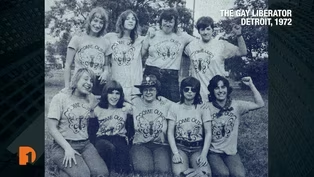
Clip: S10 Ep50 | 16m 5s | Christopher St. Detroit '72 Pride celebration remembered as catalyst for LGBTQ+ movement in Michigan (16m 5s)
Providing Support for PBS.org
Learn Moreabout PBS online sponsorship New Episode
- News and Public Affairs

Top journalists deliver compelling original analysis of the hour's headlines.

- News and Public Affairs

Today's top journalists discuss Washington's current political events and public affairs.


 New Episode
 New Episode
 New Episode
 New Episode
 New Episode

 New Episode
 New Episode
Support for PBS provided by:
One Detroit is a local public television program presented by Detroit PBS