
The History of the Black Church
Clip: Season 49 Episode 22 | 18m 9sVideo has Closed Captions
The History of the Black Church | Episode 4922/Segment 2
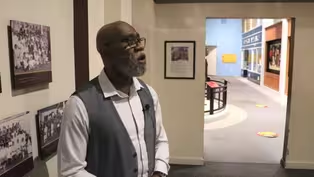
The foundation for the development of the black church is rooted in racism, values, culture and spirituality. Stephen discussed the history of the Black church with Rev. Dr. Kenneth Harris, president of the ecumenical theological seminary, and his daughter, Rev. Kenita Harris of Detroit bible tabernacle. Episode 4922/Segment 2
Problems playing video? | Closed Captioning Feedback
Problems playing video? | Closed Captioning Feedback
American Black Journal is a local public television program presented by Detroit PBS
The History of the Black Church
Clip: Season 49 Episode 22 | 18m 9sVideo has Closed Captions
The foundation for the development of the black church is rooted in racism, values, culture and spirituality. Stephen discussed the history of the Black church with Rev. Dr. Kenneth Harris, president of the ecumenical theological seminary, and his daughter, Rev. Kenita Harris of Detroit bible tabernacle. Episode 4922/Segment 2
Problems playing video? | Closed Captioning Feedback
Where to Watch American Black Journal
American Black Journal is available to stream on pbs.org and the PBS app.
Providing Support for PBS.org
Learn Moreabout PBS online sponsorshipI wanna start with just the kind of broad concept here, the link between spirituality, racism, and the development of the Black church.
It's a pretty complex subject, but you guys have spent a lot of time thinking and reading and writing about it.
So, Dr.
Harris, I will start with you, Dr.
Ken Harris, about, just talk a little about those links and where they find their roots.
The roots of spirituality in the Black church come out of the African religious and spirituality that came from Africa on the slave ships.
The slaves who came here were not savages in the jungle.
They came from cultures that were centuries older than your European civilizations.
And so, the folk that came here from Africa were, I mean, you know, in the Old Testament, the Queen of Sheba visited Solomon and the Ethiopians swear that they had a child who took Judaism back to Ethiopia, which is evidenced by Ethiopian Jews now.
That's the Judaic spirituality.
And then the Ethiopian eunuch who was saved in the book of Acts by Philip, who went back to Queen Candace with the gospel, that Christian link is there.
And so the slaves that were brought over were very, very rich in a history of scholarship, as well as religion and spirituality that spanned a wide spectrum, okay.
The American slave owners worked furiously to destroy those links.
They did everything they could to disconnect Africans from their heritage.
By the grace of God, they were not successful.
They split up families, they split up tribes and all of that, and then, the very vicious attack against African language, African culture, African family values.
Then, in the American context, were merged at some point with the Christianity in the colonies.
But the roots of it, Stephen, go way back prior to that in antiquity, in the 6th to 10th century.
The Babylonian Talmud, which contains interpretations of the Hebrew scriptures by rabbis characterized Africans as, I wouldn't say subhuman, but others.
And those Biblical interpretations included interpretations of passages like the curse of Cain, who killed Abel, his brother, that he offered a sacrifice that wasn't acceptable, the smoke came up, hit him in the face and he turned black.
And so, that immorality, hint, tinge, with black skin, was planted at that time, and also, the curse of Ham, where Canaan, one of the four sons of Ham, saw Noah in his nakedness, and then he was cursed by his father, Noah, and that curse turned his skin black.
But somehow, over the centuries, not only was Canaan turned black, but all the sons of Ham were cursed likewise, according to European and American theologians.
European racists picked up on that, and they took it to another level, especially when they began to import slaves from Africa for sale.
They had to reframe the history to cancel out, to eradicate the rich history of Africa, to looking at people as animals.
You know, they portrayed Africans with tails.
They called Africa the Dark Continent.
Physiological characterization, elongated sex organs, large hips, powerful legs, big lips, wide nose, all of that was encoded as Black, and as a result of the curse of the immorality of people of African descent.
And so, immorality then was encoded by racists as black skin versus Caucasian skin, which was purity and righteousness and morality.
The white Christ that was imported along with the slaves.
That foolishness encouraged them to do all of this nonsense against the African slaves.
They took all of that, Stephen, and they sacralized all of those myths, all those lies.
In other words, they said, this is the truth.
This is the God's truth, and this is what has happened to Africa and American theologians were just brutal against the absence of anything of any value coming out of Africa.
And so, that formed the context in which the Black church would come.
Yeah.
So when you cast forward 400 and some years, from that moment, from that sort of pivot in our journey, talk about now, where we see the vestiges of that, the things that form the Black church today, that have their roots there.
Kenita Harris, I'd love to have you talk about that.
I think where this really shows up in the Black church today is in terms of thinking about the Black church as a response to the moral imperative, that to the moral imperative in terms of injustice done, not only to Black people, and of course, the existence of the Black church is indeed that whether we acknowledge it or not, truly, the Black church, at its core, I think, has had a presence in terms of the response to injustice injustice done to Black folk, but as well as injustice done to different groups within society who've been oppressed.
And so we sort of, again, in today, see those nuances that sort of continue into the present life, or the modern day life of the Black church.
And so, in that we can see that in terms of not only in forms of responding to injustice, but injustice, such as, you know, racism, and the Black church always being a space of affirmation, of Black people in terms of their humanity, in terms of their religious experience and their spirituality and the ability to be able to freely express that.
And now, we see even a diversity.
There's never been necessarily a monolithic in terms of what it means to be Black and to be spiritual or to be Black and to have a religious experience.
There's never been a monolith, even when we think about, in terms of historically, how denominations within the Christian tradition that have been created initially by Black folk, there's still sort of a diversity there.
And what tied all of those traditions was, of course, belief in Jesus, but also, the belief in God entering into the context and the experience of Black people.
For me, myself, being a Millennial, one of the things that I think I see is sort of a return to the fact that we're really, actually, very racial and ethnically and culturally diverse within the African-American community.
That, again, stems back to us not being necessarily a monolith.
And so, what that then entails, I think, is even this sort of sense of being able to recover sort of the experiences, the culture and religious and spiritual expressions and even ideologies that we see within African culture and African spirituality and religion and returning to those, in a sense, to be able to understand even in terms of our own affirmation of ourselves as being created in the image of God and being able to freely express, and live that out.
Again, as Dr.
Harris said, those roots were never snuffed out of our spirituality.
They were still rooted deep within us.
And we see those expressions throughout different aspects of a Black religious experience and spirituality, whether we look at the music.
You know, Black, sacred music, from spiritual hymns, to folk music, to gospel music, even in those sorts of religious expressions, we still hear the rhythms, if you will, of our ancestors in terms of African spirituality.
I'm a historian, so I wanna go back just a bit and pick up that there are threads that run through the development of the Black church in America, and two words that come to the surface that Kenita and I have been talking about is the word prophetic and the word subversive.
Hmm.
Yeah.
That those two words shape the African-American response in the crucible of oppression, the Black church that James Melvin Washington called the Black communal womb.
In that incubator, the struggle over these hundreds of years in America to this day, the idea of prophetic and prophetic come to play.
Now, when I say prophetic, I mean, it's rooted in the Old Testament scriptures.
Even though Europeans try to brainwash Blacks to believe their way in terms of the interpreting scripture, Blacks didn't buy it.
You know, they were sitting quietly on the plantation listen to these stupid sermons, but they weren't believing it, okay?
And so they would go into their quarters and go into the hushed harbors and they would strategize.
How do we, first of all, we don't believe that stuff.
And so, let's continue to figure out ways to undermine how we're being treated.
And so, they were subversive in a righteous way.
They were righteous warriors and plantation owners throughout the South couldn't sleep at night because they didn't know when the slaves were gonna rise up, because these were not folk who just got off a boat, but these were African warriors.
They were African royalty, they were kings, they were statesmen who would not tolerate the conditions of slavery without a fight.
And if you look at the books that were written by Black scholars a generation ago, the titles tell you something Kelly Brown Douglas, "The Black Christ," in answer to this white Christ thing.
Cain Hope Felder, "The God of the Oppressed."
James Melvin Washington "Conversations with God: "Two Centuries of African-American Prayers."
And then, he also wrote the book, a great book, "Frustrated Fellowship: The Black Quest for Social Power," Gayraud Wilmore, "Black Religion and Black Radicalism: "An Interpretation of the Religious History "of Black America."
I mean, scholars have done a job.
(Stephen laughing) Reframing, in a proper sense, the origins of struggle and subversiveness and the prophetic authenticity of the work that they've done to confront racism and injustice in America.
It's not a moral vacuum.
It is rich in value, rich in tradition, rich in righteous indignation, and so, that is the crucible that helps us to identify who we are as the Black church.
Yeah.
Kenita Harris, I would love for you to pick up on that idea of prophecy.
What is the role that the Black church will be asked to play?
Think of all of the things that we are dealing with right now.
Yeah.
African-Americans, really trying to, I think, redefine our place and our role in American society, the church is bedrock in that movement and in that conversation.
So prophesy a little bit about where- Well, I think, again, I think reaching back into the prophetic tradition and this whole idea of subversiveness, and this role that the Black church has played in terms of in movements.
Whether it's been acknowledged or not by those of the day, the Black church experience, the presence of the Black church has always, again, had this role of holding up the moral imperative, of calling out injustice, and then calling out injustice in terms of a return to a moral sort of rightness.
As Reverend Robert talks about, a moral sort of revival, if you will, within America, and having that sort of role, prophetic role, if you will, in relationship to political realities.
I think that's really the challenge of what we're facing, as the Black church today.
And I mean, in terms of living within an age of movement, right, we've seen sort of the uprising of movements, from Black Lives Matter to the hashtag movements, to #MeToo, but then, even this sense of injustice that comes from, even with issues around immigration, issues pertaining to environmental justice, even sort of the lifting up of environmental racism.
I mean, there is a plethora of issues that we are addressing and facing.
But I think one of the things that, again, that even as a Millennial, and looking back in terms of this, again, prophetic tradition of speaking truth to power, and lifting up the moral imperative, I think one of the things that we continue to see is that particular call, and that particular role.
The Black church today, I think, has to, I think rediscover, in a sense, what its place is.
Its place in life, if you will, in terms of how and how are we called in a very diverse and inclusive way, to still speak to the issues that pertain to the Black community, to the Black experience, but as well as sort of think about our relationship to not only just our oppression, but the oppression of all.
The Role of Religion in African American Culture
Video has Closed Captions
Clip: S49 Ep22 | 4m 20s | The Role of Religion in African American Culture | Episode 4922/Segment 1 (4m 20s)
Providing Support for PBS.org
Learn Moreabout PBS online sponsorship New Episode
- News and Public Affairs

Top journalists deliver compelling original analysis of the hour's headlines.

- News and Public Affairs

Today's top journalists discuss Washington's current political events and public affairs.

 New Episode

 New Episode




 New Episode
 New Episode
Support for PBS provided by:
American Black Journal is a local public television program presented by Detroit PBS