
History in the Making
Season 21 Episode 7 | 26m 46sVideo has Closed Captions
Celebrate 100 years of the Carolina Inn and learn about Valdese’s Waldensian roots.
Dig into North Carolina’s past with a visit to Mendenhall Homeplace in Jamestown. Also learn about Valdese’s Waldensian roots, and celebrate the centennial of the Carolina Inn in Chapel Hill.
Problems playing video? | Closed Captioning Feedback
Problems playing video? | Closed Captioning Feedback
North Carolina Weekend is a local public television program presented by PBS NC
History in the Making
Season 21 Episode 7 | 26m 46sVideo has Closed Captions
Dig into North Carolina’s past with a visit to Mendenhall Homeplace in Jamestown. Also learn about Valdese’s Waldensian roots, and celebrate the centennial of the Carolina Inn in Chapel Hill.
Problems playing video? | Closed Captioning Feedback
How to Watch North Carolina Weekend
North Carolina Weekend is available to stream on pbs.org and the free PBS App, available on iPhone, Apple TV, Android TV, Android smartphones, Amazon Fire TV, Amazon Fire Tablet, Roku, Samsung Smart TV, and Vizio.
Providing Support for PBS.org
Learn Moreabout PBS online sponsorship[piano intro] - Next on "North Carolina Weekend, we're exploring history in the making, from Mendenhall Homeplace in Jamestown, we'll celebrate Waldensian Heritage, explore the Reed Gold Mine, and The Carolina Inn turns 100.
Coming up next.
- [Announcer] Funding for "North Carolina Weekend" is provided in part by Visit NC, dedicated to highlighting our state's natural scenic beauty, unique history and diverse cultural attractions.
From the Blue Ridge and the Great Smoky Mountains across the Piedmont to 300 miles of barrier island beaches, you're invited to experience all the adventure and charm our state has to offer.
[upbeat music] ♪ [upbeat music continues] ♪ - Hi everyone, welcome to "North Carolina Weekend", I'm Deborah Holt Noel, and this week, we are exploring historic destinations across our state.
I'm at the Mendenhall Homeplace in Jamestown, just outside of Greensboro.
Built in 1811, this authentic Quaker homeplace was home to Richard Mendenhall, co-founder and president of the Manumission Society of North Carolina, an anti-slavery group that advocated for the emancipation of enslaved people.
It's rumored that this was a stop on the Underground Railroad, we'll learn more about that later.
But first, let's head with Theresa Litschke to Valdese, where the Old Colony Players community theater is a great place to learn about Waldensian history.
[gentle music] - Valdese is a immigrant community founded in 1893 by the religious sect called the Waldensians, who are in the Savoyan Province of France and Italy, right there in the Cottian Alps between France and Italy.
They were heavily persecuted in their homeland, but then were granted civil freedom.
And once they were granted civil freedom, the land became more and more scarce.
They still did not have religious freedom, so therefore they were still persecuted in society and so the land was not sufficient to really sustain them anymore.
- They began to overpopulate those valleys, so that's when they came over to America and one of the places they settled was Valdese, North Carolina.
- [Theresa] Because of their strong faith, education had always been important.
- They educated children, women, everybody.
It was scandalous back in the 14th century to actually educate women and children, but because they were in love with scripture and translated scripture into their own language, even back then, they educated their whole population.
- [Theresa] It wasn't surprising then that the Waldensians built the first school in Valdese.
Construction started in 1922, finished a year later and featured their talent for stone work.
- [Annie] Yeah, yeah, the rock work is a classic method of how they constructed things and they were very resourceful.
They hauled rock from local farms from all around.
It served as a school until the late '70s, and eventually operating costs shut them down.
So the town eventually purchased the building for $1 and then started renovations in 1986 to turn it into a multipurpose facility, and that's what it is today.
- [Theresa] It's called the Old Rock School, and is now home to a 500-seat auditorium, an art studio, plus art galleries featuring local artisans, as well as craft shows.
- [Annie] We also have the Piedmont and Western Railroad Museum.
It's one of the largest indoor railroad displays in the state.
- [Theresa] It's also the home base for the Old Colony Players.
They're a community theater group who perform in the Old Rock School.
But it's an outdoor drama held a mile from the school, started in 1968 and continues today that's become their banner production.
It follows the journey of the Waldensians to North Carolina in a production called "From This Day Forward".
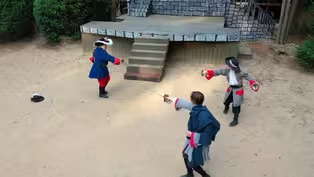
- [Edyth] The first act actually takes place in the 1680s [gun banging] under the persecution with King Louis XIV of France, who heavily persecuted the Waldenses, and then the second act is the story of the founding of the town of Valdese when the immigrants came.
- [Theresa] From the Old Rock School, that's become the centerpiece of art, culture, and history in Valdese, to our performance about Waldensian lives, the town has embraced the heritage of their ancestors and feel their story is just as relevant today as it was in 1893.
- Not only is it a story of immigrants, it's a story of hardworking people, but most of all, it's a story about tolerance and how as heavily persecuted as they were, they kept the faith, they persevered, they found a way to go on as a people, and then they came here, they became proud Americans and have totally assimilated into the culture of America now.
But the roots of the story of what it means to live out your faith and become neighbors with people you've never met before is really important.
- The Old Rock School is at 400 West Main Street in Valdese.
If you're a bluegrass fan, be sure to check out their performance schedule at visitvaldese.com.
And the outdoor drama "From This Day Forward" runs from mid-July to mid-August.
Would you believe the first major gold mine in this country was right here in North Carolina?
That's right.
And the first piece of gold weighed over 17 pounds.
Let's learn more at the Reed Gold Mine in Cabarrus County.
[intriguing music] - Reed Gold Mine is such a valuable historic site today because we are the first documented discovery of gold in the United States.
It went from North Carolina to Georgia, then to California, and then, finally up to Colorado.
So visitors today can see where the gold rush really started in the United States.
- The first piece of gold was found by Conrad Reed in 1799.
He was about 12 years old at the time, he was bone arrow fishing, probably hopefully trying to get some lunch.
He shot for a fish and he missed, and when he went to go retrieve his arrow, he saw something large and shiny just sitting there in the creek.
Him being a 12 year old thought it looked cool and it was very shiny.
- So he took it home to his parents, showed it to them thinking they would know.
They looked at it, really weren't sure if it was gold or not, but they noticed two things, it was rather large and rather heavy.
And as it turned out, they needed a door stop.
Probably one of the most expensive door stops that somebody's ever had.
[both chuckling] [intriguing music] Well, after about three years of walking past this rock on the porch, they decided to take it with them to Fayetteville on a supply run.
John Reed took it to a jeweler there who knew it was gold, and asked John Reed to name his price.
Well, John thought about it and he finally came up with $3.50 cents.
That was what he hoped to make in a week on his farm.
Problem is this gold nugget, which turned out to be a 17 pound gold nugget, was worth then 3,600 bucks.
But that helped lead to gold mining through the state of North Carolina.
- Right now, we're standing in what's called Morgan Shaft, it's 50 feet to the surface.
Although 50 feet looks very high, compared to other mines, it's very small.
The deepest depth reach at this mine was only 150 feet, but compared to the deepest gold mine in the world, 150 feet doesn't even cut it close.
The deepest gold mine in the world is located in South Africa and it's about two and a half miles deep.
Near the time of John Reed's death, he owned about 880 acres, and of that there was 5,000 feet of tunnels, but we're only going through about 450 feet of them 'cause during the time of opening this, it's all what the state could afford and also safely restore.
- Visitors coming to Reed Gold Mine today, there are several activities that you can do.
We have our exhibits throughout the visitor center.
We could then take you to the stamp mill, and during April and through October, we operate that on a daily basis to show how the rock was crushed and simulated mixed with mercury to extract the gold.
We also have several nature trails you can take that are between the mine and the stamp mill that you can walk on.
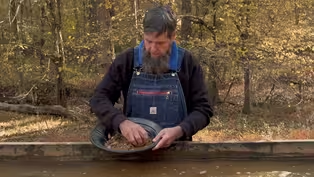
And then the big activity a lot of people like to do is pan for gold.
That's actually our only charge as well, is panning for gold.
If you didn't pan for gold, you can visit the whole site for free.
[soft music] - I think it's important to come here for a couple reasons is one is too many people they wanna go and travel and go somewhere and not see what's in their own backyard.
North Carolina has numerous sites that I encourage y'all to go to where you can go and learn about history from your own state.
A big reason to come here is that it was the first gold in the United States that we did have, you know, gold before California for about 50 years, and not too many people know that.
When you hear gold, you think of only the California Gold Rush.
But it's important to know that, here in North Carolina, in your own backyard, we had gold first and it's part of a rich history of our great state.
[soft music continues] - The Reed Gold Mine state historic site is at 9621 Reed Mine Road in Midland, that's in Cabarrus County.
The mine is open Tuesday, Wednesday, Friday, and Saturday, from 9:00 AM to 5:00 PM.
For more information, give them a call at 704-721-4653 or go online to historicsites.nc.gov.
Right now, I'm with Shawn Rogers, Director of Mendenhall Homeplace.
Shawn, I understand that Mendenhall Homeplace is on the National Register of Historic Places.
What's the significance?
- Well, beyond its architectural significance as being one of the most complete and authentic collection of historic Quaker structures in this part of the country, it represents legacy of the other south, the south, the non-slave holding, peace-loving people who actively opposed slavery, promoted the idea of universal education, and the general idea of using peace, peaceful reconciliation, to solve differences above violence and war.
- I think people don't understand who the Quakers were and how they actually helped enslaved people.
Tell me more about what happened at this house, at this place.
- Richard and Mary Pegg Mendenhall, the original owners here, by any measure were considered radical abolitionists.
And for generations, it's been rumored anyway, it's been spoken that they were a part of the Underground Railroad and that this was a quote, unquote, "Station of the Underground Railroad."
Now unfortunately, we cannot prove that.
Most of what we have are a matter of family tradition, oral tradition locally.
But we do know that Richard was one of the co-founders in 1816 of the North Carolina Manumission Society, which helped free hundreds of African-American enslaved people legally.
- When you say legally, why is that key?
- As opposed to the Underground Railroad, which was an illegal operation of sorts, what the Manumission Society did is they found legal means, they basically exploited loopholes in existing laws that would allow them to help these people experience freedom.
- Well then, of course, there wouldn't be evidence here that this was possibly an underground railroad station.
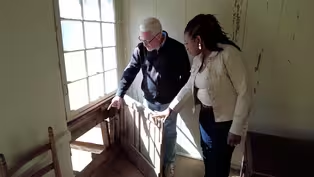
- We have a lot of intriguing circumstantial evidence and also we have an area, it's basically an attic space and in a back porch that's accessible through a low door upstairs.
Now see those joists?
- Yes.
- There are rows of cut nails and nail holes where there used to be floorboards over them.
- Wow, so this is the- - So you could actually crawl in there and go all the way around the corner to the front porch.
- Paint a picture for me, how might the Underground Railroad have operated in this home?
- They would come in under the cover of darkness into one of these hiding places and they would stay there throughout the day and then come out, and a lot of times, they would hunker down in a hiding, in like a safe place, until it was literally safe to continue on.
And in some cases, they could be their days, even weeks, until it was safe enough to move on to the next station as it were.
- And Shawn, I understand you have an artifact here that was very significant in the Underground Railroad.
- We do, and I can't wait to show it to you, would you like to see it?
- I'd love to, yeah.
- Deb, here it is, the Stanley Murrow false-bottom wagon.
This is the only artifact of the Underground Railroad that has been verified, has an established, documented provenance, this is the only one in the South.
- Why is it called false bottom?
- You remove the facing board here and you quickly see there's a false floor that creates a hidden compartment.
Now this hidden compartment extends almost all the way back, it stops about two and a half feet short from the end.
So when you pull the tailing boards or drop the tailgate, all you see is pottery packed in straw.
- Genius, about how many people could you fit in here?
- It really depended on the size of the individual and how many people you're trying to put in there.
But I will tell you this, they learned unfortunately through experience that the odds of being separated were actually lower if they left together as a group, as opposed to, you know, going at separate times.
- Wow.
It's amazing that you have this artifact and can tell this story to kids that come out here, adults, anyone who wants to know more about history and North Carolina history too.
- You know, being involved in museums for the last 20 years, you know, the number one question I field is, is this real?
Of course, you know what they mean.
- Wow.
- Is this authentic?
And to me, there's nothing like the power of authenticity.
When you are in front of something, you can touch something that you know played such a significant part in our history, I mean, it's can be life changing.
- Mendenhall Homeplace is at 603 West Main Street in Jamestown, and it's open Tuesday through Saturday.
For more information, give them a call at 336-454-3819 or go online to mendenhallhomeplace.org.
Most people don't realize that the famed explorer Daniel Boone once lived in this state as a young man, and it was in the Yadkin Valley where he perfected his skills as a hunter, married and started a family.
The way to learn more about this chapter in Daniel Boone's life is to follow the Daniel Boone Trail.
So we sent Theresa Litschke to lead the way.
[bright music] - Daniel Boone is America's pioneer hero, and surprising to a lot of people, he lived in North Carolina for 21 years before he moved off to Kentucky.
He profoundly affected American history positively because he led explorations and settlement, which led to the modern day state of Kentucky.
- He's our portal to understanding the pioneer era and that part of American history that leads into the American Revolution.
[bright music continues] - [Theresa] To experience that history, one must travel the North Carolina Daniel Boone Heritage Trail.
You'll see historic markers, monuments, museums, statues, outdoor dramas and more that celebrate his life.
- The trail is in various places across the western part of North Carolina, and it's places that you can drive to, it's places that you can visit and get out and walk.
- [Theresa] First stop on our tour is Appalachian State University in Boone.
Located on campus, you'll find one of the most exquisite statues of Daniel Boone.
- The Daniel Boone Monument in Boone, North Carolina is a very visible image of Daniel Boone with his dogs and he's hunting, sitting on a rock.
And it's a place that you can go and think about and remember that Daniel Boone was there.
[bright music continues] - [Theresa] Next stop, we travel down Highway 421 to the towns of Wilkesboro and North Wilkesboro.
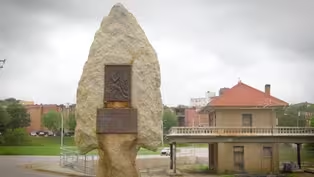
Here you'll find the Wilkes Heritage Museum and arrowhead markers used to commemorate the trail.
- Here at the Wilkes Heritage Museum, we have a Daniel Boone marker in our yard that the DAR placed here, and also inside of the museum, we do have a small portrait of Daniel Boone and some information about the part he played here in settling Wilkes County.
- [Randell] The marker that's in downtown North Wilkesboro is very interesting, in that it has metal in it that came from the Battleship Maine.
Turns out that J. Hampton Rich traveled to Washington DC and talked the Department of Navy out of giving from scrap metal from the gun components of the Battleship Maine.
- [Theresa] A visit to Whippoorwill Academy and Village will take you back to the early days when Daniel and Rebecca Boone lived along Beaver Creek, near what is known today as Ferguson.
- [Randell] Whippoorwill Village, as it's called now, includes a lot of pioneer era structures.
There's just an old chapel, a jail, a blacksmith shop, and a replica of Daniel Boone's cabin.
- [Mary] The replica Boone Cabin represents the kind of dwelling that he and Rebecca lived in here on the Yadkin River.
- Whippoorwill is a place that celebrates history, local arts, music, theater, poetry.
It is in celebration of what gives us a great quality of life.
[bright music continues] - [Theresa] During the mid 1700s, the Statesville area was the western most settlement in North Carolina.
It was protected by Fort Dobbs, a must-see heritage site on the trail.
[gun banging] - This served as not only a fort to defend the frontier, but it served as a place of refuge as it was also a supply depot, And this is an often forgotten part of North Carolina's history.
And so, we do everything we can to bring this to life, to garner an interest in it and further education about this early period in North Carolina's history.
[bright music continues] - [Theresa] Bringing our day trip on the trail to an end, our final stop is at a cemetery in Mocksville.
- Joppa Cemetery is, to me, a very sacred place, it's the place that Daniel Boone's parents are buried, it's a place where Israel, his brother, is buried.
It's a very calm and serene place.
- I think the Daniel Boone Trail would be a great weekend trip for families who are interested in history, to pile in the car, take a picnic, and let's go discover these places and let's learn something together as a family about this important man named Daniel Boone.
[bright music continues] - The Daniel Boone Trail stretches across a lot of our state, but you can begin at 126 West Church Street in Mocksville.
For more information, visit ncdanielboonetrail.org.
Mendenhall Homeplace is more than 200 years old.
And you know, one of our state's noted landmarks has a birthday this year.
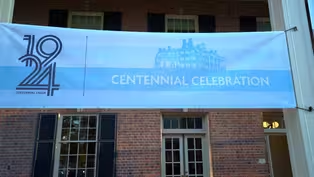
The Carolina Inn in Chapel Hill turns 100 and they're celebrating their centennial with special events and exhibits.
We sent producer Rob Holliday to join the party.
[upbeat music] - Once you step foot into The Carolina Inn, you should be ready for a very unique experience because you know that you're in Chapel Hill and you know you're in North Carolina.
Not only just in the lobby, but all the touches that are throughout the spaces, including the guest rooms where there's nods to Chapel Hill, as well as the university.
- It's a beautiful little town that we have here.
And then, entering the doors of The Carolina Inn, it sort of just adds to that entire experience.
The ambiance, it's really hard to be in a bad mood at The Carolina Inn.
- [Robert] For decades now, guests have been dropping their bags and their worries off as soon as they check into one of The Carolina Inn's 185 guest rooms.
- And the way it was built, there's some very small rooms and there's some larger rooms, there's some suites.
But, you know, I think that doesn't matter, it's just being in the inn makes you feel great, and whether you're in a small room or a large room.
- [Robert] Or a ballroom in a booth or on a bar stool, but the fun, relaxing vibes aren't just limited to those staying at The Carolina Inn.
- The Carolina Inn has always had the philosophy that they wanna be a cornerstone of the community and the campus itself.
We really wanna be a go-to place for people to come together and enjoy all the festivities.
So we do a lot of programming to bring the community into our doors.
- [Robert] That includes hosting teas, dozens of weddings, and a popular series of parties open to the whole community.
Fridays on the front porch events run from April through October each year.
- It's sort of an end of week celebration.
[upbeat music] They have a band out there normally, so you can listen to music.
Young families bring children, it's great to watch the children play on the lawn.
You meet an awful lot of people, you can have good fun out there and good entertainment and good food.
- [Robert] And speaking of food, The Carolina Inn's full service restaurant is also open to both guests in the community.
- The Carolina Inn's restaurant is named Crossroads, and if you've ever been in Chapel Hill at class changing time, you can see why that it's named Crossroads because of it really is where both locals and students are crossing paths at the same time.
I think that a lot of the Southern dishes are usually what people are looking for, to just have a unique experience.
Pimento cheese, for example, people love Pimento cheese and they're definitely coming back for something like that.
- If you've never visited The Carolina Inn before, this is the perfect time.
And the reason why is a century in the making.
- The Carolina Inn turning 100 is pretty special.
Most hotels do not have that type of age on them, they've either been converted into something else or are not in business anymore, so this is something very unique.
The building has evolved over the years, from the '20s to the '40s to the '70s and '90s.
So there's different characteristics throughout the hotel that make it special and unique.
- [Robert] Photos from all the 11 of the inn's decades line the walls along with a special exhibit that features pieces from the past.
- Well, we're really excited to kick off this centennial year and there'll be events happening throughout the year, so they're not gonna be a one-time event.
There will be many specialty dinners, including like a Gatsby dinner that features 1920s menus and drinks from that era.
There'll be specialty teas that are gonna take place.
We just launched a centennial beer in partnership with Carolina Brewery, which is a local brewery to Chapel Hill, so we have our own name brand, we just launched our own coffee line.
- It's very exciting.
This place has been here 100 years.
You can go to a lot of historical sites around the country, but none have evolved, I think, like this has.
They've maintained the traditions, they've maintained the historical significance, and yet they've moved on with the modern times too.
- [Robert] And so, with a dual focus on honoring its past, while still preparing for its future, The Carolina Inn begins its second century, always striving to put a smile on the face of anyone who walks through the doors.
[upbeat music] - The Carolina Inn is at 211 Pittsboro Street in Chapel Hill, and they'll be having centennial celebrations throughout the year.
For more information, give them a call at 919-933-2001 or visit their website at hyatt.com and look under Carolina Inn.
Well, that's it for tonight's show, everyone, we've had an incredible time out here at the Mendenhall Homeplace in Jamestown, well worth a visit to Guilford County if ever you're in the area.
And if you've missed anything in today's show, just remember you can always watch us again online at pbsnc.org, or you can find us on our YouTube channel.
Have a great North Carolina weekend everyone.
[upbeat music continues] ♪ [upbeat music continues] - [Announcer] Funding for "North Carolina Weekend" is provided in part by Visit NC, dedicated to highlighting our state's natural scenic beauty, unique history, and diverse cultural attractions, from the Blue Ridge and the Great Smoky Mountains across the Piedmont to 300 miles of barrier island beaches, you're invited to experience all the adventure and charm our state has to offer.
[bright music]
Video has Closed Captions
Clip: S21 Ep7 | 4m 28s | The venerable Carolina Inn in Chapel Hill celebrates 100 years. (4m 28s)
Video has Closed Captions
Clip: S21 Ep7 | 4m 17s | The town of Valdese honors the heritage and determination of its Waldensian founders. (4m 17s)
Video has Closed Captions
Clip: S21 Ep7 | 5m 4s | Come along for a tour of the Quaker-built Mendenhall Homeplace in Guilford County. (5m 4s)
Preview | History in the Making
Video has Closed Captions
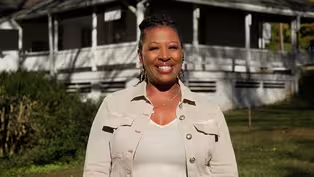
Preview: S21 Ep7 | 20s | Celebrate 100 years of the Carolina Inn, and learn about Valdese’s Waldensian roots. (20s)
The North Carolina Daniel Boone Heritage Trail
Video has Closed Captions
Clip: S21 Ep7 | 4m 41s | The Daniel Boone Heritage Trail explores Boone’s NC journeys. (4m 41s)
Video has Closed Captions
Preview: S21 Ep7 | 4m 40s | Come along for a tour of the place where gold was first discovered in the United States. (4m 40s)
Providing Support for PBS.org
Learn Moreabout PBS online sponsorship













Support for PBS provided by:
North Carolina Weekend is a local public television program presented by PBS NC