
History is Everywhere
Season 5 Episode 7 | 26m 47sVideo has Closed Captions
Explore Carson City’s rich history, from Kit Carson Trail to Stewart Indian School.
Outdoor Nevada host John Burke explores Carson City's rich history, from the legendary Kit Carson Trail to the historic U.S. Mint and the stunning Spooner Lake backcountry. Along the way, he meets local experts who share stories about the origins of Carson City, the historic governor's mansion, the Stewart Indian School, and the vital role the Carson River played in shaping the area.
Problems playing video? | Closed Captioning Feedback
Problems playing video? | Closed Captioning Feedback
Outdoor Nevada is a local public television program presented by Vegas PBS
History is Everywhere
Season 5 Episode 7 | 26m 47sVideo has Closed Captions
Outdoor Nevada host John Burke explores Carson City's rich history, from the legendary Kit Carson Trail to the historic U.S. Mint and the stunning Spooner Lake backcountry. Along the way, he meets local experts who share stories about the origins of Carson City, the historic governor's mansion, the Stewart Indian School, and the vital role the Carson River played in shaping the area.
Problems playing video? | Closed Captioning Feedback
How to Watch Outdoor Nevada
Outdoor Nevada is available to stream on pbs.org and the free PBS App, available on iPhone, Apple TV, Android TV, Android smartphones, Amazon Fire TV, Amazon Fire Tablet, Roku, Samsung Smart TV, and Vizio.
Providing Support for PBS.org
Learn Moreabout PBS online sponsorshipSupport for Outdoor Nevada comes from Jaguar Land Rover Las Vegas.
We're proud to help introduce a new generation of adventurers to the diverse experiences that our state has to offer.
Information at jlrlv.com.
Today on Outdoor Nevada, we're in Carson City touring the history, visiting with locals and embracing the culture of the area.
All this today on Outdoor Nevada.
♪♪♪ (John Burke) Carson City, Nevada is really a special place, it really is.
It's beautiful, there's lots to see and do, the people are great.
But how much do you know about Carson City, Nevada?
Not as much as you're about to find out.
Let's go talk to Dan.
♪♪♪ Dan, how are you sir?
-Good.
How are you?
-What a pleasure to see you.
-Good seeing you too.
-Hey, I gotta tell you, this is some town you got here.
-We agree, we definitely agree.
-Tell me how it got its name, because I'm thinking it had something to do with Kit Carson.
(Dan Neverette) Well, it did, but only indirectly.
John Fremont came through south of Carson City, and his scout was Kit Carson.
Along the way he identified a river, and he named it after his scout.
Carson River flows just south of where Carson City is located, so when Carson City was founded, it was named after the river.
-It was named after the river.
Okay, all right.
I got it.
Now, I understand you know a lot about this town so I'm so glad that we're meeting today, and I'm going to put you on the spot right away.
This building looks old and historic.
What is it?
-It is.
It was a U.S. mint from 1890 to 1893.
-So what was happening here exactly?
-They were minting coins from the gold and silver that was being taken out of the ground up at Virginia City in the Comstock Lode.
-That is phenomenal.
So what about the machinery, is it still in there?
-Out of the three coin presses that were originally here, coin press number one is still here at the former mint, and we do use it.
It mints medallions, and we sell those medallions to help benefit the state museum here in Carson City.
-How long was this thing in operation?
-The press was really in operation here from 1880 to 1893, and then after that, it was sent to the San Francisco and Denver mints where it actually served and minted coins at an additional time.
It was going to be scrapped at one point when it was at the San Francisco mint, and the editor of one of the San Francisco papers saw the press, and on the press there's a plate that identifies it being repaired by the Virginia and Truckee Railroad staff here in Carson City.
So he thought that perhaps someone in Carson City might want the press back.
He contacted someone here in the city, and it is now housed in the former mint.
-Fantastic.
Well, I know you're the guy, and I put you on the spot early but you delivered.
Let's go see some more stuff.
-Okay, let's go.
♪♪♪ Dan took me on the Kit Carson Trail, a 2.5-mile walk through the Carson City Historic District.
This path takes you on a journey back in time and gives you an education of the history of the area and Nevada.
Along the trail you'll see Victorian style homes, museums and churches, each with a story to tell.
It has over 40 locations to see.
Taking this walk with Dan was great.
He is a wealth of information.
Full disclosure: The further into Carson City we walk, the prettier it gets to me.
I'm just in love with this town.
-This is definitely the historic section of the city too which, you know, the homes are much older and the trees are much bigger than in some of the newer developed areas.
-The streets are wide and you got the sidewalks.
But what about this house?
This is unique.
-This stick lakeside house was purchased by Governor John Jones.
He made it his official residence as governor, and it's an ornately painted home that was restored about probably five or six years ago.
It's an amazing structure not only because of the paint job but because of the design of the house and the addition and the small coupla that's off to one side which was a playroom at one point.
-When did this house come into existence?
-1865.
-1865, and that's when he was in office?
-No, he was in office a little later than that because remember, Nevada wasn't a state until 1864.
-That's right.
Boy, this really stands out.
You don't see this every day, do you?
-No, I wouldn't want to do the paint job, either.
-Me either.
Kind of like, I don't know, decorating a cake or something.
-Yes, it is, exactly.
♪♪♪ When you walk along the trail, you'll see some cairn stone markers in front of the homes.
Each identifies the home and has a number to correspond with a map provided by the folks at Visit Carson City.
(whistling) Now, there's a humble abode for you.
-Yes.
It's a private residence, the D.L.
Bliss mansion.
Mr. Bliss was one of the lumber czars that brought lumber from the Tahoe region down to Carson City and then for construction and the mines up in Virginia City.
-He picked a good vocation.
-Yes, he did.
The house is 8,000 square feet, 14 marble fireplaces.
As I said it's still a private residence, and it's an amazing house on an amazing lot because it's also situated directly across the street from the governor's mansion.
-8,000 square feet.
-Yes.
-That's a lot of dusting.
(laughter) ♪♪♪ If you live in the historic district, if you're fortunate enough, there are rules and regulations, are there not, you just can't add on whenever you feel like it.
-Right, and people have to apply for approval on whatever they want to do, and then obviously all the requests don't always get approved.
-And I'm sure that doesn't go over well, but you do live in the historic district.
-That's correct.
-Those are the rules.
Oh, my goodness.
Where have you taken me now?
-Your new residence.
-Really?
Tell me more.
-This is the Nevada governor's residence.
-No kidding.
I never thought about getting into politics, but I'm reconsidering at the moment.
Tell me about this.
-It was finished in 1908, and you might wonder why there was such a long period of time between the time Nevada became a state in 1864 and 1908, and it was because for many years the legislature would not fund the construction of a home for the governor because they thought it was too imperialistic, too reminiscent of the British way of doing things.
-No kidding.
-So it was funded under Governor Sparks, and then Governor Dickerson was the first governor to live in here.
-It's big.
-Yes.
There's kind of an interesting-- there's a couple of interesting stories.
-Oh, tell me.
-One of them is that Governor Dickerson-- first of all, he finished Governor Sparks' term because Governor Sparks died, so he had to run for election on his own.
He made the decision to run on a temperance ticket.
Here in Nevada that probably wasn't the wisest decision.
He lost the election.
So he had to leave the mansion in January when the new governor came in.
Well, on Christmas Eve before he had to leave, he invited some guests for dinner.
He said stay after dinner.
I want to get dressed up as Santa Claus, and we're going to surprise the children with some presents.
So dinner went wonderfully.
They took the children up to the nursery, and back then no electricity in the mansion yet.
So they had a small Christmas tree in the nursery, candles on it.
Governor Dickerson leaves them, changes into a Santa Claus outfit, comes running back in, surprising the kids with presents.
Well, he reaches underneath the little tree to get some presents, and the fur on his hat caught on fire.
Quick thinking Governor Dickerson-- see the balconies on the second story?
That's where the nursery is.
He ran out of the window in the nursery, jumped off the balcony into a snowbank and put out the fire on his hat.. -You've got to be kidding me.
-Nope.
-Brilliant.
-Good thinking.
-Good thinking.
I really hope that you'll make it a point to take the Kit Carson Trail.
It really gives you a sense of appreciation for the history of Carson City and Nevada.
If you're lucky, you might run into Dan.
And if you do, tell him I said hi.
♪♪♪ Here in the Carson River Park, which as you can see is a stone's throw away from paradise, there's a beautiful walking trail which leads to a lot of history and some really interesting water features, and I've got somebody who's going to tell us all about it.
Anytime I visit an area, it's great to talk with someone local.
People love to share their passion and information about the place they call home, and Roger fit the bill.
It was really great to meet up with him.
Hey, Roger.
-Hey, John.
How are you doing?
-Good, my friend.
How are you doing?
-Doing well.
-What a beautiful day, isn't it?
-It's a gorgeous day.
-Unbelievable.
How long you been in these parts?
-Oh, I've been in Carson City for about 17 years-- been lucky to be in Carson City for 17 years.
-Now, why do you say that?
Why do you like it?
-Because it's a great place to live.
I mean, look around here.
We've got the natural environment, you know, you've got a neat little town.
You're not far from Reno, you got Lake Tahoe over the hill.
-And a scenic park here.
Tell me a little bit about this park.
What's doing?
(Roger Moellendorf) Well, this is Carson River Park.
It's about a 40-acre park, and it actually spans both sides of the Carson River.
It's kind of a hub for trails in this area.
-And I'm guessing the Carson River had a lot to do with the development of this area back in the day.
-Well, it did.
You know, it was actually a source of water number one, but then number two, they used to do a lot of timbering up there in the Sierras during the Comstock Era.
They had to have timber for the mines, so they'd cut thousands and thousands of trees, and they put them in flumes and sent them down to the Carson River.
Then they put them in great big groups and floated them all the way down the Carson River to a little town called Empire about four miles downriver that doesn't exist anymore.
Then they would process the logs into square timbers for the mines of Virginia City.
-What a site that must have been, to see this river packed with logs.
-Brim to brim.
Yes, that must have been amazing, you know.
-How did the river get its name?
Well, the river is named after Kit Carson, you know, the famous explorer, the frontiersman who came out here in the 1840s with John C. Fremont.
It's not really sure if they ever actually came into Carson City.
They may have been over in Carson Valley and then they headed up to Carson Pass.
But all the way along the way, they named things after people in the party.
Kit Carson happened to get the lion's share.
-Interesting.
Well, I know there's a pretty dynamic water feature and some more things I want to learn about history from you just about that way.
So what do you say we take a stroll?
-Let's take a walk.
-Let's go.
Carson River Park is such a laid-back area.
People are walking, biking, canoeing, having a picnic, all just enjoying themselves just like I was.
Carson River Park is such a great spot, and its history is rich.
Roger, my buddy.
-Yeah, John.
-I am sensing a historical marker.
-We got one right here.
-Tell me about this.
What is this gizmo?
-Well, we're on the Mexican Ditch that supplied water to the mills, the stamp mills that ground up the ore from Virginia City.
This water is diverted from the Carson River about four miles down to where the mills were, so what we have here is a "head gate."
This ditch was constructed about 1859, I think.
-So this is a man-made ditch?
-This is a man-made ditch.
-And how do you suppose they constructed this back in 1859?
-I think it was a lot of strong backs.
You know, they probably had some equipment that they could use teams of mules or, you know, other critters like horses and oxen to kind of scoop some of it out, but a lot of it had to be done by hand.
-So this water goes-- where does it end up?
It ends up four miles down and back into the Carson River.
-Now, it was originally used for the mines, but wasn't there some sort of discussion about who it really belonged to?
-There was a dispute.
The Mexican Dam, which is a little ways up above here where the water-- the diversion point from the Carson River and the ditch, was built by one of the mine companies, the Mexican Gold and Silver Mine Corporation, because they had the Mexican Mill down here.
They needed the water to power the stamps.
So the miners used this for mining purposes.
Well, shortly after it was constructed, the local ranchers and farmers said hey, we got a water source here so they started dipping into the water, and that started a controversy that, you know, at times gets pretty hot.
It was not only a legal issue, but there are reports it also got physical at the same time.
So finally it went to court in I think 1860 or 1861.
The ruling was in favor of the mining interest, so the miners won the rights to the water.
Well, 20 years later, 30 years later, the mines are all played out, right?
They're all gone, so now the agriculture just took over the canal.
-Isn't that something.
And you know, water in the desert, water is life and you can see where it would get heated quick as to who gets access to that.
-And what did Mark Twain say about water?
-What did he say?
-He said whiskey's for drinkin' and water's for fighting over.
(laughter) -I always liked that guy.
-It's true here.
-Hey, the Mexican Dam is down this way.
I want to take a look, and you're going to tell me why it's called the Mexican Ditch and the Mexican Dam.
-Okay.
All right.
The further we walked along the trail, you could really start to hear the sound of water.
I'm talking about the sound of rushing water.
There's something so powerful yet soothing about it.
But what I was about to see made the moment all the better.
Seeing something like this in a place you would least expect it makes it magical.
Wow!
-Well, what do you think?
-Roger, you have not disappointed.
This is amazing.
-It's pretty neat, isn't it?
Not bad for about a 150-year-old dam.
-150 years old.
Okay, so tell me about this place.
-Okay.
Well, I think you asked the question of why do you get the name Mexican Dam.
-Right.
-And the reason it got that name, and I'm going to give you kind of a long way around to it, is this is the Mexican Dam that feeds the Mexican Ditch.
The Mexican Ditch carries on for four miles downstream to the mills that ground up the ore from Virginia City.
So the ditch fed the Mexican Mill, and the Mexican Mine in Virginia City fed the mill.
All that was owned originally by the Maldonado brothers back in the late 1850s.
They bought the claim, and they named it the Mexican Dam-- or the Mexican Gold and Silver Company and started a very successful mine there.
And then of course you had to have a way to process the mine, so you have to build the dam, build the ditch and then build the mill.
-And today it still stands as a symbol of beauty.
It's just amazing.
There's something about moving water, isn't there?
-There really is, yes.
There really is.
It's kind of captivating, you know, a little bubbling up right there in the middle of nowhere.
-You know a lot about this area.
How do you know so much?
Why do you like it so much?
-Well, first of all, I'm in love with the area, number one, and I happen to be sort of an amateur history bug.
So when I get into an area, I like to learn about it as much as I can.
-When you recommend people come here and see this, because when you have good news, you want to share it, what do you hope they take away from all this?
-I hope that they take away, you know, an appreciation for maybe Nevada or this area that maybe they never had before.
You know, Nevada, you got the states in the Midwest they call the "flyover states."
Nevada is kind of the "drive-through state."
It takes forever to get across Nevada, and it looks the same wherever you go, you know, all the way across state.
But then you find these little hidden areas, and there's a lot of them in this state.
People see this, I think they don't expect to see that Nevada would have water like this, you know, or vegetation like this, so it gives them a new perspective of this area.
-Well, I've been around Nevada a lot, but I have a new perspective today.
Anytime I see something like this I'm just floored, and it's because of you so I just want to thank you for taking time to walk with me today and help me appreciate this even more than I was before.
It's incredible.
-Well, thanks a lot, I appreciate it.
♪♪♪ When you first pull onto the campus of the Stewart Indian School, it's beautiful.
You can feel the history.
At one point it was a bustling campus filled with students and activities, yet there's more to this campus, this school.
While it represents a place of personal growth and learning, it also has another side, a darker side, one of control, cultural suppression and abuse.
But instead of hiding the past, the Stewart Indian School is a cultural center and museum embracing its history.
This is a place we all need to learn from and recognize.
I for one wanted to know more.
♪♪♪ I met with Stacey Montooth, the executive director of the Nevada Indian Commission.
She's a voice for the Native American people with a strong grasp of history and culture.
The school was built and sort of forcefully.
Was it just due to a lack of respect of the culture, or did they have other plans, other ideas for building a school like this?
(Stacey Montooth) Based on how the United States developed, my ancestors here in the Great Basin, they retained their traditional lifestyles well into the 1800s, and that was completely different than our relatives on the eastern side of the country, right?
You probably learned in grade school about 1492 and Plymouth Rock.
-That's right.
-So Nevada actually didn't become a state until 1864, so my relatives continued to live seasonally, they followed the food, they were so in tune with the environment, they didn't stay in one place.
So by the time the federal government decided we're going to implement boarding schools, they had already tried four or five different policies, including the Indian Wars, including isolation, including annihilation.
So what happened was the leadership in Washington D.C. really felt that if they collected our young people and taught them what the United States government called a solid, quality education-- reading, writing and arithmetic and also taught them trades-- that my ancestors would become mainstream, that they would lose their cultural identity and become patriotic Americans.
-You know, it's interesting.
Not only did they do that, but they also, I guess, forbade them from speaking their language and totally just draining the culture out of it.
It sounds kind of brutal.
-Brutal is an understatement.
You know, in 2021 we would call what happened to my relatives, my 94-year-old grandmother, we'd call it kidnapping.
She was forcefully taken from her family with the sanction of the federal government, brought to this campus, and the school was operated on a military model.
The man appointed by the federal government, his name was Captain James Pratt, he had a military background and Stewart Indian School, as well as all the boarding schools in the nation, were based on a military model.
We know the students that attended Stewart, they endured boot camp.
Their hair was cut, which is an extremely traumatic experience for our relatives.
They were forbidden to speak their native languages.
They were made to wear uniforms.
My 94-year-old grandmother was brought to this campus at the age of four.
The creed, the motto of the authorities who operated this school was "Kill the Indian, Save the Man."
Obviously, that didn't happen.
I have a responsibility in my professional life to do almost exactly the opposite of what the federal government tried to do to our people just 130 years ago.
Well, for Native Americans, that was three generations ago.
So I've been appointed by the governor of the state of Nevada to help improve the quality of life for all our Native Americans in this area.
I get a kick out of coming to work every day and looking out my window and seeing the dormitories where my grandma grew up, where the federal government was trying to eliminate my culture.
I again have an assignment to do a job that 130 years ago, the federal government was completely against.
Stacey has so much knowledge to share.
She can make an uncomfortable conversation positive and a teachable moment.
I could have spent the whole day with Stacey, but I was meeting up with Dale and Ike, both alumni of the school.
They took me on a tour and shared their memories.
While attending the Stewart Indian School, both Dale and Ike learned from others about their traditions and culture.
Here Dale also learned how to bead.
She was taught this by a Washoe woman who worked at the school.
Dale's beadworking is amazing.
You can see it on display in the museum gift shop.
Ike participated in sports and developed a strong sense of self-worth.
They both understand the bad, but they believe more good can happen here.
This campus is beautiful.
It's full of stories, but it's empty.
What would you like to see for the future of this place?
(Dale Bryan Bennett) I'd like for it to go back to a school so kids could learn more of their culture and just learn a lot of things here, even to be more independent when they get out on their own.
That's a big thing, and as to go back to the abuse and everything, I talk to elders to this day, and they still are-- they start crying when they talk about what happened here with them.
-What would you like to see happen here?
(Ike Bennett) Yeah, I would like to see it go back because it was-- I liked it.
I liked Stewart Indian School.
-This is a complicated history, but-- -I just wish it would be-- instead of them taking it away to give it back, you know, for them to learn the language and learn everything about their culture and who they are.
You know, be proud of themselves and be proud of the school.
That way good stories are going to come out.
-Yes, I think all the stories should come out, especially the good ones.
-You guys are phenomenal.
I love hanging with you guys and talking all day; I could do this all day.
History can be ugly, and if we don't recognize it and learn from it, we're bound to repeat it.
The Stewart Indian School Cultural Center and Museum is here to make sure we not only learn about the past, we embrace the cultures it tried to suppress.
The Stewart Indian School is truly a place of higher learning.
♪♪♪ Support for Outdoor Nevada comes from Jaguar Land Rover Las Vegas, inspiring the spirit of adventure with confidence in any terrain or condition.
Information at jlrlv.com.
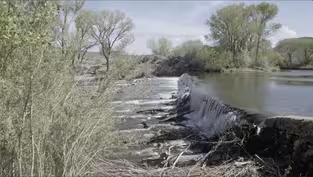
Carson City's Carson River Park and Historic Mexican Dam
Video has Closed Captions
Clip: S5 Ep7 | 8m 48s | Discover Carson River Park and the historic Mexican Dam in Carson City. (8m 48s)
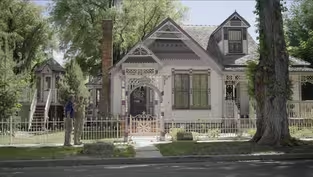
Carson City's Kit Carson Trail: From the U.S. Mint to the Governor’s Mansion
Video has Closed Captions
Clip: S5 Ep7 | 8m 21s | Explore Carson City's history on the Kit Carson Trail and visit the old U.S. Mint. (8m 21s)
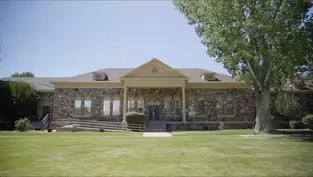
From Erasure to Empowerment: Stewart Indian School in Carson City
Video has Closed Captions
Clip: S5 Ep7 | 8m 4s | Explore Stewart Indian School’s history and how it’s become a place of healing and education. (8m 4s)
Providing Support for PBS.org
Learn Moreabout PBS online sponsorship













Support for PBS provided by:
Outdoor Nevada is a local public television program presented by Vegas PBS