
History of the Kentucky Derby
Clip: Season 1 Episode 239 | 4m 16sVideo has Closed Captions
Rachel Collier from the Kentucky Derby Museum talks about the history of the race.
Rachel Collier from the Kentucky Derby Museum talks about the history of the longest running continuously running sporting event in the United States.
Problems playing video? | Closed Captioning Feedback
Problems playing video? | Closed Captioning Feedback
Kentucky Edition is a local public television program presented by KET
History of the Kentucky Derby
Clip: Season 1 Episode 239 | 4m 16sVideo has Closed Captions
Rachel Collier from the Kentucky Derby Museum talks about the history of the longest running continuously running sporting event in the United States.
Problems playing video? | Closed Captioning Feedback
How to Watch Kentucky Edition
Kentucky Edition is available to stream on pbs.org and the free PBS App, available on iPhone, Apple TV, Android TV, Android smartphones, Amazon Fire TV, Amazon Fire Tablet, Roku, Samsung Smart TV, and Vizio.
Providing Support for PBS.org
Learn Moreabout PBS online sponsorshipThe 149th running of the Kentucky Derby is Saturday.
You know, this it was first run in 1875.
And there are things about the Derby's history you might not know.
The track wasn't always called Churchill Downs.
It was originally called the Louisville Jockey Club.
But many of the traditions we've come to know and love the hats, the roses, the mint juleps are traditions that date back to those first derby races more than a century ago.
We caught up with Rachel Collier, director of communication for the Kentucky Derby Museum, to give us a little bit of a history lesson.
The Kentucky Derby is the longest continuously running sporting event in the United States.
It has never not run since 1875.
So there is a gentleman by the name of Meriwether Lewis Clark Jr.
He is the founder of Churchill Downs and the Kentucky Derby.
His name, if it sounds familiar, that's Clark.
And there he was related.
His great uncle was George Rogers Clark, founder of Louisville.
In 1875, the very first Kentucky Derby, we had just a field of 15 horses.
There was a crowd of 10,000 people.
And the first winner of the Kentucky Derby is a horse named Aristides.
He was written by a black jockey named Oliver Louis.
And in 1902, the track was on the verge of bankruptcy.
And there was a group of investors who came in, and one of them was named Matt Wynn.
Matt Wynn was a marketing genius, and he wanted to make this race world renowned.
And he did it.
He did it in several ways.
He would recruit the top horses and convince people you need to bring your horse here and race your horse in the Kentucky Derby.
And we got really lucky.
In 1913, we had a horse named Donna Rail who won.
He was the longest longshot to win the Kentucky Derby and still is to this day.
The next year we had a horse by the name of Old Rosebud when old Rosebud set a record.
So that was another thrill.
And then finally, in 1915, Matt Wynn recruited a horse, a filly named Regret.
She whips, the boys, start to finish.
She led that race and she won by two lengths.
And it was just as Matt Wynn predicted crazy media coverage.
Those three years in a row were pivotal moments for the Kentucky Derby, and Matt Wynn took it a step further.
And through the years, he developed many of the traditions that we still know today.
The garland of roses that is blanketed upon the winner of the Kentucky Derby.
He also started the tradition of the mint julep collectible glasses.
He also started the tradition of the Gold Cup.
And it is a solid gold trophy that is awarded to the winner each year.
When you really look at what the Kentucky Derby has survived through, it is pretty incredible.
It has never not run.
We've always had it.
It survived a world war.
It ran in June that year, didn't run the first Saturday May, but it ran in June.
It has survived the Great Depression Prohibition era.
Of course, we have people sneaking in booze.
We know that it survived a pandemic, which we all saw.
We had that September derby, but we were bound and determined to have that or we weren't going to ruin that tradition of not having it run.
And then finally, in 2022, it was bridge strike was the horse and the victory that everyone needed.
He was the horse that didn't even belong in the Derby.
There was a last minute scratch.
He came into the field.
Wow, what a thrilling victory to watch him win.
And it was a story that people are still talking about.
You think about over 100 years of stories, whether it's the horse, the story, the trainer, the jockey has a neat story, and then everybody who's attending or watching it has a story about the bet that they made or the bet that they lost or that they liked a horse because of the name.
A lot of people have a really specific or special memory tied to a Kentucky Derby that they've watched or one that just stands out to them.
Now, before you watch the Derby Saturday, join Kelsey Starks and Chip Holston for Inside the Kentucky Derby.
Find out more about the Derby's history and traditions.
That's Friday night at nine Eastern, eight Central right here on K.T..
Video has Closed Captions
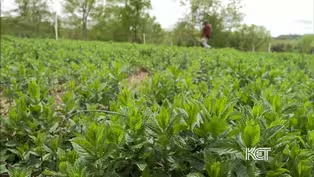
Clip: S1 Ep239 | 3m 4s | Kentucky Edition takes you to the farm that grows all the mint used at the Kentucky Derby. (3m 4s)

Video has Closed Captions
Clip: S1 Ep239 | 4m 17s | Meet the Richmond couple who run recovery centers. (4m 17s)
Video has Closed Captions
Clip: S1 Ep239 | 3m 18s | A Fayette County school receives a Green Ribbon Award. (3m 18s)
Providing Support for PBS.org
Learn Moreabout PBS online sponsorship
- News and Public Affairs

Top journalists deliver compelling original analysis of the hour's headlines.

- News and Public Affairs

FRONTLINE is investigative journalism that questions, explains and changes our world.












Support for PBS provided by:
Kentucky Edition is a local public television program presented by KET