TvFilm
History Reclamation Project | Pine and Genesee
Season 15 Episode 3 | 28m 45sVideo has Closed Captions
Join our host Jermaine Wells to watch two short films.
Join our host Jermaine Wells to watch two short films. “The History Reclamation Project” stories three black elders who made an irrevocable difference in Albany, NY. “Pine and Genesee” is an experimental documentary about the site of a former stop on the underground railroad.
Problems playing video? | Closed Captioning Feedback
Problems playing video? | Closed Captioning Feedback
TvFilm is a local public television program presented by WMHT
TVFilm is made possible by the New York State Council on the Arts with the support of the Office of the Governor and the New York State Legislature.
TvFilm
History Reclamation Project | Pine and Genesee
Season 15 Episode 3 | 28m 45sVideo has Closed Captions
Join our host Jermaine Wells to watch two short films. “The History Reclamation Project” stories three black elders who made an irrevocable difference in Albany, NY. “Pine and Genesee” is an experimental documentary about the site of a former stop on the underground railroad.
Problems playing video? | Closed Captioning Feedback
How to Watch TvFilm
TvFilm is available to stream on pbs.org and the free PBS App, available on iPhone, Apple TV, Android TV, Android smartphones, Amazon Fire TV, Amazon Fire Tablet, Roku, Samsung Smart TV, and Vizio.
Providing Support for PBS.org
Learn Moreabout PBS online sponsorship(lively music) (dramatic music) - Welcome to "TvFILM."
I'm Jermaine Wells.
"TvFILM" showcases the talents of upstate New York media makers across all genres.
In this episode, we'll share two films about untold local histories.
The History Reclamation Project is a participatory project created by high school students at Youth FX.
We'll hear the story of three black elders who made an irrevocable difference in Albany.
Courtney Symone Staton is an educator at Youth FX and the executive producer of the project.
(rhythmic synth music) - I ran this program called The History Reclamation Project, which connected high school students to Albany's local black history, by making a participatory documentary about three black elders who made some type of change in Albany, New York.
And I'm also the executive producer of the project.
And I worked closely with the students, and to guide them through the filming and the editing process, along with the help of fellow educators at Youth FX.
This is a participatory project, and we set that from the beginning, which for us means there is no director.
A lot of our decisions are made collectively.
First, it was having a lot of conversations about what does it mean to reclaim history, like what are the types of histories that we're trying to reclaim, you know, and what does that mean?
The name of the project is called The History Reclamation Project.
And that comes from a place that is very specific.
There's a lot of erasure of stories about black people, about the history of what we've done, and even some history of what's been, or a lot of history of what's been happening to us.
And I think that we try to carry that energy through the entire project, like we are telling stories about black history, but the root of them is that these people are still alive.
They still live in this area.
And they did incredible things.
They went through devastating things, but they did incredible things.
That is empowering.
I think being able to hold the difficult parts with the reality of what changes is where that empowerment comes from.
But the other empowering part that I remember is that these are young people who are telling stories, telling the story of what happened.
And ultimately, like, there is hope in part because of who is telling the story.
The core of it is, is this empowering for who we want it to be empowering for?
Who is our audience?
Like we're not focusing on a middle class white audience.
We're focusing on young black people who also don't know this history.
You know, young people of color, young people, people of color in Albany, black people in Albany, which are all different from the narrative that a lot of documentaries that we're told in the documentary world that our audience has to center.
Some of the stories that I heard, some of the histories that elders let me hold onto, helped me strategize, but also just helped me feel at peace, that I wasn't the only one going through it.
And I imagine that for some young people who watched this film, that the same thing probably happens for them, you know, that they're watching what's going on with the police.
You know, they're seeing the lack of history taught in their schools.
And then they watch this program, this documentary.
And they're hearing sound bytes, and statements that feel very close to the thing that they couldn't name.
One of the elders that we interviewed last year, Michael Brown, also passed recently.
Also just hoping that everyone who watches this film particularly holds that story, and holds the work that everyone did, but also that he did.
Reclamation is an action.
Holding histories is an action.
And I think it's one that is especially urgent now, because there's so many elders who have done so many incredible things.
And I hope, that especially for our black elders, that we're giving them all their flowers now.
Let's not wait.
(calm guitar music) - I was born in a place called Clover, Virginia.
It's right in Halifax County.
My father worked, he came up here to work on the brickyard.
He was a migrant worker for a couple of years, going back and forth.
He brought us up, and my grandfather on my mother's side, they both worked in the brickyard also.
And this is a picture of her again with her kids.
And this is my grandfather.
I came to Albany when I was 11.
It was the first time ever I went to school, where it was not just black kids.
If you were poor and you were black, more than likely you was gonna get drafted.
That army experience, it was not anything I recommend for anybody, by the way.
But spent two years in the army.
And then after the army I went to SUNY at Albany, and I got a degree in political science from SUNY at Albany.
(calm music) At Albany, it is a one-industry town, their industry is government.
One of the things that Brace and I did was that we were the first ones in the black community to reach out and form alliances with the women, and people in the LGBTQ+.
I got the hate mail, and the obscene phone calls, to support that too.
I did live in North Colonie Latham for a few years.
Black people weren't allowed to move to the suburbs until the late '70s in Albany, right?
It was very difficult out there, especially for the children, because there was so much racism surrounding them, that if I hadn't left there, they would have to encounter on a daily basis, and that would beat them down.
I didn't have much of a choice.
I moved back to the neighborhood.
But I've been there for 40 some years on Ten Broeck Street, right by the Palace.
It was very important for me, and especially my children, to be comfortable, and to be around people that look like me.
And that had some of my same background and history.
Things have changed up there now.
And unfortunately things have changed down here now too, in a certain kind of way.
But when you get around your children and your grandchildren, you have to be hopeful, because you gotta think, and you gotta try to make things better for them.
You wanna leave them in a better situation than you came in here with.
If you look around here, we need so much.
I've tried my best.
I've been in the field, I've been battered up sometimes pretty badly.
But I've always tried.
People may not consider me somewhat successful, but then again I was born in a shack in Clover, Virginia, with nothing.
And my mom had a third grade education.
You have to know yourself, and what your people have been through.
What just like propels me so much is that as hard as I might say, yeah, I had it tough, and so forth, I didn't quit school at eight and go to work in the fields, like my mother did.
We have to see ourselves in a positive light, and reclaim our history and our worth.
And as they used to say, don't leave anything in the gym.
I mean, get out there and struggle, and hit it, and try, because you can do it.
- [Interviewer] So Courtney told us that you're from North Carolina.
(ambient music) - Yeah, originally from North Carolina, Salisbury, North Carolina.
A little small town that's on the outskirts of Charlotte.
If a person said hey, can I talk to you?
It's not like, hey, can you gimme something?
It's like, I really want to talk to you.
Good morning, they really mean good morning, you know.
Boy, come on in here and eat something.
They really mean that, and believe it.
I mean, you know, it was just straight up respect for each other.
I came from that type of atmosphere, that type of background.
I didn't think that, you know, Salisbury at that time was progressive enough for me.
I didn't see the change that I wanted to see coming, you know, because down there there was a lot of segregation.
And we had to face this, you know, firsthand.
I mean this is not something that we saw on TV.
This is something that we actually went through.
So I wanted to get away from North Carolina.
You know, I left North Carolina when I was around 19 years old, 20 years old.
I was looking for excitement, (groovy music) had no idea what college life was about.
So I went and picked up a GED book, and it took me like three weeks, and I passed it.
And I for some reason put in an application for SUNY Rockefeller College.
When you come here, Rockefeller College at that time said, oh well, this is the neighborhood you should live in.
Don't live over there in Harbor Hill.
Don't go over past Clinton Avenue.
Don't go over in the south end where we at, this is a good spot to live in, right?
But as a student, I decided I didn't want to live on campus.
So I decided to walk over there to see what was going on.
Went over there and saw a bunch of black people hanging out on the stoop.
On the stoop talking, having fun, and enjoying life.
So I moved over there because that's what I wanted.
And we in the neighborhood, and I saw a lot of stuff going on that wasn't right.
Okay?
And the people in the community started coming to us, because we're college students.
And I remember this old lady came to me and she said, oh, I got a water bill for $10,000.
How could I get a water bill for this much?
So I said, give me the water bill, I'll go down to city hall.
I'm sure it was a mistake.
And I go down there, and City Hall said, hey, yeah, that's a mistake.
But being that she already paid it, you know, we can't reverse our money.
And I said, this is (no audio), what do you mean you can't give this woman back her money?
So I went to the mayor's office.
He don't want to hear what I say.
And I say, you know what, I'm gonna run for public office.
We started making flyers over at SUNY Albany.
No one thought we had a shot in hell to win this election.
And we are sitting there strategizing on how we gonna do this.
Well I say, you know, they never ran campaigns, so they don't know how.
'Cause they're sitting here appointing black people.
It didn't matter if those people understood the political process or not.
They didn't care about that, because in Albany it's a zero sum game.
There's only so much of the pie.
So we ran against them, everybody was mad at us.
One guy had dogs running us up and down the street.
Couldn't put flyers in the mailbox, but we decided, okay let's go forward.
And we also looked at the layout.
The upper part of the third ward was predominantly white, Irish, Italian.
(electric guitar music) People I ran against only wanted to target the people in the Ten Broeck Triangle area.
Totally forgot about the people that lived up there.
Why?
Because they was white.
And so we got there, television showed we had lost, but we are sitting there on the porch, eating pizza, me and the kids, you know, Bobby, Lisa, all the kids, on the block.
We sitting there on the porch eating pizza, and the ward leader drive by.
He go, "Hey Mike Brown."
I said, "What?"
He said, "You in the toilet, man."
So I'm eating pizza with the kids.
So we started laughing, right?
And, "We don't see what's funny."
I say, "Yeah," I say, "did y'all realize "that there's about 200 more votes coming in?"
And so they had to open up those ballots.
We were sitting there and they open up the ballots, and they were saying, who's gonna, are we gonna accept these ballots, or are we gonna challenge these ballots?
So I know when I look at those ballots, where they come from.
You could look at the area, you could look at the street, and you know that either they came from uptown Albany or downtown Albany.
And so when they start opening up the ballot, they was winning, breaking away.
So he's sitting there laughing at me, and then, the big stack of ballots, I looked at 'em, 'cause they pass them around.
You want to look at them.
And I gave them back to the guy, and I looked at the guy I was running against, and I said, "It's party time now."
And everything they opened up was Brown, Brown, Brown, Brown.
They lost, they ended up losing their margin, and we end up taking them by 30 votes.
(chill electric guitar music) I was able, and still are able to help a lot of people.
But I served with people who had my back.
There was three of them, four of them.
And they was all people of color.
They were women.
Sarah Carrucan, Shirley Foskey, she was the city counselor, Betty Barnett, she was the city treasurer.
And I had friends like Dennis.
Okay, these were the people I had to deal with.
These are the people we strategize with.
And I'm proud that I had these people surrounding me, because I'm gonna tell you something, you don't gotta be the smartest person in the room, but if you surround yourself with good people, you gonna do okay.
- Miss Clara, everybody call me Miss Clara, even if I don't have to, I don't even tell them that.
I mean they just, automatic, call me Miss Clara.
I was born in Langsdale, Mississippi.
And life was good because my mother was a widow.
My father got killed before I was born.
And so my mother, she raised us, she ended up getting a grocery store.
At that time down south, they called 'em shops, and had a music box in there, play music, and people would come in and put money in the box, and also sold food.
You know, a lot of chips, cookies.
And we had different type of sandwich we sold over there.
And so, matter of fact I took over, because my mother, she got so she didn't wanna bother with it.
So I took over everything.
I got married at the age of 19.
My husband came to Albany.
My brother, he had came here.
And so he came back and he said, you can get a better job in Albany.
When I came to Albany, I didn't like Albany at all, 'cause I thought Albany was a bigger city.
I thought Albany was big like New York City.
But I got here and I found out Albany was very small.
And I didn't do anything in the beginning.
And I was just here.
I had two kids.
I brought two kids with me.
And it was just like lonesome, you know?
And my friends, you know, all my friends, they was left in Mississippi.
Okay, I was the first member of the village.
What happened, I was coming from church and I was going by to visit this lady.
She was sick.
And I met Willie White, he's the executive at the time, and he had a lot of flyers in his hand, passing 'em out to people.
And he asked me, did I wanna be a member of the village?
He was starting an organization.
I said, sure, I done retired.
I said sure.
And so that's the way I got into that, the village.
I know this is an organization, but I didn't know what we would be doing, you know.
Somebody passed away, somebody get killed, we would cook, raise money for them, somebody have a fire, we would raise money for that.
And we always, you know, sometime we did a lot of traveling, going places, we did.
And around in the city we went all over the city, you know, to different organizations, and peoples having meetings and everything.
And we did a lot of marching in Albany, you know, about different things.
We used to march downtown there at, matter of fact, we used to march in the mall up there.
That's what we did, you know.
And also I did a lot of cooking.
I have cooked for probably maybe 150 people, just me, alone.
I enjoy cooking, because I learned how to cook, you know, down in Mississippi some.
My mother used to do a lot of cooking, and the people used to come to the house, and if she have anything sitting on the table, cake or pies, they would take the cake and pies, and start eating them, you know.
My mother used to have to hide her food before we could get food.
And so I guess I picked up some from her.
Well, what made me start Mississippi Day, it was Reverend Jack Johnson, he was from Mississippi.
He came here, and he used to go back every year, and sometime before that year.
And he used to bring peoples to Albany, and he brought over a hundred families here.
And he used to like have a small march down at his church, St. John's Church.
And I thought about that.
I said, well, there's so many peoples here from Mississippi that we should have, after we got the organization, I said, we should have a Mississippi Day.
I went to Mr. White and he said, you're right, Clara, he said that we should.
And so that's what we started up.
A lot of people was helping, trying to get it going.
'Cause it was a lot, to get Mississippi Day going.
And so what we did, we was asking people, some peoples you know, they would help us, and some peoples didn't.
And so what we did, this one guy was named Mark Bob Simpson.
He'd say, Miss Clara, he said, we gonna have Mississippi Day for you.
I don't care.
And when he said that, tears almost came from my eyes.
I said, not for me.
I said, it is for everybody.
And everybody can come to Mississippi Day.
You don't have to be from Mississippi.
The peoples love Mississippi Day.
Peoples come from different places.
Come from Mississippi, come here to Mississippi Day, because they hear about it, they done heard about it, and they like it.
We have the history of Mississippi that day, also.
We talk about Mississippi Day, what done happened there?
And you know, talk about some of the people that came here.
We have a lot of history on Mississippi Day.
The importance of that that the younger generation will learn about Mississippi.
Where we came from, what we did.
You know, that's the important thing is that, 'cause a lot of peoples don't even know.
I learned how to treat peoples, how to talk to people and how to treat them.
And if I can do anything for you, if you need my help, I would do my best to do it for you.
(calm music) - Next, filmmaker Kelly Gallagher presents "Pine and Genesee," an experimental documentary about the site of a former stop on the Underground Railroad, the erasure of history, and what we owe those who came and struggled before us.
- This film was made possible by a grant by the Wexner Center of the Arts, and specifically Dave Filipi at the Wexner, who commissioned this film, and films from 20 other filmmakers all across the world.
I was honored to be a part of this project.
But the Wexner Project is called "Cinetracts," And this hearkens back to a 1968 project including Godard and Chris Marker, where they created short cinematic responses to the political and social upheaval that shook Paris in May of '68.
And so, Agnes Varda was a part of it.
So filmmakers were making these quick, like roughly two-minute films, documenting the political struggles of their community, and of things that were going on.
And so the Wexner, in 2020, decided to sort of recreate this project.
The film had to be created in a 24 hour window, or 24 hour period.
This was during the kind of height of the early quarantine.
I was aware that, you know, Syracuse had been this abolitionist hub, prior to making this film.
But I didn't know, I hadn't known too much about Jermaine Loguen and his specific and imperative and huge role in making Syracuse such an abolitionist hub.
It wasn't until this kind of moment when all my senses became far more hyper-aware that I noticed this small sign outside Walgreens one day, and was really moved by learning about the history of Logan and his wife, his partner Caroline, and wanted to explore their story, but also wanted to kind of think through the ways we try to honor these legacies of resistance.
You know, this sign, literally this small placard, feels so, so much smaller than it should be.
Like, it feels like this should be something way bigger, way more known about this corner in Syracuse.
And I'm sure that's the case for so many corners like all across America, where there have been such important historical struggles against white supremacy, against capitalism, et cetera.
But the goal, or part of the goal with the film is, beyond, you know, remembering is important, and often it's even hard to do so with such insignificant markers, it feels like.
But even more so than remembering, how do we redeem?
How do we continue, how do we think about those struggles in a context of today, and all the work that still needs to be done?
(calm music) (telephone tone beeping) - [Automated Phone Voice] Hi, thanks for calling Walgreens at the northeast corner of Genesee Street and Pine Street in Syracuse.
Sorry, I can't hear anything on the line.
To continue, please press one on your telephone keypad now.
You can talk to me using full phrases.
For example, you could say, Now how can I help you today?
(wind chimes ringing) If you're calling about a prescription, or if you have any questions for the pharmacy, press one.
For the photo department, press two.
Or for anything else, press three.
Thanks for calling Walgreens.
Goodbye.
(upbeat synth music) - Learn more about the films and filmmakers in this season of "TvFILM" at wmht.org/tvfilm.
And be sure to connect with WMHT on social media.
I'm Jermaine Wells.
(uplifting music) - [Announcer] TvFILM is made possible by the New York State Council on the Arts, with the support of the office of the Governor, and the New York State legislature.
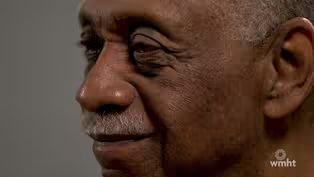
Discovering the Impact of Personal Narratives
Video has Closed Captions
Clip: S15 Ep3 | 2m 48s | Discover how personal connections to untold stories enrich our understanding of history. (2m 48s)

Exploring the Power of Ideas in Filmmaking
Video has Closed Captions
Clip: S15 Ep3 | 2m 29s | Exploring the impact of Walter Benjamin's words on Kelly Gallagher's "Pine and Genesee." (2m 29s)
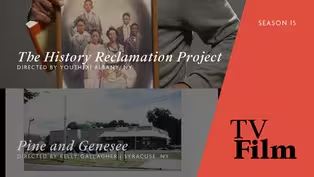
History Reclamation Project | Pine and Genesee: Preview
Video has Closed Captions
Preview: S15 Ep3 | 23s | Join our host Jermaine Wells to watch two short films. (23s)

How Experimental Animation Makes Filmmaking More Accessible
Video has Closed Captions
Clip: S15 Ep3 | 1m 22s | Explore the joy & accessibility of experimental animation with Kelly Gallagher. (1m 22s)
Providing Support for PBS.org
Learn Moreabout PBS online sponsorship



Support for PBS provided by:
TvFilm is a local public television program presented by WMHT
TVFilm is made possible by the New York State Council on the Arts with the support of the Office of the Governor and the New York State Legislature.