
History Room at Decatur Library
12/16/2021 | 29m 49sVideo has Closed Captions
Mark McDonald visits the History Room at the Decatur Public Library
Mark McDonald speaks with Becky Damptz, Head of Archives & Special Collections at the History Room in Decatur Public Library.
Problems playing video? | Closed Captioning Feedback
Problems playing video? | Closed Captioning Feedback
Illinois Stories is a local public television program presented by WSIU
Illinois Stories is sponsored by CPB, Illinois Arts Council Agency, and Viewers like You. Illinois Stories is a production of WSIU Public Broadcasting.
Support provided by:


History Room at Decatur Library
12/16/2021 | 29m 49sVideo has Closed Captions
Mark McDonald speaks with Becky Damptz, Head of Archives & Special Collections at the History Room in Decatur Public Library.
Problems playing video? | Closed Captioning Feedback
How to Watch Illinois Stories
Illinois Stories is available to stream on pbs.org and the free PBS App, available on iPhone, Apple TV, Android TV, Android smartphones, Amazon Fire TV, Amazon Fire Tablet, Roku, Samsung Smart TV, and Vizio.
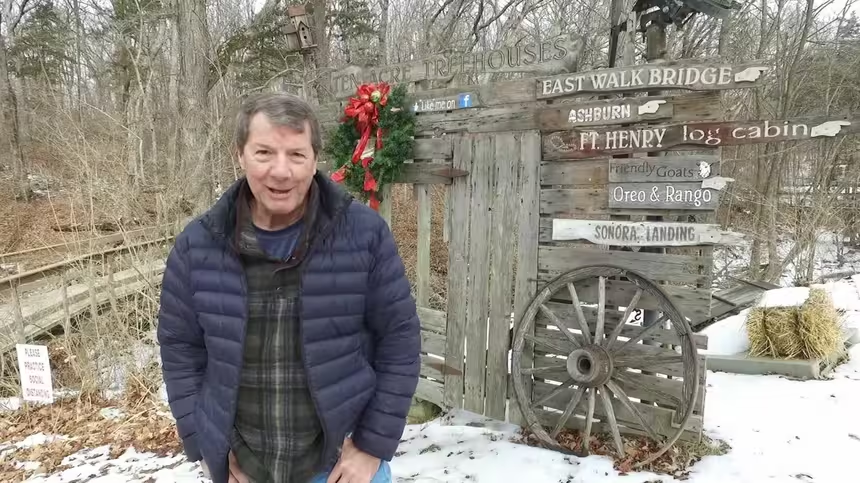
Illinois Stories
Join Mark McDonald as he explores the people, places, and events in Central Illinois. From the Decatur Celebration; from Lincoln’s footsteps in Springfield and New Salem to the historic barns of the Macomb area; from the river heritage of Quincy & Hannibal to the bounty of the richest farmland on earth.Providing Support for PBS.org
Learn Moreabout PBS online sponsorship(drum music) (upbeat music) - [Announcer] Illinois stories is brought to you by The Corporation for Public Broadcasting, Illinois Arts Council Agency and by the support of viewers like you.
(upbeat music) Thank you.
- Hello, welcome to Illinois stories.
I'm Mark McDonald in Decatur which like everywhere else has a very rich history.
But unlike everywhere else, you can head into town in Decatur and go to the public library and immerse yourself in that history.
Becky Damptz, not too long ago, the library had the opportunity to expand the local history room.
And you went from something like what, 700 square feet, all of a sudden, like almost 4,000 square square.
- 1700 Square feet to 3,700 square feet.
- To 3,700 square feet.
- Yeah.
And if I include this closet, it's 4,000.
(Mark laughs) - So what did you do with all that space?
It probably took you several years to get used to that and be able to sort of build up to it.
- Yeah, in fact, we now kind of feel that we're running out of space.
If you check our back room, which I'm sure we'll show you guys.
- [Mark] Yeah.
- But yeah, we have this.
We were able to take everything from three different locations, the little room, the lease space upstairs, that's this empty part of the building and this closet right here and move everything into our back room.
So everything is in one place.
- [Mark] Yeah, yeah.
- And we can find it.
And we don't have to go from one place to another and dig through all these boxes to find it anymore.
- Yeah.
And also for your patrons, it's better too.
Because they know if they come to this room and they're looking for genealogical information or anything historical, they can get it here.
- Absolutely.
They can, yeah.
We're a really good jump off point because we do have a genealogical society in town.
But people can come here and they can start on their ancestry or their heritage network.
We also can look up stuff in the Harold and Review newspaper for them, print out articles, obituaries, whatever they need, birth records and get started here.
And then if they need to go further, like deep dive into the people they can't find then we send them off to the Genealogical Society.
- I see.
Okay.
You have some treasures here.
And then what you did for us in anticipation of us coming, you got some of them out for us.
- Yes.
- And this one here, we start off with probably the most valuable document or photograph you have.
This is an original campaign poster from Mr. Lincoln's first campaign?
- Yes.
- And this right here.
And of course it's been well taken care of and you've got it... was it Mylar that you got there.
- Yeah, this is a Mylar sheet that it's in and it's not sealed in there.
So if we need to get to it, we can take it out.
It was originally framed and hanging in this closet just out of sight, out of mind.
And we were able to save it.
We got this actually from Jane Hammond, who was Abraham Lincoln historian.
She donated all of her material to the Carnegie library in 1922.
This is one of three pieces that we have left.
And that's it from that group.
- (indistinct) from 1860.
The original.
- 1860.
- Its amazing.
- It is an original.
- And right next to it, I love this because Carl Sandburg of course he was a Lincolnophile.
I mean, he loved Lincoln.
And so he wrote, this is his own hand.
- [Becky] Yes it is.
- He wrote a poem about how Lincoln thought that men were like trees.
And this is describes, describes and this is from 1927, February, 1927.
- Yeah, and we're really excited about this because it's a one of a kind about Decatur.
I mean, how many places?
I'm sure you wrote for other places, but how many people can say, "Oh yes, Carl Sandburg came here and wrote a poem about Decatur when he was here in 1927."
On the back of a poster for his program when he was here.
- That's great.
That's really neat.
And is this the oldest map that you have?
- so this is the oldest original plat map that we have.
This is from 1874.
We opened it to the page that shows Decatur and what it looked like in 1874, but the whole thing is for Macon county itself.
So it shows every single township, including Milam, which no longer exists.
- Well then what did you say, including what?
- Milam - Milam.
That's a township.
- It was a township.
It's now absorbed into Mount Zion.
- Oh, okay.
- Yeah.
But this is the actual book.
So what they did is they cut the pages and put them into their own individual sleeves to protect them from any further damage.
- And it's okay if I touch this like this.
- It is okay if you touch it, yeah.
That's why they did it so that people can flip through without worrying about it.
- What a fascinating way to... Yeah.
And look, this is Hickory point.
Is that a township or... - [Becky] It is, yeah.
That's the one we're Forsyth is.
- Okay.
Wow.
- Yeah, and it shows etchings and lithographs of the different farm and stuff.
So there's actually an image in here of King's orchard, which is where old King's orchard neighborhood is now, yeah.
- Well, it's fascinating.
And these are all pictures or like say, sketches of what's going on in those townships and in the various homes and farms.
- [Becky] Yeah.
(mark laughs) - Neat.
That is so neat.
- It's a very interesting book.
- If your family was from around here from a hundred years ago, wouldn't that be great to be able to... - Especially if you knew they owned farmland.
So you can figure it out.
The other really cool thing about plat books is as the city expanded, obviously it took over.
So you can go through a plat book and go back and back and back and see who owned the farmland, where your house is sitting now on the outskirts of town.
Or what you think is now the outskirts of town, you know.
Whereas in 1874, the outskirts of town was probably, oh, I don't know.
I think here it would be... - Not far from Maine and Maine.
- No.
Not far from Maine and Maine.
(Mark laughs) But I think here its actually Fairview.
- Okay.
- So which is 48.
So anything further beyond that, you know, the west end of Decatur, people can come in here and go, "oh, that was so and so's plot of land."
Okay, great.
That's, you know, usually what we're seeing.
- Yeah, yeah.
And you know, I just kind of wanna walk around because what you've done here, because these are a pair all the time.
But this map here is, well its a map of the United States.
It's ancient.
- [Becky] Yeah.
So this is from 1835.
It was donated to the library and 1970.
We've had it proudly displayed in both local history rooms in this building.
I'm not sure if it was displayed in the local history room in the north street building, I believe it was.
But it actually shows territories instead of states because some of those states were not states, like Arkansas and Wisconsin.
- Yeah.
I don't know if we could see this on the camera, but if you look up at lake Michigan, Michigan the state is on the right side, Michigan, the territory, which is now of course, Wisconsin is on the left.
So Wisconsin was not even named Wisconsin.
- [Becky] No, it wasn't.
(Mark laughs) And then down on the bottom here it actually shows the other territory's for the rest of the United States.
- Wow.
- [Becky] It's a very interesting piece.
- Now people from Decatur know the name Hieronymus Mueller.
They may not know all that he did, but he has a factory that still is operating here, that's named after him.
But he was quite a man.
He was an inventor, he built cars.
He made those valves and all that stuff that, that the company still does.
So he was really instrumental as a city father wasn't he?
- Absolutely.
Yeah.
And he also was instrumental, him and his sons helped start the volunteer fire department, which then became the fire department we have today.
And his tapping valve, I was just talking to someone who used to work for Mueller and saw it recently, the tapping valve hasn't really changed since he invented it.
- [Mark] Yeah.
Yeah.
- I mean, there's been a few adjustments here and there, but it's almost exactly the way when he invented it.
And then he's one of the reasons, if I have this correct, he is one of the reasons that we have a basic transmission.
He actually developed the ability for the cars to go backward instead of just going forward, because otherwise you'd have to get out and push.
- [Mark] Yeah.
(Mark laughs) - But one of his cars is sitting at the Mueller museum and of course, everybody's welcome to go there and see it.
And they're under a new directorship and I highly recommend going back there if you haven't been there.
- [Mark] Well we'll go back.
We'll go back and do a story there.
- Yeah.
- Now this is an interesting photo because the transfer house is an iconic location in Decatur and this is where it originally was.
Or there was a transfer house there earlier.
This is the one that everybody recognizes.
And this would be from like the twenties, I guess.
- [Becky] So this one is actually probably about turn of the century, about 1900, 1910, based on what the women are wearing.
And that transfer house was built in 1896.
The previous one was built in 1892.
And it was literally a shack, just a little tiny building.
- Yeah.
- But this was prominent and set prominently in the middle of Maine and Maine and all the buses and all the trolley cars went around it, including the inter-urban, which went out to Springfield.
- We jokingly say Maine and Maine every time we're in Decatur, because it seems like everything was at Maine and Maine.
- Pretty much.
- (indistinct) ... a main and a main.
- Maine and Maine was the, it's called the old square.
There's the old square and the new square.
The new square is central park.
The old square is Lincoln square, which is Maine and Maine.
And that's really where the city started, was Maine and Maine.
And then central park is fascinating because it was land that was given to us by captain David Allen, because he wanted to build a train station there.
Couldn't build the train station there.
Had to go to a little bit different ground 'cause it's too hilly.
So he's like, okay, we'll turn it into a park and don't build anything on it.
(Mark laughs) - Okay.
Let's go back to Maine and Maine here.
- [Becky] Yes.
- And I think, is this Maine and Maine?
- [Becky] That is Maine and Maine, yes.
- Okay, it's interesting what we have here, because you have an artist and a close friend of yours, I guess, that does this.
- We do.
He's one of my volunteers.
His name is Chuck Flynn.
And he's really great with graphic design and whatnot.
This is actually one main place.
The building still exists.
It is the back half of the St. Nicholas hotel.
It's also the spot in the parking lot where the original courthouse sat and its original foundation.
- And that's what the original courthouse looked like?
- It still looks like, actually.
- Yeah, 'cause it's on the grounds of the history museum, right?
- Mm-hmm (affirmative) It still exists.
It's in the yard of the history museum up by the airport.
And so it's still there.
It's one of the oldest buildings in Decatur.
It was built in 1830.
- Okay.
So we still have that.
- Yes.
- It got, it got removed, but we still have it.
- Mm-hmm (affirmative) - This is the second courthouse and this is of course a drawing of it.
- [Becky] Yeah.
- But unfortunately we have nothing of this left.
- We don't.
No, this is the... As far as we know, based on conversations with different historians in town, this is the only image we have of the second courthouse.
And this was across the street from the the original courthouse.
And for anybody interested, it's actually where the Staley mural is now.
- Okay.
- So that gives you kind of a location.
- Okay.
Now let's turn around because we mentioned the transfer house and we have some really good photographs right on this wall without the trolley in front of it.
This transfer house is still in Decatur got moved.
- [Becky] Yes.
Yes.
- [Mark] Right?
- [Becky] Yeah.
It was moved in 1962, literally lifted up onto a back of a truck and moved to central park and that's where it's sat ever since.
- Mm-hmm (affirmative).
Okay, we take a short break away from this turn of the century material and we look right down in front of us here.
And what you like to brag about is some of the exhibits that you put up.
And this one for instance is from more recent days and years, but you have a... What's it called?
What's it called a boo at the zoo?
- Boo at the zoo.
- Okay.
- Yeah.
- So what you do, and you and your crew do is you go through photographs from the newspaper mostly, and you find these from years past and you put them out and people come, look at them and say, "oh, that's what little Jimmy looked like in 1974."
- Absolutely.
Yeah.
- This is kind of cool.
- Yeah.
And this is this a Scovill Zoo.
And they've been here for a long time.
And in fact, the director of Scovill Zoo is in this photo here.
And he was here the other day and was really excited that we had this out.
- Let's go ahead and put this far so we can see.
- [Becky] That's Ken Frye.
- Okay, he's no longer the director, but he was.
- [Becky] No, he is the director.
- oh, he is the director, okay.
Well, he's got those goats eating out of that pumpkin.
- [Becky] Yeah.
Yeah.
But we like to do displays like this, where we show, past events going forward.
Stuff that people know and love from their childhood, that's still happening, you know.
So like, when their kids were little and it's still going on.
- [Mark] Mm-hmm (affirmative).
- And because it was just Halloween, that's why this is up here.
- Yeah.
Yeah.
It's coming down pretty soon.
- It's actually coming down next week and we're replacing it with new years.
But I'm not the one who does all these displays, Pat Riley and David Froman does them.
And I kind of have to mention that, 'cause they're really good guys.
- Oh, sure.
I guess.
Well, I mean, number one, they have to come up with the ideas.
They have to find all the stuff and then in some cases make copies and put them in frames and that's a lot of work.
- It is lot of work.
Yeah.
And some of the stuff gets planned out months to almost a year in advance.
Every time we do a black history month display, the minute the black history month display comes down, David's already planning the next one for the next year.
So it's ready to go when he's ready to go with it.
- Yeah.
- Yeah.
It's great.
They're really wonderful.
- Becky.
This is one of hundreds, dozens, I'm not sure, but you've got drawers back there full of these.
This is a very old map of Decatur.
- [Becky] This copy is very old mark, yeah.
- [Mark] Right.
Right.
And this would have been from when?
- [Becky] 1869, and it's an bird's eye view of Decatur.
So it doesn't show straight down, it shows off to the side.
You can see the river, you can see different landmarks.
They try to do almost a three-dimensional thing with it where you can actually see the little houses and stuff, which is very neat.
You don't normally see on maps.
- [Mark] No from 1869, you wonder.
Of course there were no airplanes.
You wonder how they would even even conceive of a bird's eye view.
But it's interesting.
- [Becky] There's a possibility that they could have stood on the other side of the lake, on one of the higher points, like the Allen Bend area and looked over.
But we're not quite sure what they did.
- [Mark] Yeah.
- [Becky] Yeah.
- That's really nifty.
That's nifty.
A lot of people aren't aware of this.
Everybody knows that central Illinois is coal country, but not everybody knows how much of Decatur was undermined, was coal mines.
- Absolutely, yeah.
- Now they're all closed now.
But when you look at the...
It's the pink area, isn't it?
That was all coal mines.
- So actually it's this red area and this green area here that were longwall coal mines.
- [Mark] Mm-hmm (affirmative) - And then around it just kind of shows where coal was or is.
So there's still a lot of coal under Decatur, but these here particularly were the actual mines themselves.
- [Mark] Those were big mines.
- And you'll notice this is underwater.
Yeah.
I think just went down really, really far so.
And this mine here, they actually always had to pump out the water after the lake went on and even before that, when it was just a river.
- [Mark] Yeah.
Yeah.
- [Becky] Some of the openings still exist.
You are not recommended to go down there.
(Becky laughs) - [Mark] No, no, - [Becky] They are sealed off, but they do still exist.
- [Mark] Yeah.
Let's move these, if you don't mind.
- [Becky] Sure.
- Will you take this one?
- I'll take this one.
- And I'll be very careful with this one.
'Cause I want to show the display that you have right under it.
- Okay.
(paper shuffling) - You got it.
You got part of it.
There you go.
- I got part of it.
- All right.
- Just put it right on top of this one.
- Thank you.
(paper shuffling) You and your crew like to do this too.
And what you've done is use this table space, very imaginatively.
- We do.
- Because you have, like every town does, you have certain businesses that have been around and people remember from their childhood, et cetera.
And one of those places is the chocolate shop, right.
- [Becky] Mm-hmm (affirmative) Yep.
the chocolate shop was at 221 North Water Street.
And basically, it was a chocolate shop.
- [Mark] Mm-hmm (affirmative) - I believe it also had like sodas and stuff as well.
- Sure.
- But yeah, it was well known.
And in fact, people come in all the time going, "oh, I wish we still had that or..." - I bet they made their own chocolate too.
- They did.
I believe they did.
- Mm-hmm (affirmative).
- Yeah.
So, and that was just a neat little place.
- All these ads and articles from throughout the years.
Yeah.
These probably all came from the Decatur Herald in review, I assume most of them.
- They did, yeah.
But look they had Tangerine, orange candy and you know, just different little things at this confectionary.
- [Mark] Yeah.
It makes me hungry.
- [Becky] Yeah.
You could also apparently get lunches.
- [Mark] Oh.
But they did.
- [Becky] So they had an actual lunch.
- [Mark] They probably had a soda shop and... - [Becky] Sandwiches.
- [Mark] mm-hmm (affirmative).
- [Becky] Yup.
- And the Conklin's also another sweet tooth.
My sweet tooth is shown.
Conklin Bakery was also one.
And that's what you got on this table.
- Yeah.
So this one was on East William Street, in the 100 block of east William street.
And it was a bakery.
And you know, they had like clean made bread, which I love this ad.
I don't know if you can see it from here.
But it says kept clean from the oven to you, you know.
(Mark laughs) As compared to what?
Were you putting and rolling it in dirt.
I'm not sure.
But that it's cute.
- [Mark] It's very cute.
- And this actually shows the inside of the bakery right here.
- [Mark] It was a pretty big operation, wasn't it?
- [Becky] I believe so, yeah.
- [Mark] It wasn't just a storefront.
It was a big operation.
- [Becky] No.
It was an actual operation.
- Mm-hmm (affirmative) Okay.
Now also they're no longer here, doggone it, the Carnegie library.
Well, it's a mixed thing because now you have all the space you would have never had in the Carnegie library.
- True.
Yeah.
- But it'd be nicer if the building itself were still there and could be used for something else.
- True.
- Where was the Carnegie?
The original Carnegie library.
- The Carnegie library was on North Main and El dorado.
Now there is a bank there.
I think it's the first mid bank.
But yeah, we sold it in 1970 and in 1972, it was torn down by the bank.
And we moved to the North Street Library.
- You are certainly lucky to some of this survived, some of the furnishing survived.
Show us this piece right here.
- [Becky] Sure.
- This is from the old Carnegie library.
- So there are several pieces that are actually in the library itself today that are from the Carnegie library, this happens to be one of them.
And this was in the art department.
- Oh, that's nice.
- And the roll top still works.
Probably turn of the century.
- That is nice.
And look how effortlessly that went up.
- Yeah.
- [Mark] That's pretty amazing design.
- Yeah.
Its in great shape.
- [Mark] Yeah.
- Its was used in the north street library in the art department.
When we moved to this building in 99, it was put in local history in the original room and it was used by us for storage.
And in fact, we use the drawers, which still work too.
- [Mark] Yeah.
Don't give up space for heaven sake.
- You know, this is where we store a lot of our old requests and stuff.
So if you make a request from us, we do keep it for two years in case you need to come back and get it.
- Now, Mr. Millikin, we were accustomed to, you know, hearing his name associated with the college.
- [Becky] Yes.
- And he did in fact name...
The college was named after him.
- [Becky] Yes.
- But he made his fortune in land and banking.
And this is the Millikin bank.
Unfortunately it is no longer there.
- Yeah, it's gone now.
And in its place is a big brown building called the Millikin building.
But yes, that was torn down.
I can't remember if that burned or if it just got torn down, I believe it just got torn down.
But a lot of the buildings on this sheet right here of images are gone except for the first national building and the citizens bank.
- This is the first national building.
This is still here.
- [Becky] Yes.
Its called Busey.
- Okay.
Oh, Busey bank and citizens bank is still there, but- - [Becky] yes, - The old high school?
- [Becky] The old high school is gone.
That's where the civic center is now.
- [Mark] Oh, okay.
- [Becky] And then the US post office and YMCA.
The YWCA is still there, but the old post office is gone.
- [Mark] Post office is gone.
- [Becky] Yeah.
- Now you have some, the 1CME side of Decatur shows up here, right, right above.
Who was... What's his name Froman?.
- Yeah.
So Ed Froman.
- Ed Froman.
- Ed Froman is the great-grandfather of one of my volunteers, David Froman, who actually does all of my displays.
And he has a fascinating history.
He was not only a saloon owner, but he also ran for the alderman of the fifth ward.
- [Mark] Okay.
- [Becky] Yeah.
So he was also a politician.
- [Mark] Now, he's the fellow with the vest right in the middle of the doors.
- [Becky] He is.
- [Mark] Okay.
- [Becky] Right by the dog.
- [Mark] Yeah.
- [Becky] And in this photo, this is a saloon that was at Maine and Franklin.
And we looked it up, he actually used to rent to eight ladies of the evening, in his upstairs.
- [Mark] And he didn't get shut down for that?
- [Becky] Didn't last very long.
- [Mark] The saloon lasted.
- [Becky] The saloon lasted.
- But the other operation didn't.
- That didn't last very long.
Not in Decatur.
Not, it's not gonna fly here.
What was the orange blossoms?
- [Becky] The orange blossoms.
- Who were the orange blossoms.
- [Becky] So it's a burlesque show or Oriental dancing show.
And this is actually on Franklin street where the library is today during the 1892 corn carnival, which was kind of like a Decatur celebration, but in 1892.
- [Mark] Corn carnival.
- [Becky] Yes.
- [Mark] okay.
But it had nothing to do with corn.
- Oh no.
It was kind of agricultural, but it had a lot of different shows and stuff that went with it.
So you could have a trapeze artist walking between the buildings at merchant street.
You could have dancing girls near the saloon.
- [Mark] Oriental dancing.
- [Becky] Oriental dancing girls.
- [Mark] Becky, there are several Decatur's around the country, Decatur, Illinois, Decatur, Alabama, and some others, who was Decatur?
- [Becky] So Commodore Stephen Decatur was a war hero from 1812.
And in fact he did... What did you say he did?
- Well, I just looked at this sentence here.
He defeated the proud British frigate Macedonian during the war of 1812.
- There you go.
Yeah.
- So he must've done some other things as well, but I mean, that's what he's most most known for.
- Yeah.
- And like you said, there was a trend around 1820s or so to start naming things after him.
So he was very popular.
- Yeah.
People love war heroes, especially 1812.
So, and especially Stephen Decatur.
- Yeah.
And next to him, this is interesting.
We've talked about Lincoln earlier in the program, but many people don't know that Decatur represented a very important part of his campaign.
Tell me about it.
- [Becky] So Lincoln was actually nominated as the Republican candidate for president in 1860 here in Illinois.
- [Mark] And this is when that picture was taken.
- [Becky] And that was when this picture was taken.
- [Mark] Here in Decatur.
- Yeah.
May 9th, 1860 taken by Edward Barnwell.
It is the only picture of Lincoln taken in Decatur.
We're very proud of it.
In fact, the library owns the glass positive of this, was donated by Barnwell's daughter in the 1947.
And the positive is actually kept in the bank vault on the same site, the photo was taken, which is right near the wigwam, which was just down the street where he was nominated.
- Yeah.
- And he didn't know he was gonna be nominated.
- No.
- It just kind of happened that way.
And that's where the rail splitter thing comes in and all that.
- Yeah.
Yep.
Yep.
Yep.
It was very instrumental.
Decatur was instrumental in his success there's no doubt about it.
Also we mentioned the cars, there were three or four cars made in Decatur at- - [Becky] Two.
- Two.
Okay.
The Comet Automobile Company was here and this is a picture of one of the Comets.
And also accompanying that you also have, this is fascinating, a stock certificate from one of the owners, a fellow that had a $10 share.
He had several, well its 75 shares at $10 each.
And that's what that's from.
- And the Commet Automobile Plant, it was only here til probably about 1926.
It did go bankrupt.
It was like a carriage version of the car where they were making them individually.
It was not really like a Ford thing where they were making it on a semi line and making a lot of them.
It was an individual, you come pick out your stuff, we will make a car for you kind of deal.
The factory where these were made, actually part of it still stands.
And it ended up becoming the Hyundai Hershey plant, which was our Manhattan project plant on Garfield.
Yeah.
Now it's owned by another company.
I can't remember offhand who it is, but part of it's still stands to this day.
Yeah.
- When you got your new room, you also got a lot of workspace in the back.
- We did.
- Now, the public doesn't usually come back here.
You work back here.
You've got all your materials, a lot of your materials back here.
What lives back here?
What goes on?
- So what lives back here is the unprocessed collections and some of the processed collections that can't go out on the shelves 'cause they're really fragile.
What else is back here is the vertical file, which you happen to be standing in right now.
And these glass negative collection, which I happen to be standing by right now.
In fact, I'm holding one up.
That is B.E English in his world war one uniform.
- [Mark] Now this is the earliest photography, right.
- This is one of the earliest versions of photography, but this is the most stable.
These are glass negatives with the dry emulsion.
They were used at the turn of the century until probably about 1920 or so.
And then it went over to cellulose nitrate, which is very fragile and will combust.
So those are not here anymore, but we did keep the glass negatives.
And these all came from the Watson studio, which was Charles Watson, who also worked for the national geographic and did stereograph cards for the International Stereograph Company.
I believe he actually owned the company.
- And he was here.
His studio was here in Decatur.
- He was here in Decatur until roughly about 1930.
- Wow.
- Yeah.
- Now you called this a vertical file, where I'm standing.
Is that right?
- Yes.
- Okay.
- So that's a vertical file.
Basically it's by topic and then alphabetical by person or business or organization, church, whatever topic you happen to be under.
- Yeah.
This is a biography.
I'm standing in front of biography.
You have four or five drawers here that are just biography.
- Yes.
- If you are looking for information on a person that you know at one time lived or worked in Decatur and you had the name, there's a good chance you might get lucky and find out what you wanna find out here.
- [Becky] Yes, there's a very good chance.
- And I just opened this up to K and it's Kraig Bom.
And you tell me that there are a lot of Kraig Boms, still in Decatur.
And this is Colonel W.L Kraig Bom.
Its shown him in his military uniform.
And there's a lot of more information about this family here as there is about dozens of other families.
Here's... what do I wanna settle on here?
There's Abraham Lincoln.
- [Becky] Yes.
- There's a lot about Abraham Lincoln.
- Yes, we made sure that his folders were in there.
- There's Lindquist, Jean Lindquist.
I don't know that name.
- She was a photographer and owned a photography studio and was actually well-known.
I believe she owned the- - Picture of her with her camera.
- (indistinct) house too, yeah.
- Yeah.
Yeah.
- [Becky] Many people in town would know her.
They probably had their photograph taken by her at some point.
(Mark laughs) She is, I believe now gone, but she was well known and well loved in this town.
- And above that you have these boxes.
Now these are in a box, they're in boxes for reasons.
- Mm-hmm (affirmative).
- I pulled one down and I just happened to pull down businesses.
- [Becky] Yes.
- Decatur businesses.
And I want to find out something about, let's see, what's the name of the bus...?
Spencer Kennedy or Spencer Kellogg.
What do you know about Spencer Kellog.
- So Spencer Kellogg was a grainery company.
And they actually got bought out by ADM. And some of the pictures you're seeing there are the people who work at ADM. You probably know those buildings quite well.
- Its a big operation.
- [Becky] Its a very big operation.
- And they had train tracks going right up into.
- [Becky] Yep.
Yep.
- Wow.
- And yeah.
It was huge.
But yeah, they got bought out not too long.
Well probably in the 40s, 40s 50s.
But they had been here since the turn of the century.
We've always been a big grainery town.
A very, you know, big on grain, big on agriculture.
- Soy capital.
- Soy capital.
Spencer Kellogg was one of them.
The other one was Shellabarger mills.
They also got bought out.
I believe they got bought out by Staley.
- [Mark] Yeah.
Yeah.
- So, but yeah.
We've always had these kinds of companies here.
It's one of our bread and butters.
Yeah.
- Yeah.
It's a terrific resource.
I can't imagine that, you know, anybody that's doing research on this area of Macon county and Decatur, I can't imagine they didn't wanna pass this up.
Thank you very much for the tour.
- [Becky] Thank you for coming.
- It's been great.
- [Becky] Yeah.
- The history room here at the Decatur public library is open Monday through Friday from 10:00 - 5:00, but the staff here is very flexible.
And if you need help at other hours, they say, well, make an appointment and come ahead.
With another Illinois story in Decatur, I'm Mark McDonald.
Thanks for watching.
(upbeat music) - [Announcer] Illinois stories is brought to you by the Corporation for Public Broadcasting, Illinois Arts Council Agency.
And by the support of viewers like you.
Thank you.
(upbeat music)


- Arts and Music
The Best of the Joy of Painting with Bob Ross
A pop icon, Bob Ross offers soothing words of wisdom as he paints captivating landscapes.










Support for PBS provided by:
Illinois Stories is a local public television program presented by WSIU
Illinois Stories is sponsored by CPB, Illinois Arts Council Agency, and Viewers like You. Illinois Stories is a production of WSIU Public Broadcasting.