
Home Christmas Displays, The Spirit of Christmas Past in Kentucky, and More!
Season 31 Episode 9 | 28m 46sVideo has Closed Captions
Learn about Christmas traditions from around Kentucky, holiday decorating, and more.
Meet two Lexington families who have taken holiday decorating to new heights and why they love to share it with others; learn about Christmas traditions from around the state; the third-generation postmaster in Bethlehem, Ky., is working to keep a Christmas tradition alive; and the Kentucky holiday heritage of "Old Christmas" is celebrated on January 6, especially in Appalachia.
Problems playing video? | Closed Captioning Feedback
Problems playing video? | Closed Captioning Feedback
Kentucky Life is a local public television program presented by KET
You give every Kentuckian the opportunity to explore new ideas and new worlds through KET. Visit the Kentucky Life website.
Home Christmas Displays, The Spirit of Christmas Past in Kentucky, and More!
Season 31 Episode 9 | 28m 46sVideo has Closed Captions
Meet two Lexington families who have taken holiday decorating to new heights and why they love to share it with others; learn about Christmas traditions from around the state; the third-generation postmaster in Bethlehem, Ky., is working to keep a Christmas tradition alive; and the Kentucky holiday heritage of "Old Christmas" is celebrated on January 6, especially in Appalachia.
Problems playing video? | Closed Captioning Feedback
How to Watch Kentucky Life
Kentucky Life is available to stream on pbs.org and the free PBS App, available on iPhone, Apple TV, Android TV, Android smartphones, Amazon Fire TV, Amazon Fire Tablet, Roku, Samsung Smart TV, and Vizio.
Providing Support for PBS.org
Learn Moreabout PBS online sponsorshipComing up on Kentucky Life, we'll look back through Kentucky history to see where some of our most cherished holiday traditions originated.
We'll explore what goes into the building of some absolutely incredible home-like displays and the months of preparation that goes into them.
We'll go to the small town of Bethlehem, Kentucky, and see how they play a key role in a Christmas tradition for many.
And we'll look at why many Kentuckians used to celebrate Christmas in January.
That's up next on Kentucky Life.
[music playing] Hey, folks, and welcome to Kentucky Life.
I'm your host, Chip Polston.
It's good to see you again.
Welcome to a special holiday edition of our show, and welcome to my home.
Now the reason we're here, as you'll see, is I'm a bit of a Christmas nut.
Now, I love decorating for the holidays, and have for years.
I even had the opportunity to go to the Christmas markets in Germany a few years back, and a lot of the items here made the trip back across the pond with me.
And yes, that is indeed a full-size leg lamp in our front window.
It's a major reward, if you know what I mean.
I've always enjoyed getting ready for this time of year and it's really special to get to share this with you.
Now, one component of getting ready for the holidays for many of us is putting lights on our house.
That's especially the case in Lexington where two families take these exhibits to a whole new level.
And there's far more to these displays than meets the eye.
Let's take a look.
Every holiday season, neighborhoods light up with unique light displays spreading Christmas cheer.
In some parts of Lexington, the lights do more than just twinkle.
They perform.
But who are the people behind the dazzling displays that draw crowds each year?
For both the Joneses and the Turners, these lights are more than just a hobby.
They are a passion.
The light display is somewhere around 15,000 lights and it's all synchronized to music.
There's about six different songs that I programmed and narration between each of the songs, and it all loops every night during the month of December.
People come and watch from their cars.
The music plays over an FM transmitter, so they tune their radio to 89.5 FM.
We started with our own three children, started decorating.
Very little, you know, but the kids enjoyed it so much and got excited.
And some of the neighbors' children will come over and join our children, and it just grew from there and started gradually.
Every Christmas, it just got bigger and bigger.
And we just started having parties, inviting people over.
And then, we had Santa Claus.
And it's amazing how it spread and how many people it has made so happy.
I get beautiful letters from people, and cards and gifts, just telling me how much they appreciate what we've done.
So, what drives them to get bigger and brighter each year?
Decorating for Christmas and viewing Christmas lights in one's neighborhood or in one's community is a shared experience that most of us can relate to, whether we celebrate Christmas or not.
And regardless of what that shared experience is we know from countless studies that the more people are engaged in similar activities, the more that they can talk about those experiences, the more bonded and the stronger the community connections are.
For the Joneses and the Turners, it all began with family, creating memories and sparking that childlike wonder in everyone who stops to watch.
I was born legally blind.
I had about 20/400 vision when I was growing up.
Over time, my vision got worse.
So, when I was in my early 20s, my vision changed to where it is now.
But I have a lot of memory of what things used to look like when I could see more when I was younger.
So, I know what Christmas lights look like, and I can somewhat see the lights from them when I'm really close.
I have 13 in my family.
And then, I lost my father at a very early age, and then my mother was diagnosed with some bad health problems.
So, I've always said that once we can do this and take it to the next step, we were gonna do it.
My whole family plays a big part of all this.
I couldn't do it without them.
The light shows do more than just light up Lexington.
They share a message.
I think there's absolutely a bond that can be developed between the creator of the Christmas displays and the viewer, even if they never meet.
The message is, “I wanna bring you joy.
I wanna show you something beautiful.” And so I think that that can feel really good.
And the secret behind Ryan's magical setup?
A special software helping the Joneses bring their incredible vision to life.
I have to spend a lot more time on the sequencing than most people.
The songs that I have in the show right now took anywhere from 40, 50, maybe 60 hours of work to program those songs.
I start putting the lights up physically in October each year.
It takes me about two months.
And between each song, there's a segment of narration anywhere from 20 seconds to a minute and it's going through different parts of the Christmas stories.
And so, my wife Kayla does all the narration.
The whole thing fits together to provide not only the music, but the narration and the lights with it.
And for the Turners, their secret is simple, teamwork.
We both have different views of things, naturally.
So, his job is to take care of the outside, mine is the inside.
I do what I wanna do in here, and he does what he wants to do out there, and it works a lot better.
[laughs] Beyond the glitz of the displays, both families want to remind the community of something deeper, the true meaning of Christmas.
Christmas to us is important to share about the birth of Jesus Christ, and that's something that's important to us to share via the light show.
I want to create a feeling of happiness and hope for people.
Christmas is about hope, that's the whole meaning of Christmas.
I wanted the children and the adults to realize what Christmas is really about.
It's not gifts, it's not Santa Claus, but there's more to this.
It is Jesus's birthday.
We need to celebrate, and we need to thank Him for all His blessings.
And then, ho-ho comes running out with gifts, so that's even more exciting.
And what does that mean for the families who gather here?
I think there is a sense of tradition and a sense of nostalgia and a sense of stability that can come from engaging in traditional activities that we do year after year.
At the end of the day, these displays don't just tell a story of the season, they deliver joy, connection, and remind us all of what matters most.
You can do things you wanna do even if you have a challenge in doing them.
This shows that you can do things if you decide to dedicate yourself to doing them.
And if you have the access and use the right tools and technology, you can accomplish the things that you want to accomplish even when you have challenges to overcome.
It may take you a little bit longer, you may have to do them a different way, but it can still be doable.
So, those two things are the real keys that we want to communicate with our light show.
[music playing] We have a lot of traditions that surround Christmas today, from decorating the tree to hanging stockings or mistletoe.
Kentucky history is rich with these customs, but where did they originate?
Well, we took a journey across the commonwealth and across time to Christmas past to learn about some familiar traditions and some... not so familiar.
[music playing] In the 1700s, Kentucky was at the edge of the frontier, wild, untamed, and full of promise.
Among the first settlements stood Fort Boonesborough, built by Daniel Boone and his companions in 1775.
Life was harsh, but at Christmas families celebrated quietly in their cabins, sharing simple meals, music, and moments of gratitude that kept hope alive.
Today, Fort Boonesborough keeps those traditions alive by inviting visitors to experience Christmas as the settlers once did.
We began with just a few volunteers, and we started by having different cultures that would have been represented on the frontier, represented in each of the cabins.
German, Dutch, English, Irish, Scottish.
Because the immigrants that came here would have brought their Christmas customs with them.
One such German tradition now mostly forgotten can be seen here.
This re-enactor may look like Santa at first, but he's actually Krampus who came for naughty children.
Half-goat and half-demon, Krampus rattled chains and carried switches to warn misbehaving children.
Though the custom has faded, echoes of Krampus still appear in festivals.
A reminder that Christmas once held both light and shadow.
Christmas wasn't celebrated in the same way we do today.
It wasn't very public, and so people did their personal celebrations in their own homes.
There's very little documentation of Christmas celebrations on the frontier.
One thing that they did do around that time was make mincemeat pies, which was a form of food preservation.
It was a way to save meat.
They would chop that up with dried fruits and berries and nuts, and then bathe it in rum and let it ferment and then bake it into a pie.
But tonight, we have various frontier foods represented that would have been left over from harvest or preserved for later in the year.
We don't know for sure if people gathered together, but we feel like that the early settlers would have pooled their resources maybe to have a special meal.
Moving forward to the Victorian era of the 1800s, our first stop is My Old Kentucky Home State Park in Bardstown.
Once home to the Rowan family and visited by distant cousin Stephen Foster, it's believed to have helped inspire Foster in the writing of our state's song.
Our Christmas exhibit, which is called Merry and Bright, runs from mid-November through the beginning of January, and it focuses on Christmas traditions that the Rowan family would have celebrated here at Federal Hill.
We have trees in just about every room in the house, which is something the Rowan family never would have had.
They would have had one tree in the house probably after the mid-1840s, which is when they became popular.
And it would have been a small tabletop type of fir tree.
We have one of those in the parlor, which is decorated with glass ornaments, hand-knitted or tatted ornaments, as well as candles, which would have been lit only on Christmas Eve or Christmas Day for a very few minutes.
And there would have been buckets of sand and water standing by, because those candles were the source of untold thousands of house fires.
The way that the Rowan family would have decorated their home during Christmas wouldn't have varied a whole lot from the way that the ordinary families who were perhaps less well-off would have decorated theirs, because most of the things that you'll see around the house are things that come from outside.
A tree, pieces of holly, ivy, magnolia leaves, things that stay green for most of the year.
The idea of celebrating Christmas is something that everyone in Kentucky could have done on quite a slim budget.
Our final stop is Riverview at Hobson Grove, a historic mansion in Bowling Green.
Construction began on this estate in 1857 but was paused during the Civil War when Confederate forces used the basement for munitions.
It was later completed in 1872 and now preserves the elegance of the Victorian era.
Today, visitors can experience that history and the warmth and charm of a Victorian Christmas.
A lot of people are surprised when they come to not see a full-size Christmas tree.
And we have a tabletop tree in our front parlor from the Victorian period.
Prince Albert, who was married to Queen Victoria, was of German heritage, and he actually introduced the Christmas tree.
There's a very famous rendering of Queen Victoria and Prince Albert in Godey's Lady's Book with their tabletop Christmas tree.
We have a lot of the Hobson's original pieces on the table.
We have gilded walnuts on the table as well.
That was something the Victorians did.
They would either paint or gild walnuts, and those could be scattered across the table or they would hang those on the tree as ornaments.
And in the nursery upstairs, we actually have what's called a cobweb party set up.
Since there weren't as many gifts to make it a little more exciting, they would usually tie a piece of string to a present and then create a web with the strings, and you would give the child the ball of yarn at the end and they would have to follow that to find their present in the room.
Whether in frontier cabins or grand Victorian homes, Christmas has always been a time to come together.
Sharing stories, meals, and joy.
The heart of Christmas remains of hope, love, and togetherness that transcends time.
[music playing] Christmas customs come and go over generations, but one tradition that may, may be in its last days is that of going to the mailbox to find a Christmas card.
Research shows around 60% of Americans report getting fewer and fewer cards each year, and sales of the cards have seen a steady decline.
But for one small Kentucky town, their post office becomes a destination for those across the United States seeking something special for their Christmas cards.
And it's all in the name, Bethlehem.
[bells chiming] Bethlehem, Kentucky is a small town in Henry County, around an hour east of Louisville.
It's literally a no-stop light town.
There isn't even a stop sign on the main road.
The post office is in a tiny building that used to be the home of the grandmother of the current Bethlehem postmaster, Melinda Spear.
Now, Melinda is the third generation of her family to hold the position.
Her grandmother, Anna Laura Peyton, is in the center of this photo at the old post office counter there in Bethlehem.
Around 80 years ago, Peyton had an idea to do something special for the Christmas cards mailed in her community.
My grandmother, when she was here, asked if she could have a stamp designed for the post office, and they granted her that wish.
So, she had the stamp designed and it is the three wise men following the Star of David, and it says, “Christmas greetings from Bethlehem since 1947.” This is the original stamp Melinda's grandmother had created.
She estimates it was used on more than a million pieces of mail.
Now, back in those days, some 60,000 or so cards were brought to the Bethlehem post office each year for the stamp.
And while those numbers have dwindled, Melinda says Christmas in Bethlehem is like her Super Bowl.
My season starts on the Black Friday after Thanksgiving.
That's when I will start checking the mailbox that you see out in front.
I will start checking it to see if anybody is dropping cards in there, because we wanna make sure all the cards that come through here get stamped.
The first year I was here, we did around 15,000, and it's gone down a little bit each year.
Last year, we did, it was either 11,000 or 12,000.
Why do you think it's going down?
Part of it is because stamps are increasing, but the other part is technology.
I mean, we came into the computer age back in the ‘80s, and it has really taken over and it's taking a hit.
I mean, it's not just the post office, you know, where cards and things, because everything can be emailed or an e-card or anything like that.
Robert Carini is a sociologist at the University of Louisville.
He says the outlook for Christmas cards may not be as bad as anticipated.
His research shows greeting cards are seeing somewhat of a resurgence, particularly among younger folks.
There has been this trend toward younger generations being interested in some older things that we might think of as kind of old-timey or out of date.
With technology, for example, film cameras or digital cameras have become very popular.
Vinyl records are back in vogue.
Even things like home canning has become popular among younger people over the last decade or so.
So, there is perhaps a yearning for things that are predictable and comforting from the past, particularly when the world is changing very rapidly.
We have all kinds of technological things going on right now that might be a little bit scary.
Perhaps they're full of promise, but, you know, we don't really know where it's going.
Even with the decline seen in Bethlehem, Melinda hopes Christmas cards are a tradition that never goes away.
This is where someone has taken the time, has thought about, “Hey, I wanna send this card to this person.” They have given their time in order to sit down, write a card and fill it out.
And then, they bring it to me, and I'm taking the time to cancel it and make sure you get it there.
It's a dying tradition, unfortunately.
But when you get that Christmas card, and I've gotten two or three this year, it just gives you a little bit of joy when you open them up because somebody is saying, “Hey, I was thinking about you, and Merry Christmas.” Melinda is honest about what the future may hold for her tiny post office.
She readily admits her December traffic and stamp sales keeps the post office alive through the slow times of the rest of the year as the population of Bethlehem has declined.
But moments like what happened a few days before we arrived, when a customer who had driven all the way from Georgia with her Christmas cards came through the door, help her stay optimistic for the future of the Bethlehem post office.
What the future will hold, that's gonna depend on how things go in general.
I mean, hopefully, we will be here for years to come, but everything has its time.
I am really glad that I'm able to carry on the tradition and be here, still filling my grandmother's shoes.
So, yeah, happy.
[laughs] Very happy.
[music playing] We've all heard traditional Christmas carols like Jingle Bells and Deck the Halls, but what about The Cherry Tree Carol?
With origins traced back to the 7th century, this old song has ties to another fairly obscure tradition called Old Christmas.
Begun in 1582, Old Christmas was celebrated on January 6th, and this was followed in Appalachia up until the 1930s.
Now, the whole thing is a little complicated.
So, we turn to the good folks at the Kentucky Historical Society for some clarity.
[music playing] Unraveling the traditions of Old Christmas and how it found its way to the mountains of Appalachia involves a bit of a history lesson, and there's no better place to get things sorted out than the Kentucky Historical Society in Frankfort.
So, the whole concept of Old Christmas, why did that start and where did that come from?
So, Old Christmas is the tradition of celebrating Christmas Day, so the Feast of the Nativity or the birth of Jesus, on January 6th as opposed to December 25th, which we're all more familiar with.
And it goes back to a difference between the Julian calendar, so the old calendar that used to govern the Western world, to the Gregorian calendar, which is the calendar we all currently use today.
Over time, the Julian calendar, named after Julius Caesar, became more and more inaccurate.
And by the late 1500s, Pope Gregory XIII was ready to make things right.
So, in 1582 on October 5th, he decreed that the next day was not going to be October 6th, 1582, it was going to be October 14th.
So, he added 10 whole days to the calendar to try to get things back in sync.
So, what used to be December 25th was now January 6th, and some people weren't very happy about that.
And that's a major clue to the mystery of how Old Christmas came to Appalachia.
So, when the Pope made the calendar shift, so Catholic countries immediately adopted it, but Protestant countries or non-Catholic countries like England didn't actually make the switch for hundreds of years.
So, Old Christmas was Christmas in England up until 1752.
So, it was a very entrenched tradition.
And a lot of people who came to Appalachia had roots in Britain, Protestant, Ireland, England, Scottish Highlands, things like that.
And the Kentucky Historical Society has some amazing Old Christmas items in its collection.
We have a book of poetry by William Aspenwall Bradley.
He was a New England journalist who came to Appalachia in 1913 to kind of interview people and then write poetry about what he found.
He wrote a whole poem called Old Christmas that tells of that tradition of animals kind of speaking and kneeling in the barnyard.
It's this beautiful verse that kind of encapsulates what Appalachian old Christmas felt like.
[music playing] They's heaps o' folks here still believe On Christmas—that's Old Christmas—Eve The elders bloom upon the ground And critters low and kneel around In every stall, though none I know has seen them kneel, or heard them low... Another Old Christmas tradition that was popular in Appalachia is The Cherry Tree Carol.
So, the Cherry Tree Carol, again we're going back in history, it goes all the way back to a story in the 7th century, a story about Mary and Joseph on the flight into Egypt with the child Jesus.
So, they're stuck in the desert, Mary's getting faint, it's hot, and she wants dates from a date tree but she can't reach them.
And so, her baby Jesus miraculously has the date tree kind of bend down to give her this fruit.
And this is a very popular story.
It was recirculated and told a lot and then passed down.
Eventually, it gets to England, again we come back to England, and it's changed a bit.
It turns into a story, now it's cherries instead of dates.
It's now not the flight into Egypt, it's actually Mary is still pregnant, and Joseph doesn't wanna pick fruit for her because he thinks that she's cheated on him, which is not true.
But the core is the same, and it gets turned into a song.
So, a folk ballad, a kind of religious song that gets played at religious festivals and things.
But it's the same story all throughout this time.
And again, that song comes from medieval England and then back into an Appalachian folk song.
[music playing] [“The Cherry Tree Carol” song playing] I think Old Christmas reminds us kind of what Christmas really means.
I think remembering how people celebrated in the past can help us decide what traditions we want to celebrate and what we want to pass down to the future, and reminding us that we're all connected throughout history.
So, the things that we do today don't exist in a vacuum, and we're building on things that came before us that are related to medieval songs and old calendars and Appalachian traditions and folk tales, that we're all in kind of this one big story together.
[music playing] It's been terrific getting to share my home with you during this special, but we've saved what I think is the best for last.
Every year, I build a Christmas village.
It's a big part of our holiday tradition.
Now, it started small enough.
This is my first one pictured with my mom and dad around 27 years ago.
And it's, well, gotten bigger over the years.
It takes around three weekends to fully construct, but I've got it down to a science now.
I fully admit that I enjoy it, but the real treasure is getting to see how others react to it, especially kids.
There's a quote that says, “The magic of Christmas is even more real when seen through the eyes of a child.” And that's what makes this so special.
I hope you enjoy it, too.
Now, if you've enjoyed our show, be sure to like the Kentucky Life Facebook page or subscribe to the KET YouTube channel for more of what we like to call Kentucky Life Extras, where you'll have access to lots of other great videos.
And so, from our entire crew here at Kentucky Life, we wish you a Merry Christmas, a happy holiday season, and a joyous New Year.
I'm Chip Polston, cherishing this Kentucky life.
[music playing] [music playing]
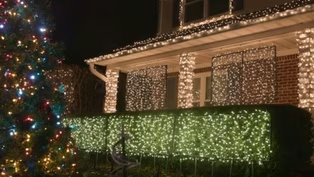
A Family Affair: Home Christmas Displays
Video has Closed Captions
Clip: S31 Ep9 | 6m 34s | Come visit two Kentucky families to have taken the tradition of Christmas lights to new heights. (6m 34s)
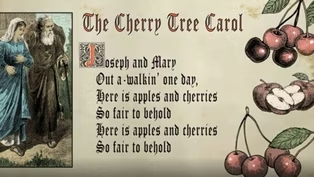
Old Christmas: From the Middle Ages to the Bluegrass
Video has Closed Captions
Clip: S31 Ep9 | 5m 42s | Some people observe December 25 as sacred and also mark January 6 as “Old Christmas.” (5m 42s)
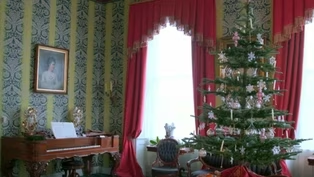
The Spirit of Christmas Past in Kentucky
Video has Closed Captions
Clip: S31 Ep9 | 6m 17s | Explore Kentucky's Christmas history and see where some of these traditions came from. (6m 17s)
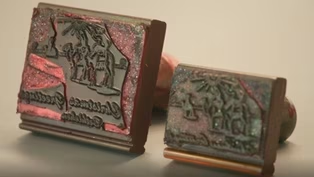
Oh Little Town of Bethlehem (KY)
Video has Closed Captions
Clip: S31 Ep9 | 5m 38s | People across the country seek special Christmas cards at a small Kentucky town called Bethlehem. (5m 38s)
Providing Support for PBS.org
Learn Moreabout PBS online sponsorship













Support for PBS provided by:
Kentucky Life is a local public television program presented by KET
You give every Kentuckian the opportunity to explore new ideas and new worlds through KET. Visit the Kentucky Life website.