
Home repairs, ‘Bad Axe’ film, Detroit Sugarbush Project
Season 7 Episode 18 | 26m 46sVideo has Closed Captions
One Detroit and the Detroit Free Press go behind-the-scenes of Michigan’s voting process.
In an election year where the voting process has been under increased scrutiny, how will the votes be counted and certified? One Detroit and reporters from the Detroit Free Press have teamed up for a special one-hour episode dedicated to demystifying our state’s election process. Follow the voting process step by step and hear from election workers and voters themselves.
Problems playing video? | Closed Captioning Feedback
Problems playing video? | Closed Captioning Feedback
One Detroit is a local public television program presented by Detroit PBS
Home repairs, ‘Bad Axe’ film, Detroit Sugarbush Project
Season 7 Episode 18 | 26m 46sVideo has Closed Captions
In an election year where the voting process has been under increased scrutiny, how will the votes be counted and certified? One Detroit and reporters from the Detroit Free Press have teamed up for a special one-hour episode dedicated to demystifying our state’s election process. Follow the voting process step by step and hear from election workers and voters themselves.
Problems playing video? | Closed Captioning Feedback
How to Watch One Detroit
One Detroit is available to stream on pbs.org and the free PBS App, available on iPhone, Apple TV, Android TV, Android smartphones, Amazon Fire TV, Amazon Fire Tablet, Roku, Samsung Smart TV, and Vizio.
Providing Support for PBS.org
Learn Moreabout PBS online sponsorship- [Presenter] Just ahead on One Detroit, we've teamed up with Bridge Detroit for a report on the tremendous need for home repairs in Detroit and the impact it's having on residents and neighborhoods.
Plus we'll talk with the filmmaker behind a new documentary about the struggles of a family owned restaurant in Bad Ax, Michigan during the Covid Pandemic.
And in honor of Native American Heritage Month, we'll take a closer look at the indigenous tradition of making maple syrup.
It's all coming up next, on One Detroit - [Announcer] From Delta faucets to Behr paint.
Masco Corporation is proud to deliver products that enhance the way consumers all over the world experience and enjoy their living spaces.
Masco, serving Michigan communities since 1929.
- [Announcer 2] Support for this program is provided by the Cynthia and Edsel Ford Fund for Journalism at Detroit Public TV.
The Kresge Foundation.
- [Announcer 3] The DTE Foundation is a proud sponsor of Detroit Public TV.
Among the state's largest foundations committed to Michigan focused giving, we support organizations that are doing exceptional work in our state.
Visit DTEfoundation.com to learn more.
- [Announcer 4] Nissan Foundation and Viewers Like You.
(upbeat music) - [Presenter] Just ahead on this week's One Detroit, a new documentary chronicles one family's efforts to keep their restaurant open during the pandemic in the small town of Bad Axe, Michigan, while fighting political backlash.
Plus, in honor of national Native American Heritage Month we'll take you to the nation's largest urban sugar bush in Detroit's Rouge Park for a look at a long time tradition among indigenous Americans.
But first up, a special report on the huge need for home repairs in Detroit.
We partnered with Bridge Detroit to examine the issue and some solutions.
For many families, the cost of making major repairs is out of their reach.
And when asked how the city should spend its allocation of funds from the American Rescue Plan Act, the top response from residents was to fix up homes.
Bridge Detroit Reporter Malachi Barrett teamed up with One Detroit Senior Producer Bill Kubota for this story.
- It was like snow and rain coming in cause there was nothing I could do about it.
So I just worked it out.
I just have a bucket there, put some towels down.
That's it.
Just do, do what I do to make it work.
- [Malachi Barret] That's lifelong Detroiter Samela Dean talking about a gaping hole that was in the roof of her 100 year old home on the city's northeast side.
- Dripping and dripping and dripping and one day it just fell in.
I had planned to get it patched but I never could come up with the $500.
This man was gonna patch it for me.
- [Malachi Barrett] Ms. Dean is a senior, disabled and qualifies for a property tax exemption for low income residents which made her a prime candidate for the city's Renew Detroit Home Repair program.
It's a $45 million effort to help 2000 low income Detroiters fix up their homes over the next four years.
Those who applied in the first round could receive a new roof at no cost.
A second phase of the program opened in October and will include window replacements.
- My guess is if we drove down the street three or four years ago you wouldn't see people fixing up houses along here, right?
- [Malachi Barrett] Dean was one of the first people to get a new roof through Renew Detroit.
- We get Ms. Dean's roof done.
I think you're gonna see more and more investment in this community.
- I am so excited to have a roof and so emotional, because I never ever dreamed this could happen to me.
- [Malachi Barrett] Renew Detroit only goes so far.
Just a small fraction will get help who need it.
The University of Michigan research estimates 38,000 families are living in homes that need repairs.
- Most people need roofs, gutters, siding, brick work porch work, windows.
They need everything.
- [Malachi Barrett] Vanessa Taylor lives less than five miles west from Dean in a house that she's owned for 40 years.
- The house was built in 1920.
- [Malachi Barrett] Taylor says she also applied for the Renew Detroit program, but she hasn't yet heard whether she qualifies.
- I would like to get the siding done on my house.
I would like to get the roof done and I would like to get the rest of the new windows in the house.
I get that done, I'm okay.
- [Malachi Barrett] Taylor estimates it will take $20,000 to $40,000 to do the repairs.
She's on a fixed income.
- No, I have to make sure that I'm getting food for myself.
I have to make sure that my DTE bill is paid.
I have to make sure that my water bill is paid.
By the time I finish doing all that, I'm lucky if it's like $200 left.
- With roofs, like on a small house, a roof is $10,000.
- [Malachi Barrett] Edythe Ford with Mac Development says even with programs to help, gaps in the system leave many Detroiters short.
- So if you need a roof, it's raining in your house you got mold and mildew on the walls it's affecting the electricity, your health and everything.
It's a long time getting help.
It's hard a lot of times for citizens to know how to navigate the programs.
- [Malachi Barrett] Ford says the city is partly to blame.
Residents have been overtaxed an estimated $600 million following the great recession.
Money that could have gone toward fixing their homes - They could have been able to save towards getting their own roof.
I had one lady here, her payment plan was $782 a month, her mortgage was never that much, to pay her back property taxes.
But then when the Detroit Home Property Tax Relief grant came from the Gilbert Foundation we were able to get her a property tax exemption and to get that past due amount wiped out.
When that came, you would hear people banging and hammering, people started fixing stuff on their houses.
- That's interesting.
So the direct impact of giving people some tax relief is they immediately went.. - They immediate started doing stuff on their house that they know they needed to do.
- [Malachi Barrett] Foundations owned by billionaire Dan Gilbert are helping Detroiters with their taxes and home repairs.
His 20 million Detroit Home Repair fund was announced this spring - Incredibly, when we rolled out the Detroit Home Repair Fund we saw about 150,000 phone calls in the first 48 hours and 250,000 phone calls in the first week which was honestly an emotional realization because we had just tens and tens of thousands of people who really needed support and they were not getting it from existing ecosystem partners.
- [Malachi Barrett] The Gilbert Foundation expects to help 1000 Detroit homeowners pay for repairs over the next three years but that's still just another small fraction.
So many more Detroiters are going to miss out.
- We don't see our role as serving every single person in the system.
I think that's really the role of the broader social safety net.
The City of Detroit, the Wayne County the community partners who are working in this space every day - [Malachi Barrett] Some Detroiters are finding creative ways to raise money.
Field Street Block Club President Jennine Spencer crowdfunded more than $14,000 in the last year to help families in the Island View neighborhood on Detroit's east side.
- We're actually able to help four families, not just with heat but with other home repairs.
- I feel like the fact that you guys are fundraising really shows the gaps in these programs.
- Yeah.
- Like you wouldn't have to do that if these programs were able to like serve.
- No, not at all.
Not at all.
I don't qualify.
I'm not disabled, nor am I a senior so I don't qualify for these home repair grants.
So what do I do?
- So what happens when Detroiters don't get help?
- It makes people leave because they give up.
It stops passing on generational wealth, it's always attack on our housing so that we are losing our houses.
- So what's the effect on the like the black middle class then in Detroit?
- Well, what has happened, that has driven the Black middle class outta Detroit?
Well, you gotta have all income levels and all classes of people to make a city work and that has driven them out.
Because why should I spend a hundred thousand to rehab this house when it one next to me is like only God and cobwebs is keeping it up - [Malachi Barrett] I mean we're talking about quality life at the end of the day, right?
- [Edythe Ford] Yes, and an equity, making our community resilient.
- [Presenter] There's a new documentary opening in theaters on November 18th that tells the story of an Asian Mexican American family in the rural community of Bad Axe, Michigan trying to hold onto their American dream during a global pandemic and a rise in racial tension.
The film is called Bad Axe and it focuses on the familys struggles to keep their restaurant open in light of the covid shutdowns and restrictions.
One Detroit's Bill Kubota sat down with filmmaker David Siev and his parents to talk about what they hope viewers will take away from the documentary (gentle music) (phone ringing) - They wanted ketchup with your kids tenders.
- Okay, - Do you need ranch?
- They want ranch.
and then you just need a kids' quesadilla right?
- [David] Raquel, is it busy right now?
- We're actually not super busy right now but we're not used to doing this many takeout orders.
So it's a bit of a learning curve.
- [Bill Kubota] This could have been a restaurant anywhere two years ago, a takeout assembly line.
- [News Reporter] There are now more than a thousand confirmed cases of coronavirus here in Michigan.
- [News Reporter 2] All restaurants, coffee shops, all ordered by Governor Whitmer to stop normal business to prevent the spread.
- [News Reporter 3] The surge in hate crimes against Asian Americans only getting worse.
- [Bill Kubota] A town of 3000 surrounded by the flat lands of Michigan's thumb, two hours north of Detroit up M53.
Now a documentary film named after that Town.
In Bad Axe, a family restaurant called Rachel's.
When Covid hit some of Rachel's family came back to help.
Daughter Jacklyn and son David, U of M grad and filmmaker.
- [Reporter] If you're not an essential business you need to close, and you need to protect your employees.
- When making Bad Axe, I always said I wanted to share my family's story, even before I started shooting it.
And I always thought I would share this story of a Cambodian refugee - Show it to the camera like this.
- They have to have that talk of unemployment.
- And you know, a Mexican American woman like these two individuals who built their American dream here in Bad Axe, Michigan - Here's a picture of Rachel with our children Jacklyn and Michelle, our baby at the time, David.
Here's the three kids stand in front of the front entrance.
Didn't take a whole lot to keep the children happy.
Just tell 'em this is gonna be our future donut shop.
- [Bill Kubota] The donut shop would become Rachel's restaurant.
- You know, when I moved back home from New York during Covid, and just picked up my camera and began filming.
- David, why are you filming me right now?
- [David] We got a lot of free time.
- David having the camera in his hands is not something new.
It was something that, you know he's always walking around with his camera, but to get moments that were, you know, very personal.
- Bad Axe is probably a lot safer than New York right now.
It's probably a good thing you guys got out when you did.
But it's crazy to think that literally one week ago we were on a cruise ship and now like things are like starting to get really bad.
- [Bill Kubota] The filmmakers family, willing participants for the most part.
- I think he was also like very respectful because when I did really ask him to stop, he did but he also didn't sometimes too.
So I don't know.
It just, I guess that was that's what makes a really good film.
We are.
We will wear masks, glasses, gloves.
We know.
We're not stupid Jacklyn - You have high blood pressure.
Three fourths of the people that have died, three fourths.
- The way this documentary came together, it was very unexpected.
I had no plans or intention of making a documentary.
That's just the way it unfolded so.
- I was taking orders.
- Shut up.
- That's not how.. - You're wasting more time - [Michelle] You are mom.
- The film is showing everybody, not just in this town, but everywhere across the country, even in the world, what a family gone through - The carry out dine out option is still something that is available to people.
This is an essential service which is the feeding of the people of our state.
- Obviously out of everybody's control.
It reminds me of when we literally like we're just struggling to survive trying to make money off of donuts - Through Bad Axe, we relive 2020 all over again, our lives during lockdown.
The film, a collective history for all of us.
Like when One Detroit checked on Roseville restaurant owner Steve Morse whose been checking in regularly with the governor.
- Well, what do you think she's gonna do?
- [Bill Kubota] When can customers eat in again?
Covid cases up.
Will she shut 'em down again?
At One Detroit, we heard the fear and uncertainty over in Clawson.
- We're all scared that we're gonna run out of money.
We're scared that people are not gonna come in.
We're scared that too many of 'em are gonna try to come in.
- I wear a mask and a shield while I'm teaching - [Bill Kubota] The masks and the politics that came with them.
- Well, I did wear, I had one on before.
I wore one in this back area but I didn't want to give the press the pleasure of seeing it.
- [Bill Kubota] It was the same year George Floyd was killed by Minneapolis Police.
- [Mandy Wright] I'm Mandy Wright.
I'm live right now.
Right next to the Marriott.
Police are in riot gear pushing protesters back.
- [Bill Kubota] Night after night in Detroit.
Rallies, skirmishes arrests.
- [Reporter] There's a line of protestors making a human chain.
- [Bill Kubota] So many other Black Lives Matter protests that summer, in the suburbs, even in conservative Bad Axe.
A memorable scene in the documentary - I feel like one of the reasons why my parents were able to make the restaurant successful is because they assimilated in the way that people expect them to.
Come to work.
Get your stuff done.
Don't open your mouth, don't say too much.
Make sure you don't speak up too loud.
My parents are good at biting their tongue, but I don't think I can be that way.
- Hello.
- Hey.
- Hello, how you doing?
- Good.
How are you'all?
- Okay.
- It's so weird having this happen in this environment.
Like I'm more comfortable, I guess in Ann Arbor at a Black Lives Matter protest versus being in Bad Axe at a Black Lives Matters protest.
- In the 2016 election, I voted for Donald Trump.
I had been surrounding myself with very conservative Republican people, families, friends and it took me a really long time to realize what type of a person he truly is.
I really dug deep into my soul and thought, I can be my own person.
This will be the first step that I've taken publicly that I'll be able to look back on it one day and tell my children.
You know, it takes every ounce of your soul to stand up for what's right even if your family doesn't agree with you.
(crowd chanting) - You know a couple small incident that we have see in the film, you know, during the Black Lives Matter protesting with my daughter, my very outspoken daughter, Jacklyn get tangled up should I say it with those three men that are, you know, fully armed.
Come in there, try to intimidate everybody.
At the time, it seems like, wait a minute, the town judging us in the wrong way to say, you know what, your kid the one that started a problem with these armed men.
No, these not an arm men.
These just the men that have a really bad intention.
Now, if anybody in the town support those men, they have some problem.
And they make me really proud when I see that film.
That my children actually stand up again, for what is right and what is wrong.
- [Bill Kubota] Chun Siev's immigration story at the forefront of the film.
- I told this play down and burn it right down - Exactly.
Just outta spite because you're a child.
- That's right - [Bill Kubota] The stress of the pandemic, but how much is connected to the trauma suffered a half century ago escaping the Cambodian killing fields.
- [Chun Siev] This is the last place that I saw my father.
- [Bill Kubota] Despite it all Chun and his family thrive in 2020.
You'll need to watch to the end as they look back with gratitude to the people in their town.
- Honestly, our town supported all of our restaurants.
Not just ours, but all of 'em.
Hello Rachel's of Bad Axe, How may I help you?
I cannot thank our community enough for that.
I mean, they helped all of us.
(group cheering) - You guys rock man.
- It's usually like coastal stories, right?
Of like what's going on in New York or LA but with Bad Axe, it's a whole other part of America that so many people in our country are a part of that community.
And so when you're seeing our family go through this you have to think about all the other families in all these other small towns that are just like Bad Axe across the Midwest.
People seeing their own experiences represented on the big screen through our family.
- [Presenter] Bad Axe opens in select theaters tomorrow.
And finally we go to Rouge Park.
November is National Native American Heritage Month.
A time to celebrate the rich ancestry and traditions of the indigenous people of the United States.
The sugar bush ceremony is one of these ancient customs.
It involves collecting sap from maple trees in late February to early March and boiling it down to syrup or sugar.
One Detroit contributor, AJ Walker got a closer look at the Detroit Sugar Bush project earlier this year.
(gentle music) - Right around the last freeze these trees are gonna suck all that water into the tree.
It's gonna go all the way to the top.
And then as soon as it gets above freezing all of that sap is gonna come back down.
And that's when all the sap is gonna flow.
- [AJ Walker] And when it does, that's when the Detroit Sugar Bush project will get their sweet reward.
But for those hard at work tapping these maple trees the work itself is most rewarding.
Dr. Shakara Tyler says tapping maple trees is about much more than getting syrup.
- The sugar bush process is a very sacred ritual where we commune with our trees as ancestors, as the kin that they are, as they gift the sap to us so that we can consume it however that we see fit.
And it's, and I wanna emphasize the ritualistic part of it because we offer gifts to the trees in the process of them returning the sap or giving the sap to us.
It's about sustaining the mind, body, and spirit.
It's not just something that we consume because it tastes good.
This is a very spiritual process where we can honor our sacred histories and honor the ancestral energy that's present.
- You can live off the land.
Our ancestors did it.
And so we're just trying to keep those traditions alive.
- [AJ Walker] Antonio Cosme, who works for the National Wildlife Federation is one of the Detroit Sugar Bush projects organizers.
He helps to bring the NWF together with Native American communities to carry out this annual tradition.
Alexis Chingman-Tijerina who is Anishinaabe says hauling these buckets and doing this work is about paying homage to her culture and staying connected to her roots.
- The food sovereignty initiative with my tribe, if we want to be living our culture then we need to be doing what we would do in terms of food.
Harvesting and gathering and all the ceremony that goes into that.
That is our culture.
So if we're eating our foods, our heritage foods, then you know, we are reconnecting.
And that's a really powerful way that we can do that.
- [AJ Walker] For Cosme, bringing sugar bush tapping to Detroit is helping to heal deep wounds in communities of color, those who are Native American and those who are not.
- We're really trying to build relationships between native communities and urban communities between black communities and native communities because we think a lot of things these communities are facing, they're parallels and a lot of that comes from the sadness, the hurt, the pain, the disconnection from our ancestral roots and nature and the land.
- [AJ Walker] And Detroit's Rouge Park has proven to be the perfect place to do so.
- Rouge Park was the most natural destination for us.
We came out here, we walked a little bit out on the trails and I mean, it's just, these are just huge maple groves.
It's just a perfect maple tapping spot.
And so we went to the city and we said, Hey, this is a part of our heritage, our culture, our religious and spiritual rights to do this every season to honor the nature, the season ourselves and our ancestors.
And so the city was like wow.
Yeah, that's dope.
And so we're out here doing it now.
- I want that smell when I come in the house and it's still on me.
- That's what humans are supposed to smell like.
- Yep.
- [AJ Walker] Today the fire is the beginning of a long process.
- The fire is kind of like the center of the community.
We want to get the fire going today to keep you guys warm and keep us warm while we're working.
- Next is going tree to tree.
So this fire here is to keep us warm and then in a little while, you're gonna build a separate fire.
- Yeah.
- And that's going to be to boil everything down.
- Yeah.
We're gonna need a lot of heat to boil down the maple sap.
It'll, like I said, it's gonna take a long time.
Five to 10 hours sometimes we have boils depending on how much sap we're gonna have in at any given point.
Could take up to 24 hours.
- Looks like over here is where the real work begins and you're going to start actually tapping into those trees.
- Right?
We've got about 50 gallons already pulled from the taps already.
It's gotten a little bit colder so the trees have slowed down but we're gonna go collect right now what we've got out here in Rouge Park.
We're gonna add that to the tote.
And then later this week we're gonna be building a large cooking pit over here for the maple syrup.
And my friends are going out to collect the sap right now.
- [AJ Walker] Tapping maple trees for their sap is a tradition that goes back thousands of years, but doing it today is especially important and it's a labor of love.
- Reviving these traditions are part of the reclamation process.
Culturally, politically, socially, even economically.
And so it's a huge aspect of what it means to decolonize .
The way we center indigeneity and center indigenous futures and histories in the present.
And so this is not something new that we're trying to figure out.
We're pulling from a very ancient lineage of practices and stories and cultures to learn in the present today.
- [Presenter] That will do it for this week's One Detroit.
Thanks for watching.
Make sure to come back for One Detroit Arts and Culture on Mondays at 7:30 PM.
Head to the One Detroit website for all the stories we're working on Follow us on social media and sign up for our weekly newsletter.
(upbeat music) - [Announcer] From Delta faucets to Behr paint.
Masco Corporation is proud to deliver products that enhance the way consumers all over the world experience and enjoy their living spaces.
Masco, serving Michigan communities since 1929.
- [Announcer 2] Support for this program is provided by the Cynthia and Edsel Ford Fund for Journalism at Detroit Public TV.
The Kresge Foundation.
- [Announcer 3] The DTE Foundation is a proud sponsor of Detroit Public TV.
Among the state's largest foundations committed to Michigan focused giving, we support organizations that are doing exceptional work in our state.
Visit DTEfoundation.com to learn more.
- [Announcer 4] Nissan Foundation and Viewers Like You.

‘Bad Axe’ film tells Asian-Mexican American family’s story
Video has Closed Captions
Clip: S7 Ep18 | 9m 13s | “Bad Axe” director David Siev talks about the creation and success of his documentary. (9m 13s)
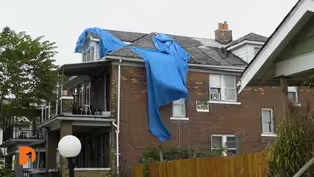
Detroiters face financial barriers to fix home repairs
Video has Closed Captions
Clip: S7 Ep18 | 6m 24s | More than 37,000 Detroit homes need major repairs, but residents face financial barriers. (6m 24s)
Providing Support for PBS.org
Learn Moreabout PBS online sponsorship
- News and Public Affairs

Top journalists deliver compelling original analysis of the hour's headlines.

- News and Public Affairs

FRONTLINE is investigative journalism that questions, explains and changes our world.












Support for PBS provided by:
One Detroit is a local public television program presented by Detroit PBS