
Honoring and aiding Nevada’s Veterans
Season 6 Episode 18 | 26m 46sVideo has Closed Captions
We explore help for veterans and the movement to remove Indigenous imagery from mascots.
Senator Jacky Rosen (D-NV) and UFC Hall of Famer Randy Couture share the work each of them are doing to assist veterans and their families. We also look at “Imagining the Indian: The Fight Against Native American Mascoting”, a new documentary on the efforts to remove Indigenous imagery and names from sports mascots.
Problems playing video? | Closed Captioning Feedback
Problems playing video? | Closed Captioning Feedback
Nevada Week is a local public television program presented by Vegas PBS
Honoring and aiding Nevada’s Veterans
Season 6 Episode 18 | 26m 46sVideo has Closed Captions
Senator Jacky Rosen (D-NV) and UFC Hall of Famer Randy Couture share the work each of them are doing to assist veterans and their families. We also look at “Imagining the Indian: The Fight Against Native American Mascoting”, a new documentary on the efforts to remove Indigenous imagery and names from sports mascots.
Problems playing video? | Closed Captioning Feedback
How to Watch Nevada Week
Nevada Week is available to stream on pbs.org and the free PBS App, available on iPhone, Apple TV, Android TV, Android smartphones, Amazon Fire TV, Amazon Fire Tablet, Roku, Samsung Smart TV, and Vizio.
Providing Support for PBS.org
Learn Moreabout PBS online sponsorshipU.S.
Senator Jacky Rosen joins us to discuss combating anti-Semitism and helping Nevada veterans, plus... We explore efforts to end the misappropriation of Native American culture this week on Nevada Week.
♪♪♪ Support for Nevada Week is provided by Senator William H. Hernstadt.
Welcome to Nevada Week.
I'm Amber Renee Dixon.
Local perspective on a new documentary detailing the movement aimed at ending the use of Native American names, logos, and mascots in sports and more, that's ahead.
But we begin with U.S.
Senator Jacky Rosen, who in a recent interview shared which veterans' issues are top of mind for her this Veterans Day, while addressing how a rise in anti-Semitism is impacting her personally.
-So first off, Senator, how are you and your family doing following the threats that were reportedly made on your life simply because you are Jewish?
(Senator Jacky Rosen) Well, thank you for asking that question.
My family and I, we're doing fine.
I'm grateful to law enforcement, Department of Justice, for apprehending this individual and getting him off the streets.
But I will tell you that this is just a fraction of what Jewish people around the country and in some cases around the world are feeling right now.
As ADL has reported a rise, almost a 400%, in anti-Semitic incidences over the same time last year.
So people are feeling less safe.
They're feeling threatened in their communities.
And no one is more threatened right now than our college students.
And I want to take one moment to talk about that, because as a mother, that's what struck me the most when my daughter called me and she had heard of the threats.
And I realized, through her eyes, how it-- how it felt.
And that's when I realized the enormity of it.
I know as a mother as well, when you send your kids to college, sometimes the first time they're away from home, they're away from their support systems, all students should feel safe on campus.
It's a university's responsibility.
And I did call Secretary of Education Cardona to reiterate these guidance for universities about doing that.
Just today, he did do that.
It is the university's responsibility.
He's going to call together a task force to talk about these issues, qualified individuals, all the stakeholders, and there will be consequences if we don't keep our students safe.
-And what do you think those consequences should be?
-Well, I'm going to let the taskforce determine that.
But it is, whether you're a Jewish student, it is their responsibility, Jewish student or any other student.
Parents send their children to school.
They want them to have a robust education, to make friends, and to feel safe.
And so whatever that is, universities need to do that.
So we're going to let the taskforce the Department of Education will put together, that will be what they determine is appropriate.
And they're going to issue their guidance, and we'll see what comes out from that.
-As you mentioned, the Department of Education is responding.
They have reportedly mentioned that federal funding could be at stake if these colleges and universities fail to protect their Jewish students.
In that letter that you wrote to the Department of Education, you said, quote, Schools have a legal responsibility to protect their students from discrimination.
Yet many university presidents and administrators have failed to forcefully condemn anti-Semitic speech and incidents on campuses in the wake of Hamas' terrorist attack.
Why do you think these university presidents are not forthcoming with their condemnations?
-Well, I can't speak to each university president, but what I can tell you is that they need to stand up for all their students.
And today, it's a terrorist attack.
Hamas, a terrorist organization, brutally went into Israel, killing over 1,000 people.
Still almost 240 people, I think by current estimates, hostages still in Gaza.
And so whether it's Jewish students or any other event, university presidents need to stand up and be strong to protect their students.
That's what's disappointing to me.
Why are they withholding those statements against a terrorist organization?
So we're going to work on that with the Secretary of Education, perhaps federal funding, perhaps there's other sanctions that we can do.
But I believe, as well as everyone else, and I say-- I speak not just as senator, but as a mother-- we need to keep our college students safe from harm.
-You mentioned the dramatic rise in anti-Semitic incidents following Hamas' attack on Israel.
At the same time, the Council on American Islamic Relations is reporting a spike in hate incidents against Muslim Americans.
What is your message to your Muslim American constituents right now?
-Well, I can tell you hate in all forms is unacceptable.
Now, in America, we have a beautiful right to free speech, but that doesn't give you the right to threaten or to intimidate or to incite violence.
And so the President put together a task force to combat anti-Semitism.
He's, again, just this last week or so, putting together that task force to combat Islamophobia.
But I would argue that there is no place for hate in this country.
There's no place that we want to tolerate threats or intimidation based on your race, your ethnicity, or your religion.
And so that's what we're going to continue to work on with everyone.
We can have an open dialogue, but we can't threaten each other.
-I'd like to transition to Veterans Day now.
You are so involved in many veteran related bills and projects.
Of the issues that they face right now, what's top of mind for you?
-Well, I can tell you healthcare is top of mind for our veterans.
I would say healthcare, business opportunities, and just the benefits that they've earned.
And so I'm the daughter of a World War II veteran.
But my grandfather and my grandmother, her three brothers, everyone served in the war.
And I have so many friends who are veterans, and actually we have many veterans on my team.
And so it's important that we let veterans know that they have earned the benefits.
They deserve their benefits.
So what's the first one we're talking about?
About a year ago, the PACT Act that gave veterans expanded access to health care.
What if you were exposed to Agent Orange, toxic burn pits, high levels of radiation?
You need and deserve the care to take care of your symptoms, your illnesses, whatever they may be.
To that end, you know in Southern Nevada, we're blessed to have one of the largest VA hospitals in the nation.
And in Northern Nevada, I asked the President to include a new VA hospital in Reno, because that VA Hospital is old and out of date.
He agreed to that.
So we're going to see expanded access to care up in Northern Nevada as well.
So healthcare, number one.
-And then in September, your office helped secure almost $1 million for the city of Reno Housing Authority to help homeless veterans access housing.
On the topic of housing, you recently helped introduce the VA Home Loan Awareness Act.
Why is that needed?
-Well, again, veterans need to know the benefits that they have out there.
And sometimes, you know, you separate from the military, you come back home, you're busy getting your life back, maybe going to school, going back to work, and then you want to buy a home.
Well, you've forgotten that one- or two-day course you had and all the benefits that were coming to you.
So we want to be sure for the VA home loan, only about 13% of veterans are taking advantage of that.
I want to be sure that every veteran takes advantage of that.
That helps with housing.
Housing helps with health care, your mental health, your physical health, your financial health, you have a stable place to live.
And this is, again, a benefit that they've earned.
And I'm very proud too.
I'm going to add one more thing we've done.
A lot of veterans want to open small businesses, and I fought for Veterans Business Outreach Center.
I'm on the Small Business Committee.
First ever in Nevada.
It's going to have two locations: one in Reno, one in Las Vegas.
Ribbon cutting will be coming up pretty soon.
And we'll let you know about that.
-How soon do you think?
I think there are veterans out there excited for that.
And how were you made aware of the need for this?
-Well, you know, our state, 99% of businesses in Nevada are small businesses.
People think of Nevada, and they think about the Las Vegas Strip with our giant casinos and the like.
But honestly, 99% of our businesses are small business-- women owned, veteran owned, minority owned.
They support our tourism industry, not just on the Las Vegas Strip.
I'll tell you, our outdoor tourism industry, multibillion dollar economic impact in our state.
In fact, I'm chair of the Tourism, Trade, and Export Promotion subcommittee, and we've been talking about this just in the hearing earlier today.
And so it's really important that veterans have this ability to, again, use the SBA resources and take advantage of everything that they've earned and that they deserve.
So bringing this to Nevada to support our few hundred thousand veterans, it's really important to have locations up and down the state.
Also important and, of course, I'm sure there'll be doing things on webinars as well so they can get to everybody.
It matters, and I want our veterans to thrive in Nevada.
-U.S.
Senator Jacky Rosen, thank you so much for joining Nevada Week.
-Well, thank you so much for having me.
And Happy Veterans Day to everyone.
-Our Veterans Day coverage continues now with a look at the local nonprofit The Xtreme Couture GI Foundation.
Established in 2009, the 501c3 raises money and awareness for those wounded in action and their families.
Its founder, a six-year U.S. Army veteran and a mixed martial arts legend, Randy Couture joins us now.
Randy, welcome to Nevada Week.
(Randy Couture) Thanks.
Good to be here.
-So as I mentioned, you started this nonprofit in 2009.
It's been more than 10 years.
You are helping the financial needs of our veterans who have been wounded in action.
I wonder, over that time period, have their needs, their struggles changed, or is it the same old, same old?
-I think it's the same.
I mean, the VA is slowly making adjustments.
Obviously, the previous administration cleaned some things up there, but it's still a big struggle.
And we hear a lot of those woes from a lot of our veterans from both Xtreme Couture and Merging Vets & Players.
But-- and I think the problem is numbers.
I mean, it was a 20-year war on terror since 9/11.
That's a lot of folks putting themselves in harm's way, coming back trying to find a way to transition after being wounded, after going through multiple surgeries, learning to walk again.
The list goes on.
So that's our goal is to try and help those folks, take at least some of the financial pressure off while they're in that state and going through that transition.
What are some of those woes you were mentioning?
-Well, I mean, in '06, I got to go to Iraq and spent 12 days on the ground over there.
And as a former soldier, it was pretty stark and interesting to be in a battlefield, to see those guys doing the things I took an oath and trained to do and never had to do, thankfully, in the '80s.
I'm a Cold War vet.
It's a joke I say all the time.
And then in '06-'07, I got to go to Walter Reed in Bethesda and actually meet a bunch of soldiers fresh off that battlefield after being injured, after being wounded.
And it was there, you hear the horror stories: Well, Mom's been down here for six months while I'm going through my surgeries, learning to walk again.
Her car is in the parking garage with a boot on it.
We can't afford to pay the tickets to get the boot off of it so she can go back to work.
I mean, stupid little things like that, that are just infuriating for a lot of these folks that are in this state and trying to get themselves back right to transition to normal life.
And it's those folks we're targeting.
We've expanded our mission over the years.
We've created a portal on the website so the guys that are struggling with their bills and trying to stay flush can go in and fill out paperwork and present me that bill.
And I'll pay that bill off and get it off their back, you know, just to alleviate some stress in their lives and help them out.
-You provide up to $5,000 in assistance, does not have to be repaid.
The need for that financial assistance right now versus in years past, has it changed?
-It's extremely difficult right now for a lot of folks, not just our veterans.
I think with the current economy and the other stuff that's going on in our society right now, it's a very difficult time for a lot of folks.
So certainly our veterans population struggles with the same things.
It's tougher to fill the gas tank, tough to put groceries on the table right now.
-Could you put a number on how many applications you're getting?
-Gosh!
It's, you know-- the portal is very active.
I don't track all that stuff.
I would go crazy trying to track all that.
But we are doing the best we can, and we're helping as many as we can.
-The need is significant.
A U.S. Air Force Staff Sergeant who your nonprofit helped wrote on your website that several veterans organizations had refused to help her because she either wasn't homeless or in an unstable relationships.
How common is that story?
-That's very common as well.
And we've helped several that were in that, you know, they weren't bad enough off that some of these foundations take care of folks that are in a rougher situation.
But they still needed a hand up.
They still needed some extra help, and we're happy to fill that void.
-Yeah.
You also help mentally in addition to financially.
That same Air Force Staff Sergeant wrote that when she was given the money, she had to sign something or make some sort of a promise.
And what is that promise, and why do you have them do that?
-Obviously we're not trying to enable anybody.
So in the portal, you have to present me that bill.
I'm not going to hand you cash and hope you do the right thing.
And I think that can be an issue, especially combat veterans, adrenaline seeking, self-medicating.
A lot of times the VA wants to slap an opioid or an antidepressant on, and we know the side effects to those.
So the problem just continues to compound.
It's hard to put stats and numbers to it.
Obviously, we're talking about 22 a day that we lose to PTSD and suicide, which is a ridiculous number, frankly.
It's never going to be zero, but that's, that's-- and I think that's probably a light number.
So doing the best we can to help these folks, let people know they're not alone.
Our training is our worst enemy.
We're trained to soldier on, not complain, not show vulnerability, or ask for help.
Get the job done.
And that sometimes can be our biggest, biggest enemy, our own selves.
So changing that narrative.
It's okay to ask for help.
It's okay to seek counseling, to get some professional help to develop more tools and put those tools in the tool belt to deal with the struggles of that transition, to deal with everyday life in some regards.
So we found some counselors that want to help, and so we'll buy 10 block sessions to those folks that need a little extra help and professional help.
MVP is great for the peer-on-peer counseling.
I guarantee somebody in the circle has struggled with what you're struggling with right now.
So I would rather hear from that guy that took the same oath I took, you know, than some psychiatrist that, you know, wants to tell me how broken I am.
That peer-on-peer is very, very powerful.
But sometimes you need that extra professional help to develop those new tools and new frame for those situations so that you can do things a little more effectively.
-You bring up MVP, Merging Vets & Players.
It's such a unique program because it's veterans with ex professional athletes coming together to work out and then discuss the transition that they've made into normal life.
How is that program going?
-That's-- we're in nine cities now across the country.
The Vegas chapter was the second chapter.
We started in LA with Jay Glazer and Nate Boyer.
Nate was a Green Beret and aspiring football player, playing at University of Texas while he was still on active duty.
And through Jay and I's MMA athletics program, got him geared up and got him a tryout with the Seahawks.
He ended up making the team as a long snapper.
It's a pretty amazing story, and he's a pretty amazing guy.
And through that process of recognizing the transition issues for both athletes and veterans and the mutual respect both those groups have for each other, it was a no-brainer to kind of bring them together to work out again, get them in the gym, sweating, which breaks down some barriers and creates a connection that you don't have with just anybody walking around, and then sitting on the mats after those workouts and talking, letting the demons out in a safe place where there's only us.
We speak a very particular language as athletes and veterans, and I've been both.
It's a remarkable place.
The demons come out.
They let those things out into the light of day.
They don't like that.
They hate that, in fact.
So being in a safe place with people you're comfortable with, where you can let some of that stuff out that you can't even sometimes let your wife know some of the things you've seen and done is pretty powerful.
-Operation Knockout is Saturday, November 11, at the Sahara.
Will you tell our viewers what that entails.
-This is our 12th year teaming up with Tuff-N-Uff.
Tuff-N-Uff is a small amateur fight organization.
My son, Ronda Rousey, a lot of great fighters came through Tuff-N-Uff to make their way into the pro ranks.
And they just do a great job.
Jeff does an amazing job.
Vinny helps us with sponsorships and all that.
Operation Knockout is at Sahara this year.
There'll be 11 or 12 fights on that card, a couple grappling matches as well.
All the proceeds go to the Xtreme Couture GI Foundation.
All my MVP guys are going to be there cheering on the fighters and supporting the event as well.
So it will fun.
I think the doors are at 4:00 and the show starts at 6:00 on Saturday at Sahara.
-How big of a role does that event play in your annual fundraising efforts?
-It's one of several events.
We do motorcycle poker runs in Seattle, up in Quad Cities.
We're doing a new one down in Florida.
This will be our second year there.
Obviously, we've been doing that ride for 15 years here in Vegas.
This our 12th year doing Operation Knockout with Tuff-N-Uff.
So definitely getting a little long in the tooth in the foundation here, but it's great.
We're affecting and helping a lot of folks.
-And we are taping this ahead of Veterans Day.
But I want to know how you spend your Veterans Day and how you suggest others who want to honor those who've served spend theirs.
-Survivor's guilt is a real thing.
A lot of these folks on these holidays struggle because they've lost brothers and sisters in that field of combat.
And a lot of times, it's, Why them?
Why not me?
And it can be very, very difficult.
So doing things that are fun: having the fights, having events where we all get together, go on a hike, barbecue--that's something MVP does with family members and those veterans a lot--getting together, sharing in finding those places and those people I can lean on if I'm struggling, remembering somebody, and not self-medicating, not seeking adrenaline.
Doing some of the more healthy things that we can do to lean on each other and remember those we care about.
-Try to have some fun is what you're saying.
-Exactly.
-Yeah.
Randy Couture, thank you so much for your service, for coming on the show.
Thank you to our veterans.
We'll have you stick around because you are going to be on Nevada Week In Person.
That airs on Saturday, November 11, at 6:30 p.m.
Thank you for coming on, Randy.
-Pleasure.
Thank you for having me.
-Well, November 11 is Veterans Day.
November in its entirety is National Native American Heritage Month.
And right now, an award-winning documentary is exploring the movement that aims to end the use of Native American names, logos, and mascots in sports and beyond.
Maria Silva attended a special screening of the film and joins us in studio.
And Maria, the screening was held at the Palms Casino Resort for several important reasons.
(Maria Silva) Amber, it was definitely a very special evening.
Now, the screening was held on Indigenous Peoples' Day at the Palms Casino Resort, as you mentioned, the first casino resort in Las Vegas to be fully owned and operated by a Native American tribe, the San Manuel Band of Mission Indians.
They are also executive producers of the film Imagining the Indian.
I got the chance to talk to the filmmakers who shared why bringing this powerful film to the big screen has truly been a labor of love six years in the making.
-It's just a football team.
-We are not your mascot!
Change the name!
-That to me is not honoring somebody; that to me is demeaning.
- Imagining the Indian, the fight against Native American mascoting examines the social movement that is ending the use of Native American names, logos, and mascots, especially in the world of sports.
(Ben West) Washington's football team changed its name while we were making the film.
And so we had to cover that in realtime.
And, you know, we had people come up to us and say, Oh, well, Washington has, has changed their name; you don't need to make the movie anymore.
And we said, Well, no, that's not the case.
-For Co-Director and Co-Producer Ben West... -I'm Cheyenne, or Tsis tsis'tas as we call ourselves.
-... the documentary, very personal and a call to action.
-About 2,000 public schools, many of them, most of them taxpayer funded, who have mascots and names, and we still have three major sports franchises in the U.S.--that being Chicago hockey, Atlanta baseball, and Kansas City football--who need to follow D.C.'s lead and go ahead and make wholesale change.
- Imagining the Indian, a family affair.
Ben's father, Richard West, founding director of the Smithsonian National Museum of the American Indian is featured in the film.
(Richard West) It is utterly unidimensional.
They're warriors.
They're braves in breechcloths rather than Native peoples as they were even then and certainly are now.
-Father and son both made a special trip to Las Vegas to take part in the screening and panel discussion at the Palms Casino Resort.
-But I was close enough to it.
I saw it being pieced together through a long period of time.
-One thing I'm extremely proud of as a Native person myself is the fact that this film really did come out of Indian country.
You know, I mentioned San Manuel Band of Mission Indians.
(Jessica Stops) What I hope happens today is that everyone really understands something new that they didn't know before.
And it's even more important and more impactful that it's on Indigenous People's Day at the casino resort that was the first to be wholly owned and operated by a tribe in Las Vegas.
-In the documentary, and especially during the panel discussion... -I'm descended from people who were stolen from their homelands and brought over to this country on slave ships.
And so I've been involved in trying to support other communities in their fights.
-...allyship was discussed in detail.
Being an ally is what drew Producer and Writer Yancey Burns to the project.
(Yancey Burns) Well, I'm a big believer in empathy.
They're going to walk away from this film and they're gonna think about the public health impact of these mascots.
They're gonna think about the fact that it's not an issue of, Oh, you're being too woke or too sensitive or you're just being bothered for no reason or this isn't that big of a deal.
I hope they're gonna walk away understanding this is a public health crisis.
We know from decades of social science research that these mascots and exposure to them lead to increased levels of suicide amongst Native people, particularly Native youth.
They lead to decreased levels of self-esteem in Native people, particularly Native youth.
They lead to just generally worse health outcomes for all Native people.
I want people to come away from this movie and if they have someone in their life who loves Atlanta baseball or Kansas City football, Chicago hockey, or loves one of these 2,000 schools across the country, I want them to say to those folks, you know, You know the public health impact; you know that it's tangibly hurting people.
-And if it was any other race of people, nobody would stand for it.
-There's no good reason why the name of a sports team should ever be more important than the health and well being of people.
-We are people first, not redskins.
We are not scouts.
We are not chiefs.
We're not squaws.
-You will see in the film the many voices that come out of Indian country, and it's essential that Native people tell their own stories.
-It's up to Native peoples to own their own images, to own their own words, and to be able to own their own feelings.
-We have a voice now.
-Representation matters.
I definitely left inspired.
Now, the filmmakers tell me Imagining the Indian will go into full distribution next year.
And by fall of 2024, they will introduce their educational curriculum, which they are currently creating with PBS Learning Media.
Amber?
-Thank you, Maria.
And the moderator of that panel, Fawn Douglas, was a featured guest on Nevada Week In Person.
You can watch her interview at vegaspbs.org/nevadaweek.
And I'll see you next week on Nevada Week.
♪♪♪
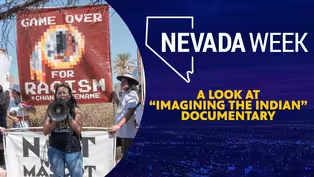
A look at “Imagining the Indian” documentary
Video has Closed Captions
Clip: S6 Ep18 | 5m 44s | “Imagining the Indian: The Fight Against Native American Mascoting”. (5m 44s)
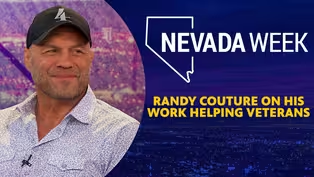
Randy Couture on his work helping veterans
Video has Closed Captions
Clip: S6 Ep18 | 10m 11s | UFC Hall of Famer and veteran Randy Couture shares the work his foundation. (10m 11s)
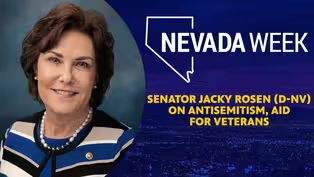
Senator Jacky Rosen (D-NV) on antisemitism, aid for veterans
Video has Closed Captions
Clip: S6 Ep18 | 9m 23s | Senator Jacky Rosen shares her concerns about rising antisemitism on college campuses. (9m 23s)
Providing Support for PBS.org
Learn Moreabout PBS online sponsorship
- News and Public Affairs

Top journalists deliver compelling original analysis of the hour's headlines.

- News and Public Affairs

FRONTLINE is investigative journalism that questions, explains and changes our world.












Support for PBS provided by:
Nevada Week is a local public television program presented by Vegas PBS