Journey Indiana
Hoosier Who's Who
Season 7 Episode 10 | 26m 46sVideo has Closed Captions
It's a Hoosier who's who. Profiles of some of Indiana's most Interesting residents.
We go gaga over famous Hoosiers at the Hall of Hoosiers at the Indiana State Museum. We dress up with Jerry Lee Atwood, Hoosier fashion designer to the stars and his famous western suits. We play back the life of John Miley and his whopping collection of baseball games taped straight from TV. Finally we shoot for the start with Hoosier legend Gus Grissom.
Problems playing video? | Closed Captioning Feedback
Problems playing video? | Closed Captioning Feedback
Journey Indiana is a local public television program presented by WTIU PBS
Journey Indiana
Hoosier Who's Who
Season 7 Episode 10 | 26m 46sVideo has Closed Captions
We go gaga over famous Hoosiers at the Hall of Hoosiers at the Indiana State Museum. We dress up with Jerry Lee Atwood, Hoosier fashion designer to the stars and his famous western suits. We play back the life of John Miley and his whopping collection of baseball games taped straight from TV. Finally we shoot for the start with Hoosier legend Gus Grissom.
Problems playing video? | Closed Captioning Feedback
How to Watch Journey Indiana
Journey Indiana is available to stream on pbs.org and the free PBS App, available on iPhone, Apple TV, Android TV, Android smartphones, Amazon Fire TV, Amazon Fire Tablet, Roku, Samsung Smart TV, and Vizio.
Providing Support for PBS.org
Learn Moreabout PBS online sponsorship>> Funding for "Journey Indiana" was provided in part by: >> The WTIU Vehicle Donation Program.
Proceeds from accepted donations of a car or other vehicle make this program possible.
Most vehicles are accepted and pick up can be arranged at no cost.
Learn more at WTIU.org/support.
>> Charitable IRA rollover gifts.
Individuals aged 70 and a half or older may make a tax-free charitable distribution from their IRA to WTIU.
Consult your advisor and visit Indianapublicmedia.org/support for more details.
>> WTIU sustaining members.
Committing to regular monthly contributions, providing WFIU and WTIU with reliable ongoing support.
Becoming a sustainer is one of the most effective ways to support public media.
>> And by viewers like you.
Thank you!
♪ >> Today on "Journey Indiana," it's a Hoosier who's who, profiles of some of Indiana's most interesting residents.
Discover famous Hoosiers you didn't even know about.
>> There are so many people that have so much connection with Indiana.
>> Meet a tailor to the stars.
>> When I discovered embroidery, and then, you know, putting embroidery on clothing, then putting that on a person, it's like a person becomes like this walking canvas.
>> See how one man's obsession turned into a priceless archive.
>> When I got to NBC and later to HBO, any time we were doing historical stuff, one of my suggestions was, let me check with John Miley.
>> And learn about the legacy of one of our most stellar Hoosiers.
>> He had the dedication, the experience, and the patriotism to give up his life.
>> That's all on this episode of "Journey Indiana."
♪ >> First, let's meet some of our most iconic Hoosiers at the Indiana State Museum's American Originals Exhibit.
♪ The Indiana State Museum in downtown Indianapolis.
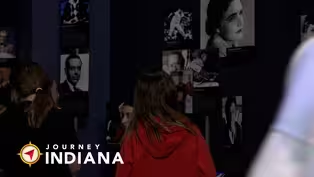
Wander inside, and you'll soon find the American Originals Exhibit.
It's a celebration of some of our most iconic Hoosiers.
>> So, you know, the goal of American Originals really is to answer that question that many of our visitors -- either local or folks that are visiting our city, answers is, who's from here?
Who's from Indiana?
Who has a relationship with Indiana?
Who has -- who's found some meaning in our state?
And answering those questions every day with the folks behind me.
>> But don't think that this is just a Hoosier Hall of Fame.
>> You know, right now, American Originals mostly has folks from pop culture and sports.
We have some astronauts in here, some architects, some designers, but mostly it's those household names from, you know, a little bit yesterday to today to tomorrow that our visitors are going to have a conversation around and say, oh, I know that person.
Oh, I have some connection with them.
>> Now, no offense to these Indiana icons, but it's hard to not have favorites, even for the museum staff.
>> In American Originals, I think we can all find a favorite.
There's so many people that you can recognize.
And even if you don't recognize them, you can see their image, learn a little bit more about them, and then explore afterwards.
There are some stories that I like to share.
For example, the story of Wes Montgomery, who was a self-taught guitarist born here in Indianapolis.
He went on to win two Grammys.
Those Grammys are in the Indiana State Museum collection.
So being able to connect the face with his image, his Grammys and his story is something that I love to share.
Reggie Miller is another favorite.
Although he was not born here, he came here and he established a legacy here.
He was selected by the Indiana Pacers in 1987.
He was the 11th overall pick.
And in one year, in 1995, he scored eight points in 9 seconds wearing the blue and gold.
Reggie Miller is in the Hall of Fame, and Reggie Miller is an Indiana legend.
>> You'll probably be surprised by some of the faces you see at the American Originals exhibit, and that's the point.
>> You know, it's really fun to explore the faces here because I would say that almost every exhibit is about the person who's viewing it, right?
And so you're in here, you're exploring, you're finding people that you have a connection with, and you're starting there, and then discovering that there's so many people that have so much connection with Indiana.
♪ >> Next, we'll meet tailor Jerry Lee Atwood, whose custom made western-style suits are striking a major chord.
>> The type of machine I use, the old chain stitch embroidery machines, as you are embroidering, it's -- it's like painting with thread.
You know, you're sitting at the machine, filling in and, you know, making decisions in the moment.
You can kind of manipulate the machine to have a directional stitch, and then change the direction so the way the light hits it, even though you are just using, like, one color, you are getting a lot of depth and a lot of texture, just in that, like, color field.
My name is Jerry Lee Atwood, and I'm a fashion designer and tailor for Union Western Clothing Company here in Indianapolis, Indiana.
When I discovered embroidery and then, you know, putting embroidering on clothing, then putting that on a person, it's like a person becomes, like, this walking canvas.
Like, I feel like I've been pretty lucky to make a lot of suits for a lot of celebrities.
You know, Post Malone, Lil Nas X, Orville Peck, Diplo, most recently Matthew McConaughey and Woody Harrelson.
You know, every once in a while, I'll go to, like, the Old Town Road video.
Just, you know, like, how many people have seen it now, you know?
Going from, like, when I started making western wear and thinking, like, if I'm lucky maybe a small band from Indianapolis will wear my stuff on tour and -- and be seen in front of, like, you know, a couple hundred people at a show every night.
From, like, that mindset to, oh, something I've made has been seen by, like, hundreds of millions, potentially over a billion people, kind of just blows my mind.
I was an art school dropout and ended up working in coffee shops.
I don't know, I just got this idea to make western shirts.
And I borrowed my roommate's sewing machine, and made a really horrific western shirt.
♪ So it kind of brought back a lot of nostalgia.
My dad had all of these old country albums that had, you know, people in their western suits on the covers, embroidery and rhinestones and the arrow pockets.
That really kind of came to prominence in the late '40s, early '50s with tailors like Nudie Cohn, Rodeo Ben and Nathan Turk.
The term that most people use is "nudie suit."
Nudie was the most well known.
He brought it into pop culture.
The country musicians in the '50s and '60s.
So if you are somebody like Porter Wagoner or Webb Pierce and you were playing in a small town in Oklahoma or Indiana or wherever, you're bringing the glitz and glamor to them.
And it, I think, was a way of paying respect to your audience.
♪ Generally, a customer will come to me with an idea and motifs that they want on the suit.
So I'll work on some sketches inspired by their ideas.
So right now, I'm making this suit.
This is a customer who is getting married.
You know, he likes these vintage guitars.
I think he has a collection of guitars.
This is a perfect example of working with the customer and kicking ideas back and forth, coming up with, like, a really strong vision for the direction of the suit.
I'll draft up a mock-up suit, and then I go to the machine, embroider everything which, you know, is a days' long process.
We'll rhinestone everything, and then, you know, do all the tailoring.
Like Starry today is doing some pad stitching.
The suit gets sewn together and finished and sent out to the customer.
From cutting to finishing, just the actual work on a suit is about 120 hours.
Usually I have, you know, a month or so from when I start a suit to when I need to send it out.
It's not a long window to do a lot of work.
You know, my canned answer is always the next suit I make is my favorite.
But of things that I've actually made, the Stranger Things suit, far and away, like, my favorite suit that I've made.
I mean, it's just really, really densely embroidered and has a lot of rhinestones.
I remember watching "Stranger Things" and thinking of, like, if I made a suit, a Stranger Things suit, how I would incorporate, like, some of these different themes and images in the show.
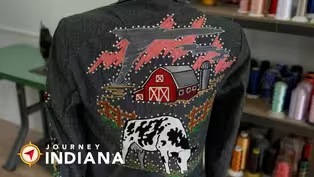
My own suit that I made is that -- the Indiana suit.
So it has the corn and the carnation, cow in a field with a tornado in the background.
Country music was always kind of like the lame music that my dad listened to.
♪ So it's kind of interesting to see, like, this thing that was so closely associated with country musicians kind of rise to prominence in our modern, somewhat polarized society in American society.
These suits are becoming popular again and being worn by, like, many, many different types of people.
You know, not just country musicians but, like, hip hop artists, you know, sports people, actors, you know, all sorts of people.
People from across, you know, political and cultural backgrounds can kind of come together in an appreciation of this art form.
>> Next, a clip from the recent WTIU documentary "Archiving Airwaves."
Here we'll see how amateur radio enthusiast John Miley built one of the most impressive sports archives in the country.
>> The spine-chilling sound of baseball history being made.
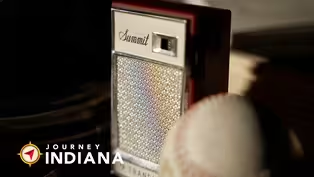
It's moments like these that fuel the passion of John Miley of Evansville, Indiana, owner of the world's most complete collection of baseball audio.
>> My collection started probably back in the 1940s when I bought a -- my parents bought me a wire recorder.
At that time, they didn't have tape recorders.
>> Whatever I would record, I'd just take this microphone, I would start the recorder, whatever -- however you start the recorder.
I don't remember that.
But when you start the recorder, then you just take this microphone and you put it next to the radio.
And I remember taping the -- the thing that really got me started was the California-Northwestern Rose Bowl in I believe 1949.
>> He's going wide.
He's untouched.
Off left tackle and Jensen, and he's into the pair.
He's down to the 40.
He's down to the 30, to the 10 and he's over for the touchdown!
[ Cheers ] >> I had no idea what I was doing, really.
What I was trying to do was I knew that when I retired I would want something to do, and what better than listen to old sporting events.
Well, I have, I believe -- I don't know this for a fact, but I believe I have the best and most comprehensive sports audio and video collection that has ever been had.
>> Two strikes and a ball.
Mitchell waiting.
Standing straight.
Feet close together.
Larsen is ready.
Gets the sign.
Two strikes, ball.
Here comes the pitch.
Strike three!
A no-hitter, a perfect game for Don Larsen.
Yogi Berra runs out there.
He leaps on Larsen, and he's swarmed by his teammates.
Listen to this crowd roar!
[ Cheers ] >> In the mid-'70s, I was at KMOX Radio in St. Louis and I just decided on my own, let's do a weekend retrospective about the three World Series that the Cardinals were in in the 1960s, all the games called by Harry Caray and Jack Buck on KMOX.
>> I came across KMOX and they're playing old Stan Musial highlights.
My favorite player of all time, Stan Musial.
So -- and I've got everything that Musial ever did, right?
No!
He had some stuff that I didn't have.
So I'll be doggone, if after the program was over around 10:30 in the morning, I picked up the phone.
>> And he just called out of the blue.
Got connected to the sports office at KMOX.
We had a conversation.
He invited me to come to his home.
And I drove to meet him in Evansville.
>> He picked out several things that he wanted to hear.
>> And I was stunned by what he had even then in 1976 and how precisely he had it cataloged.
Now, some of it was among the greatest moments in sports history.
You know, Louis knocks out Schmeling or Jessie Owens at the '36 Olympics or some sort of scratchy broadcast of a 1933 World Series.
>> One year, CBS called me.
They wanted to play highlights of old World Series games.
They were doing the World Series on -- on radio and they wanted to play highlights of old World Series.
They gave me a list of 48 World Series highlights that they wanted from the past.
I had all 48 of them.
>> Two away.
Cochrane on second base.
Goslin batting.
It's the last half of the ninth inning.
The ballgame tied up 3-3.
French steps in on the mound.
He's getting the signal.
Here's the pitch, and a drive going out to right field for a hit!
And here comes the throw to the plate.
Here comes the run in and the ballgame is over!
And the Detroit Tigers are the new champions of the world!
>> When I got to NBC and later to HBO, any time we were doing historical stuff, one of my suggestions was, let me check with John Miley.
And very often, he had not only what we were looking for but more than we had asked for related to that topic or that game or that broadcaster.
>> Everyone comes to me.
The major networks, the players, the relatives of the players, fans of -- of the sport in particular, people who know about my collection, and -- and think -- wonder what in the world does he have?
>> We did a tape for Oakland, as we did for Marty and Joe and Harry Caray.
We did a tape for Oakland's 25th anniversary, and they gave -- they gave the tape away to the first 10,000 that came into the ballpark.
I got all the cassettes and reel-to-reels in here, including large reel-to-reels that I used to make my Notre Dame tape, which was sold up at the Notre Dame Bookstore.
>> No one -- and I mean the archives of the networks, I mean the Smithsonian if they've archived any of this stuff, I mean the respective Halls of Fame in Cooperstown, Springfield and Canton, no one and no entity has as much stuff, and as precisely cataloged as John Miley does.
>> There's whole television series that never got recorded and saved because they were just considered disposable.
>> Super Bowl III, when Joe Namath and the Jets upset the Colts, to my knowledge, no one had the full game.
Things just disappeared.
Don Larsen's perfect game just disappeared.
>> Television stations would tape over them.
So the only way that you would have access to a lot of these recordings is if somebody took the time to record them on their own and then maintained them.
>> Last, we'll learn about the life and the legacy of Gus Grissom, one of the original Mercury seven astronauts.
>> That's one small step for man.
One giant leap for mankind.
>> In July 1969, the world watched as American astronauts landed on the moon.
They left behind several mementos to commemorate the occasion, including a patch, listing the names of three American astronauts who died tragically in the nation's quest to reach the moon.
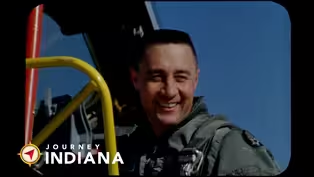
Roger Chaffee, Ed White and the leader of the team, Hoosier astronaut Virgil "Gus" Grissom.
>> He had the dedication, the experience, and the patriotism to give up his life for the American space program.
That's something that should not be forgotten.
It should be remembered always.
>> Grissom grew up in a modest home in tiny Mitchell, Indiana.
One of his most cherished childhood memories was when he was introduced to a local barnstorming pilot who, for a small fee, would take residents for a ride.
Grissom had no money, but gladly traded his prized BB gun for an opportunity to soar high through the Hoosier sky.
>> It was a way for him to escape from perhaps some small town life, to have this thrill of getting an airplane ride when most kids his age didn't have that same advantage as he did.
And I think that really encouraged him, perhaps one day, to be a pilot himself.
>> By 1950, Grissom had a degree in mechanical engineering from Purdue University, and was a fighter pilot serving in the Korean War, completing 100 missions over enemy air space.
>> Gus was a good pilot.
He had a very even keel.
It's a characteristic of any pilot, you have to have a cool character, have to keep calm in pressure situations.
[ Beeping ] On October 4th, 1957, the Soviet Union really shocked the world, and particularly Americans, by announcing that they had launched the first artificial satellite Sputnik into space.
And it engendered a crisis of confidence in the American public.
>> Priorities within NASA, the fledgling American space program, were suddenly launched into high gear, and they began reaching out to several of the country's top pilots, including Gus Grissom.
>> This puts the astronauts in the spotlight, and puts a lot of pressure on them, particularly for Gus' mission into space, which happens in July 1961.
>> During NASA's initial Project Mercury program, Grissom was scheduled for a 15-minute test flight, aboard a vessel he named the Liberty Bell 7.
The test was a success.
But as military helicopters descended to rescue the ship and Grissom, the hatch of the capsule suddenly blew off, causing thousands of gallons of seawater to flood the ship.
>> More and more water's coming in the space suit.
He's losing his buoyancy.
Luckily for him, that other helicopter comes by, throws him a line and winches him out of the water and gets him aboard.
Some in the press look to blame Grissom for the blown hatch, though most within NASA never held him directly responsible.
In less than five years, Grissom would again be chosen to head one of NASA's next biggest initiatives Project Gemini.
>> Gemini III mission went off really without a hitch, and the astronauts were lionized.
They went to the White House.
Gus was honored for being the first person to fly in space twice.
They had ticker-tape parades in New York and Chicago.
>> By the start of 1967, NASA announced its next phase of space exploration with the launch of the Apollo program, the initiative that would eventually land astronauts on the moon.
Along with fellow astronauts Ed White and Roger Chaffee, Grissom ran a series of ground tests aboard the Apollo 1 space capsule on January 27th, 1967.
>> Negative.
>> And while all this is going on, there is a scuffed electrical wire in the miles of all of this wiring in the spacecraft that's been chafed, and there's an open wire.
Suddenly something happens.
It sparks and in that pure oxygen atmosphere under pressure, just the tiniest thing like that can cause a blazing inferno, and they die on the launch pad.
♪ >> Without Gus' sacrifices and the sacrifice of Ed White and Roger Chaffee, you know, Neil Armstrong and Buzz Aldrin and Michael Collins could not have made it to the moon and back as they did in July 1969.
>> In June 2022, leaders from NASA joined the families of Grissom, White and Chaffee to dedicate a new historical marker at Arlington National Cemetery in Washington, D.C., a memorial that pays tribute to the Apollo 1 crew, and their contribution to one of the greatest scientific accomplishments in history.
>> Thanks for watching.
We'll see you next time on "Journey Indiana" ♪ >> Funding for "Journey Indiana" was provided in part by: The WTIU Vehicle Donation Program.
Proceeds from accepted donations of a car or other vehicle make this program possible.
Most vehicles are accepted and pick up can be arranged at no cost.
Learn more at WTIU.org/support.
>> Charitable IRA rollover gifts.
Individuals aged 70 and a half or older may make a tax-free charitable distribution from their IRA to WTIU.
Consult your advisor and visit Indianapublicmedia.org/support for more details.
>> WTIU sustaining members.
Committing to regular monthly contributions, providing WFIU and WTIU with reliable ongoing support.
Becoming a sustainer is one of the most effective ways to support public media.
>> And by viewers like you.
Thank you!
Video has Closed Captions
Clip: S7 Ep10 | 6m 14s | John Miley has been taping baseball games for decades, now he has world-renowned archive. (6m 14s)
Hall of Hoosiers: Indiana's Most Famous Residents All in One Place
Video has Closed Captions
Clip: S7 Ep10 | 2m 47s | The American Originals exhibit at the Indiana State Museum celebrates iconic Hoosiers. (2m 47s)
A Hoosier Amongst the Stars: The Wild Ride of Gus Grissom
Video has Closed Captions
Clip: S7 Ep10 | 6m 3s | Virgil "Gus" Grissom grew up in Mitchell, Indiana and went on to become one NASA's first astronauts. (6m 3s)
Video has Closed Captions
Clip: S7 Ep10 | 6m 21s | Fashion designer Jerry Lee Atwood makes dazzling country and western suits (6m 21s)
Providing Support for PBS.org
Learn Moreabout PBS online sponsorship












Support for PBS provided by:
Journey Indiana is a local public television program presented by WTIU PBS