
Hospital Infrastructure
Season 1 Episode 107 | 26m 46sVideo has Closed Captions
We’ll discuss how our response to the pandemic can be made more sustainable.
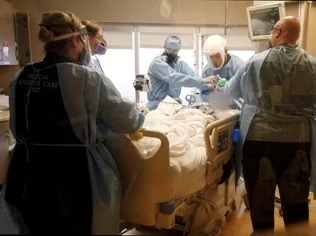
This month on Flatland we’re hearing from healthcare professionals about the toll recurring Covid-19 surges are taking on our healthcare system. While our most recent surge of Omicron was often described as mild, the number of hospitalizations still packed beds and spread an already exhausted workforce thin. We’ll discuss how our response to the pandemic can be made more sustainable.
Problems playing video? | Closed Captioning Feedback
Problems playing video? | Closed Captioning Feedback
Flatland in Focus is a local public television program presented by Kansas City PBS
Local Support Provided by AARP Kansas City and the Health Forward Foundation
Hospital Infrastructure
Season 1 Episode 107 | 26m 46sVideo has Closed Captions
This month on Flatland we’re hearing from healthcare professionals about the toll recurring Covid-19 surges are taking on our healthcare system. While our most recent surge of Omicron was often described as mild, the number of hospitalizations still packed beds and spread an already exhausted workforce thin. We’ll discuss how our response to the pandemic can be made more sustainable.
Problems playing video? | Closed Captioning Feedback
How to Watch Flatland in Focus
Flatland in Focus is available to stream on pbs.org and the free PBS App, available on iPhone, Apple TV, Android TV, Android smartphones, Amazon Fire TV, Amazon Fire Tablet, Roku, Samsung Smart TV, and Vizio.
Keep Exploring


More to Explore
Meet host D. Rashaan Gilmore and read stories related to the topics featured each month on Flatland in Focus.Providing Support for PBS.org
Learn Moreabout PBS online sponsorship- [Narrator] "Flatland" is brought to you in part through the generous support of AARP and the Health Forward Foundation.
- Hi, I'm D. Rashaan Gilmore and welcome to "Flatland."
Every month as you know, we dig into one issue that's raising questions, causing tensions or has gone curiously unexplored in our area.
And for this episode, we'll be talking about the pressure space by healthcare professionals.
(upbeat music) When the COVID-19 pandemic first began, healthcare workers were applauded as frontline heroes, but as COVID mis-information and pandemic fatigue has spread, we've lost sight of how hard our healthcare professionals are continuing to work.
And while the most recent surge of Omicron is often described as mild, the number of hospitalizations has still packed beds and spread an already exhausted workforce quite thin.
Let's take a look at how our response to the pandemic can be made more sustainable and what support healthcare professionals really need.
- [Lauren] There's nothing like it in the world to be a caregiver.
Those moments that you spend with people the good and the bad, they just imprint on your heart so hard.
The kind of beginning of the pandemic, we're realizing that it's bad and fear is mounting and staff are really putting in the work.
We're becoming aware that we are being put on the front lines and that all hell is about to break loose.
- [Jordan] I volunteered to go to the COVID unit.
I figured I would do that for a few months and then we would all get vaccinated and then it would go away.
Then it kept going on and on and on.
And then we didn't have a COVID unit anymore, the COVID patients were everywhere.
And I've seen so much death even in young people with COVID.
And I have seen several of them with young children, 40 year old people with nine year old children and they have died.
And it's really hard to tell the family of a person who was healthy before that they are not coming home.
They are not going to be with their children when they graduate.
That was making me want to consider a different career, for sure.
- [Arel] I didn't become a nurse to watch people die.
I became a nurse to save lives.
I hate to say it, but I've lost more patients than I've saved.
And you just feel helpless.
- [Lauren] There were very few joyous moments for a really, really long time.
But you know, when we're the one standing there right in front of them in a gown, in a mask, holding a Q-tip that's about to go up their nose.
We became the physical representation of mask mandates and vaccines.
And you know, not being able to see your friends and family and you have to cancel your holiday plans and we're the perfect punching bag for them.
- [Jason] We were up against all the misinformation that was out there about the vaccine, about COVID in general.
If you're a clinician you have these arguments with patients then you have to go home and you have those same arguments with extended family who are subject to the same misinformation.
- This last Omicron wave.
We didn't have more patients than we had at our last peak.
What we had was 20% fewer staff to treat them because so many of us got sick all at once.
And because there's been a slow loss of folks to retirement and to choosing nonclinical jobs and other things over the last two years.
But some of that is driven by the fact that they were not treated well and their wellbeing was not prioritized early in the pandemic either.
- I have to share a story because it blows my mind.
Management decided to do something kind, a gift.
The gift was a single roll of two ply toilet paper that was being handed out to staff as we walked out of the door from our 12 hour shifts, I will never forget that.
I will never forget the absolute slap in the face that that felt.
That your value, what you are putting into this job, what you're risking for the job is worth toilet paper.
We're just dealing with these constant slaps in the face.
- [Arel] When I first started, I hardly ever got three patients because in the ICU you're running vents, you're running multiple medications.
You have very, very critically ill patients.
These companies really started thinking that like, hey maybe this is okay.
It's okay that we started giving them three patients and it started to get dangerous.
Our license were on the line.
It does get draining when you realize that you're not being appreciated and compensated to the ability that these companies can compensate you for.
And so I turn to a travel agency, they aren't fighting to keep loyal staff members and they're losing them to travel agencies.
The underlying problem is the way that the these hospitals are being ran.
They're treating healthcare like it's a business and it's not.
We are taking care of human lives, first - [Jason] There are precedence for epidemics and pandemics and we knew historically that the United States, not just the United States, but a lot of countries were going to attempt to prioritize economic considerations above all else.
Until things got really bad.
We knew that if our government did that that we were going to be looking at mortality rates in the hundreds of thousands of people.
And so that's the beginning sort of mindset that you're already in, as things begin to get really bad.
But to have it compounded by the feeling that so much of what we're going through could have been avoided if there were some adults in the room making adult decisions.
- [Dr Keirns] So the concept of moral distress comes out of the nursing ethics will literature.
And that's not really surprising because when you think about it, it's the idea that you are faced with a situation in which you are prevented from doing the right thing.
So nurses are the most likely to find themselves in a situation being asked to carry out a plan that they either don't agree with, don't think is the best thing for the patient, or they're constrained by larger systemic issues in terms of the resources to do what they believe is the right thing for the patient.
And there's even been a push toward thinking about a concept called moral injury, and that comes from the PTSD literature of being asked to carry out things that they believe are actively harmful.
We're trapped in a broken system that is under unprecedented stress.
And even if the leaders of our institution wanna do the right thing, or the leaders at the county or state level wanna do the right thing, we often don't have the resources to do it.
- [Dr. Samuel] Basically killing our healthcare professionals.
What can we do to help?
The intervention has three different component, right?
So we had a group discussion component and then we have the mindfulness act activity component and we have the yoga practice component.
Twice every week we will meet for an hour.
And then they talk about the things that are going on in your lives, professional lives.
Then you see that, oh, I am not alone.
We found that there was a significant reduction in measures of burnout, in depression, in anxiety.
There was an improvement in resilience and an improvement in compassion.
- It's most important to make sure we disassociate burnout and resilience from character, right?
There's not a lack of character when people feel burnt out, it's a moral dilemma.
It's the inability to do things the way that I believe they should be done for the services that I believe should be given.
And people are having a very difficult time reconciling that.
And that's what the HRSA grant is all about.
There are two core components that we're gonna focus on; curriculum, there's eight hours dedicated to the actual tactical skills that you'll need.
Reframing, like how can you enter in a certain circumstance and try to control your thoughts and how you handle that which then leads to healthier behaviors.
And the other main component is connections.
How do we intentionally provide you space and emphasize the importance of staying connected to other people?
I'm under no illusion that if I just intervene with early healthcare career professionals, we can declare victory, right?
So there are healthcare employers that will play a role.
If you take care of those things, the pay, the ratios, the operations, you make sure that's equitable, it's healthy, it's fair.
Our job is to provide you with people who are gonna meet you halfway.
- [Jordan] Nurses should be limited on how many patients they have.
We do need the nursing ratios passed and enforced and we need everyone in the public to try to keep themselves healthy, if possible.
- [Jason] I would really like to see us commit to making sure that we will take care of people's mental health.
And that likely involves us really being serious about universal healthcare access.
That as a society we don't have because of our enduring politics of the undeserving poor.
A number of investments in public infrastructure that we won't make because we're afraid that poor people of color might benefit from them.
And I hope that we can begin to have a reckoning with that mindset as a nation.
- [Dr Samuel] If we cannot get medical students to go into primary care and those who are already practicing are planning to leave because they are chronically tired and then they feel miserable.
Then we have a problem on our hands.
I think that policy makers and healthcare organizations can help by first, recognizing this harmful effect of emotional distress on healthcare professionals.
To ensure that programs are in place to improve the emotional, the mental health, the social support to healthcare workers, especially those on the front lines.
- [Lauren] We are experiencing the depression and the anxiety and the fatigue and the fogginess.
And the staff that have had COVID, you know, we're experiencing some long term effects from that.
And so now they're really pushing for counseling and therapy and there's onsite people and then they're offering this for free.
And, you know, they finally, a year and a half into the pandemic, you know, raised our incentive pay.
And so for a lot of people, it's too little too late.
I want people to know that we're still here... And that they're still here too.
They're still part of this just as much as we are.
And... Just because they're not the ones holding someone's hand as they die, doesn't mean they have a right to look away.
And welcome back for the discussion portion of today's program.
With us in studio today is Kansas city Missouri's new health director, Dr. Marvia Jones, Dr. Jen Baccani, assistant Dean of the office of Rural Medicine Education at KU Med, Dr. Samuel Ofei-Dodoo, director of residency research in the Department of Family and Community Medicine at KU Med and Dr. Carla Keirns, associate director of medical ethics and palliative care physician at KU Med.
So let me go to you, Carla, you've been on the front lines of this pandemic since the beginning.
What are the biggest challenges that you all have faced throughout the various versions of COVID-19 over the past two years?
- The first nine months from about March of 2020, till December, everyone was terrified for our own health and the health of our families.
We were taking care of a lot of sick patients who many of whom were dying, many more of whom than we had hoped.
And there was no vaccine, not enough PPE in much of the country.
And so there was a lot of personal risk.
And at the same time, a lot of personal courage.
The second phase, I would say most of 2021 as vaccines became more available, we really struggled with folks who chose not to take them, because it felt so much like so much of this suffering we were seeing was preventable.
And then the last phase, everyone seems to think it's over.
And we still have a hundred people in our hospital with COVID and we're still losing moms and dads and sons and daughters.
- How do we get people to see that we've still got a little bit of a ways to go here?
- I think we have to meet people where they are.
So we have to listen to their stories and their concerns and what they feel like this has cost them and then help figure out how to make goals together that we can work toward.
So we're not gonna get to zero COVID, but if we listen to the parents who are scared about their kids not learning to read and listen to the folks who are worried about their jobs, then I think we can make more comprehensive plans that everybody can feel comfortable with.
- And so I'm curious from a rural perspective, do you find that it's different in terms of how people are approaching their attitudes toward COVID, frankly?
- We have seen that throughout the pandemic that rural communities tend to be more hesitant with vaccines and really the overall guidance at the national and state levels, even at the county level.
I actually am a practicing family physician in my hometown.
And so I do that along with my associate Dean role.
And I also am the county health officer.
And so even though it is my hometown, I know all these people, I've known them since I was a kid, it still doesn't always resonate with people and they're not always listening.
They're not always following all the guidance.
And that's just kind of the culture you might see in some of these rural communities and it's very hard to change as a society.
- Going forward, what are some of the strategies that we can employ to make conditions more sustainable for our healthcare workforce?
- Really understanding what are the things that people really responsible for.
And then just being very pragmatic, realistic about what we can actually do with those resources.
I think sometimes we believe because a day contains 24 hours that it's okay to just kind of tag extra things on and people will make it happen.
We have to have real conversations with people about what is actually your role, how do we prioritize the tasks that actually need to get done?
And the things that are nice to have and we would love to be able to do all of that, we may have to deprioritize until we have more resources.
We've all been kind of raised to think that we are these role, we gotta just rise to every occasion but it's killing our people.
I think about stress and cortisol all the time.
And I know that we can't burn candles at the both ends.
So that's one strategy.
The other one is just really recognition across the board, enhancing that recognition from the people who are at the lower couple rungs of the organization all the way to the leadership, just doing a better job of calling out, "Look, this person has been with us and has done this, great job, thank you."
We are not gonna continue to celebrate overexertion because I think that creates a culture that demands it, but really getting people would say, "Hey, thank you for giving us the best of what you could give us."
As employers, as leaders, we should be looking for ways to give people a relief valve.
And so we have to be creative is that, I got an email today from a staff member who said, "Hey, gas is high."
- [Man] Yeah, yeah.
- Is there any way we could get a weekly telework day?
Yes, it may require some logistical shifting or whatever, but absolutely should we look into how we can do something like that and move it across the board.
- Dr. Dodoo, you spend a great amount of time studying burnout even before the pandemic.
I'm just very curious what you think are the biggest factors contributing to burnout among healthcare professionals.
And do the issues that Dr. Jones and Dr. Baccani just described, play a role in that?
- Prior to COVID-19 a study that we conducted, we found that about 49% of healthcare professionals experience at least one manifestation of burnout.
Three months into the pandemic, it was 50.4.
Then it roses to 69.2, 18 months into the pandemic.
And I don't think it's going to get better, and personally, I have stopped calling it burnout, I call it COVID-out.
- Mm.
- That is a new term that I use because until we do something to help healthcare professionals, I don't think it's going to get better.
The study that we conducted, we also looked at folks who are actually on the frontline working with the COVID patient.
And what we found was that those who were treating COVID patient, they were four times more likely to report at least one manifestation of professional burnout.
And they were three times more likely to experience emotional distress than those who were not.
- Have we as a public expected too much of our healthcare professionals?
- I mean, I worry that we have.
There's a term from the PTSD literature called moral injury.
And that treating someone who is resisting taking our advice definitely feels like that.
- We've both expected so much more of our physicians, providers, nurses, respiratory therapist, everybody across the board, while at the same time, somehow telling them that we aren't also going to support you or we're going to create legislation against some of the work that you're doing.
Or that we are going to pretend like we're listening and then act differently when we are in public.
I mean, there's just so much that contradicts itself, the expectations, but also the lack of support out there for healthcare.
- We don't want to listen to our healthcare professionals, right, but when things happen we just run back to the hospitals, the clinics, and then we want these healthcare professionals to take care of us.
And that is unrealistic.
We put a lot of pressure on the system.
- We really need to figure out, and this is something that I know we're all working to learn, is how do we ensure that the people who are on the front lines understand that we still value them even as we are dealing with catastrophic situations.
And sometimes I think when we're in the middle of a fire, like we have been with COVID-19, sometimes it can feel like the work is the most important thing.
The work at hand is the most important thing, and it's the only thing.
And so I think that the science that we are trying to figure out still is, how do you address that issue?
How do you address the work and the fire that's in front of you, while also pouring into the firefighters or the workers.
- For the person who is experiencing burnout or COVID-out as a healthcare professional, what tips do you have for them?
And then a second piece to this before we go on the conversation, what tips do you have for those who are trying to support those who are on the front lines every day and experiencing these extremely high rates of stress?
- They can thrive by fostering meaningful connection among themselves through socialization opportunities, and/or support groups, as well as building this kind of shared meaning.
Exercise and mindfulness activities.
Healthier eating, decompression from daily stress and connecting meaningfully with family and friends.
I always talk about the fact that people should not underestimate the power of meaningful friendship, meaningful relationship with friends and family.
- Well it's interesting because I see all of of our panelists nodding and I think you you hit upon something there that, if anything, it seems to me at least that what this whole two year plus journey I think has tried to show all of us is how much we need one another.
- Yes.
- And I'm just curious, Dr. Marvia Jones, it seems to me that if we're talking about what we can to support healthcare workers and what they can do to support themselves, I have to ask the question, what are some of the broader health implications for the public if we're not doing that?
- You know, I have to also think about the folks who are on the phone lines, calling people to come get their shots.
Or the people who are trying to get someone who has been bound at their home for whatever health reason, figuring out how to rally resources to get them out and to come get a vaccination, or just dealing with all the broken pieces of our society that they're now running up against trying to get them just a vaccination.
People will leave.
And so what we keep saying now while we are in a period, I know like Dr. Keirn says, we are not out of this by any stretch.
But as we have seen some decline, this is the time to build those folks back up so that we can prepare for the next thing.
- What is the supportive role that we need government to play in terms of legislation that has an impact on all of these things?
And again, I see all of our panelists nodding heads.
- So I think number one, financial support, because for example, my health department has four full-time employees that is doing everything that a health department has to do in a county, plus the contact tracing.
Oftentimes our healthcare workers in our hospitals and clinics aren't getting paid enough.
And then using the language, using the words and actually not creating legislation that vilifies us.
In Kansas we have multiple bills that are out there that are telling public health what they can and can't do.
And for years we've kept communities safe, and now people are saying, "No, we know better.
We're gonna tell you what you can and can't do, even though you've still been working over the last couple of years to keep us safe."
We need to support our healthcare workers and our public health in so many ways.
And we're doing the exact opposite right now.
- We also think that the healthcare organizations or the systems should try to pay for scribes, where, so that our healthcare professionals are not secretaries anymore, right?
So once they take care of the patient, somebody can do the work for them.
And there should be a payment reform, insurance company interface.
And then more importantly, clinical support.
I believe that policy makers and healthcare organization can also help by first recognize the harmful effect of emotional distress on healthcare professionals wellbeing and to ensure that appropriate programs are in place to provide this emotional, mental health and social support for our healthcare professional.
The good news is that the US Senate recently pass a bill to address the stigma that healthcare professionals often face when they are seeking healthcare services.
It has been named after the emergency department physician who took her own life in April after treating patients of COVID-19, Dr. Lorna Breen.
So these are some of the strategies that we can all put in place to be able to help healthcare professionals.
- In the ethics space, one of the biggest things that we have done is talk about TRIAGE.
And if we run out of resources, who are we going to treat and who are we going to essentially abandon?
Institutions all over the country wrote these guidelines and then no one wanted to implement them.
And so I think we need to honor and recognize that we believe that everyone deserves care and that we need to build the system to allow that to be our goal and our motive being.
- Love that.
If you would like to share your gratitude for our community's healthcare workers, please go to flatlandshow.org to join our call for community letters.
You can also find additional reporting on healthcare challenges in our region at the link below, as well as an opportunity to submit your curious Casey question for next month's topic.
This has been "Flatland" I'm D. Rashaan Gilmore, and as always thank you for the pleasure of your time.
- [Narrator] "Flatland" is brought to you in part through the generous support of AARP and the Health Forward Foundation.

- News and Public Affairs

Top journalists deliver compelling original analysis of the hour's headlines.

- News and Public Affairs

FRONTLINE is investigative journalism that questions, explains and changes our world.












Support for PBS provided by:
Flatland in Focus is a local public television program presented by Kansas City PBS
Local Support Provided by AARP Kansas City and the Health Forward Foundation