
Housing Along Streetcar Line
Season 3 Episode 5 | 26m 46sVideo has Closed Captions
The Flatland team examines the impact of the streetcar expansion on housing affordability.
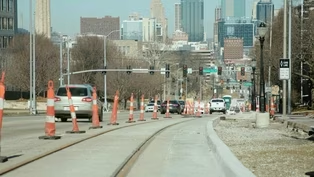
In 2025, the prolonged KC Streetcar expansion from Union Station to the Plaza is expected to begin moving passengers. KC's midtown businesses and residents may see associated cost of living increases as new development concludes and ridership begins on the extension. This month, Flatland in Focus analyzes the costs and examines the benefits and drawbacks for developers and the midtown community.
Problems playing video? | Closed Captioning Feedback
Problems playing video? | Closed Captioning Feedback
Flatland in Focus is a local public television program presented by Kansas City PBS
Local Support Provided by AARP Kansas City and the Health Forward Foundation
Housing Along Streetcar Line
Season 3 Episode 5 | 26m 46sVideo has Closed Captions
In 2025, the prolonged KC Streetcar expansion from Union Station to the Plaza is expected to begin moving passengers. KC's midtown businesses and residents may see associated cost of living increases as new development concludes and ridership begins on the extension. This month, Flatland in Focus analyzes the costs and examines the benefits and drawbacks for developers and the midtown community.
Problems playing video? | Closed Captioning Feedback
How to Watch Flatland in Focus
Flatland in Focus is available to stream on pbs.org and the free PBS App, available on iPhone, Apple TV, Android TV, Android smartphones, Amazon Fire TV, Amazon Fire Tablet, Roku, Samsung Smart TV, and Vizio.

More to Explore
Meet host D. Rashaan Gilmore and read stories related to the topics featured each month on Flatland in Focus.Providing Support for PBS.org
Learn Moreabout PBS online sponsorship- [Narrator] "Flatland In Focus" is brought to you in part through the generous support of AARP, the Health Forward Foundation, and RSM.
- Welcome back to "Flatland In Focus," I'm your host D. Rashaan Gilmore.
And tonight we are steering into a discussion on how the new streetcar extension will change the midtown landscape, and what it means for those who call it home.
(upbeat music) (gentle music) (air whooshing) All right, let's tackle a topic that's moving Kansas City forward, quite literally.
The streetcar extension is rolling down Main Street and it promises, to not only connect major districts in our city, but also reshape our city's landscape.
As construction carries on to a 2025 completion date, several major developments along the streetcar line are underway, and they promise to bring additional residential and commercial spaces with it.
But sometimes new development ushers in higher property taxes and rents.
And at a time when renters across the country are severely cost-burdened, this raises the question of how this line will impact Midtown residents.
So let's take a look at the changes that are coming for Midtown, who benefits, and how we navigate those changes together.
(air whooshing) (pulsating music) (bells clanking) - [Interviewer] So how often do you use the streetcar, and where are you headed?
- So I'm headed to work, Blue Cross Blue Shield, across the street from Union Station, and I use the streetcar probably two to four times a week.
- I use it every day.
Almost every day, yeah.
- I'm only like a block from my apartment, so it's like why wouldn't I use it?
- I could use it on a weekly basis.
- I like how easy it is, it's just hop on, hop off.
When I was looking to buy a place, I was looking for anywhere that was along the streetcar route so I could take it to work.
- Kansas City is a streetcar town, it was born a streetcar city in the late 1800s.
Really through the 1950s, the streetcar shaped the face of Kansas City.
It connected neighborhoods, it served a spine for retail, and development, and activity and that made way for the bus.
And the suburbanization of the Kansas City region, the construction of the Interstate Highway system, and the loss of thousands of people and thousands of jobs from the core of our city.
We've secured, it's a $350 million capital investment, we've leveraged the new local contributions to secure $200 million in federal funding.
So we're building Main Street, we're gonna be connecting the Riverfront to UMKC, connecting the two largest jobs centers in the city through the densest residential neighborhood.
Our role of just a downtown circulator is no more, we are gonna be the spine of a multimodal system that's connected to bus routes to Johnson County and South Kansas City.
These were once vibrant, dense neighborhoods, and in many cases they're half empty.
How do we use infrastructure like streetcar to try to encourage developers to look at empty spaces, and find opportunities to bring people and jobs back?
- Midtown and downtown are really attractive markets in Kansas City.
Frequently ranks as the number one or number two place people want to live.
But then when you look and you say, "Well, who's pet friendly?
"Who's inclusive?
Who's got parking?
Who's got laundry?
Who's got new units?
Who's got places where you're not paying 2, $300 a month in utilities because, you know, the windows are 100 years old?
We realized the supply and demand didn't really match, that there's a lot of vacant inventory.
So the city can handle all of us doing successful projects.
The building next door, the city had listed as a dangerous building, it was planning to tear it down.
And so we were really lucky to time it right and say, "Why does that building look like it's falling down?"
They said, "Because it is."
You know, now we've got probably about 200 residents plus a pretty large size restaurant space in there.
What the streetcar does, is it changes that location, location, location story.
And so now having fresh supply along streetcar means that you don't have to just be in the crossroads, or just be on the plaza to be 5 or 10 minutes away from restaurants, dog parks, or work.
So that spread out demand should change how rent's priced, and give people more options where it's still easy, free, and doesn't require a car to get where you're going, which in general will put pressure on the higher priced options to come down.
- Streetcar acts as a great amenity that developers know that people will want to be near, and so they're willing to invest in bigger, more expensive projects.
If you go up and down our major corridors today, Main Street, 39th, Broadway, it's still shocking how much just vacant land there is, or how much is just surface parking lots.
All of that land can easily accommodate many, many more residents without actually displacing anything that's existing or very little.
Most people who own rental property are gonna charge whatever they can, you know, to get the most income out of it that they can.
If they see that there are these, you know, fancy new units next door, and they're one-bedroom and they're renting for 2000 a month, and I've got this one bedroom and it rents for 700, well shoot, maybe I could rent that for 1500.
As people can charge more, they're going to charge more.
- We've seen probably the most development around Kansas City in this midtown area, but a lot of what is being built is really not for people that like live in Midtown.
We have already seen rents like skyrocket in and around the streetcar.
You know, they can buy buildings for super cheap, you know, kick all the existing residents out, and then like double the rent.
So like Mac Property is like a corporate developer from Chicago, they own like 40 properties up and down Armor Boulevard.
They're planning on building like $1,400 one-bedrooms, like where the New Yorker has been like $500 a month flat rate.
- [Speaker] More city leaders said no tonight to a developer's request for taxpayer help to build a Midtown of housing complex, (indistinct) from KCATA shot down the idea.
- After they didn't get their tax break, about a month later, all the tenants at the New Yorker, they were all given letters on their door that they had to be out in the next 30 days, or their rent was going to increase by 150%.
- [Reporter] Stephanie Sippel enjoys living at the New Yorker.
- I pay 530 with all utilities included.
- [Reporter] But recently she sat with the reality that she would have to move.
- And I was in tears.
I said, "You know, it's just so sudden to me."
- [Gabe] We were able to come together, organize, and we were eventually able to win them relocation deals for the exact same rate that they were paying into other Mac units.
They would not have done that unless we came together.
(somber music) - I still see some of the people that didn't take the deal out on the street now, right now today, staying in homeless shelters and things.
(somber music) You can't even get a studio apartment for 1000, and if you do find a place, they want you to make three times that amount.
You know, at first I thought, "Well, maybe the streetcar would be a great thing."
I mean, it's beautiful, it's nice looking.
But who is it gonna look good for?
We're not gonna be in here in the Midtown to ride the streetcar.
This is my home (chuckles), here Midtown, it's my home.
In a way I feel like I'm being ran out of it, and actually that's what's going on, I'm being (indistinct) out.
- KC Tenants is not like anti-Streetcar, we're also not anti-development, but we are anti-getting priced out of our own neighborhood.
It's seen as progress, but what people don't see is like the lives that are impacted by this.
Like there is a cost to like human life when people are displaced.
- The most important thing we can do for affordability is make sure we're building enough housing to soak up the demand.
And we effectively make it really hard to build a 100 new homes, what are they gonna do?
They're gonna buy the existing housing, and they're gonna bid up the price of it.
And so if we don't build enough housing, then what happens is all the existing housing will go up in price much quicker.
Inflation has been really out of hand, and then interest rates going up so quickly has just made a lot of new projects not financially viable.
Even the rents that many of us would think are crazy, they can't make the numbers work.
There's lots and lots of different kinds of housing and we need all of it, we need all of it for all kinds of people, there's no financial way around all that.
Without a direct cash subsidy for lower income housing, you won't see any of it built.
- Whether we're working Midtown or on the east side, our goal is to not displace anybody, so we like to lease to the neighborhood first.
We can also say on the attainable housing, our goal is to make, you know, a 3 to 5% profit, but on the upper-end housing, maybe we wanna make a seven to eight profit.
We have to make some level of profit because otherwise we can't do the next project, the banks won't lend the money.
Midtown's positioned with a little bit more communication and thought to be a great example of how you can have an inclusive community that's got a lot of different economic classes in it where everybody's having fun, and feels included.
- In order to really be effective, right?
We can't look at 1/4 of the region's population of housing, we've gotta be looking more holistically, and that's a big lift, right?
That's multi-jurisdictional, it's multi-state.
We can have true affordability, not just housing affordability, but transportation affordability, right?
Which is a big part of the overall equation.
We have huge needs East-West from a connectivity standpoint, routes on 31st Street and 39th Street, and we've got an opportunity for those services to be just as high quality as what we're building on Main Street.
Because too often we're talking about one or the other, and it is both.
- I think there just needs to be like a commitment to preserving the housing that is already along the streetcar, and also like a commitment to like maybe even developing truly and permanently affordable housing along the streetcar.
And actually like again, sitting down with folks that have lived in the neighborhood, and seeing what their needs would be.
But like if this type of development gentrification continues to happen, like no one that made this neighborhood what it is, like we'll be able to afford to live here anymore.
(air whooshing) - All right, welcome back for the roundtable discussion.
In studio with me today is Kevin Klinkenberg, Executive Director with Midtown KC Now, Gabe Coppage, a leader with the Midtown Tenant Union and KC Tenants, Tom Gerend, Executive Director with the Kansas City Streetcar Authority, and Councilman Eric Bunch from the city of Kansas City, Missouri.
And so, you know, we invited representatives from the Kansas City Housing Department as well as developers along Main Street, and the extension line, including Mac Properties, Lux Living, and North Point Development to join us for our roundtable, but all parties declined to participate in today's episode, unfortunately.
But you know, we've got a great panel, and this is a really important topic that I think affects a lot of us in Kansas City.
What is it that we as Kansas Citians should expect, not just in terms of the, okay, we're gonna have a new line, this extending asset, But when you have a streetcar line and when you have an expansion, there's usually a lot of good things that crop up around that.
- Yeah, so the Main Street extension is a 3.5 mile extension of the southern term of the streetcar from Union Station to UMKC.
So it's bringing the streetcar south on Main Street, again, the historic spine of the region's transit system.
And it's putting, really in place a 50-year investment in infrastructure.
And it's not just the rails, and the streets, and the streetcar, but it's a sewer in the water, it's thousands of feet of sidewalk, it's hundreds of ADA Curb ramp, it's a hundred plus new trees and green infrastructure that's being installed.
So it really is about a fundamental reconnection, with not just transportation infrastructure, but with all that comes with that.
And it really is about, again, extending the operation downtown, and really building what we're saying is the spine of a system, a multimodal system, that extends well beyond streetcar, bus, paratransit, on demand services, East-West connectivity at key nodes along the way.
So it is a unifier, it's the biggest transit investment this region's ever made.
And we know, again, that it's intended to be here, not just this year and next year, ride in 2025, but really for decades to come.
- But it begs the question for me of who the streetcar extension is actually for?
And I wanna start with you, Councilman.
- Anytime you make a major investment, a capital investment, or an investment in quality of life, there's always the risk that it becomes something that it creates change in demographics, it creates higher demand for living near it.
And that's something that we have to be prepared for, and something that we're actively talking about.
For me, one of the most important things when it initially started was that the streetcar was free, and it would remain free through the policy of the Street Authority, and through the financing and the funding mechanism that it would remain free in perpetuity.
And that to me is a big deal, and very important that we make transit as accessible as possible, and remove any barrier.
You know, a $1.50 that the transit usually costs before we made it zero fair across the board, that's money that goes back into things like food and rent.
- I think one of the things that occurs for a lot of people in Kansas City as we talk about, I mean, just as we have recently been doing with the buses, you know, will they, you know, remain free?
You know, that whole conversation, and even today's taping of this show is occurring a day after Transit Equality Day, but it's honoring Rosa Parks' birthday, and the fight for equitable access to transport.
And so that for me, Gabe, makes me wanna ask you, are the people and the groups that you are part of, and that you represent, do they feel like this is for them?
Not just the actual access to the lines, but the development happening around that as well?
- The new development that's coming in, I do think has actually priced out a lot of the people that have historically called Midtown their home.
You know, we've seen proposals for developments along the extended streetcar line for like $1,400 one-bedrooms.
And so, you know, that's not necessarily for people who would use public transit to like get to work, or like pick their kids up from school.
I think it's, you know, something that has been happening, not necessarily because of the streetcar inherently, but you know, we really define gentrification as like the influx of like new development, and new neighbors, and like often these new neighbors are like wealthier and wider.
And so that's really like the biggest question, how are we going to maintain affordable units like along the new streetcar line?
- How do you anticipate the new extension will influence the types of housing that we see being developed along the streetcar extension?
And I'm also curious to know, if you feel like there are enough opportunities for the people that Gabe talked about to be able to stay in the, or move to the areas along Midtown?
- When you build a streetcar, people wanna develop, they want to build new housing projects because people want to live near that streetcar.
- Yes.
- And that's gonna happen as we move forward.
What has to be different this time, is that we have to create safeguards so that the affordable housing exists is protected, but we also have to produce more affordable housing.
And so we're working on putting together the tools to make that happen.
- I would say most people are excited about what's coming with the streetcar, and they're excited for the change, they're frustrated with how long construction takes.
We all know that's just part of the reality, and that's a really difficult process to go through, but it's a major infrastructure project.
We take surveys every year of Midtowners, and the chief concern on most people's minds actually is public safety and crime, that is far and away the number one concern that most people have.
And then beyond that, what people really talk about that they hope to have more of is, they want their neighborhoods to be more walkable, to be more accessible and safe to walk around, to have better public space.
- And how does that match up against having a streetcar (laughs)?
- Well, it actually is great because, you know, we always talk about the first leg of any journey on public transportation is a walking trip.
And so the better we can make that walking experience, the better it will serve, whether it's a streetcar or a bus route, or anything else.
- How can bus service and streetcar service best operate hand in hand to ensure that, you know, transportation for the people who need it most, as Gabe talked about, are really able to access something that we say is for everybody.
- Streetcar is just a mode of transit in the region's transportation system, and (indistinct) RideKC is a coordinator of all modes, bus, paratransit, on demand services.
And from the very beginning, the planning around Streetcar was really an evolution of the main Street Max, and that line had outlived its useful life.
It was time to sort of replenish, rejuvenate, and bring a higher quality of service and transit capacity to Main Street as Main Street does evolve in the years to come.
And so each one of our stop locations is coordinated very directly with the 31 and the 39, and the 201 north of the river- - So the busiest bus lines, yeah.
- Right, so I'm talking about the East-West Connection.
So we will have very intentional transfers at those key locations to ensure that, you know, at the end of the day, people just wanna get where they want to get.
And it is a means of transportation, and that connectivity with other modes is key.
Streetcar is not the right solution for every transit problem.
It fits very well the goals of Midtown KC Now and Main Street for this opportunity, but it isn't the solution for everywhere.
And so connecting ourselves to other services, and thinking about even as it grows into the future, there's places where it may make sense and probably many where it doesn't.
And so it doesn't need to be the limiting factor, right?
The region deserves great public transportation beyond the streetcar.
Are there any incentives or programs in place to make sure that those new developments that are happening along the streetcar extension line are something that everyone can enjoy?
You know, are we seeing developers really take advantage of those incentives?
- It's gonna take a carrot and a stick approach and we've already implemented some of that.
So for example, we have a set aside ordinance that requires any new development that's using incentives, it's required to set aside some affordable units.
I think that there is an argument to be had, whether that's truly affordable or not.
And I think where I stand is that it's not, so that's more of the stick approach, but the carrot is that it's an incentive, and we have a lot of incentive programs.
But we have to go deeper, and we have to get more deeply affordable.
So using things like the state LIHTC program to help create more affordable housing, but- - And that's the Low-Income Housing Tax Credit program.
- Yeah, and I would also say that we've done other things to protect tenants who are currently in housing- - But that's what I was gonna go to next.
What's in place for those folks, so that they don't find themselves priced out if they've lived there and they wanna stay there?
- Well, a couple of things to keep people protected from evictions is that we have fully funded our office of the tenant advocate, but as well as providing a right to counsel for anyone who is potentially facing eviction.
So that has prevented perhaps hundreds of evictions when we know that so many times the defining thing with a person who's facing eviction, maybe unlawfully, is that they don't have access to legal representation.
And so we've started doing that, and that has, I think, resulted in a lot of protections.
Every landlord in the city will now have to take housing vouchers as well as any other income.
- Which is a big deal for any community, and I just have to say that a lot of the credit goes to absolutely Gabe and the folks at KC Tenants- - Absolutely.
- For really pushing that agenda forward- - And bringing it to our attention, the thing that I love about KC Tenants, and it's not just because Gabe's sitting here, but it's because not only do they come to bring problems to our view and let us know what they are, but they also come to the table as solutions.
- [Rashaan] Yeah, they're very solutions-oriented, yeah.
- And explain the thing... And source of income discrimination, banning that is not new, Kansas City is on a long list of cities who have already banned that form of housing discrimination.
And I'm, you know, was proud to support that, proud to sponsor it last week.
And I think the advocates like KC Tenants and others who stepped up, and really provided some guidance on that.
- Like Eric was talking about, I think we need to like revisit the definition of like what is considered affordable.
You know, like when we see affordable apartments in the news, like that looks great on paper, but when you look at how affordability is actually defined, they're basing that on HUD's definition of the entire Kansas City Metro's MI, so not just Kansas City City limits, where this like set aside ordinance is in place, and that includes 14 counties with neighborhoods like Mission Hills.
And so in 2023 KC Metro's AMI was $97,000.
And so you can consider 60% of that affordable, and what that looks like to tenants like us is like a $1,450 one-bedroom being considered affordable.
And you know, if you're getting tax incentives for building affordable units, that's like the baseline, and then they can kind of go up from there.
- What does the future of Midtown look like in your eyes?
- You know, every time that you're in a place, it's like a snapshot in time, okay?
And we experience our neighborhoods in our cities as they are today, and we often don't realize maybe what happened 20 years ago or 50 years ago, or 100 years ago.
And what I try to focus on is when was Midtown the most successful, and the most thriving for the most people?
And that really was, you know, seven or eight decades ago when we had neighborhoods that had far more people, we had public transit everywhere, we had a fantastic streetcar system.
People walked, they rode bikes, we had many, many local shops.
We had multiples of neighborhood grocery stores within neighborhoods.
That's the kind of midtown that when we talk about that, that people respond to and they say, "We'd like to see that, we'd like to have more of that."
And we're not gonna get there immediately, but that's where the direction that I think we need to go.
- Gabe, what do you say?
What does the future of Midtown look like?
- Growing up I used to feel like kind of what was happening to the neighborhood was just inevitable.
Gentrification, things like that, you know, it's a policy choice.
We can make policy that invests in truly affordable housing, and invest in the people over just new development, and tax revenue coming in because I think what makes Midtown, Midtown is the people.
You know, I'm a fan of historic buildings and all that, I love the architecture, but really it's like the people that matter most, so investing in that.
You know, personally, I organized with KC Tenants in the Midtown Tenant Union because I am afraid of my future in this neighborhood.
You know, I'm born and raised in Kansas City, I've lived in Midtown for the last 12 years, but if things keep going the way they have been, like I'm afraid I won't be able to afford to live in the neighborhood that really raised me.
And so I would like to see, you know, truly affordable housing, and prioritize just as we are investing in other amenities and things like the streetcar.
- The people who need it the most and rely on public transit the most have to have the best access to it.
And so what I envision for Midtown as this transit network continues to grow is that Midtown remains a home for all, and becomes even more inclusive, both economically and culturally and racially.
And I think that we can get there, but it's gonna take deliberate policies in order for us to ensure that, that's the reality going forward.
- I see a vibrant, healthy neighborhood that's connected like it hasn't been connected in 50 years, and I see Main Street as the spine of a regional transit system that provides access to opportunity not just on Main Street, but through connections with RideKC, and regional partners across the entire region.
And I see people and foresee people getting excited about public transportation as a viable option.
This is no longer just a downtown service, it's a service that's connecting our densest neighborhoods, our largest employment centers to jobs, as well as to other services around the region.
If we can co-locate jobs and housing on Main Street, and shorten the commute, and provide people high quality access via public transportation, then our future in Midtown's bright.
- And that's where we wrap up tonight's episode of "Flatland In Focus."
And you know, we're reminded that the streetcar extension is more than steel and concrete, it's a pathway to new potential horizons in Kansas City, and we all get to benefit from that.
You've been hearing from Kevin Klinkenberg, Executive Director with Midtown KC Now, Gabe Coppage, leader with the Midtown Tenant Union and KC Tenets, Tom Gerend Executive Director with the Kansas City Streetcar Authority and Kansas City Fourth District Councilman Eric Bunch.
As Kansas City moves forward, remember that in the movement toward progress, every ride, every stop is a chance to build, not just a route, but a community.
Goodnight and stay engaged, stay informed, and keep shaping the Kansas City that we all call home.
I am D. Rashaan Gilmore, this has been "Flatland In Focus," and as always, thank you for the pleasure of your time.
(air whooshing) - [Narrator] "Flatland In Focus" is brought to you in part through the generous support of AARP, the Health Forward Foundation, and RSM.
(gentle music)
Preview: S3 Ep5 | 30s | The Flatland team examines the impact of the streetcar expansion on housing affordability. (30s)
Providing Support for PBS.org
Learn Moreabout PBS online sponsorship
- News and Public Affairs

Top journalists deliver compelling original analysis of the hour's headlines.

- News and Public Affairs

FRONTLINE is investigative journalism that questions, explains and changes our world.












Support for PBS provided by:
Flatland in Focus is a local public television program presented by Kansas City PBS
Local Support Provided by AARP Kansas City and the Health Forward Foundation