
Housing Boom
4/1/2022 | 26m 46sVideo has Closed Captions
The housing boom is shutting many would-be homeowners out of the market.
Increased demand, limited supply and the COVID-19 pandemic has created a perfect storm in the housing market. The housing boom has shut many would-be homeowners out of the market and there are few signs that the hot housing market will cool down anytime soon. ncIMPACT features what communities are doing to help create more housing supply.
Problems playing video? | Closed Captioning Feedback
Problems playing video? | Closed Captioning Feedback
ncIMPACT is a local public television program presented by PBS NC
Housing Boom
4/1/2022 | 26m 46sVideo has Closed Captions
Increased demand, limited supply and the COVID-19 pandemic has created a perfect storm in the housing market. The housing boom has shut many would-be homeowners out of the market and there are few signs that the hot housing market will cool down anytime soon. ncIMPACT features what communities are doing to help create more housing supply.
Problems playing video? | Closed Captioning Feedback
How to Watch ncIMPACT
ncIMPACT is available to stream on pbs.org and the free PBS App, available on iPhone, Apple TV, Android TV, Android smartphones, Amazon Fire TV, Amazon Fire Tablet, Roku, Samsung Smart TV, and Vizio.
Providing Support for PBS.org
Learn Moreabout PBS online sponsorship- [Anita] Coming up on ncIMPACT, the housing boom is shutting many would-be homeowners completely out of the market.
We find out what communities are doing to help increase the number of houses.
This is ncIMPACT.
- [Male Narrator] ncIMPACT is a PBS North Carolina production in association with University of North Carolina School of Government.
Funding for ncIMPACT is made possible by: - [Female Narrator] Changing the course of people's lives.
That's the impact UNC Health and the UNC School of Medicine work to deliver every day.
Our 40,000 team members across the State of North Carolina are committed to caring for you, our patients, and communities as well as educating the next generation of healthcare professionals.
Individually, we can do a little, but collectively, we can do a lot to create impact.
- Hello, and welcome to ncIMPACT.
I'm Anita Brown-Graham.
Prices for single-family homes continue to surge and the housing boom shows no signs of slowing down.
In fact, Raleigh and Charlotte are both ranked in Zillow's top five housing markets in the entire United States.
It's creating a frustrating home search process for many prospective home buyers.
ncIMPACTs' Evan Howell introduces us to Samantha Ward who is giving up on house hunting in Durham.
- Let's go see your buddy.
He said hi.
- [Evan] All Samantha Ward wanted in 2020 was a one bedroom condo in downtown Durham, but she quickly found there were plenty others who wanted one, too.
- Everything that I found and fell in love with, I knew it was gonna go 50 to 75 over asking.
And I just couldn't compete with that.
- The Chapel Hill native had moved back from Boston to run her business.
What she found was a housing market with prices that were simply out of reach.
- I remember the first time I put down an offer, it was 18 grand over asking for a one-bedroom condo, six grand due diligence.
And they came back and said, "Wasn't nearly high enough?"
- She ended up moving in with her parents to give her time to search for that dream home, but realized there wasn't enough time and chose to move out.
- My rent here is more than I would be paying for a mortgage and it's a tiny little one bedroom, but as a 27-year-old, I was ready to get out of my parents' house.
I was already there longer than planned on.
So I finally gave up on the housing market and moved in into an apartment.
- So let me know what your schedule looks like and we can figure out a time to go see 'em.
- [Evan] Realtor Allison Zimmerman says the number of available houses for sale was already low even before the pandemic.
She says, it's worse now, as homeowners are choosing to stay put and work on their homes, which brings the inventory even lower.
- Buying and selling a home at any point is very emotional.
And in a situation where you know on most everything you look at, you're gonna be dealing with a multiple bid situation.
It becomes a panic.
It becomes a very stressful situation where you don't know what it's gonna take for you to actually secure a home.
- [Evan] US home sales in 2020 surge their highest level in 14 years with a median existing single-family home price jumping over 18% to around $335,000 by 2021.
Zimmerman says it reached the point where in some cases a house could stay on the market for as little as 24 hours.
- It is a crazy market.
I don't think anyone believes this can last to the same degree that it is at this current juncture.
That being said, I do still see that these high due diligence prices and going for or above ask price, I don't see going away anytime, particularly soon.
- [Evan] Ward says she'll stay in her apartment for the time being, and has some advice for others who are thinking about playing the real estate game.
- I don't think it's gonna happen.
I wish it would happen for them, but I think good luck.
I would probably find an apartment first.
- [Evan] Still, Ward says staying put for now helps her focus on her business and will give her the time she needs to finally find that dream home.
For ncIMPACT, I'm Evan Howell - Come on.
- So many home buyers who find a home have to offer way above asking price as they compete with dozens of other offers.
ncIMPACTs, Evan Howell shows us a Raleigh couple looking for the perfect starter home.
- This is one of six windows that needs to be replaced.
- [Evan] Chris Lassiter and his wife walked into the housing market with high hopes of finding the perfect turnkey starter home, but were quickly shocked on what they found.
- It was really, really competitive, really, really expensive.
And it was really, really disheartening.
- [Evan] Lassiter and his wife, Allison had saved for this moment and thought they were in a decent financial position to make a reasonable offer on a house.
- We put in a few offers, did not get them, some in which we were told that we were nowhere close to the top, even though it was pretty much every dime we had.
- [Evan] The home they finally settled on was a typical 1970s split level in considerable need of repair and updating.
With prices as high as they were for newer homes, they decided it was time to rethink their approach and just get in the door.
- It kind of became a cost benefit analysis.
Like, we can put every egg that we have in one basket for a house that's potentially overpriced, or we can go the route of let's do a good amount of this ourselves.
- [Evan] Lassiter is not alone.
The triangle housing market drove many would-be buyers out between 2020 and 2021.
The average home price increased by 12.3% over $327,000.
- We're gonna be looking to remove the popcorn ceiling.
I mean, as you can tell there- - [Evan] Lassiter says that buying a fixer effort was a small price to pay after he and his wife went through what seemed to be an endless series of rejections.
- It was tough for us to continue to want to look.
It was also really tough for us to continue to make sense of how much money we were gonna potentially be spending to just get a house.
- [Evan] Lassiter takes a lighthearted look at his home buying experience, but says, if you're willing to put in the time and energy, you'll likely end up getting what you're looking for.
If you're willing to wait, if you're willing to compromise a little bit, you could find a house that's for the bones are good but needs a little bit of a face lift - [Evan] He says he's looking forward to getting the house renovations done and says it'll all be worth it when they can finally make it their own.
For ncIMPACT, I'm Evan Howell.
- Joining me now is Erika Brown.
Erika is the housing program manager with the Triangle J Council of Governments.
Erika, I'm sure you can relate to these stories after going through the home buying process yourself in 2020.
Tell us a little bit about your personal takeaways from that experience.
- Absolutely, Anita.
Unfortunately, those stories were very similar to what I experienced.
I started looking in late summer, early fall, 2019, and I finally was able to purchase a home in January.
And that process looked similar, but I will say I didn't even consider putting offers on many of those homes because I knew that the asking price was going to be much less than what it actually sold for.
And as a first time home buyer, I had not a ton of money coming from another property that I had sold to utilize to be able to compete in this crazy market.
- So Erika, help us understand how did we get here?
What in the world is causing this housing boom?
- Well, I mean, I think it's pretty simple.
The triangle is a very attractive place for a lot of reasons.
People from all over the country and the state are consistently moving here in unprecedented amounts.
And unfortunately, the housing stock just is not enough to keep up with that demand.
So the limited housing stock we do have is extremely competitive.
I know that if we built no more houses today, I think the inventory would last us like a month or two tops.
And that's just very competitive, very unhealthy.
So, and fortunately, we have a lot of jobs, we're growing rapidly, but the housing stock is just not able to keep up with that demand.
- Thank you, Erika.
The city of Raleigh is working to address the housing shortage through zoning changes.
They've joined other municipalities in implementing the missing middle model.
ncIMPACTs' Melody Hunter-Pillion joins us in the studio.
Melody, what is missing middle housing?
- So Anita, missing middle is a term that refers to housing that falls between single-family homes and apartments, think duplexes and town homes.
It's referred to as missing because zoning laws in some places across the country have made it difficult for builders to build homes like this in single-family neighborhoods.
But the city of Raleigh has relaxed some of those restrictions.
And city leaders say it's increasing the capital city's middle housing supply.
- They're sometimes called a mansion apartment.
- [Melody] As Raleigh's deputy director of planning and development, Ken Bowers deals firsthand with the city's growth.
- What we've seen happen since the turn of the 21st century is much greater demand for in-town living.
And that has been satisfied mostly by allowing in our zoning these mid-rise apartment buildings that you see springing up all over town in places like North Hills and downtown and Hillsborough Street.
- [Melody] But Bower says not everyone wants to live in an apartment.
And with no room to add more single-family homes, the city began looking for ways to add missing middle housing, such as duplexes and town homes in single-family neighborhoods.
- What the missing middle housing is supposed to do is allow these neighborhoods to preserve their built character, but provide more housing options for people at different stages of life for whom a detached single-family house may not be something they can either afford or is the right type of housing for them at the stage of life that they're at at that moment.
[car engine roaring] - [Melody] Missing middle housing already exists in many of Raleigh's neighborhoods.
But under the old zoning ordinance, builders could not tear down a multifamily home and replace it with another multifamily home.
They had to build a single-family home.
The new zoning laws change that.
- The duplexes in Raleigh are in really cool areas.
And if you can, it may be functionally obsolete, but if you can remove it and build a new duplex and it's in a great location, you're really helping continue that density and not displacing a family, not taking a duplex out and just putting one home back in and displacing a unit.
- [Melody] Paul Kane is the president and CEO of the Home Builders Association of Raleigh Wake County.
He supports the changes saying it's a simple matter of supply and demand.
He says creating more housing will lower home prices.
- We didn't get into this situation of housing shortage and affordability issues overnight.
And we're not gonna get out of it overnight, but you've gotta start putting all the tools in place.
And I think that's an important first step.
- Historic apartment buildings had no impact or- - [Melody] Bower says it's a first step that will lead to more inclusive neighborhoods and create more affordable opportunities for those who want to live within the city limits.
- There's no reason to think that zoning has to separate these different housing types for you to have a healthy, vibrant neighborhood.
- City leaders say they were able to learn from cities that have adopted zoning laws to accommodate missing middle housing.
Those cities include Minneapolis, Portland, Sacramento, and even Durham Asheville.
During the drafting and review process, the city of Raleigh also partnered with the local chapter of the Home Builders Association and their development services advisory committee, which is made up of local developers and land planners.
- Thank you, Melody.
So much public private partnership on these issues.
- And we'll need it.
- Joining me now is state representative Mark Brody.
Representative Brody represents union in Anson counties.
Mark, you sponsored a bipartisan bill about local zoning changes that really sought to accommodate this missing middle housing.
What kind impact do you see this legislation having on increasing the housing supply?
- Sure, Anita, thank you very much.
The impetus of the bill was communities like Raleigh and Charlotte.
And we decided that let's give that a try.
Let's give them permission.
You have some times you have to give them permission to change zoning or something.
So we give them permission to go ahead and do that.
The purpose was that those communities who wanted to have that option could do it.
Oddly enough, couple points, a number of communities were adamantly against it.
So you have to deal with that and you didn't see the legislation go through because of the cry from other communities that didn't want it.
So we have to work on that a bit.
The other interesting part, and I'll just give you, for what it's worth, my wife and I's very first home was the three family unit, three bedroom down, two up, they helped pay the rent.
And we were able to use that to get the financing for that.
- Absolutely.
It's how so many of us got started.
So let's talk about pushback.
You talked about pushback at the state level, but in communities that are adopting local zoning that is less restrictive, what are some ways that community leaders can respond to pushback?
- Well, I think that type of product is designed for specific needs, specific area.
So I always have to hand it right back to the local government.
It's not necessarily a community, for example, Raleigh or the larger communities, It can be a smaller community, but limited to a certain area too.
So that's another option, so you don't have an open book anywhere, you have a single family, you can do it.
No, you're limited to certain areas and see how it works and see how the community, if they accept it.
And then you can move on forward from there.
- Looking for balance always.
Representative Brody, thank you so much for your leadership on this issue.
The town of Rollsville in Wake County is considered the fastest growing town in all of North Carolina.
There are more than 3000 new homes being built and even more planned.
ncIMPACTs' David Hurst explores the solutions they've come up with to meet the growing housing demand.
- Anita, the town of Roseville has more than doubled in population in the past decade.
The rising price of housing has pushed some families out of the Raleigh area and into smaller towns like Roseville.
Town leaders tell me they've been able to keep pace with this growth because they've been planning for it for years.
- Another large development down here- - [David] Looking for a better place to raise her family, Lisa Kane moved to North Carolina from California in 2010.
- Just saw on every list and everywhere, everything you read that Raleigh's the best place to raise a family kept showing up.
- [David] Her family settled in Wake Forest, but then moved to Rollsville in 2015 to open a charter school.
- Once I became really invested in the town and started meeting people who had grown up in the town and started talking to people, I realized that this town was so much more than just a great location on a map.
It was an amazing community.
The people here love their town, have a lot of pride in their town.
And I really saw it as like one of the kind of last Friday night light type town opportunities.
Anything in the lighter gray area is the ETJ.
- [David] Kane also works as a realtor.
And she says with more and more people looking to move to communities like Roseville, the demand for housing has increased.
- I mean, with three to 4,000 homes in planning and another three to 4,000 behind it, and we have a lot of growth ahead of us.
- [David] Town leaders say they see many of the same challenges other communities face as it relates to housing supply.
Labor shortages and high material costs are affecting the pace of which new homes can be built.
But in Roseville, town leaders say they've been able to keep up with the demand better than other communities.
They credit their foresight to plan early, their collaborations with regional partners and their willingness to be flexible with zoning to allow for missing middle housing.
- A family look looking in a particular neighborhood, have a choice of price points.
So between a, say a townhouse and a large single-family house.
So we tried to make it available in one neighborhood, kind of different where stages of life, where if you need a bigger house 'cause of a bigger family, that's provided there too.
- [David] Town leaders say commercial projects are next on the horizon.
Along with the main street vision plan, there are two plans for mixed use developments, which include apartments, town homes, restaurants, retail, and office spaces.
- And it's the quickest I've ever seen to where a vision can be turned into reality.
So they'll be probably five years between the vision plan and the execution of it.
And in our experience, that's lightning fast.
It just shows that they got it right.
- So this is a permanent policy.
It's win insurance, as opposed to if insurance.
- [David] Justin Thigpen moved to Roseville a couple years ago and works as an insurance agent.
- A $2,000 Lump sum payment into the policy and it'll go into your cash value.
- [David] He says, not only will the commercial growth help his business, he believes it also has the potential to shift the town from a bedroom community to a destination community.
- Due to the size of Roseville itself, I don't think it's ever gonna be a big town.
So it's always gonna have this sort of small town feel, but it's got the capital connection, which is the proximity to Raleigh and to the major metro.
So I think Roseville, yeah, is always gonna be a place where people can kind of have the best of both worlds.
- Might have you seen this sign go up recently- - Yeah.
- On those?
- [David] For Lisa Kane, she believes she's picked the perfect community to raise her family and is excited to see where the future holds.
- Cause right now while there's a lot of love for Roseville and a lot of sense of community, there's nowhere where the community can truly gather.
And once that comes, I think that everything that a lot of people envision or hope for in Roseville will be here.
And I'm excited for not only that for me, but for my kids to have that.
- The town of Roseville also relies heavily on regional collaboration.
They're part of the capital area metropolitan planning organization and also work closely with neighboring communities.
Town leaders tell me since they're one of the newer municipalities, they've learned from other local communities about best practices and mistakes to avoid with their land-use plan.
- David, thank you for that.
- Yeah.
- Let's bring back our experts joining us for our ncIMPACT round table is Yolanda Winstead.
Yolanda serves as president and CEO for DHIC.
Yolanda, let's start with you.
Obviously, this is really complicated.
Soaring prices for land materials, shortage of labor, all making it harder for housing to be affordable.
What do you see as some of the biggest challenges our region will face right now?
- Some of the biggest challenges will be not only serving those folks that wanna live here coming from other of parts of the country and the state, but the folks that are already here.
DHIC serves low income families with home ownership opportunities, both rental and ownership through counseling and education services.
And as more people come into our area, driving up the price of housing both on the rental side and on single-family pricing, the folks that are already here who may not be coming following those jobs that are coming with higher incomes are struggling as well.
And that's the biggest challenge that our organization's trying to help face.
- So Yolanda, let me stay with you for a second.
Will you say a little bit more about what role DHIC is playing in helping to create more housing inventory?
- So for single-family home ownership opportunities, we are currently working with a national home builder to build some town homes on an out parcel of a redevelopment project that we have in the college park neighborhood of Raleigh, where there'll be 58 town homes.
17 of those are gonna be targeted for sale to low income purchasers.
Their challenge is just finding anything that's in the range that someone earning less than a median income in our area, which for Raleigh's $95,700 for a family of four.
you imagine if you're making 60 or 50% of that, then how can you possibly compete in the market to find a home that you can afford and even aspire to home ownership?
So there, we're hoping to be able to help some families get into home ownership by use of having those prices be lower and then also using down payment assistance programs available through both the state and the city of Raleigh.
- Thank you.
Erika, we've been focusing on Raleigh and Durham, but what are some ways that this housing situation is affecting rural communities in the triangle region?
- Absolutely.
So the triangle is a region and many people work in some places and live in others.
So because of the really rapidly soaring housing prices, many households are seeking to find houses outside of these big cities because they are somewhat cheaper and then just driving into wherever they need to go.
So we're seeing that.
I know one example is in Chatham County, it's a very rapidly growing more rural type of community.
That being said, the proximity to Chapel Hill off 15,501, we're seeing all kinds of rental, home ownership, luxury type housing springing up because people want to live and work close together.
- Representative Brody, we saw in the Roseville story, a great example of public private partnership.
What are some ways that you think communities should be working collaboratively with builders to address some of the labor and supply shortages that are driving this housing boom?
- Well, I think it's a very good question.
What was mentioned before though is the problem really boils down to supply and demand.
The supply is low and the demand is high.
So how do you go about changing that?
Is increasing the supply.
There are two bottlenecks in that, that we need to work on.
Number one is there is a lot of resistance in communities to allow development to happen.
And the other is that it's something that we can't do here in the state, but the federal government is just injecting so much cash and money into the system.
It's causing an inflationary spiral to go up.
And we all know that.
And it's not political, it's strictly that's what's happening.
So we're dealing with those two factors.
And if as soon as we can increase the supply that the prices will stabilize and then eventually maybe we'll end up with an oversupply at some point as far as homes for people have lower incomes.
I think the ability to get some area zoned for lower income people or smaller homes, more dense homes will greatly help that.
But once again, there is resistance in a lot of communities that would allow us to do that.
- Yolanda, I want you to pick up on this point because you've been talking about people who have been long-term residents being completely priced out of the current housing market.
What are some ways that you see communities able to support dreams of home ownership for those folks?
- I agree with representative that we do need a variety of housing stock and we need to be able to do more density in some areas where we've been exclusively doing single family and offering condos, town homes, having mixed income communities where everyone can share in.
We definitely don't want to create an atmosphere where we're segregating off low income residents from other other income levels.
Just like we wanna have a diversity of housing stock, We wanna have a diversity of the people living in those homes.
- I wanna thank all of you for the amazing work that you're doing on a very complicated matter at the regional level, the local level, and the state level.
Thank you for supporting this program and sharing your perspectives.
And of course, wanna thank all of the local leaders who allowed us to tell their stories.
And of course, thank you to our amazing audience for watching and engaging.
You know solutions are out there if we work together.
Tell us what your community is doing or how we can help you.
You may email us at ncimpact@unc.edu, or message us on Twitter or Facebook, and be sure to join us every Friday night at 7:30 on PBS, North Carolina, for new episodes of ncIMPACT.
Coming up on ncIMPACT, tens of thousands of north Carolinians have lost their lives due to the opioid epidemic.
The crisis is especially challenging in some rural areas, leaving some pleading for help.
[bright upbeat music] ♪ - [Male Narrator] ncIMPACT is a PBS North Carolina production in association with the University of North Carolina School of Government.
Funding for ncIMPACT is made possible by: - [Female Narrator] Changing the course of people's lives.
That's the impact UNC Health and the UNC School of Medicine work to deliver every day.
Our 40,000 team members across the state of North Carolina are committed to caring for you, our patients and communities, as well as educating the next generation of healthcare professionals.
Individually, we can do a little, but collectively, we can do a lot to create impact.
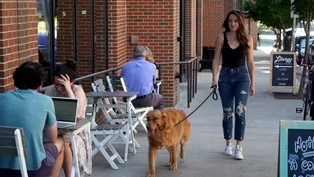
Hot housing market pricing out many first time homebuyers
Video has Closed Captions
Chapel Hill native Samantha Ward gives up on a house in Durham’s hot housing market. (2m 39s)
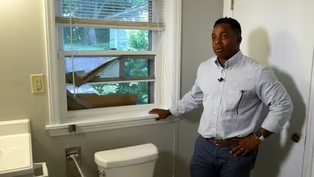
Lack of housing equals lack of options for homeowners
Video has Closed Captions
Sky-high home prices forced Chris Lassiter to choose a ‘fixer-upper” he could afford. (2m 13s)
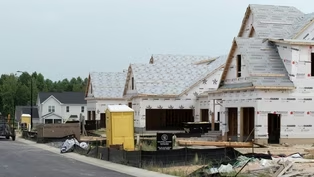
Lessons learned from the fastest growing town in NC
Video has Closed Captions
What the Town of Rolesville is learning from their unprecedented growth. (3m 39s)
"Missing Middle" tries to help with housing supply shortage
Video has Closed Captions
The goal of missing middle housing is to improve a community’s housing options. (2m 28s)
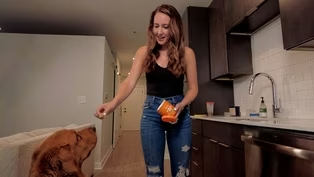
The housing boom is shutting many would-be homeowners out of the market. (20s)
Providing Support for PBS.org
Learn Moreabout PBS online sponsorship
- News and Public Affairs

Top journalists deliver compelling original analysis of the hour's headlines.

- News and Public Affairs

FRONTLINE is investigative journalism that questions, explains and changes our world.












Support for PBS provided by:
ncIMPACT is a local public television program presented by PBS NC