
How AI May Impact the Future of Our Hospitality Industry
Season 8 Episode 27 | 26m 46sVideo has Closed Captions
We explore how AI, automation, and tariffs play big roles in this year’s CES.
Do tariffs have a big impact on the products introduced at this year’s Consumer Electronics Show? We discuss the trends experts are seeing now and in the future. Then, we explore how automation and AI’s growing technology could impact the future of the hospitality industry in Las Vegas.
Problems playing video? | Closed Captioning Feedback
Problems playing video? | Closed Captioning Feedback
Nevada Week is a local public television program presented by Vegas PBS
How AI May Impact the Future of Our Hospitality Industry
Season 8 Episode 27 | 26m 46sVideo has Closed Captions
Do tariffs have a big impact on the products introduced at this year’s Consumer Electronics Show? We discuss the trends experts are seeing now and in the future. Then, we explore how automation and AI’s growing technology could impact the future of the hospitality industry in Las Vegas.
Problems playing video? | Closed Captioning Feedback
How to Watch Nevada Week
Nevada Week is available to stream on pbs.org and the free PBS App, available on iPhone, Apple TV, Android TV, Android smartphones, Amazon Fire TV, Amazon Fire Tablet, Roku, Samsung Smart TV, LG TV, and Vizio.
Providing Support for PBS.org
Learn Moreabout PBS online sponsorship(Amber Renee Dixon) Robots take center stage at CES and could eventually take thousands of local hospitality jobs.
How the state and workers can prepare, that's this week on Nevada Week.
♪♪ -Support for Nevada Week is provided by Senator William H. Hernstadt and other supporters.
-Welcome to Nevada Week.
I'm Amber Renee Dixon, joining you from CES at the Las Vegas Convention Center.
This year's Consumer Electronics Show is highlighting humanoid robots, robots meant to look and perform like humans.
As for their impact on Nevada's workforce, a new report suggests that robots could impact up to 92,000 hospitality jobs in the state by 2035.
That story is ahead, but we begin with an update on tariffs.
At CES 2025, the Consumer Technology Association warned about their potentially negative impacts on the US economy and American consumers.
We spoke with Ed Brzytwa, the Vice President of International Trade for CTA about that and more.
I want to go back to CES 2025.
And ahead of that, the CEO of CTA Gary Shapiro said about the tariffs that President Trump was proposing that they would be a major inflation-causing tax on Americans and harmful to the US economy.
So fast-forward a year, what has the result been?
(Ed Brzytwa) I think we have seen greater inflationary pressures.
Clearly, Americans are concerned about affordability.
I mean, I remember right after the election in November, there was this sense that somehow all the people who voted for the President, because he said he was going to address inflation and address the affordability crisis, would be comfortable with imposing tariffs, which are regressive taxes that consumers in the United States ultimately pay.
And the data is showing that the pass-through, there's one study that said the pass-through of the tariff cost is 94% through the US economy to consumers.
-Has that already hit?
-That has hit in part, but not in full.
And let me walk you through that.
It's hit in part because some companies did have to pay the tariffs to import their products.
Other companies just front-loaded so much inventory before the tariffs were imposed that their tariff costs were not as great as they could have been.
Now, there are certain retailers that have billions of dollars of tariff costs, and small businesses have tariff costs, but the true hit might not happen until this year when all that inventory dries up.
And that could happen over the next couple months, and then companies have to import again and they're going to be paying the higher tariff rate.
So this story is not over yet, from my perspective.
What's also been interesting to me is that the manufacturing sector has gotten hit really hard.
And because they need inputs, not just from within the United States, from other parts of the world, manufacturing is a very global supply chain.
And there's one particular index run by the Institute for Supply Management, the Manufacturing Index, and it's been in contraction mode for month after month since the tariffs were imposed.
-Manufacturing is an industry that Nevada would like to get into further to diversify the economy, but now might the State want to rethink that?
-I think this administration, if they want to support the manufacturing sector, all tariffs all the time is not going to help manufacturers.
They need to have an understanding of what are the inputs that we need from our friends and allies and close trading partners around the world where it's okay to have zero tariff like we did in the past.
-The President would argue that this is raking in a lot of money for the country, that we are taking back money that was essentially stolen from us.
-Well, you know, when companies go out of business, that's not great for our economy either.
That deprives local jurisdictions, states from revenue as those companies disappear, as they can't employ more people.
I mean, there are costs to these actions that we're seeing play out over the course of time.
-Well, tell me more about that, because I don't know if that has been covered a lot, companies closing.
-Yeah.
What I've read recently is that bankruptcies in the small business sector are increasing.
When we talk to our small business members, the tariff situation and the tariff uncertainty, in general, like the tariffs on/tariffs off, exceptions, the complexity of the tariffs, that has been more devastating to them relatively to larger businesses.
Now, the larger businesses are deeply impacted by this as well, but the small businesses, they're disproportionately impacted.
And we have-- If you look at CES, there's hundreds and thousands of small businesses here.
-And then what about the impact on the tech sector as far as consumers?
They have been buying technology despite tariffs.
-So we did a number of studies looking at the potential impact of the tariffs as proposed by the President during the campaign and then initially imposed back in like April, May.
And what we found was that for certain products, depending on what the pass-through was, you could see a much higher price over the course of time for that product, and that would lead to less purchases by consumers.
So the consumer purchasing power has gone down over time, particularly at the lower end of the economic spectrum.
So for people who can't afford the latest and greatest iPhone or the latest and greatest, you know, video game console, they're going to hold on to products for longer.
So what we estimated was that people would, instead of spending money on new and great products that are launched here at CES, they would hold on to products for a much longer time.
And so when we're talking about-- -But it was a good Christmas for the tech sector.
-Because of the front-loading.
Because of all that product got brought in preholidays with intent to deliver very affordable products to the marketplace for the holidays.
-Which industries have been hardest hit so far, and then what are you expecting in 2026 within consumer electronics?
-Well, it depends on your definition of "consumer technology," right?
I think it's not just these reciprocal tariffs or the fentanyl tariffs, it's also tariffs under a different statute called Section 232 of the Trade Expansion Act of 1962, which is-- it relates to national security.
And so the President, in his first term, used that statute to impose tariffs on imports of steel and aluminum-- 25% for steel, 10% for aluminum.
And now in this term, they ratcheted that up to 50% for steel, 50% for aluminum, and an expansive list of what they call "derivative products."
So these are products that are not steel or aluminum, but they contain steel or aluminum.
And that has caused a lot of problems for manufacturing industries, particularly automotive.
And I think every company that has some sort of steel and aluminum now has to pay attention to what is the amount of steel and aluminum in their product.
What's the value?
What's their potential tariff payment in the future?
And so they've done this as well, used that same statute, to impose tariffs on lumber and timber products, copper, and they'll potentially do it in the future on critical minerals and downstream products, semiconductors and consumer technology products that contain semiconductors.
So this is-- The tariff story still is evolving here, but those industries that got hit hard by the steel and aluminum tariffs are really suffering.
-Last question, and this is about the critical mineral supply.
Nevada has the only operating lithium mine in the country.
There are other critical minerals here that can be mined.
It's a big industry here.
Their argument is, this is the time to now really pull away from China and bolster our own national security by having our own supply.
What would you say to that?
-Well, it's one thing if you're just focused on China.
This investigation is not just about China.
This is about the whole world and imports of critical minerals in general, whether they threaten to impair US national security.
So I could make an argument that we actually should have strong critical minerals trade with our treaty allies and close trading partners to create a better supply and a more affordable supply of those critical minerals for our industry in the United States and for our manufacturers.
If we impose tariffs on those inputs as well from whether it's coming from Europe or Australia or Southeast Asia, that doesn't seem to me anyway to be the best decision.
If we're going to focus on China, let's focus on China and not just throw a tariff wall up across everyone else around the world.
-So you would be okay with the tariffs on China?
-I think that's a different conversation compared to talking about our tariffs on our allies and trading partners.
We've always had a concern about China's use of certain policy tools to restrict critical minerals trade.
When I was at the office of US Trade Representative, we worked on a WTO case on China's export restraints on rare earths and other types of critical minerals.
And we won that case against China.
We worked together with Japan and the EU as our allies to effect change in China, and China did change its policies.
We're not doing that anymore.
It seems more in the unilateral world, rather than working with our allies to change China's behavior.
-Ed Brzytwa, thank you so much for joining Nevada Week.
-Pleasure.
Thank you so much.
-According to a hospitality technology report from CTA, two out of five consumers would welcome service robots, robots like this that can transport linen and luggage and waste.
But in Las Vegas, where 26% of workers are in hospitality or tourism, there is a big concern about job displacement.
And that concern is something that the president of this particular company would like to address.
Ried Floco, thank you for joining Nevada Week.
And tell me what is your response when someone says, Hey, isn't your company taking jobs away from hospitality workers?
(Ried Floco) We look at it as a service.
Honestly, it's another tool in helping our team members to actually succeed.
We are big believers that as hotel owners and operators, we should actually make the jobs easier for our team members.
So they can take the trash out, the robots could take the trash and heavy lifting, the dirty laundry off of the employees so they can focus on more important tasks: interacting with guests, making the product a better product, and actually, you know, turning something into a positive.
Again, we look at it as a tool for every team member to actually be able to thrive with.
-There are people who would say, yeah, it's a lot cheaper to have one of these than to pay an employee.
Have you gotten rid of any employees after utilizing this?
-So in our current hotels, the hotels we own and operate, we have not.
We actually look at it, again, as a tool.
So now we have a more productive team.
And remember, there's always call-offs.
There's always people not showing up.
The robot's there 365 days, 24 hours a day.
It's there just continuing to play support.
So what happens when someone calls off, you end up with saying-- Let's say I'm cleaning rooms and we have 12 people cleaning rooms, all of a sudden 10 people have to clean the same amount of rooms that 12 would have.
The robot's there as a support.
So it no longer has to, like, just fall on those 10 people.
The robots can actually carry that, do that heavy lifting and take the hard, dirty stuff off the team members so that they can focus on actually getting the job done.
-And real quick, you told me off camera about your background in this industry, which I think lends itself to you backing this.
-Yes.
I've got 30 years in the hotel business, about 12 to 15 years in the tech business, depending when you start and stop that.
But honestly what we are, we're looking to be the work horses, the support service for the hospitality industry.
Really there to-- I started, you know, doing housekeeping, doing maintenance, all the way up to managing big, massive portfolios, hundreds of hotels.
Again, we're focused on solving the real problems to really help people have better lives.
-Ried Floco, thank you for your perspective.
-Appreciate it.
-And for another perspective, we turn now to a recent interview with John Restrepo.
He is the principal of RCG Economics.
That research firm recently released a report called "The Robot Reality."
John Restrepo, welcome back to Nevada Week.
-Thank you, Amber Rene.
Thank you so much.
-So your report has a figure that an estimated 77,000 to 92,000 core positions in the hotel casino sector alone could be affected by 2035.
-That's correct.
-How would you describe that piece of information?
(John Restrepo) It's really a wake-up call, I think, to kind of pay attention to what's going on.
This AI revolution is a major, major event in human history; and it will have a massive effect on the state of Nevada, and particularly Las Vegas, because the nature of our economy, with so many jobs and low-wage, low-skill workers in the resort industry.
-Right.
Your report also lists out specific jobs that are more at risk than others and sooner than others.
So right now, between 2025 and 2026, customer service reps, reservations agents, call center operators, data entry personnel are all at a high risk of being displaced.
Then the near future, 2027 to 2030, front desk clerks, housekeeping dispatchers, accounting clerks, food service workers, they are at less of a risk.
For those at home who may see their occupation on these two lists, what do they do?
-That is the toughest question, because it requires reskilling and change and providing different skills and training to these folks, which in many ways is out of their control, right?
It's really an issue of policy makers.
It's an issue of what kind of contracts the unions can negotiate, what can the resort industry itself do.
It's more of a community-level response.
Some of the estimates that we're coming up with, they're anywhere between 750 million to a billion dollars over the next 10 years we skill people in Southern Nevada.
That's, again, a legislative issue.
It's a local issue.
How do we deal with our tax structure if our tax structure will accommodate these kind of, these kind of costs?
But there's really very little the-- -Because the hotels and casinos aren't going to take on that cost themselves?
-No, unless they're forced to.
Forced in the sense that they, a certain percent, let's say, of the hotel room tax gets reallocated for training or an increase, like they did for the stadium, you increase it by, you know, .75% to do reskilling.
But that's how it's going to have to be dealt with.
What the individual can do is they need to pay attention to what's going on.
And whatever opportunities they have that are offered through their company or the community to get retrained and reskilled, they have to do.
We also have to understand that some people just won't reskill if they're maybe a little older, they don't want to go back to school.
That's a whole other issue that we're gonna have to take care of with our social structure, our social service structure.
So there's a few things, a limited amount of things that an individual can do is you really talk to your legislator, talk to your city council, talk to the government, and say, What are we going to do with this?
Because it is a massive undertaking, again, along with the water issue and the land issue.
We have all these things hitting at the same time.
-You mentioned the Culinary Union.
We had them on two years back when CES was here, and they talked about a new contract they put together.
That included, if new technology is going to be implemented, you have to give us six months notification if there is training required that has to be paid for by you.
And if this person cannot be retrained, there has to be severance, including benefits.
That's what you're calling for.
But you're calling for the state to do that?
-Well, it's a combination, right?
It's going to be the Culinary and the unions negotiating with the resort industry, but that's not going to be sufficiently enough, sufficient enough.
It's going to be-- It's really a public/private effort, right?
The private sector will have to do something with the unions in the industry.
For example, the resort industry.
And the government is going to have to get involved, probably at the federal level as well at some point, on a more massive level.
But in a more shorter-term level, the state of Nevada and local government is going to have to be involved, looking at our tax structure, looking at our regulatory structure.
What can we do to prepare for this coming revolution that we're about to see within the context of our economy?
So it's a complicated issue.
The worst thing that we can do is pretend it's not coming.
-The Culinary Union and its power already having some of this in its contracts, will this delay the hotel and casino industry in Las Vegas from implementing AI and automation as quickly as it might like?
-To a point, but the power of AI is so major in terms of cost efficiencies in particularly those kind of jobs you mentioned earlier and savings as well, and it's going to be pretty hard to stop it for very long.
They can delay it for a little while, the Culinary can.
And but the resort industry, like all other industries, are moving quickly toward AI.
And so this is, again, this is beyond just the resort industry.
This is a macro economic issue in terms of it's not only the resort industry is moving toward AI, but every other industry in Nevada is moving toward, wherever they can, to basically replace human beings.
-And your report specifically mentions, though, the massive amount of money that's being poured into AI when it comes to hospitality alone, which significantly impacts Las Vegas.
The hotels and casinos, will they be impacted equally?
Will everything become automated?
-No.
I think that the research shows that limited service hotels will move more toward automation.
They'll be-- they'll be hit pretty hard.
-Like budget motels?
-The budget motels, you know, limited service hotels/motels, exactly right--the Holiday Inn Expresses, those kind of places.
And then some of the national data that's coming out on that is it's about 75% of those jobs will be negatively affected over the next 5 to 10 years, okay?
In terms of massive casino resorts that we see on the Strip, those high-end luxury properties, probably 25% of the jobs will be affected because they require more face-to-face, because what they charge.
I mean, they want to talk to a human being.
And then the general kind of luxury hotels that are not casino hotels, maybe 50% of the jobs will be lost.
Wherever they can, back-of-the-house kind of jobs will be lost to automation.
It's already been occurring.
And so depending on the quality of the lodging, depending on the, on who your customer base is, you move toward an automation at different rates and at different levels.
But at some point, it's all affected, right?
Even if it's only 25% at one of the higher-end resort properties on the Strip, it's still 25% of the jobs.
So what do we do with those folks?
How do we retrain them?
What happens?
-And when you talk about the retraining, some people will say, Well, yeah, the displacement is going to lead to new jobs, which you have talked about.
But how much retraining would be necessary?
Is that within reach for most people in these current jobs?
-No.
-Why not?
-Well, it is if they want to spend the time to do it.
Keep in mind, this is an interesting statistic that we came up with from this research.
This, again, a national number, 77% of all the jobs required by-- or can work in AI have to have a master's degree or above.
-And those are the kind of jobs that would be-- -Those are the kind of jobs will be being created from this during this transition.
So how many of the folks that are high school work, you know, high school grads or maybe even college grads are now going to go to the next level to get their master's degree-- -Wow.
- --in some technical expertise, as we laid out in the report.
So that's a big challenge, too, for the education system, for retraining.
If, in fact, we're moving toward this AI, what kind of job is AI going to create, which they will, but it's going to take time to transition to that.
And how many folks can we get retrained?
-And who's going to pay for that?
-And who's going to pay for people go to grad school?
-What's a little hard for me, at least, to rationalize is that after covid, the hotels and casinos really struggled to bring employees back.
And I think some still are.
But why would they do that, just to be laying them off a few years later for automation?
-I don't think anyone thought at that point, including the economists, how quickly AI was progressing and advancing.
Just think about this, how somewhat primitive Zoom was when it first came out.
Look at all the capabilities of just remote meetings now, all those different applications that you can do for remote, whether it's Microsoft Teams or Zoom, whatever it is, how quickly that has changed and improved.
-Yeah, right.
-Look at AI, ChatGPT and Claude, and all the generative AI and what that's doing to writing.
-Right.
-Research.
-Very much so.
-No one expected this thing to happen so quickly.
So I don't think the resorts thought that-- You know, AI was coming.
They were going to employ it in a few ways, the robot bartenders and stuff like that--but no one anticipated the speed at which it's being adapted and improving and growing.
-A couple more points.
Your report notes that women will be disproportionately impacted by these displacements.
Why?
-Because a lot of the jobs-- And unfortunately I have a daughter, and it bothers me.
A lot of the lower-end kind of service jobs are done by women, even at the resort industry.
One of the interesting things about the resort industry is that it's always been a very good employer of women compared to a lot of other industries.
So it's been-- Las Vegas has been in the forefront of giving women a fair shot and paying them, you know, equal to men in many ways.
But there are a lot of women in these, particularly in the hospitality industry--this is nationally and globally and locally--are in these kind of jobs, you know, because, to be honest with you, a lot of them are undocumented workers.
-Right.
-And so there's all kinds of things that come into play, but yet women have always had a relatively large role in the hospitality industry.
And by the very nature, they'll be the most affected, because there's so many of them in the industry.
-Last question: Is this what it's finally going to take for Nevada to diversify its economy?
Is it going to be forced to diversify because of AI and automation?
-Yes.
And the land and the water issue.
All these things are coming into play.
They're forcing us to say, We have to grow up now; the toga party is over.
We went through the toga party period in the early 2000s, then we had the Great Recession.
We thought-- I thought we grew up.
The Great Recession went away, and we kind of learned from it, but not really.
And then covid hit, and I thought this will really teach us to kind of act like adults now and put away the togas.
But it hasn't happened yet, in my opinion, to the extent that we should be further along that economic resiliency path than we are right now.
Hopefully-- Hopefully?
It's going to have to be-- the AI revolution is going to force us to make a lot of societal, cultural, economic, public policy changes, and hopefully we have the leadership both at the private-- It's not only the public sector leadership, the governor and legislature and city councils and things like that, but it's also the private sector.
The private sector has got to be in the forefront--leadership in the private sector--to lead the, you know, How do we deal in this brave new world that we're entering?
So it's really a massive community effort.
-From hospitality to healthcare now.
That is another industry that AI is expected to revolutionize.
The American Psychological Association thinks it can greatly expand access to mental health treatment.
But there are concerns, including will robots like Aria here replace qualified professionals?
Aria, will you be replacing qualified professionals?
(Aria) I will be whatever you need, except your doctor, your lawyer, or your tax accountant.
Those jobs are safe for now.
-These are important issues that the state of Nevada is actively trying to answer.
We're going to dive into that next week, as well as have a longer conversation with Aria here.
That's next week on Nevada Week.
In the meantime, thank you for watching.
And for any of the resources discussed, go to vegaspbs.org, and I'll see you next week on Nevada Week.
♪♪♪
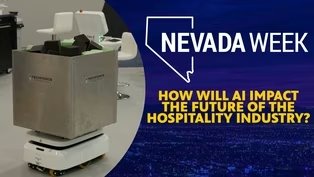
How will AI impact the future of the hospitality industry?
Video has Closed Captions
Clip: S8 Ep27 | 15m 59s | As AI continues to evolve, questions arise about the hospitality industry in Las Vegas. (15m 59s)
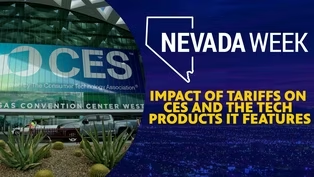
Impact of tariffs on CES and the tech products it features
Video has Closed Captions
Clip: S8 Ep27 | 9m 48s | Tariffs introduced in 2025 affect the price of tech products, from metal to computer chips (9m 48s)
Providing Support for PBS.org
Learn Moreabout PBS online sponsorship
- News and Public Affairs

Top journalists deliver compelling original analysis of the hour's headlines.

- News and Public Affairs

FRONTLINE is investigative journalism that questions, explains and changes our world.












Support for PBS provided by:
Nevada Week is a local public television program presented by Vegas PBS