
How COTS Detroit is helping at-risk families achieve stability and success
Clip: Season 11 Episode 15 | 9mVideo has Closed Captions
In celebration of the anniversary, the nonprofit has released a publication titled “COTS is Care."
Ten years ago, COTS Detroit launched an initiative called “Passport to Self-Sufficiency.” The framework helps at-risk families build pathways to long-term success. Contributor Stephen Henderson of American Black Journal speaks with COTS CEO Cheryl Johnson and Passport to Self-Sufficiency participant Shoushanna Simpson to learn more.
Problems playing video? | Closed Captioning Feedback
Problems playing video? | Closed Captioning Feedback
One Detroit is a local public television program presented by Detroit PBS
How COTS Detroit is helping at-risk families achieve stability and success
Clip: Season 11 Episode 15 | 9mVideo has Closed Captions
Ten years ago, COTS Detroit launched an initiative called “Passport to Self-Sufficiency.” The framework helps at-risk families build pathways to long-term success. Contributor Stephen Henderson of American Black Journal speaks with COTS CEO Cheryl Johnson and Passport to Self-Sufficiency participant Shoushanna Simpson to learn more.
Problems playing video? | Closed Captioning Feedback
Where to Watch One Detroit
One Detroit is available to stream on pbs.org and the PBS app.
Providing Support for PBS.org
Learn Moreabout PBS online sponsorship(upbeat music) - This was a really ambitious idea when you launched this 10 years ago.
I think you came on this show to talk about it.
- Yeah.
- Tell us about that decade- - Yeah.
- That's happened and what you've learned.
- Yeah, so, it literally came out of a moment where I was asked to go on a sabbatical called Away, began to kind of reminisce over the time that I had spent at COTS, our successes and the areas that we just wanted to say, "No, we don't need to do that anymore."
- [Stephen] It wasn't working, yeah.
- Right?
So, one of the things that really kept coming up for me were the number of stories from some of our families who were present there, who would say something like, "I remember being here when I was five years old."
Now, keep in mind, they're now the adult parent.
And that didn't sit well with me.
Like we had done very well in getting people housed, but breaking the cycle of what we call generational poverty- - [Stephen] Yeah.
- Was at play.
And so, I think one of the most courageous thing, was to call it what it was.
Let's talk about poverty and not about homelessness.
- [Stephen] Hmm.
- And the Passport came out of that.
- Yeah, so, talk a little about how that works, right?
I mean, as you point out, COTS has spent forever, in my memory at least, helping people find shelter- - Yeah.
- Someplace to stay.
That's a really very different task from moving people to the place where they don't need help getting shelter.
So, how does that work for you?
- So, the Passport literally is a theory of change.
It is really addressing five particular areas in a person's life, beginning with family stability, education, employment, your overall health and wellbeing, and then what we call economic mobility, financial literacy.
And we realize that if a person is lacking, or has some diminished capacity in any of those areas, and I don't care who you are, that means everything else in your life is at risk.
And so, to move this and address the issue of generational poverty, we've got to look at it in terms of generation, how we actually cross generations, and it takes time to do that.
And so, the first thing that we addressed was we will no longer, and it was a decision to serve single people, but families, so that we could like measure this over time and across generations.
- Wow.
- And so, the coaching is really at the middle of it.
It is about meeting our families where they are.
And we don't talk about anything else but these five particular areas and helping them to address whatever the goals are that they choose and then helping them to meet that.
And so, it is a long-term engagement, even after they leave any of our housing, which could be the emergency shelter, or our supportive housing programs.
- Mm-hmm (affirmative).
Yeah, so, Shoushanna, talk about your journey through this program.
- Well, I actually was in a bad situation.
And I lived with no amenities.
So, that's still considered being homeless.
But once I was connected with a coach, she pushed me forward.
She gave me the confidence to just push forward in life with me and my children.
Once I got in a housing situation, she was like my personal cheerleader.
She pushed hope into me that was taken out.
Like I just felt hopeless in this house where I had to make sure my children had something to eat, somewhere to wash, things that I couldn't just wake up and do.
She definitely gave me that confidence- - [Stephen] Yeah.
- As well as everyone else in this facility.
And that was very rare for me, I couldn't help.
- So, the situation that you were in, tell our viewers a little more about that and how you found yourself there.
- I owned a home.
And one day, I came home and my furnace and hot water tank was gone.
- Stolen?
- It was stolen and I couldn't, I had to pay the taxes, I had to pay other things.
But those two things were gone.
And that's just like what a house is.
That's the heart of your house.
I had nowhere else to go, so I had to live there.
Me and my children had to live there.
- No heat?
- Yeah.
- No hot water.
- Yep, the electricity was still on, so I had to work with that.
I had to buy the water and things like that.
So, that take the bulk of my money, but I just wanted my kids to be somewhere safe.
- Mm-hmm (affirmative).
- And that's what I had purchased, this home, so I had to be there.
- And now, what's different?
Talk about what is specifically different for you.
- Everything, I can't imagine!
When I was just in that home, I was feeling just so hopeless, like it wasn't going to be nothing.
Now, after this, like I just thought it wasn't.
But once I got that coach, everything is different.
I'm smarter, my decisions are much better.
I'll wake up with more hope than I can imagine.
Yes, everything is definitely different with her just being there.
And somebody you can turn to it and just give what you feel- - [Stephen] Yeah.
- Your opinion.
And she's going to say, "I don't think," or "Yes, yes, that's a good idea."
- Yeah.
- And I'm very much different.
- So, Cheryl was talking about how the idea here is to identify what you want, what you want to do and sort of how you want your life to be and to help you get there.
Can you talk about what that means for you, what you want and where you want to be?
- From watching what they do and how they do it and how they allow me to help them when I'm needed, I want to be a peer support counselor coach.
I want to be a certified coach.
- Hmm.
- So, I have got my peer support coach certificate that needs to be certified with 500 hours.
And they allow me to get those 500 hours.
- Yeah.
- And I'm also online at Grand Canyon University for my bachelor's in social work.
- Cheryl, this has got to feel really good to hear Shoushanna talk about this, but you have this story, I imagine, in many places now.
- Absolutely.
And as I'm listening to Shoushanna, I'm thinking about the impact across generations.
So, here, this is what's really important, is that the experience that Shoushanna has had, her kids won't have to experience that as adult people.
- Hmm, right.
- That's the critical piece.
And to see that we are listening, like we are listening to the voices of our families.
And historically, in work, we've known better.
We know better for you, right?
But we've come away from that and realized that the power, their voices are their voices.
- Mm-hmm (affirmative).
- And their dreams are their dreams.
And so, we align ourselves with that.
- Hmm.
- And help them to reach that.
And so, when we look at those five particular dimensions, Shoushanna has worked really hard around her finances, around getting her family stable and then her own education.
And she's not just looking at a job, and that's a good thing.
She's looking at a career that can sustain her family and bring her joy.
And so, our desire is for our families to not just thrive, but to flourish.
- Hmm.
- That is our desire.
- Wow!
 New
NewConstruction is underway for Detroit PBS and 90.9 WRCJ’s new home
Video has Closed Captions
Clip: S11 Ep15 | 2m 17s | The new public media campus is scheduled to open in the fall of 2027. (2m 17s)
 New
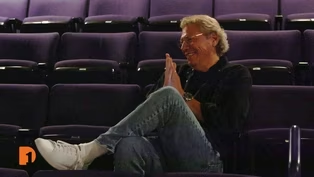
NewDevin Scillian makes his playwrighting debut with "Bastard" at The Purple Rose Theatre Company
Video has Closed Captions
Clip: S11 Ep15 | 11m 17s | Journalist Devin Scillian talks about his first play at Jeff Daniels’ Purple Rose Theatre Company. (11m 17s)
Providing Support for PBS.org
Learn Moreabout PBS online sponsorship New Episode
- News and Public Affairs

Top journalists deliver compelling original analysis of the hour's headlines.

- News and Public Affairs

FRONTLINE is investigative journalism that questions, explains and changes our world.

 New Episode
 New Episode
 New Episode
 New Episode
 New Episode
 New Episode


 New Episode
Support for PBS provided by:
One Detroit is a local public television program presented by Detroit PBS