
How Data Centers Impact Energy Prices
Clip: Season 4 Episode 343 | 8m 44sVideo has Closed Captions
Renee Shaw talks with PSC Chair Angie Hatton.
Data centers have been billed as the next revolution in the digital information age as proponents envision sizeable economic development gains from their expansion. In parts of Kentucky, deep-pocketed tech firms attracted to Kentucky for its cost-friendly land, electricity, and water face opposition from those fearful the hardware installations will raise energy prices for ratepayers.
Problems playing video? | Closed Captioning Feedback
Problems playing video? | Closed Captioning Feedback
Kentucky Edition is a local public television program presented by KET
How Data Centers Impact Energy Prices
Clip: Season 4 Episode 343 | 8m 44sVideo has Closed Captions
Data centers have been billed as the next revolution in the digital information age as proponents envision sizeable economic development gains from their expansion. In parts of Kentucky, deep-pocketed tech firms attracted to Kentucky for its cost-friendly land, electricity, and water face opposition from those fearful the hardware installations will raise energy prices for ratepayers.
Problems playing video? | Closed Captioning Feedback
How to Watch Kentucky Edition
Kentucky Edition is available to stream on pbs.org and the free PBS App, available on iPhone, Apple TV, Android TV, Android smartphones, Amazon Fire TV, Amazon Fire Tablet, Roku, Samsung Smart TV, LG TV, and Vizio.
Providing Support for PBS.org
Learn Moreabout PBS online sponsorshipData centers have been billed as the next revolution in the digital information age.
As proponents envision sizable economic development gains from their expansion and pockets of the state, deep pocketed tech firms are attracted to Kentucky for its cost friendly land, electricity and water.
Face opposition from those fearful the hardware installations will raise energy prices for ratepayers.
And part two of my conversation with Public Service Commission Chair Angie Hatton, we discussed the impacts of data centers and who should bear the cost load.
There's a lot of conversation in Frankfort, too, about data centers, about regulation, about if they if they are putting a lot of demands on the power grid, that they absorb it.
Right, and not the the homeowner, the consumer, the business, etc.. Where is the Public Service Commission?
And this conversation about the expansion of data centers?
And is there any kind of guidance you can give lawmakers and what they're considering?
So Kentucky is a little lighter to the game than some other states.
There's some places like Northern Virginia where are a data center.
Capitol.
But there's a data center corridor in Northern Virginia, and it has been, an intense, negative effect in that area because I guess regulators and the utility companies and definitely the local officials and state officials did not understand the impact it was going to have on bills.
So in Kentucky, we're coming a little bit lighter to it.
And which.
Advantage.
Is in this case we've learned from the mistakes of other state.
So that our goal, is the goal of a lot of these bills and a goal, the goal of a lot of tariffs that have already been filed by, Kentucky utility companies is to make sure that the data center covers its own cost.
So you saw recently the the five largest hyperscalers in the country made a pledge to the president that they would make every effort to absorb their own costs and not spread the cost of expanding infrastructure to cover data centers across the other right classes.
And customer classes.
So I think that that is the goal of the extreme high load factor tariffs that have been filed by all of our utilities have different versions.
And then there's some bills and no one has already passed the House.
Representative Price bill.
And that seems to be the goal of that bill as well.
Right.
To make sure that if a data center is needed and they're needed in the country would, and, Kentucky doesn't have to have them.
But they are definitely needed in the country to power the increased need for streaming services.
For I, you know, when you get on your phone and search, for something on Google, it uses way less electricity than if you use AI to do that same search.
Right.
Exponentially more power.
So if I'm up at 4:00 in the morning googling something that's on my mind, like, why would a chicken like an egg every day that's on my mind.
I'm just it doesn't make sense to me that a chicken would want to lay an egg every single day.
And why is that, something that nature developed.
So I Google that.
But if I Google it through AI, I'm using a ton of electricity.
And if I want to make my neighbor be in a, a silly disco dance or something like that and use AI to do it, or make my new profile picture uses a ton of electricity.
And so we have to have data centers to house the infrastructure to actually, create and channel that power.
Yeah.
And can our utility companies keep up with the, increased demand of power?
And are we diversifying our energy portfolio enough.
These are all very good questions.
So it takes a lot longer to build a new power generation plant than it does to build a data center.
So that is that is really the issue when we created monopoly territories for, for our utilities.
They are required to serve anyone who comes to their territory.
So the data center, which needs 250MW of power, say, comes to their territory, they're required to serve them.
So, luckily, we do have the the extreme high low factor tariffs in place for all of our major utilities now, either already approved or pending so that when a data center comes, they can either bring their own generation.
Right.
Or they can absorb the cost of whatever new infrastructure has to build, whether it's transformers and transmission or whether it's, a whole new plant.
Yeah, there is a lot of conversation, as there usually is during a legislative session about coal and the importance of coal to electric generation in Kentucky, and the relatively lower are low.
I don't know how you want to characterize it.
Energy rates during normal times, maybe not during high usage times.
Is is that a conversation that the PSC has about what Kentucky's energy portfolio should look like?
Well, we don't set it.
We don't set policy.
We carry out the policy that's set by the legislature.
Or to some extent the Kentucky Office of Energy Policy.
So the legislature created the Energy Planning and Inventory Commission a couple of years ago to look at our resource mix.
In general, Kentucky is better off than a lot of states because of the mix we have in our state.
Still, let's I think it's about 60% or 69% coal, 25% natural gas.
And then about 5% hydro and then 1% all others.
Right.
So their solar did double last year.
We doubled the capacity for solar in the state last year, but it's still only a little over 1%.
Right.
And there's a conversation about nuclear energy.
Right.
And we know the senator, Danny Carroll, in the western part of the state in Paducah, has really been a part of this effort for really ten years.
Yes.
And we know the moratorium was lifted a few years ago.
So that's going to be another source.
And will the PSC have regulatory control and authority in that particular field?
We will.
We were mandated by SGA.
140, I believe.
In that Senate Joint resolution.
140 yes.
Thank you.
That came out last year that mandated the PSC study nuclear so that we could get ready to regulate it if it happened.
So we've done that.
We've educated ourselves about other states policies.
We've joined first movers, group, with the National Association of Regulatory Utility Commissioners and National Association of State Energy Officials, organization, the National Governors Association has done a nuclear push, and we're co-chairs of that.
Our state is we've toured nuclear facilities in North Carolina and Oak Ridge and Tennessee.
We have, done a series of public comment hearings.
The first was in Moorhead, and the next one is going to be in Louisville.
And then we're going to have four more across the state to take in information and provide what information we can, in on a neutral, basis to just educate people about nuclear.
Right.
And then Senator Carroll's bill will provide incentives for, a $25 million for each of three new potential, early site development permits.
And they're supposed to be geographically diverse.
So it's supposed to be spread out across the the country and or excuse me, across the state.
And then, he also has I believe it's his bill that creates the nuclear ready communities.
But in general, nuclear sort of checks all the boxes when we talk about the resource mix, that it's reliable.
It has a 90% capacity factor, which means that it is operating efficiently at all times 24 seven, except for when it has to go down to to change the fuel, cartridges that look like little ping pong balls in the, in, in some of the facilities.
And so that is a higher capacity factor than any other fuel source for producing power.
Right?
So it's reliable and it's completely green energy.
There are no emissions.
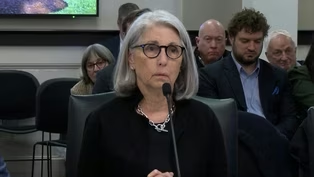
Fayette Judge Testifies In Her Impeachment Hearing
Video has Closed Captions
Clip: S4 Ep343 | 3m 32s | Lawmakers will decide whether to impeach the judge over abuse of power claims. (3m 32s)

Mother Pushes for Change to Medicaid Waivers
Video has Closed Captions
Clip: S4 Ep343 | 2m 52s | The Kentucky mother wants Medicaid to cover community interveners. (2m 52s)

Second Kentucky Soldier Killed in Operation Epic Fury
Video has Closed Captions
Clip: S4 Ep343 | 1m 15s | Tech Sgt. Ashley Pruitt was from Bardstown. (1m 15s)
Providing Support for PBS.org
Learn Moreabout PBS online sponsorship
- News and Public Affairs

Top journalists deliver compelling original analysis of the hour's headlines.

- News and Public Affairs

Today's top journalists discuss Washington's current political events and public affairs.












Support for PBS provided by:
Kentucky Edition is a local public television program presented by KET