
How Expensive It Is to Be Broke/Angelique Power
Season 5 Episode 26 | 26m 46sVideo has Closed Captions
How Expensive It Is to Be Broke/Angelique Power | Episode 526
Covid-19 put American social safety net programs to the test, making long standing systemic issues even more visible. How much would you be willing to pay to improve children's lives? Would you pay higher taxes? The “Exiled To Motown” exhibit at the Detroit Historical Museum explores the Japanese American experience here in Metro Detroit. Episode 526
Problems playing video? | Closed Captioning Feedback
Problems playing video? | Closed Captioning Feedback
One Detroit is a local public television program presented by Detroit PBS
How Expensive It Is to Be Broke/Angelique Power
Season 5 Episode 26 | 26m 46sVideo has Closed Captions
Covid-19 put American social safety net programs to the test, making long standing systemic issues even more visible. How much would you be willing to pay to improve children's lives? Would you pay higher taxes? The “Exiled To Motown” exhibit at the Detroit Historical Museum explores the Japanese American experience here in Metro Detroit. Episode 526
Problems playing video? | Closed Captioning Feedback
How to Watch One Detroit
One Detroit is available to stream on pbs.org and the free PBS App, available on iPhone, Apple TV, Android TV, Android smartphones, Amazon Fire TV, Amazon Fire Tablet, Roku, Samsung Smart TV, and Vizio.
Providing Support for PBS.org
Learn Moreabout PBS online sponsorship- [Will] COVID-19 has stressed America's social safety net, already compromised before the pandemic.
One thing it's highlighting?
How expensive poverty actually is.
- The complexity of poverty is a shocker.
- [Will] This is Circles USA's Michigan Executive Director, Suzanne Van Dam and Circles coach, Bonita Bingham.
Circles USA pairs middle- and high-income allies with low-income clients, developing networks and plans to pull clients out of poverty.
- One of the first things, the narrative needs to change around, "poor people don't want to work," right?
No, poor people don't want to work, I'm really tired of hearing that because what that fails to take a look at is why poor people who are, yeah, they're getting so much unemployment.
They're finally able, getting enough money to pay their rent and buy groceries, right?
So, people are being looked at in a negative way because they finally get to exhale a minute because they're not working three jobs trying to make ends meet.
- You know, it costs more to be poor.
(chuckles) Why is that?
A lot of those barriers are systemic.
If there's a disincentive to work sometimes, given the way our public assistance is meted out.
- [Will] Suzanne is referring to the benefits cliff, which is when a person or family loses benefits because of a small raise.
It puts them in a position where they still can't pay for their basic needs, but earn just enough to disqualify them from receiving assistance.
The Michigan Department of Labor and Economic Opportunity recognizes our state's benefits programs are inadequate and designed to be extremely difficult to access.
This is Melissa Dunn, a single mother who got help from the Washtenaw County Circles program.
She now works in the medical field and lives in southwest Detroit.
But that doesn't mean she doesn't still need help.
Is that what your experience was?
Do you think that it was almost set up to make it hard for you to get any of the assistance that you did receive?
- Absolutely, yes.
And for me being a single mom just because I have a career, doesn't mean that I should be disqualified for that.
Just because I make maybe a little bit more money than some people doesn't mean that I don't need the help, I don't need the assistance.
- So it might be a cut to their food stamps, or their housing subsidy, or their childcare.
And so that actually an increase in income results in an overall net decrease.
Because they can lose all of these benefits abruptly, all at once, and that's a good example of systems theory, or it's not just one person dealing with this, but many people.
- Food stamps, it was 10 or 15 dollars a month.
It was never more than that.
I never got any rental assistance, I never got any assistance for any bills.
I struggled a lot.
- [Will] When I asked local residents on social media how they were surviving on low pay, there were more than 150 responses.
Stephanie said high rental costs prevent saving for home ownership.
Samantha couldn't cover bus fare to her job.
Lisa got hit with extra fees for not having money, which can lead to what's called bill cycling.
- This month I'm gonna pay my rent and next month I'm gonna pay the power bill and the next month I'll get part of my medication, - Part of my rent, part of my medicine.
- Part of my rent.
People are going, "What?"
You know, "How does that work?"
And then that gets at how, the complexity of that is that then all of those things get late fees.
- [Will] Natalie zeroed in on another kind of cliff effect, one that disproportionately forces women out of the workforce, the childcare cliff, where the cost of childcare exceeds a person's income.
- Employers are wondering why it's so hard to find people right now.
We have a childcare shortage but we also have, the childcare cliff is one of the most severe.
- I got pregnant when I was 17.
Had him two months after I turned 18.
And got in the medical field and because I made more than minimum wage, that automatically just put me into the cliff effect.
- Michigan has one of the most severe cliffs.
So people working who are parents lose their childcare subsidy very early on.
And then, to get normal childcare could cost up to 40% of your income.
- [Will] According to Michele Robinson from the Wayne Metro Community Action Agency, poverty doesn't only stifle the poor.
- And what people don't often realize is what happens in Detroit impacts all of Metro Detroit.
So if the property values in Detroit are lower, the property values in Metro Detroit are lower just because all of those things, they domino, they spiral out.
So everything that happens at the core just kind of works its way out.
And we're not realizing that, you know, you may be in Metro Detroit, but you're actually paying more for a good or a service because of something that's impacting a lower-income resident.
So building those incomes, it actually does have a positive impact on the rest of us as a whole.
- [Will] Benefits cliffs, late fees, and childcare costs are complicated, systemic policy issues that require complex solutions to break the cycle that keeps people in poverty.
- So from average citizen to average citizen, the first thing that you can do is educate yourself on the local level on what is going on right in and around you.
The second thing that you can do as an average citizen is being involved in the process.
With my vote, I used to vote a straight ticket, no questions asked.
Now, before I cast my vote, I do some research.
How will this policy impact me?
How will what's happening impact my household and the people around me?
- Change the narrative, like a living wage would be a start.
Who wants to work for something that's not a living wage?
And like we said, it's not a matter of cobbling together more and more and more jobs, because people get exhausted.
And they have kids that need love and attention.
And so, just to put it all on this kind of exploited person is really not fair.
- [Will] The Department of Labor and Economic Opportunities has a long list of recommended policy changes, like adopting a cost of living adjustment for all benefits, no longer stripping benefits from parents whose child misses school.
What Melissa wants is much more simple.
- We don't want to survive anymore, we want to thrive in life.
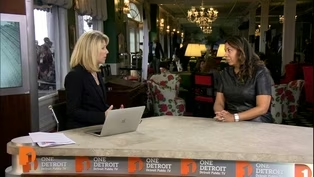
Video has Closed Captions
Clip: S5 Ep26 | 6m 34s | New Skillman Foundation CEO Angelique Power on What Michiganders Want for Their Kids (6m 34s)
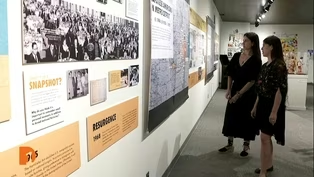
Video has Closed Captions
Clip: S5 Ep26 | 8m 21s | Exiled to Motown Exhibit | Episode 526/Segment 3 (8m 21s)
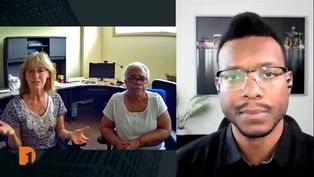
How Expensive It Is to Be Broke
Video has Closed Captions
Clip: S5 Ep26 | 6m 43s | How Expensive It Is to Be Broke | Episode 526/Segment 1 (6m 43s)
Providing Support for PBS.org
Learn Moreabout PBS online sponsorship
- News and Public Affairs

Top journalists deliver compelling original analysis of the hour's headlines.

- News and Public Affairs

FRONTLINE is investigative journalism that questions, explains and changes our world.












Support for PBS provided by:
One Detroit is a local public television program presented by Detroit PBS