
How Living Donors Can Make a Difference
Clip: Season 4 Episode 363 | 3m 4sVideo has Closed Captions
April is Donate Life Month.
April marks Donate Life Month. Of the 123,000 Americans currently on the organ transplant waiting list, most need a kidney. A doctor with the UofL Health Trager Transplant Center says living donors can truly make a difference.
Problems playing video? | Closed Captioning Feedback
Problems playing video? | Closed Captioning Feedback
Kentucky Edition is a local public television program presented by KET
How Living Donors Can Make a Difference
Clip: Season 4 Episode 363 | 3m 4sVideo has Closed Captions
April marks Donate Life Month. Of the 123,000 Americans currently on the organ transplant waiting list, most need a kidney. A doctor with the UofL Health Trager Transplant Center says living donors can truly make a difference.
Problems playing video? | Closed Captioning Feedback
Where to Watch Kentucky Edition
Kentucky Edition is available to stream on pbs.org and the PBS app.
Providing Support for PBS.org
Learn Moreabout PBS online sponsorshipThe month of April marks Donate Life Month, a time to raise awareness about organ donations and encourage registration of the 123,000 Americans currently on the waitlist for an organ transplant.
Nearly 100,000 of them need a kidney.
On average, 13 people die every day waiting for a kidney.
As one doctor with the University of Louisville Health Trager Transplant Center explains, that's where living donors can truly make a difference.
Kidney disease is a silent disease, okay.
You will not know you have kidney problems until the numbers drop really low.
People will not even notice that they have symptoms.
And they usually say, I was feeling fine.
I don't know what was going on at a given time.
There are at least 100,000 patients waiting for a kidney.
There are nearly 500,000 patients who are on dialysis, and 100,000 patients who are listed waiting for a kidney.
So waitlist deaths also matter because there's almost 13 people who die every day waiting for a kidney.
The reason we would like to transplant them early is because they have a survival benefit.
An average deceased donor kidney lasts around 10 to 15 years, whereas a living donor kidney lasts around 10 to 25 years.
So that's a big different right, going from 50% survival at five years on dialysis to living 25 years with a living donor kidney.
That's a major difference.
Living donors are like I always tell their angels wanting to do this.
Organ donation saves lives and transforms many lives around patients.
Anyone who wants to be an organ donor can sign up at the DMV and let them know that you want to be an organ donor.
You can safely donate a kidney, and if you have any loved ones who are struggling with kidney problems who are on dialysis, it doesn't hurt to get informed about living donations or even volunteer to be evaluated.
When you're being evaluated to be a donor.
You go through a rigorous a thorough process before you donate.
You have to be in good health.
You have to be free of kidney problems, diabetes, and high blood pressure.
And only when you go through this checklist that's pretty rigorous is when you say you're a donor.
That means if you donate a kidney, say if you donate a kidney, you're outcomes compared to the general population are almost the same.
Because when you go through this checklist, you're pretty healthy.
So we cannot predict the future.
But you can always say that these patients have lived a relatively normal life compared to the general population for the donor.
It becomes an amazing process because you're literally changing someone's life.
You're giving them a second chance at life.
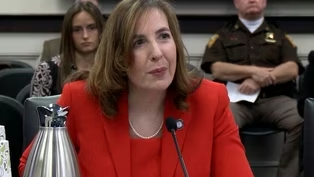
Auditor Ball To Testify Before Congress
Video has Closed Captions
Clip: S4 Ep363 | 58s | Wednesday's hearing will focus on fraud in federally funded programs run by states. (58s)
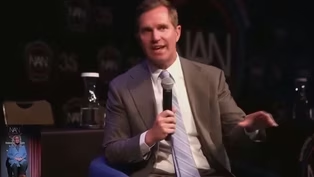
Beshear Drops New Hint About 2028 Presidential Campaign
Video has Closed Captions
Clip: S4 Ep363 | 1m 44s | Over the weekend, Beshear said his 2023 re-eleciton campaign may not have been his last. (1m 44s)

JCPS Program Keeping Kids Engaged in Reading
Video has Closed Captions
Clip: S4 Ep363 | 3m 42s | Student learned new skills over spring break including how to play chess and soccer. (3m 42s)
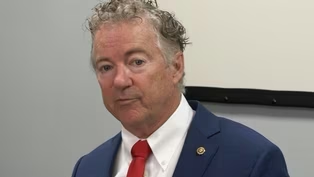
Sen. Paul Talks Iran, the Pope and Federal Hemp Ban
Video has Closed Captions
Clip: S4 Ep363 | 3m 40s | Sen. Paul discussed the Iran war while speaking to reporters in Elizabethtown. (3m 40s)

What Artemis II Means for Future Space Exploration
Video has Closed Captions
Clip: S4 Ep363 | 4m 24s | Kentucky's JPL NASA Ambassador reflects on the record-setting mission and what comes next. (4m 24s)
Providing Support for PBS.org
Learn Moreabout PBS online sponsorship New Episode
- News and Public Affairs

Top journalists deliver compelling original analysis of the hour's headlines.

- News and Public Affairs

Today's top journalists discuss Washington's current political events and public affairs.

 New Episode

 New Episode

 New Episode



Support for PBS provided by:
Kentucky Edition is a local public television program presented by KET