
How Local Groups Are Trying to Reduce Absenteeism in CPS Schools
Clip: 8/24/2026 | 9m 22sVideo has Closed Captions
Many CPS students are chronically absent, meaning they miss 10% or more of the academic year.
Grant funding will support four local organizations as they work to provide mental health services, family support and more.
Problems playing video? | Closed Captioning Feedback
Problems playing video? | Closed Captioning Feedback
Chicago Tonight is a local public television program presented by WTTW
WTTW video streaming support provided by members and sponsors.
How Local Groups Are Trying to Reduce Absenteeism in CPS Schools
Clip: 8/24/2026 | 9m 22sVideo has Closed Captions
Grant funding will support four local organizations as they work to provide mental health services, family support and more.
Problems playing video? | Closed Captioning Feedback
Where to Watch Chicago Tonight
Chicago Tonight is available to stream on pbs.org and the PBS app.

WTTW News Explains
In this Emmy Award-winning series, WTTW News tackles your questions — big and small — about life in the Chicago area. Our video animations guide you through local government, city history, public utilities and everything in between.Providing Support for PBS.org
Learn Moreabout PBS online sponsorship>> Thousands of kits flooded the hallways of Chicago public schools this morning for the first day of school.
But for many CPS students, they may become chronically absent, meaning they'll miss 10% or more of the academic year.
The new initiative is working to combat that for local organizations received grants to help increase attendance by providing mental health services, family support and more.
They're focusing on areas on the south and West sides that experience higher rates of absenteeism joining us to talk more about this are Bradley Johnson CEO builds Chicago nonprofit youth development organization on the city's west side.
Vero T's senior director of community Wellness at an LA say Chicago nonprofit organization that works to confront systemic inequities located in Little Village.
And Natalie Brand A C I O C I better search of a better Chicago to venture philanthropy organization that invest and nonprofits helping children in poverty.
Thanks to all of you for joining I'm Natalie.
Let's start the numbers.
Right.
Nearly half of CPS students were considered chronically absent during a 2024 25 school year.
Those rates were particularly high for freshman.
48.5% and seniors at 72% in high school.
What do we know about why students are absent to this extent this regularly and frequently?
Well, there are many reasons why young people are absent could stress it be anything from chronic illness to family, stability, issues, mental health concerns stemming from anxiety and depression.
>> And so part of the work that we at ABC U.S.
to understand all of the different barriers that are getting in the way of youth opportunity.
And it was through that deep dive into the data that we discover just how many young people are missing school and obviously missing school matters for so many reasons.
Not only because of academics, right?
You're missing critical learning opportunities.
But you're also missing access to critical supports and resources like mental health, like food access, or even simply a caring adult who's there to listen to the young person.
And so this is really an issue that we want to bring attention to.
>> To that point, you know, what do you think it was important in?
And of course, we're going to talk to the 2 of you about the work that you're doing in particular.
But why do you think it was important to have local organizations intervene on a community level rather than have this be something that CPS or the state does.
Yeah.
So part of our research, we discovered that, you know, there are many reasons many drivers of chronic absenteeism and they really vary by community.
>> And so part of our everyday counts initiative is understanding that there are many solutions to this problem.
And back to me based organizations are best positioned to deliver programming that is responsive to those community needs and all of this work is happening alongside schools.
And so each of the 4 organizations are having staff within the school building have really strong school partnerships now working alongside staff at schools.
And so they're bringing additional capacity to do the work that a lot of school simply can't do.
Whether that's door knocking sitting with a family to really provide a family crisis, support all of those things that, again, our educators don't have the time or capacity over the years we've begun to ask more and more of our schools.
>> better CPS data shows that lets next and black students experienced disproportionately high rates of chronic absenteeism.
Black students, 45%, Latino students.
41% start with you first.
Why do you think these rates are higher in these communities?
>> Well, there's several reasons.
I think point number of them, mental health challenges, economic hardship also and black and brown communities.
The immigrant crisis.
But ICE has been a big problem.
We have refugee and immigrant families who been terrorized essentially ID scared to come out.
We also been impacted by the pandemic that has yet to really deal a lot of change young people and students willing to come out.
The other factor is the community from community safety.
It's mental challenges as well for the several factors that that play a part in it.
But the main thing is, is that absenteeism is a problem, but it's a symptom of a larger problem.
And these are some of these root issues.
>> Vero, same question.
But also what are some of the long-term impacts of chronic absences for black and Latino students?
>> Yeah, I have to add on the immigration challenges.
Definitely created a great deal of fear for our communities to engage in larger systems that can be quite intimidating.
But I think also long term is the lack of connecting this to school can lead to disengagement from community and wide.
And so our communities just not engaging in community events working in the community, living in the community honoring and loving the community leads to disengagement can also lead to disconnect in this, which I think then leads to inner fighting sometimes or competing for resources.
You go to school to connect with people.
You go to school to learn.
And without that, you just feel disengaged and disconnected.
>> Bradley Bill plan to use the money to provide mentor in clinical therapy after school programming.
You're working with Spencer Technology Academy.
Tell us a little more about the work of doing well.
You know, Spencer Technology Academy had the highest absentee incident.
>> Hempstead, TSA in Austin neighborhood.
They were hovering around 55% chronic absenteeism.
And so we know that those issues lead to other things that feeds into violence prevention, but also life outcomes.
And so with our work thankful to have that Congo with that allowing us to do put up for team inside of a school so that we have care coordination.
We have therapists inside his school.
We have youth advocate working with the kids throughout the day.
Plus the after school program as well.
And then wrap around supports able to get into the homes and work directly with the parents as well as providing incentives for young people to help the want to be at school.
same question in losses, providing mental health services in family across 7 community schools in Little Village.
So a bigger footprint.
It sounds like.
>> Tell us what you think.
This is the best approach for helping students and families.
>> first, we were already embedded in 15 schools in Little Village.
And so ABC is giving us an opportunity to activate love.
The already established partnerships and work projects that were already in.
And we believe that by bridging the community into schools, helping reduce the barriers that are our families have in just engaging with the school.
And that could just be from calling finding out to picking up the phone when CPS calls.
What we want to do is increase trust in the for the community with school systems and help bridge elementary to high school.
You mentioned earlier about that that that absenteeism starts about freshman year, right?
What happens?
Freshman year.
They become of age to work.
And I worry that sometimes some of our young people are going out to work.
And that's where the priorities are.
And what we're hoping is that by invigorating mental health supports family support and activating outside partnerships, like simple tonight who give us our elevated mental health for adults is that our young people will stay in school longer and find more opportunities to find their niche and hopefully not seek outside supports outside, know, engagement.
>> And so we know that, you know, your 2 organizations are just a piece of the puzzle that a better Chicago is is putting together because another one of the grants that you're giving there actually employing young people to get paid.
Tell me a little bit about that why that's important now that that it helps counter the absenteeism.
So the lines, 98, it's also a community-based organization in Little Village and one of the barriers there that folks have mentioned is this migration enforcement, which forced young people.
>> To go out you know, raise money for their families when their parents can go to work.
And so that is really driving young people outside of the typical school environment.
And so what this organization is doing is bringing paring some of those job placement opportunities education.
So sense of icing, their attendance at school, but also giving them a chance to work in their local community where there are a number of businesses so that they can get their foot in the door in terms of entrepreneurship and expose themselves to expose them to different careers.
And so it's an opportunity to meet their immediate needs, which are, you know, which is focused on economics.
Well, also at the sizing, the importance of staying in school, the every day counts initiative that the 10 million Dollar grant to be given to organizations over the next 5 years.
What's next?
>> Today's days, literally the first day of Yeah, data.
And so these organizations have been working hard to launch their programming.
So over the next couple of years, what we're doing is going to be learning about what's working.
We're building this learning cohort that is testing out different solutions.
We hope to reach 465 students across 12 schools and 3 communities and hopefully recover.
2600 days of missed school.
And so we'll be learning about what's working, what's not working and ultimately elevating that to the field so that we're able to scale of the most promising solutions citywide, OK, that's a good place to
Thousands Still Without Power in Gary Nearly 2 Weeks After Intense Storms
Video has Closed Captions
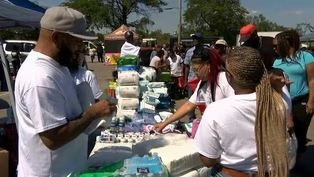
High winds damaged homes, uprooted trees and knocked out power for hundreds of thousands of people. (8m 16s)
WTTW News Explains: How This Year’s Chicago Board of Education Elections Will Work
Video has Closed Captions
November 2026 marks the one and only time all 21 seats will be up for election. WTTW News explains. (2m 42s)
Providing Support for PBS.org
Learn Moreabout PBS online sponsorship New Episode
- News and Public Affairs

Top journalists deliver compelling original analysis of the hour's headlines.
 New Episode
- News and Public Affairs

Today's top journalists discuss Washington's current political events and public affairs.
 New Episode
 New Episode
 New Episode
 New Episode
 New Episode
 New Episode
 New Episode
 New Episode
Support for PBS provided by:
Chicago Tonight is a local public television program presented by WTTW
WTTW video streaming support provided by members and sponsors.