Unspun
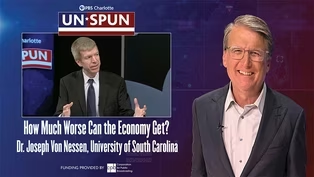
How Much Worse Can the Economy Get? Unspun
Season 2 Episode 224 | 27m 15sVideo has Closed Captions
Americans feel the economic pressure, as Dr. Joseph Von Nessen explains what's next.
Pat McCrory sits down with economist Dr. Joseph Von Nessen to discuss the economic pressures facing American families. From inflation and grocery prices to housing costs, interest rates, jobs, and retirement savings, they examine what’s driving uncertainty and what may lie ahead. Plus, why North Carolina’s biggest challenge may not be growth itself—but how to pay for it.
Problems playing video? | Closed Captioning Feedback
Problems playing video? | Closed Captioning Feedback
Unspun is a local public television program presented by PBS Charlotte
Unspun
How Much Worse Can the Economy Get? Unspun
Season 2 Episode 224 | 27m 15sVideo has Closed Captions
Pat McCrory sits down with economist Dr. Joseph Von Nessen to discuss the economic pressures facing American families. From inflation and grocery prices to housing costs, interest rates, jobs, and retirement savings, they examine what’s driving uncertainty and what may lie ahead. Plus, why North Carolina’s biggest challenge may not be growth itself—but how to pay for it.
Problems playing video? | Closed Captioning Feedback
Where to Watch Unspun
Unspun is available to stream on pbs.org and the PBS app.
Providing Support for PBS.org
Learn Moreabout PBS online sponsorship- [Announcer] This is a production of PBS Charlotte.
- Tonight on "UnSpun."
The economy may be the issue that touches more Americans than any other.
From the cost of groceries to interest rates, jobs, and retirement savings, people are wondering the same thing.
How much worse can it get?
Plus why North Carolina's biggest challenge may not be attracting growth.
It may be paying for it.
In today's America, welcome to the spin game.
Believe me, I know.
I'm Pat McCrory.
When I was governor and mayor, I played the spin game.
I was played by the spin game.
But aren't we all done being spun?
Let's take the spin out of the world we're in here on "UnSpun."
Good evening, I'm Pat McCrory.
The economic headlines often seem to send mixed signals.
Unemployment remains relatively low, consumer spending has held up, yet many families still feel pressured by higher prices, housing costs, and the uncertainty created by global trade disputes, world conflicts, and government debt.
Joining me is Dr.
Joseph Von Nessen, a research economist with the University of South Carolina and one of the leading voices on economic trends across the Carolinas.
He spent years studying employment, housing, consumer behavior, and the factors driving economic growth in our region.
Welcome, Doctor.
Great to have you here.
- Thank you for having me.
It's a pleasure.
- Now, do you go by Joe or what, Joseph?
- I always say I go by Joseph in print.
Joey in person though.
Well, it's Joe.
- I'm gonna call you doctor regardless.
So it's and honor to have you and especially to come up from Columbia to Charlotte.
- My pleasure, my pleasure.
- Let's first talk about the world economy because we always think the economy just centers on the United States, especially when we talk about Senate elections and presidential elections.
But tell me about the world economy.
For example, is inflation impacting the rest of the world?
- It is, we've seen inflation that has been steadily high over the last several years, that's certainly been true in the US as we all know, but that's been true globally as well.
And you can see that, for example, in Europe where they've actually struggled more with inflation than the United States has for several reasons.
Number one is that they were impacted more by the Russia-Ukraine conflict.
And then secondly, in 2026 by what's going on in Iran.
In both cases oil supplies flow more heavily to Europe than they do to the United States.
And so it depends on the region, but yes, we've seen inflation basically be a worldwide phenomenon in the last several years.
- And this is true in South America, Africa, Asia, Russia for example?
- Generally speaking, yes.
And especially when you look at energy prices, for example, they don't stay confined to the price at the pump.
That gets incorporated into goods across the board.
So everything that people are buying, whether it's on Amazon, whether it's food, you know, all that has to be transported around the world.
And so we see the impact of energy prices especially on worldwide goods and of course international supply chains.
So the market is truly global, and as a result you see a lot of interdependencies.
- I think that's where there's a lot of confusion because even the politicians from our president to Democratic and Republican senators say, "Wait a minute, we have our own oil."
Which is nice to say, 'cause we didn't use to be able to say that.
- [Dr.
Von Nessen] Yes, yes.
- We have, you know, oil in America, we have Canada oil, we don't need the straits where the problems are in the Middle East, but the prices aren't dependent upon US trade.
- Exactly.
- Explain that very quickly.
- So it's a global market.
You have to think about oil and gas, and oil especially as part of a global market.
So if the price of oil rises, that means that certain areas in the US do benefit.
Because if you look at oil refineries and look at regions that are producing oil, then those markets are going to do well, but they're selling it to the highest consumer on a global market.
So prices are still going to go up.
And so it's not like the US is isolated in that case.
- And the president, or Congress, or a state governor doesn't have the power to go, "You have to charge us less."
- Right.
- We're gonna do our work based upon the world prices because their responsibility is to their stockholders.
- Exactly.
But it is true that the US has been affected less than many other countries in 2026 because of what's been going on in the Middle East, because we do have a larger oil supply in the US.
So that it does have an effect, but it is a global market.
- All right, your expertise is really the Carolinas, and it's so good to have you here from Columbia and the University of South Carolina.
The Carolinas is booming.
- [Dr.
Von Nessen] Yes.
- I mean it has been booming for a decade actually.
After the 2012, 2013 recession, I know that's when I was elected, '14, '15, '16, we started coming out of it.
After COVID.
- It really took off.
- Why?
- It's mainly population growth.
That's the causal factor.
And if we zoom out for a moment and look at the US as a whole, we are seeing population growth in the southeastern United States as a whole, but especially in the Carolinas.
- When you say population growth, where's it coming from?
- Well, it's mostly people that are migrating from elsewhere in the US.
- That's what I wanted to hear you say.
- Yes.
Yes.
Largely from New England, though not exclusively there, but in general, if you look at migration patterns across the US, the southeast is going to see more population gains over the next three decades than any other region of the country.
We see North and South Carolina consistently ranked in the top 10 among all states for population growth.
South Carolina was actually ranked number one in 2025, but consistently in the top 10.
And it's for a variety of reasons, but the biggest one is cost of living and especially being driven by lower housing costs.
Now, it doesn't feel like that for Carolina's residents always, but when you look at the perspective of the US as a whole, the Carolinas is very affordable, particularly when you consider locations like New England or like California.
And so that attracts people here.
Also, economic opportunity.
We see employment growth that's among the highest in the country in this region as well.
So the Carolinas are really doing well.
- So I raised a question in a previous show about economic incentives.
You know, we as governors, and mayors, and Democratic and Republican give out all these economic incentives in the hundreds of millions of dollars.
South Carolina, Nikki Haley, Governor Hodges, going back to Governor Beasley, who I knew, you know, come to South Carolina when you needed the economic growth.
And as a result, BMW Greenville exploded.
Charleston has exploded.
Are economic incentives still gonna stay with the areas in the Sun Belt?
Do they continue to need them to recruit industry?
- Well, I think so those are two separate questions.
I would say are they going to stay?
I'd say the answer is likely yes.
Because if you look at it from a state perspective, whether South or North Carolina or anywhere else, the states are competing against one another.
And so if incentives become a normal part of economic development, then from a given state's perspective, they have to compete.
So I think that is the normal path that we are seeing.
And incentives can be successful at bringing companies in, at developing clusters.
But that doesn't necessarily say that they always will be or that every incentive is a good idea by any means.
It's an ROI.
It's a cost benefit.
- Yeah, sooner or later, especially during the 10 years when you're giving these incentives, you have no income coming into the state.
I've given hundreds of millions of dollars of incentives.
They're tax breaks.
- Yes, yes.
- And yet the highway between Charlotte and Greenville is packed.
They're widened in it all the time.
You know, years ago South Carolina did the pennies for growth or pennies for roads.
North Carolina, even in Charlotte, we're trying to deal with a toll lane, which has just been rejected.
Where's the money gonna come from as you study this from economic development standpoint?
- Well, the ideal scenario from an incentives perspective is that if you invest the money early, that draws in a company, that's gonna draw in suppliers, and that's going to generate more tax revenue that in the long run over a 5, or 10, or 15-year period will make up for those incentives.
Again, that's not a guarantee by any means.
Incentive packages are always a risk, and that's one reason why they're so controversial.
And the other factor with incentives is more philosophical and more political.
Whereas you have the position that if companies, let's say on one end of the state are getting incentives, large companies, but you've got small businesses on the other side of the state that may not benefit at all from that development, is it right for them to have to support that given that these small companies aren't getting incentives?
So that's a political discussion.
And again, all that's why there's so much controversy surrounding incentives, even if you grant that they can generate economic wins.
- Well, Nikki Haley and I had major fights across the border.
In some fights I pulled out of because they going to Fort Mill or to Rock Hill, and I'm going, "Well, I'm not gonna pay a company a hundred million dollars for a three mile difference because the region grows anyway."
But I'm the one who doesn't get to cut the ribbon, therefore the political thing.
But Fort Mill is now, I think, the fastest growing town in the United States of America.
- Yes, yes.
- Explain that to me.
Is that because it's really a Charlotte suburb?
- It really is.
It's a Charlotte suburb.
And so South Carolina benefits from those spillover effects.
But we also see the I-77 corridor going all the way down to Columbia that is growing.
It's becoming increasingly attractive for manufacturing.
Scout Motors is in Blythewood now, which is outside of Columbia, just about 45 minutes from Charlotte.
So I think over the next 10 years or so, we're gonna see the I-77 corridor continue to develop.
And if you look at Fort Mill, that means more opportunities there.
Again, a lower cost of living relative to other areas of the country.
And so given the combination of South Carolina providing a lot of opportunities and of course Charlotte being right next door, goes a long way towards explaining that growth.
- You know, it's kind of interesting.
During my tenure as mayor and even as governor, we always had a connection with Greenville in Charlotte and Spartanburg.
You know, the textile, the 85 to Atlanta, you know, there was just immediate, and then the Raleigh and so forth in Greensboro.
To Columbia, we never did.
And I tried to establish that, but there was this dead land between.
After you pass Rock Hill and go through Blythewood and so forth and get to Columbia, that's changing.
- That is changing, yes.
- So is Columbia now gonna, a state capital closer to Charlotte than Raleigh, do you think there's gonna be more economic connection and cultural connection between Columbia and Charlotte in the future?
- I think so.
I think that we're headed in that direction.
Columbia historically within South Carolina now has always been the anchor of the state, meaning that it doesn't tend to see as much expansion or contraction during the booms and busts of the economy, which can be a good or or bad thing.
But Columbia is growing.
And one of the things it's trying to do as a region is look to capitalize on the clusters that are in and around the area.
So manufacturing, finance, automotive manufacturing in particular with Scout Motors.
So from Columbia's perspective, it's not about reinventing the wheel, it's about just looking at what's working already and how does Columbia better integrate into those existing clusters.
And it's making some strides in that direction.
- Maybe some connection more between the universities too.
University of South Carolina, Columbia, and University of North Carolina and Charlotte.
They're so close and yet there's this disconnect.
- Yes.
- It always amazed me with my good friends in Columbia.
In the remaining minute or so here, what recommendations do you have to economic developers, to the governors, to mayors in this region regarding the future of economics?
- Well, I think in general, the main takeaway when looking at economic development is to look at the competitive strengths that your region has.
What does that look like?
Is it the labor force?
Is it manufacturing?
Is it healthcare?
Is it finance?
What are those strengths, and how can you build on those strengths going forward?
Because the regions are growing as a whole, so it's not like we have to necessarily generate demand.
It's just where's that demand coming from and how do we capitalize on that going forward?
- In the remaining minute, energy.
It's gonna be a major factor.
You know, Duke Energy, and now Duke Energy is a part of South Carolina, beyond Greenville, but Columbia and so forth, it's expanded.
Where's the power gonna come from?
Especially with the data center controversy.
- That's the biggest question right now.
Energy prices have typically been, or energy costs have been a competitive advantage for the Southeast, and so how do we continue that going forward given the population growth, given these data centers and more AI infrastructure that's gonna be with us for the foreseeable future certainly?
And it's a combination.
One factor for example, is nuclear power, which the Carolinas region has about a quarter of in the country.
Many people don't realize.
- Aging plants.
Oconee, Catawba, McGuire.
- Yes, and the technology developments with SMRs, these new types of plants that are coming online.
Not to say that that's the only solution, but looking at how the technology is evolving and how to capitalize on it.
- Doctor, I could talk to you for another 30 minutes, for an hour, or all day.
I appreciate this connection between the two regions, and I hope to have you back sometime soon.
- Thank you, anytime.
It's my pleasure.
- Thank you very much.
- Thank you, sir.
(upbeat music) - Alright, now's the time for the UnSpun Countdown, top five countdown.
You know, what do politicians say to the public, especially during tough economic times and especially when they're up for reelection?
Let me tell you the top things politicians say.
Believe me, I know.
Number five.
I'll make sure billionaires pay their fair share of taxes.
It's so easy to go after the billionaires.
In fact, right now in New York and California, they're gonna tax the billionaires.
Guess what the billionaires are doing right now.
They're moving.
They're moving to Texas, Colorado, Florida where there are no income taxes.
Hey, the billionaires made billions for not being stupid.
Number four.
I will fight for the middle class.
I will fight for the middle class.
Both Republicans and Democrats, they're fighting for the middle class.
Well, guess what they never do.
They never define who the middle class is.
Do you know why?
Because it might leave out you, some voters.
Number three.
I will stop big insurance and big pharma from ripping us all off.
Oh, it's so easy for politicians to do a TV commercial.
In fact, there's one right now here in North Carolina going, "I'm gonna stop the insurance companies from ripping you off."
Well, how are they gonna do that?
And what are they gonna do when the major insurance company wants to move to North Carolina?
They're probably gonna give them a tax incentive to move here, to bring the jobs here.
A lot of hypocrisy, no details, but it sells well and it gets votes.
Number two.
You deserve a tax break.
They never define who should get a tax break, so they just go, "You, I will give you a tax break."
And a lot of people go, "Well, they're talking to me.
I'm gonna get a tax break if I vote for that individual who's promising me a tax break."
But sooner or later, as I said previously, someone has to pay the bill.
And number one.
My opponent does not care about you.
Believe me, I do.
(upbeat music) Well, it's time now for "UnSpun 1-on-1."
Joining me now is WFAE's political and government reporter, Steve Harrison.
Steve, great to have you back.
Thanks for coming.
- Thanks for having me on the show, Pat.
Appreciate it.
- So this is the part where, you know, how much I love the media.
And now that I'm a part of the media, I've got to listen and answer your questions.
- So, alright, well let's get into it.
We're talking about the economy.
It is mid-June 2026.
So on the one hand, unemployment rate still pretty good, low.
Stock market's fine.
Gas prices are coming down.
However, inflation in May hit a three-year high.
If the midterms were held next week, next week, just hypothetically, how bad do you think it would be for Republicans nationwide?
- Terrible, terrible.
I've seen some surveys recently and we'd probably lose the House for sure.
The Senate, well maybe within one state.
That's why Maine is all also the focus and the Democrats are supporting a flawed candidate.
Or Texas, they're hoping we have a flawed candidate.
When I say we, I'm a Republican.
And even the legislature in North Carolina could turn, could flip, which would make Governor Stein a whole different individual.
Although sometimes you don't wanna give him too much power, then the governor loses total influence.
So right now it's not looking good, but it's a long time between now and November.
- Well, that's what I'm gonna ask.
Gas prices, they're already coming down.
They will probably continue to come down at least for the next two months.
So that if you're a Republican, you are really hoping for that continued good news.
But how much is the cake baked, so to speak, by Labor Day?
You know that people's attitudes start to be about the economy, start to be cemented at the beginning of the fall.
And it's really hard to move them no matter what the data says.
- You know, that's a great question because elections didn't use to start until Labor Day.
And people would save all their money because you don't run commercials and things in August and July when no one's watching TV.
They're out playing, especially here in North Carolina.
Those days are changed now with social media.
In fact, you're already seeing US Senate candidate, former governor Roy Cooper, running commercials.
That means he has plenty of money.
And that also means you don't see his opponent, Michael Whatley, playing commercials because he's trying to get some money still because the surveys look bad.
You know, when surveys look bad, you can't raise money.
Believe me, I've been in that game before.
So the commercials are already starting.
Cooper, former Governor Cooper, is trying to knock it out of the park before it even starts, which is a very smart move.
- I think one thing I've noticed in looking at this race is that former Governor Cooper, when I look at his social media, now, he's not writing it of course, but his staff is writing it, his Twitter, and his Facebook, et cetera, never mentioned President Trump by name.
It's always, I mean, they'll be very critical of, quote, the administration, of the federal government, but still never mentions Trump by name even with the president being so unpopular.
I assume there's a strategy behind that.
- Oh, absolutely.
He did it with me when he beat me in 2016 by, you know, 10,000 votes out of 4.6 million.
He skimmed off from Trump voters from me by not going after him.
By him not going after Trump.
It was amazing.
In fact, they even ran ads in the rural areas of the state, almost looking like he was a Trump supporter.
He didn't show those in the urban areas 'cause the urban areas were pure blue.
But he wants to skim off some votes from Whatley like he did with me.
And, you know, 10,000 votes here and there can win you a US senate seat and it can win him a governor's election too.
- So the Senate race, the polls continue to show Michael Whatley eight, nine percentage points behind at least, maybe 10.
So he seems to be running a very conservative, not conservative politically, but just really not taking any risks.
- You're talking about Roy Cooper now?
- No, well, I mean both in a way.
Roy Cooper, he's ahead.
But Michael Whatley is really, you know, for someone who's behind by 10, I don't see a lot of chances.
Does he have time?
- Now he's gotta throw some things against the wall to get free media.
He's not gonna be able to beat.
Cooper's getting so much super PAC money.
Whatley, in fact, if anything Whatley ought to be scared.
I know how his game is played.
The super PAC money may be cut off from him and moved to Texas.
- Exactly.
- And there's no loyalty in politics.
The big money's gonna go, "We look at the numbers, we really like you, but sorry, if you're even three points down, we won't support you."
So Cooper right now is throwing out commercials, brilliant ad, saying I'm go after, keep the insurance companies from ripping you off."
No details.
Not telling how a US senator would ever do that.
By the way, most of the laws are state insurance laws.
But it appeals to the masses.
By the way, that might appeal to the Trump voter.
Don't get ripped off.
- And I think, and Paxton winning in Texas defeating John Cornyn was bad news for the Whatley campaign.
Texas is so expensive, money's gonna have to go there.
- So he's gonna somehow start, you know, pick the subjects.
There might be weaknesses in some of Cooper's stances that need to be shown the bright lights that were never shown during his eight years as governor.
The guy, Roy Cooper's strength is he's vanilla.
He says little and does even less.
And I say that somewhat as a hit and somewhat as a compliment.
And the media leaves him alone because he avoids the media and.
- Yeah, there haven't been a lot of opportunities in covering this race.
- And that's a talent.
I give him credit for that.
- And what about in the fall?
I mean, do you think we'll have a debate?
- Barely, barely.
I think it'll be a debate on the lowest rated TV channel in North Carolina.
- Because I've heard some people say they may not.
- And it'll be short.
- Some people think that Cooper may not decide to do it at all.
- I wouldn't be surprised if he avoids all the debates.
He's very similar to Senator Ted Budd in a way.
The two people I've lost elections to stay in the background, say very little, and maybe they've got the winning formula in today's politics.
- I think, again, it's important to note Republicans have been on this great winning streak in North Carolina since 2008.
- In the Senate races.
- And the Presidential.
However, in the Senate races, they have never, this is the first time since 2002, they are, you know, running for Senate in a midterm with a Republican in the White House.
The calendar has been very favorable up until.
- And unlike four years ago, the Democrats didn't put any money in North Carolina against Ted Budd, nothing.
They left stranded the Democratic candidate, and it was only a two or three point race.
The Democrats in fact might give up here because they're so far ahead at this point in time, but you never know, that can backfire.
Dynamics can change with both Trump and the economy, the war.
You never know what natural disaster or things will occur between now and November that can flip an election.
- I'll say one more thing.
I want to ask about the economy.
President Trump had this comment, remember recently, "I love the inflation."
Now.
I think he meant, I love the inflation numbers.
- It doesn't matter.
It's gonna be in a commercial from here on out.
- It will be in a commercial, but will it matter to his voters.
- Not to his voters, no.
But the independent voter, that's gonna make a difference.
Steve Harrison, it's an honor to have you.
- Thank you, pat.
- Best to you.
(upbeat music) During these uncertain economic times, there's something interesting happening in North Carolina.
Charlotte, Raleigh, Asheville, and Wilmington are still booming.
In fact, more than 500 people a week are moving to Charlotte alone.
I used to say as mayor and governor that I would rather deal with growing pains than dying pains.
And right now our major urban areas are definitely dealing with growing pains.
Not enough schools, not enough roads, a shortage of affordable housing, concerns about crime, homelessness, and the rising cost of living.
Yet people keep coming.
Why?
Because job opportunities still exist here.
Businesses are expanding here.
And despite all of our complaints, the quality of life in North Carolina remains attractive compared to many other parts of the country.
That's the good news.
The challenge is paying for success.
And that's a problem politicians don't like to talk about.
Even today, state and local governments, Republicans and Democrats alike, are offering hundreds of millions of dollars in incentives to attract companies from around the world.
We celebrate the new jobs, we cut the ribbons, we take the pictures, but eventually someone has to pay for the new roads, waterlines, schools, police officers, and transit systems that growth requires.
So how do we do it?
Toll roads?
Well, many voters just said no.
Believe me, I know that.
Property tax?
Well, they're already straining housing affordability for many families.
Corporate taxes?
Well, legislators are moving in the opposite direction.
Sales taxes?
Well, voters just approved one for transit, but those taxes fall more heavily on lower income households.
There are no easy answers.
In fact, during my time in office, I pushed for a diverse tax system.
Some taxes based upon income, others based upon the use of services.
The idea was simple.
Don't put all your eggs in one basket because when the economy changes, that basket can break.
I also believe that once North Carolina became truly competitive, we wouldn't have to keep handing out selective incentives to recruit companies, but politics has a way of creating expectations.
Once government gives something away for free, people start expecting it forever and so do the companies receiving it.
The problem is that nothing is actually free.
Somebody always pays, maybe not today, maybe not tomorrow, but eventually the bill comes due.
If we don't figure out how to pay for growth responsibly, those growing pains can turn into something much worse.
Because while growing pains are frustrating, dying pains are a lot harder to fix.
Well, that's the truth as I see it.
I'll see you on the next "UnSpun."
(upbeat music) - [Announcer] A production of PBS Charlotte.
How Much Worse Can the Economy Get? Preview | Unspun
Preview: S2 Ep224 | 30s | Americans feel the economic pressure, as Dr. Joseph Von Nessen explains what's next. (30s)
Providing Support for PBS.org
Learn Moreabout PBS online sponsorship New Episode
- News and Public Affairs

Top journalists deliver compelling original analysis of the hour's headlines.

- News and Public Affairs

Today's top journalists discuss Washington's current political events and public affairs.


 New Episode
 New Episode
 New Episode
 New Episode
 New Episode

 New Episode
 New Episode
Support for PBS provided by:
Unspun is a local public television program presented by PBS Charlotte