State of Affairs with Steve Adubato
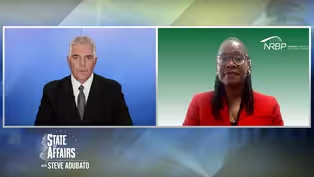
Ferlanda Fox Nixon, Esq.; David Alland, MD; Harry Pozycki
Season 9 Episode 17 | 26m 32sVideo has Closed Captions
Ferlanda Fox Nixon, Esq.; David Alland, MD; Harry Pozycki
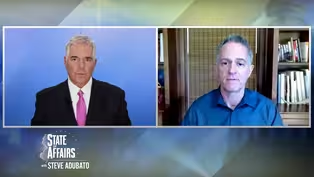
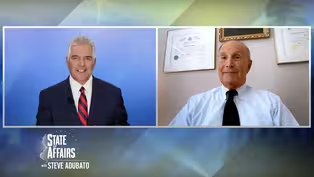
Ferlanda Fox Nixon, Esq., President & CEO of Newark Regional Business Partnership, discusses how the Partnership provides resources for business leaders in Newark. David Alland, MD, Director of The Public Health Research Institute, investigates pandemic preparedness. Harry Pozycki, Founder & Chairman of The Citizens Campaign, talks about reigniting civic engagement.
Problems playing video? | Closed Captioning Feedback
Problems playing video? | Closed Captioning Feedback
State of Affairs with Steve Adubato is a local public television program presented by NJ PBS
State of Affairs with Steve Adubato
Ferlanda Fox Nixon, Esq.; David Alland, MD; Harry Pozycki
Season 9 Episode 17 | 26m 32sVideo has Closed Captions
Ferlanda Fox Nixon, Esq., President & CEO of Newark Regional Business Partnership, discusses how the Partnership provides resources for business leaders in Newark. David Alland, MD, Director of The Public Health Research Institute, investigates pandemic preparedness. Harry Pozycki, Founder & Chairman of The Citizens Campaign, talks about reigniting civic engagement.
Problems playing video? | Closed Captioning Feedback
How to Watch State of Affairs with Steve Adubato
State of Affairs with Steve Adubato is available to stream on pbs.org and the free PBS App, available on iPhone, Apple TV, Android TV, Android smartphones, Amazon Fire TV, Amazon Fire Tablet, Roku, Samsung Smart TV, and Vizio.
Providing Support for PBS.org
Learn Moreabout PBS online sponsorship- [Narrator] Funding for this edition of State of Affairs with Steve Adubato has been provided by United Airlines.
Horizon Blue Cross Blue Shield of New Jersey.
The Port Authority of New York and New Jersey.
Moving the region through air, land, rail, and sea.
The New Jersey Economic Development Authority.
EJI, Excellence in Medicine Awards.
A New Jersey health foundation program.
New Jersey Sharing Network.
PSEG Foundation.
The Fidelco Group.
And by NJ Best, New Jersey’s five-two-nine college savings plan.
Promotional support provided by Insider NJ.
And by New Jersey Monthly.
The magazine of the Garden State, available at newsstands.
[INSPRATIONAL MUSIC] - Hi everyone, Steve Adubato.
We kick off the program with Ferlanda Nixon, who is the President and Chief Executive Officer of the Newark Regional Business Partnership.
The website will come up right now.
Ferlanda, thank you so much for joining us.
We appreciate it.
- Thank you, Steve, for having me.
- Tell everyone what the partnership is, the business partnership is, and why it's so significant in the city of Newark, Brick City.
- Sure.
So the Newark Regional Business Partnership, affectionately known as NRBP, is a chamber of commerce.
So we are the premier chamber of commerce serving the greater Newark region, and we do what every chamber of commerce does.
We provide connections, resources, advocacy, on behalf of our members.
So we are a member based organization, and our members are primarily businesses of varying sizes, small, medium sized, major corporations, and solo entrepreneurs.
We also have members who are institutions of higher learning, hospitals, and our major arts institutions here in Newark.
- Let me ask you this, in terms of commercial real estate post COVID, what is the commercial real estate situation in Newark as we speak today?
- Well, I don't think it's any different from any other city.
Our downtown area, we do have a lot of vacant buildings here in the city, but we don't believe it's a reflection of the economy.
We believe it's a reflection of the property owners trying to cash in on the value of their property, just holding onto it.
So, and paying taxes, but not really doing anything, waiting for the right offer to come along.
But the downtown area is thriving, and Newark is, you know, it's on the cusp of a renaissance.
The waterfront is being built up, and new residential housing you'll find being developed throughout the city, in the downtown area.
So it's very promising.
- For an entrepreneur looking to establish a business in Newark, what are some of the most pressing challenges they face and are they any different in Newark, than any other entrepreneur starting a business anywhere in the state of the country?
- So your second question is the easier one to answer.
The challenges are endemic to just business ownership in general.
Nowhere, no matter where you go.
So access to capital will always be at the top of the list.
And particularly it's challenging for small businesses, for new businesses, trying to tap into sources of capital to either start your business but more likely to scale up your business.
And so what we try to do here at Newark Regional Business Partnership is to connect our members to varying funding resources.
So obviously banks, but also, the New Jersey Economic Development Authority has grant opportunities and in the city itself, has its own grant opportunities that you can get through Invest Newark.
And so just making sure that our members are kept abreast of those opportunities and that they have the contact information for people who can really help them and advance their mission and their purpose.
- Ferlanda, talk about transportation in the city, Newark as a transportation hub, please.
And it's connection to business.
- Oh, oh, yeah.
So, that's probably the largest industry sector for Newark.
You have the airport, you have Amtrak, you have the Port Authority.
It's the gateway, really for the Northeast.
And so it's actually our biggest council within NRBP.
We have a transportation council because of the significance of transportation for the city of Newark.
And so, it's a hub.
And so with that being a hub, industry and enterprise flourishes around that particular sector.
So you have your restaurants, you have your catering, you have your tourism that really is flourishing because of the, I think the effectiveness of, and the easy access to various modes of transportation in and outside the city.
- Last question, arts and culture.
We've been long time collaborators with NJPAC, New Jersey performing Arts Center and other arts institutions.
Talk about, Ferlanda, the connection between arts and culture, arts and cultural institutions in Newark, and the economic vitality of the city please.
- Yeah, I think that's a great question and I think it's a great question to ask immediately after talking about transportation because it's all tied in together.
- That's right.
- So the arts culture, Newark takes a tremendous pride in the artistic environment that exists here.
So you mentioned NJPAC, but we also have the museum, we have Symphony Hall, we actually consider our institutions of higher learning as part of the arts culture as well.
And if it works for tourism, right?
So people need a reason to come to the city.
And when you have a thriving arts culture that satisfies that need, so you wanna make sure that there's a vibe about the city that attracts people in, but you also wanna make it easy for them to get in the city and out of the city.
And you want people to come from all points around New Jersey, obviously, but we also attract a lot of visitors from Manhattan as well.
And so when you have the ease and facility of that, it actually helps to thrive, build your economy and make it more profitable.
- Ferlanda Nixon, President and CEO of the Newark Regional Business Partnership.
Ferlanda, thank you so much for joining us.
I wish you all the best.
- Thank you so much.
And again, thanks for having me.
- You got it.
I'm Steve Adubato.
Stay with us, we'll be right back.
(grand music) - [Announcer] To see more State of Affairs with Steve Adubato programs, find us online and follow us on social media.
- We're now joined by Dr. David Alland, who is Director of the Public Health Research Institute at Rutgers New Jersey Medical School.
Doctor, thank you for joining us again.
For those who watch... Another interview we do with the doctor, I cut him off at the end of the program.
We were talking about being prepared for the next, if and when there's another pandemic.
And you said, to put things in context, we are less prepared than we were in March of 2020.
Recap for those who missed that interview, why we're less prepared, and then I wanna talk to you about distrust in the public health system that so many Americans seem to have right now.
- The reason why I'm very worried about preparedness is that there's been a lot less support for public health, both in the opinion of the United States people, but also in terms of financial support.
There have been serious cuts to the Center for Disease Control and Prevention.
There has been elimination of entire laboratories that can confirm when diseases are present.
There's websites that have gone down.
There's generally less support to public health.
People who work in public health don't get paid a lot, they work very hard.
One of the (indistinct) rewards for that is that you expect that people appreciate what you do, and what had happened instead during COVID was they got death threats.
So a lot of good people have left the public health sphere.
Again, there's a lot less support and less money there used to be.
And we haven't learned from our mistakes too.
So one of the big problems we had early on with COVID-19 was it was very hard to diagnose it.
There were very...
There were no tests available at all and when the CDC developed the first test, it had problems and they were able to only put out a relatively small number of tests.
So just for example, understanding what that problem was, we put together a proposal that was funded by the New Jersey State Department of Health with support from the CDC to, at Rutgers, develop a rapid diagnostic center where we'll be able to put together tests within a week or two, not make millions of tests, but make thousands of tests to supply to the public health department, which is all you need at the beginning of an outbreak to control it.
And all those funds were cut and the project was eliminated.
That's just what- - You mean cut...
I'm sorry for interrupting, and the cut in the federal government... From the federal government right now?
- Yes, so those funds were cut from the federal government right now.
- What was the explanation given as to why?
- Because COVID is no longer a problem.
- Okay, so stay on this, and the graphic will come up right now.
The graphic in a miniseries we're doing called "Vaccines: What You Need to Know".
Please put it up team because I'm gonna ask Dr. Alland this question.
So to those out there watching right now who say, well, this MMR vaccine, I keep hearing things about vaccines and autism.
I saw the secretary of... Well, the leader in the federal government responsible for public health in our country.
Everyone heard him say, "I support vaccines, but it's a matter of choice.
It's personal choice."
And when asked about autism and vaccines, he said, "Well, more research needs to be done."
Doctor, what research needs to be done?
A and B, is it purely a personal choice?
- First of all, I want to say that I understand people that are concerned about vaccines.
My own family, we have issues.
- Same here, same here in my family.
- Okay, so I understand personal concerns, but vaccines are tested very, very strictly before they come out.
There still can be undiscovered, small side effects, but the MMR vaccine has been out for a very long time now.
There's been numerous, multimillion studies involving millions of children and there's been no association found with autism.
I think that when the question was first raised was a valid concern.
As I say, we've had issues, you know, within our own families, we want to know the answers to these things and that's why the studies get done.
But to keep on doing the same studies over and over again, at a certain point you're only doing a study because you want to get an answer, a specific answer, as opposed to just going with where the science tells you to go.
- Yeah, and by the way, we have a niece about to give birth.
God willing, everything will be all right, but I also happen to know that her parents are anti-vax and I do wonder and worry about that baby and not getting the MMR vaccine and I know that can, is replicated in countless cases.
- Sure.
- Let me ask you this.
Go back to the issue of distrust.
What do you say to those who say, and I asked your colleague, Dr. Denise Rogers this question, and earlier today in an interview, and I wanna ask you.
"Hey, listen, I saw it on a Joe Rogan podcast or I saw it on Theo Vaughn's podcast."
And no disrespect to those two very entertaining podcasters, influencers, if you will.
"I heard what was said on the podcast, I saw it on social media.
I don't need to listen to Dr. David Alland, who was an infectious disease scientist.
I saw it, I heard it, I know what I need to know about vaccines, plus, I don't trust the public health bureaucracy."
Talk to those folks, doctor.
- I think it's difficult to find out what information is accurate these days.
I think you have asked certain questions.
Does the person have an agenda?
Are they trying to prove a certain side?
Are they trying to make money off of this?
Honestly, the conversation I'm having with you right now is taking me away from my research and from some important work I have to do.
- I'm sorry about that, doctor.
- But the point is, I have no agenda here.
I think that you have to acknowledge and listen to people that acknowledge that we don't know everything and that we are always trying to learn more and what we're going by is the best knowledge that we have now.
Other than that, it can be very difficult because people do have an agenda and they're very entertaining, probably far more entertaining than I am.
Not as entertaining as you are, of course, but more than me.
- Entertaining is not science.
- Not science.
- And science sometimes is not entertaining.
- It's sometimes, it's the opposite of entertaining because you hear one thing and then six months later, you hear something slightly different.
- And to tell folks who say, "Hey, Fauci, Dr. Fauci, he said the thing about the mask and then he changed, so Fauci must be part of some conspiracy," which is clearly not the case.
It was because, and again, I'm a PhD not from Rutgers, but not in science.
But I gotta ask you, isn't it a question of the fact that you're finding out as you're moving forward and you take that information and you share it as you go?
Because if you don't, you're not being honest.
- It's better to say the best of your knowledge than to say nothing sometimes.
The issue with what happened with masks is that there have been two outbreaks of SARS.
SARS-1 and SARS-2.
SARS-1 was only transmissible in people that had symptoms and so you didn't have to wear a mask in the subway to be worried about people that were not coughing or not sick.
SARS-2, it turned out, was transmissible, in fact, more transmissible.
And the SARS-2 caused COVID-19 was more transmissible the day before, two days before they got symptoms.
But if we had based the data on SARS-1 the advice was right.
And remember, COVID was killing lots of people, we didn't have enough masks.
So it was a matter of saying, "Please save the masks for the healthcare workers."
- That's right.
- Who are getting exposed and who are going to die without these masks and we just didn't know until we did more studies and then learned that, in fact, it was very transmissible.
- Dr. David Alland, I apologize for taking you away from your research, but you have done a tremendous public service by sharing your expertise, your insights, and perspective and the science with our audience.
Thank you, doctor, we appreciate it.
- Thank you very much.
- You got it.
Stay with us, we'll be right back.
(grand music) - [Announcer] To see more State of Affairs with Steve Adubato programs, find us online and follow us on social media.
- We're joined once again, it's been way too long, by our good friend, Harry Pozycki, chairman of The Citizens Campaign and founder of The Citizen Service.
Good to see you, Harry.
- Good to see you, Steve.
Thanks for having me.
- Tell folks what The Citizen Campaign is, put the website up so we can see, because I know too much about how great you guys are, let everybody know what you're doing.
- Well, look, we've understood that the power structure in this country is out of whack, too much top down, so we've been developing empowerment training for citizens for years, and a year ago we deployed a new national public service called The Citizen Service, where we recruit, train, and deploy citizens in positions in their own towns that don't require that they run for office and fit their busy lives.
- Hey Harry, let me ask you something.
Well, right before a gubernatorial election, this will air before, possibly even after, 'cause this is Evergreen.
What the heck is the responsibility of New Jersey, and then we'll talk about the nation, New Jersey citizens.
If we want to have the best government we can that serves the people well with a lot of people, loaded question I know, saying "What do you want from me?
"I'm not running for governor."
What do we need from our people?
- Well, I'll tell you.
I think the greatest danger to our democracy, not just here in New Jersey, is disengagement.
People are getting frustrated and feeling like a pox on both your houses, why should I go out and vote?
And we need not only for them to engage, we need them to engage more deeply and with more knowledge of their own power.
- But Harry, you do understand why a significant number of people are so "disengaged."
You do understand that?
- I do.
I think that there's been a failure of both political parties, money-driven elitists, and not really responding to the day-to-day needs of citizens.
But I think we have a responsibility as well.
I think that that's largely due to the fact that we have to some degree disengaged, we look at politics as entertainment, it's grown a political climate of careerism and celebrity as opposed to the climate of service that we used to have.
- But Harry, last time we had you, let's just say there were phones out, there were mobile phones, but they were not as ubiquitous as they are today.
Question.
What is the danger from your perspective of people, too many of us, having an algorithm that the folks who run these social media platforms understand about us, and we simply get back information that reinforces are what we think we believe and then we're told we're right, and it's a long-winded way of getting to this question, How is that not being an engaged citizen who finds out important information that may not comport with what I already think I believe?
- You know, I think that one of the greatest dangers to our democracy has been social media.
I think that right now it's a fact that more than half of the public gets their information from social media and it's riddled with disinformation, conspiracy theories, and the like.
I think the antidote is community.
If you are working and communicating with people whom you know, whom you're going to see again, whom you can determine whether they're trustworthy or not, you can reach fact a lot faster than on social media these days.
- But along those lines there are communities.
It's just that the communities are polarized.
I have often said this on the air, and I'll never say who said this, but one of my closest friends who, very big supporter of Donald Trump, and, again, a very close family friend, has been saying to me for years, "You know, Steve, we're gonna have a 'civil war' "and we're gonna have to pick sides."
And I said to him, "What?
"We're brothers, sisters, we're all in this together."
"Yeah, I know, but sooner or later you gotta pick sides."
And I stopped arguing with him because I still want to be friends with him.
Along those lines, here's the question.
People are in communities, very often in communities of other people who see the world the way they do, and if there's gonna be a civil war, at least metaphorically, they're just on the side of the people they're with.
What's the problem with that?
- I think people are more in algorithmically-built cults than in communities.
Community is characterized by definition by values, and the values that characterize this country, unselfish service and mutual respect, are what define community, and we are without community because we've largely let down the standards of unselfish service and mutual respect.
And as individual citizens, we can raise those standards up again and then have a community of Americans.
- Harry, one of the themes you talk a lot about is the no blame, if you will, problem-solving approach.
So much of public life today, something goes wrong, who can we blame?
Even political violence.
We can't even acknowledge what happened, who did what, who they did it to, who was targeted, meaning they point the finger at blame as opposed to just abhorring political violence and saying all political violence is horrible regardless of who the victim is, regardless of who the perpetrator is.
What's the no blame thing?
- The no blame thing is to go beyond recognizing that political violence is harmful to our society, and to uphold standards like mutual respect and unselfish service, to be an example to our fellow citizens of unselfish service.
You know, my grandmother used to say there's good and bad in all kinds.
There's good in the worst of us and bad in the best.
We've gotta get a little more humble and not think that we're better than the guy next door and try and put our heads together for the betterment of our entire community and our country as well.
You know, it's gotta begin with citizens.
It's too destroyed at the top with money and technology and so on.
We have to build up again by the example of individual citizens, and that's the good news.
There's a lot of stress reduction when you get off the couch and you join The Citizen Service, I can tell you that much.
- And by the way, put up our website, SteveAdubato.org and check out the interview with Professor Eddie Glaude from Princeton who wrote a wonderful book called "We Are The Leaders We've Been Looking For," and it goes to a lot of what Harry Pozycki is talking about.
Harry, in the time we have left, younger people who are more obsessed with their phones than the-- Some of us are obsessed but they're obsessed more.
How the heck do we get younger people engaged to be the citizens they need to be, to keep our representative democracy going that we all say we care so much about?
- I think we gotta get beyond talking about individual issues and recognize what younger people already know and that is that we need radical change in our political system, and we need to do that by engaging ourselves, and we just launched a Youth PowerUp Program starting in the city of Newark, but a model for the national level, and we have 20 youths, 16 to 25 years old, meeting monthly, solving problems in their own community.
You just gotta let them know the power that they have.
We have new rights and new technological powers in the 21st century that can make young citizens and all citizens for that matter much more powerful and much more able to take control of the political climate in this country, but we have to learn about those rights.
That's why we train them in The Citizen Service.
- 30 seconds left.
The role of those of us in media, particularly public media, and this effort is... - Keep having guys like me on.
I know I can recruit people for The Citizen Service, and I'll tell you, one year of service, five different roles, fit your busy lifestyle, and you can get off the couch and feel a lot better, not just be a spectator to the demise of our democracy.
- That's Harry Pozycki, chairman of The Citizens Campaign and founder of The Citizen Service.
Thank you, my friend.
It will not be this long before we have you on again.
Thanks, Harry.
- Good to see you, Steve.
Thank you.
- You got it.
I'm Steve Adubato.
That's Harry Pozycki fighting the cause every day, the good fight.
See you next time.
- [Narrator] State of Affairs with Steve Adubato is a production of the Caucus Educational Corporation.
Funding has been provided by United Airlines.
Horizon Blue Cross Blue Shield of New Jersey.
The Port Authority of New York and New Jersey.
The New Jersey Economic Development Authority.
EJI, Excellence in Medicine Awards.
A New Jersey health foundation program.
New Jersey Sharing Network.
PSEG Foundation.
The Fidelco Group.
And by NJ Best, New Jersey’s five-two-nine college savings plan.
Promotional support provided by Insider NJ.
And by New Jersey Monthly.
- (Narrator) Public service.
It's what we do, at the PSEG Foundation Through volunteer hours, partnerships and our other contributions.
We're committed to empowering communities.
We work hand in hand with you, our neighbors, to educate young people, support research, environmental sustainability and equitable opportunities, provide training and other services all over New Jersey and Long Island.
Uplifting communities.
That's what drives us.
The PSEG Foundation.
How Newark Regional Business Partnership is uplifting Newark
Video has Closed Captions
Clip: S9 Ep17 | 8m 6s | How Newark Regional Business Partnership is uplifting Newark (8m 6s)
Investigating pandemic preparedness and growing polarization
Video has Closed Captions
Clip: S9 Ep17 | 9m 31s | Investigating pandemic preparedness and growing polarization (9m 31s)
Strengthening our democracy through civic engagement
Video has Closed Captions
Clip: S9 Ep17 | 9m 40s | Strengthening our democracy through civic engagement (9m 40s)
Providing Support for PBS.org
Learn Moreabout PBS online sponsorship
- News and Public Affairs

Top journalists deliver compelling original analysis of the hour's headlines.

- News and Public Affairs

FRONTLINE is investigative journalism that questions, explains and changes our world.












Support for PBS provided by:
State of Affairs with Steve Adubato is a local public television program presented by NJ PBS