
How One Tree in La Habra Heights Launched a Global Avocado Industry
Clip: Season 9 Episode 2 | 11m 15sVideo has Closed Captions
How one backyard tree in La Habra Heights launched a global avocado industry.
The Hass avocado began as a backyard experiment in La Habra Heights and became the world’s most popular variety. Its rise reflects innovation, agriculture, and commercialization in Southern California. This segment traces how one tree helped launch a global industry and reshape how avocados are grown, sold, and consumed.
Problems playing video? | Closed Captioning Feedback
Problems playing video? | Closed Captioning Feedback
Lost LA is a local public television program presented by PBS SoCal
How One Tree in La Habra Heights Launched a Global Avocado Industry
Clip: Season 9 Episode 2 | 11m 15sVideo has Closed Captions
The Hass avocado began as a backyard experiment in La Habra Heights and became the world’s most popular variety. Its rise reflects innovation, agriculture, and commercialization in Southern California. This segment traces how one tree helped launch a global industry and reshape how avocados are grown, sold, and consumed.
Problems playing video? | Closed Captioning Feedback
Where to Watch Lost LA
Lost LA is available to stream on pbs.org and the PBS app.
Providing Support for PBS.org
Learn Moreabout PBS online sponsorshipI'm Nathan Masters, and today we're going to see a tree from La Habra Heights that accidentally changed how the world eats the Haas tree.
That started it all.
And yes, we confirmed that pronunciation with the experts.
Let's dig in.
The strangest thing?
The avocado.
It has a complicated and fascinating story.
We'll get some fun telling it.
That story begins long ago, when avocados co-evolved with a giant ground sloths and mastodons that once roamed the Americas.
When those creatures vanished.
The avocado persisted and became an evolutionary ghost.
It survived because humans intervened, cultivating it across Mesoamerica for thousands of years before it made its way up north.
Today, I'm driving with DJ Waldi one of Southern California's most perceptive chroniclers, who wrote about the history of the avocado in his latest book.
His essay traced how this ancient fruit, once dismissed as the ungainly alligator pear, was transformed by California growers into something you spread on your morning toast.
There is one we need to talk about who created the avocado that we really know today and and put it on our plates and in on our produce stand.
Exactly.
An unassuming mailman.
Yeah.
Rudolf hass.
Rudolph Haas.
In 1926, a postal worker named Rudolph Haas pooled his savings and borrowed money from his sister to buy a one and a half acre avocado grove in La Habra Heights.
And one tree on that property would go on to change everything Oh.
Thanks for having us.
To meet you.
Good to meet you.
So is the tree in here.
The trees inside there?
Yeah.
All right, let's take a look.
Want to take a look?
Here we go.
Wow.
So this is it.
The most important tree in the history of avocados.
From this tree, a global industry developed.
Yes.
So anybody who has had a bowl of guacamole or Avocado toast, those avocados.
Probably descended from this tree.
Most likely, yes.
And it almost didn't happen.
There are a couple of different versions of the story that vary in different details.
History often is that way.
I don't quite remember it.
Okay, but the genesis of it all is a guy named Albert Rideout, who was my great uncle's brother-in-law, and he was also a nurseryman and a breeder and an avocado enthusiast.
And what he would do would be to sprout avocado seeds that he got almost anywhere, any seed, and sell those seeds to people who were planting orchards.
And those seeds would be planted in the orchard, as was the case with Mr.
Hass Orchard.
They went ahead and and performed that grafting on the trees, and one of them failed.
The tree actually produced some very strange fruit.
And Mr.
Haaskids loved the fruit, so they asked him not to graft it.
And he eventually decided to patent the variety and commercialize it.
And the issue there, of course, was that the fruit as it ripened turned black.
That's right.
All of the avocados in the markets in those days were green colored, and they were differently shaped than the Hass.
And so this was a new wrinkle in the industry.
And change isn't always the thing that markets really look for.
So to the untrained eye, it might have appeared like a dud.
Yes.
Well, the black fruit was associated with rot.
Yeah, but the question is, why are we looking at this pile of firewood?
Well, Mr.
Hass original tree lived for many, many years, but it eventually was infected with a fungus that attacked its roots and started to die.
And my father, who had his own nursery at that time, kind of took it upon himself to try to nurture that tree and help it out.
But finally, in, I believe, 2002, he lost that battle.
So, Nathan, this is kind of like a shrine.
It really is like a shrine, right?
I mean, this is clearly a well loved tree.
Basically has an entire barn to itself, right?
Well, yes.
That's it is?
Yes.
The barns purpose?
Yes.
A short drive down highway 126 took us to the Brokaw nursery, which produces hundreds of thousands of avocado trees a year.
Many of them a direct genetic descendent of Mother Haas.
Our shoes are going to take a decontamination bath.
All right.
Show me the drill.
Okay.
We are now decontaminated.
And now it's the Jeep.
Stern.
Okay, okay.
Wow.
Just love the light in a greenhouse.
Yeah, it's always nice.
So here we are at the nursery.
And this is where we reproduce the trees.
And we make about 300, 400,000 avocado trees a year.
Wow.
So the central operation here is grafting.
So what we do is we get seeds and we grow up those stems and we graft.
We take a little twig from a Hass tree, and we splice it into the stem of the seedling.
And then everything that grows out of that bud on that little twig produces fruit that's exactly the same as the tree that we took the twig from.
But we have one really special grafter that we want you to meet.
And that's Consuelo over here.
Consuelo has been working with us for.
We figured out just now 56 years.
Wow.
More than half a century.
More than half a century.
That's a lot of avocado grafting.
Yes.
She.
She worked alongside my father back in the day, and we just did the numbers, and we tried to figure out how many trees she has grafted in that time.
And it came up to 9.1 million.
Yeah.
That's above.
I'm afraid to say this, but it actually looks simpler than it sounds.
But I'm sure it's not a simple task to perform.
Well, you're about to find out.
Okay, okay.
You'll provide some encouragement.
Or first aid, depending upon what happens.
That's right.
Okay.
Four, four of these.
Yeah.
Well, these are really baby avocado trees.
Yeah.
So these are the little graphs that we we harvested this morning or yesterday from the Hass trees in our orchard.
Okay.
Sorry.
Oh, little more there.
Yeah.
Okay.
Okay.
Now, this is the part that I'm not going to be able to do.
I pull hard enough to get it.
Just right.
Right.
Oh.
Just right.
Yeah.
I'm not really helping much here.
You see, the problem is, it's really easy when she does.
It to make it look easy.
Okay.
Yeah.
There we go.
It's a thing of beauty.
Okay.
We're going to put a little X on that one, and we'll send you a picture in three weeks.
So this is about five weeks later.
It takes about three weeks for that for those cut surfaces to to come together and heal.
And the sap starts flowing across there.
It fuels the development of those buds.
And you see that nice growth going.
In this beautiful lead.
Yeah.
Yeah.
Let's unravel this thing and see if we can see what the bud union looks like.
Bandages come off.
Yeah.
Showing the scars.
Very little trauma.
A little bit of scar tissue down here at the bottom, but that's fine.
It'll grow right over it.
And that tree is on its way.
I don't know how many places you can see this many varieties of avocados.
Astonishing, really?
Yeah.
So we have about 200 different cultivars planted up in our orchard.
So that way we have a bunch of different genes over here.
Maybe you could explain what a cultivar is.
Cultivar is a genetically different avocado like one from another.
So for example one of the avocado cultivars, they has it's the most common.
That's what's being sold nowadays.
But we've also gone through a lot of different cultivars or selections in the past.
Like the Fuerte here, it was one of the initial ones in the California industry.
And then we have bacon that's a pollinator cultivar.
So they all have different characteristics and different flavors.
This doesn't taste like bacon, though, does it?
No, unfortunately.
That's it.
Now prop two.
I don't remember voting on that one.
That's still a secret.
It's a new one that you might be seeing in the industry in the future.
Okay.
Just don't show anybody on TV.
Right?
So I'll cut one of the Fuerte.
And if you were eating an avocado in 1920, it would have been this.
That would have been the Avocado.
In California.
Oh, that looks like.
Oh, yeah.
Do you want to try some?
Why not?
Yes.
Of course.
I've never had a Fuerte avocado.
Oh, I don't believe I have it either.
Big occasion.
It's very good, but different from the Hass.
It is different.
Yeah.
Mr.
Brokaw, you're following in the line of of cultivators, of avocados going back 12,000 years that indigenous people in central Mexico and Central America and Guatemala, they brought together some of these cultivars and made some of these avocados possible.
Your family's been innovating for a long time, and there's evidence of that right here.
The innovation goes on, though.
Yes.
The Hass has been around for a century now.
We know that we need new varieties, and so we're trying to identify some new varieties that might be acceptable for entry into the commercial realm.
Up the hill from the nursery Rob and Consuelo maintain an orchard of some 200 cultivars.
A living laboratory that just might produce the next Mother Hass.
Got it.
Okay.
That might be the avocado of the future.
You never know.
Never know.
So if in the greenhouse you were coddling the avocado trees out here, you're exposing them to the elements.
Now they're at war.
Yes, yes.
So they're they're challenged.
We do what we can for them out here, and we can give them very precise doses of water and fertilizer.
We can prune them, but we can't fully protect them.
So they have to do their part.
It is quite spectacular to see all of this work done on this land, the work that you and your family have done over many, many years.
Consuelo has done.
To be on this hillside overlooking the long valley is just an amazing experience.
You know, it all ties back to Mr.
Hass and his leaving the graft off of that tree and enabling everything that we've been able to do since.
Amazing, unexpected chance discovery.
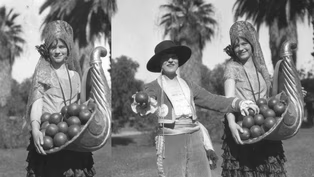
How Riverside’s Famous Orange Tree Sparked a Citrus Boom
Video has Closed Captions
Clip: S9 Ep2 | 14m 44s | The original tree that launched California’s citrus boom. (14m 44s)
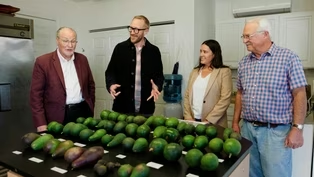
Oranges & Avocados: A Tale of Two Fruits (Preview)
Video has Closed Captions
Preview: S9 Ep2 | 30s | Exploring two fruit trees that transformed Southern California. (30s)
Providing Support for PBS.org
Learn Moreabout PBS online sponsorship














Support for PBS provided by:
Lost LA is a local public television program presented by PBS SoCal