
How Rutgers University- Newark supports young entrepreneurs
Clip: 3/1/2025 | 8m 59sVideo has Closed Captions
How Rutgers University- Newark supports young entrepreneurs
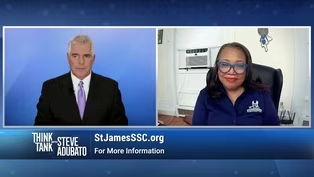
Steve Adubato sits down with Jasmine Cordero-West, Associate Director of Rutgers Advanced Institute for the Study of Entrepreneurship and Development and Co-Founder & Co-Director of Urban Solutions Lab at Rutgers University – Newark, to discuss supporting young entrepreneurs in urban areas.
Problems playing video? | Closed Captioning Feedback
Problems playing video? | Closed Captioning Feedback
Think Tank with Steve Adubato is a local public television program presented by NJ PBS
How Rutgers University- Newark supports young entrepreneurs
Clip: 3/1/2025 | 8m 59sVideo has Closed Captions
Steve Adubato sits down with Jasmine Cordero-West, Associate Director of Rutgers Advanced Institute for the Study of Entrepreneurship and Development and Co-Founder & Co-Director of Urban Solutions Lab at Rutgers University – Newark, to discuss supporting young entrepreneurs in urban areas.
Problems playing video? | Closed Captioning Feedback
How to Watch Think Tank with Steve Adubato
Think Tank with Steve Adubato is available to stream on pbs.org and the free PBS App, available on iPhone, Apple TV, Android TV, Android smartphones, Amazon Fire TV, Amazon Fire Tablet, Roku, Samsung Smart TV, and Vizio.
Providing Support for PBS.org
Learn Moreabout PBS online sponsorship- Hi, everyone.
Steve Abubato.
Thank you for joining us.
We kick off the program with Jasmine Cordero-West, Associate Director of the Rutgers Advanced Institute for the Study of Entrepreneurship and Development.
Jasmine, good to see you.
- Good to see you, Steve.
Thank you for having me.
- You got it.
I'm fascinated by this thing.
And I'm a Rutgers grad.
I got the whole history.
Blah, blah, blah, blah, blah.
But I never, when I was there, there wasn't such a thing as the Urban Solutions Lab at Rutgers Newark.
What is this lab?
And why is it having such great impact on students, please?
- Well, the Urban Solutions Lab is relatively new.
We just started right during the pandemic, and it has two facets.
One, it helps our students at Rutgers Newark.
Those that are interested in entrepreneurship.
We have paid internships for them to work on their businesses, and we provide them with a whole host of services, mentorship, support.
We even have a small investment fund to invest in their ventures.
And we also have, as part of the Urban Solutions Lab, the RU-Flourishing Program where we help those that have been- - RU-Flourishing, I got that.
- Yes.
- R, I saw what you did.
And what is that?
- It's a program to help those that have been previously incarcerated to start their own ventures or grow existing ones.
- I'm so curious about this.
As a struggling entrepreneur, like so many others, I often, and I also teach and coach around leadership, and I'm fascinated by this.
How much of being a successful entrepreneur is a product of, I know I'm a broken record of people who hear this, having tremendous grit and never, ever, ever giving a up?
- That is a big part of it, yes.
Those that have grit and are determined are the ones that'll make their business successful.
But there are also other facets as well.
- Please.
- Two of the things that we teach our students and entrepreneurs are one about the finances.
They really need to understand and know their numbers.
Many entrepreneurs work through what I say, the checkbook.
If you're in the black, you're good.
If you're in the red, that's not so great.
But you really need to have a good financial management system in place to really be able to grow your business and understand the health of your finances to make you, help you make better business decisions.
- We'll stay on that one.
How would a student, unless there was such a lab, an Urban Solutions Lab in Newark, you and your colleagues are doing.
How the heck?
Even if they have tremendous passion and drive, "I wanna start, I'm gonna do a startup and I have this great passion."
That's not enough?
- They should find us and come to the Urban Solutions Lab.
And I wanna tell you about one of our students, Miriam Brickman.
She actually wanted to start a brick and mortar for her bakery business.
We partner with our community and we found her an accountant who helped her do projections.
Do you know what she found out, Steve?
That actually in New Jersey, because of all the permits and licenses, a food truck.
She wanted to have a food truck.
The food truck was more expensive to have than a brick and mortar.
- Really?
- And she, really.
And she found a small shop.
She just opened up the Brickery Cafe, I believe last summer.
- What's it called?
I wanna promote it.
What's it called?
- Brickery Cafe in Teaneck, New Jersey.
- Okay.
- Last summer.
And this, now she has opened up a second cafe at a Rutgers New Brunswick campus.
- Wow.
Look, I gotta ask you something.
Jasmine, I'm fascinated by entrepreneurship.
Why are you, more importantly?
- Small businesses contribute tremendously.
Not only by jobs, but also by their giving.
So, one of the things that sets us apart from other entrepreneurship centers at Rutgers is we concentrate on prosocial entrepreneurship.
Most people are familiar with social entrepreneurship, but prosocial entrepreneurship, we use it in the broad sense.
And we tell our students, "Be the good that you want to see in the world."
So when you develop- - Hold on.
Didn't Gandhi say that?
- Yes.
- Gandhi said, "Be the change you want to see in the world."
- Well, we say "be the good."
- This is "be the good."
Go ahead.
- Be the good that you wanna see in the world.
So, when you're creating your business, all of our students have to have a prosocial aspect.
So don't just concentrate on the profit, but also have something that gives back to the community or the world.
For example, hire locally, give back by donating your services to low income individuals or nonprofit organizations.
For our returning citizens, their prosocial usually is always, "I want to hire more returning citizens because they cannot get jobs."
- Oh, returning citizens.
Are you talking about folks who come out of incarcerated situations?
- Yes.
Yes.
- Please share that.
- With our RU- - Why is that important?
Why someone says, "You know what?
I can't take the risk."
You're saying, "No, don't go that way."
- We're saying do something good.
Do something good.
- Which means at times, opening that opportunity for someone who was previously incarcerated and served their time.
- Exactly.
And it's not gonna cut into your profit because people think you cannot have a business that does good in the world and make a profit.
And yes, you can.
Because if you're hiring, for example, previously incarcerated individuals, whether you're hiring previously incarcerated or non-previously incarcerated individuals, you're still paying payroll, you're still paying the same salary, and you're still making a difference in the world.
And it's not cutting into your profits.
- Did you grow up in a family where entrepreneurism was the thing?
- I did not, Steve.
I just- - So, go ahead.
- I just have a passion for it, because every day I get different emails from the entrepreneurs, from the students that I'm helping, and the difference that they have made.
And that is what brings joy to me, is that I know that the work we're doing is having a direct impact on people's lives, creating generational wealth, and in our communities.
- That's your passion.
- That's my passion.
- Making a difference.
- Yes.
- It must be great to see these entrepreneurs or people who want to be entrepreneurs.
Nothing wrong with getting a job at a company, and you could be an intrapreneur.
Made it up.
Inside your entrepreneurial spirit, and that's great.
But the idea of starting your own thing and making all the mistakes that those of us who have done that make.
Learning, getting resources, and support, and help and guidance from organizations like, you know, we're talking about the Urban Solutions Lab at Rutgers University-Newark.
I mean, what is greater than that?
It is tremendously rewarding.
And as Jasmine said, giving back at the same time.
I'm off my soapbox.
Hey, Jasmine, you're terrific.
Join us again.
And down the road tell us about the progress of the lab, okay?
- Yes, absolutely.
And again, thank you so much for having me, Steve.
- Well, it's great having you.
That's Jasmine Cordero-West, making a difference.
Stay with us.
We'll be right back.
- [Narrator] Think Tank with Steve Adubato is a production of the Caucus Educational Corporation.
Funding has been provided by Community FoodBank of New Jersey.
The New Jersey Economic Development Authority.
The North Ward Center.
The Russell Berrie Foundation.
New Jersey’s Clean Energy program.
The Fidelco Group.
RWJBarnabas Health.
Let’s be healthy together.
Citizens Philanthropic Foundation.
And by Robert Wood Johnson Foundation.
Promotional support provided by CIANJ, and Commerce Magazine.
And by New Jersey Monthly.
- Let's talk about the state of hunger.
- The state of no hunger.
- (Narrator) For 50 years, the Community Food Bank of New Jersey has worked to fill the emptiness caused by hunger with food, help and hope.
Now it's time to look forward.
What will the next 50 years bring?
How can we, regular people like you and me, make a difference?
How can we change the state of hunger?
Can we change the state of hunger?
We can.

Analyzing urban education & misinformation in public policy
Video has Closed Captions
Analyzing urban education & misinformation in public policy (10m)
How this food pantry is uplifting communities in need
Video has Closed Captions
How this food pantry is uplifting communities in need (9m 18s)
Providing Support for PBS.org
Learn Moreabout PBS online sponsorship
- News and Public Affairs

Top journalists deliver compelling original analysis of the hour's headlines.

- News and Public Affairs

FRONTLINE is investigative journalism that questions, explains and changes our world.












Support for PBS provided by:
Think Tank with Steve Adubato is a local public television program presented by NJ PBS