State of Affairs with Steve Adubato
How sports betting balances innovation and regulation
Clip: Season 10 Episode 12 | 10m 14sVideo has Closed Captions
How sports betting balances innovation and regulation
Steve Adubato talks with Joe Maloney, President of Sports Betting Alliance, about the evolution of sports betting and the leadership needed to balance innovation, regulation, and public trust.
Problems playing video? | Closed Captioning Feedback
Problems playing video? | Closed Captioning Feedback
State of Affairs with Steve Adubato is a local public television program presented by NJ PBS
State of Affairs with Steve Adubato
How sports betting balances innovation and regulation
Clip: Season 10 Episode 12 | 10m 14sVideo has Closed Captions
Steve Adubato talks with Joe Maloney, President of Sports Betting Alliance, about the evolution of sports betting and the leadership needed to balance innovation, regulation, and public trust.
Problems playing video? | Closed Captioning Feedback
Where to Watch State of Affairs with Steve Adubato
State of Affairs with Steve Adubato is available to stream on pbs.org and the PBS app.
Providing Support for PBS.org
Learn Moreabout PBS online sponsorship[INSPRATIONAL MUSIC STING] - We're now joined by Joe Maloney, who's the president of the Sports Betting Alliance.
Joe, good to see you.
- Thanks for having me.
- Tell everyone what the Alliance is.
We have the website up now.
- Trade advocacy organization representing the top five online sportsbooks and online casino game operators throughout the country.
We operate in 31 states.
Legal, regulated sports wagering in online casino.
Our members are bet365, Fanatics, DraftKings, FanDuel, and BetMGM.
Three core objectives for our trade advocacy organization, Steve.
We try to expand the map of legalized jurisdictions for sports wagering.
We try to expand the map of legalized jurisdictions for online casino games.
And then in jurisdictions where these products are already legal, we really try to describe the benefits of legalization and the importance of growth and innovation in these regulated frameworks.
- Let's talk about jurisdictions.
What exactly are the laws around legalized sports betting in New Jersey?
- Really the vanguard of legalized sports wagering, particularly with respect to online and digital gaming throughout the country.
State of New Jersey moved before anyone else did with online casino games back in 2013.
And it's really a credit to the elected stakeholders at that time who pursued this avenue, which was basically delivering consumer protections for New Jerseyans throughout the state as well as delivering some important tax revenue.
What happens when a jurisdiction decides to legalize online casino or then ultimately legalize sports wagering?
They're not inventing gambling, of course, Steve.
They're deciding to legalize it, to regulate it, and to tax it.
There's two really important factors into that.
One, consumer protections.
Age and identity verification, responsible gaming tools, advertising restrictions as well.
In the illegal and unregulated market, they pay no heed to those types of requirements.
They don't subscribe to any type of data privacy standards.
They don't guard any of the important information that is shared.
They don't verify age and identity, and they certainly do not comply with federal anti-money laundering regulations that exist in Washington DC.
What's important to remember as well is when you legalize and regulate a product such as gambling, as the state of New Jersey has done for many, many years now, you actually now have the opportunity to tax it and generate revenue that can go to any number of critical priorities in a given jurisdiction.
So with the- - Joe, hold on one second.
- Sure.
- Are there separate federal laws around sports betting, legalized sports betting, and different sports betting laws in 50 different states?
- There are different sports betting laws in 50 different states, and that's a result of the Federal Wire Act, which prevents interstate activity when it comes to activities such as gaming.
However, there is compliance at the federal level for anti-money laundering purposes- Which agency does that, Joe?
Sorry.
- Department of Treasury and a subset agency known as FinCEN.
So they actually ensure that anti-money laundering laws are being adhered to and provide that transparency.
So when someone commits an amount of money to wager in a casino setting or in an online gaming setting, we actually have to verify age and identity as well as the financial institution information upon where that deposit is being made from.
That is all information that's actually shared with the federal government.
- So your alliance represents the casinos as well as the five largest sports betting operations, right?
You said the casino, not casinos, but casinos who have online gambling, right?
- Yeah, the five largest legal, regulated sportsbook operators and iGaming operators.
So BetMGM is one example of an entity that is a joint venture of of a large- - Well the MGM, it's a casino.
- Of a large land-based casino, correct.
Yes.
- But here's what I'm curious about.
So when we hear about a sports betting scandal, all right, in the pros.
You know, again, look it up.
You don't need to hear it from me.
There have been scandals where athletes, sometimes coaches, folks who have information, bet themselves or give that information, particularly when it comes to these so-called prop bets, not even the outcome of a game, not even covering the spread of a game, who's favored, who's an underdog, by how many points, but whether so-and-so is going to get two hits, three hits, strikeout four times, whatever, but they have inside information.
How the heck, and what is your alliance's responsibility, if any at all, to protect against that?
- It's a great question, Steve.
And the answer to that is quite simply, you cannot police what you cannot see.
Legalization is affording collaboration and coordination with law enforcement and regulators and legal sportsbooks like never before.
So, while we read about these sports scandals and we hear about them, and the director of the FBI stands in New York with the US Attorney and announces a series of indictments against NBA coaches and players, what's important to remember is that sportsbooks are the forefront of that information sharing, of that identification of the abnormalities and the anomalies and betting patterns that actually foretell that there could be an integrity risk here.
And that's called integrity monitoring.
States like New Jersey require all licensees to commit to integrity monitoring, to sharing information around abnormalities and around anomalies that exist with betting volumes.
So the compliance steps in and says, "We are seeing an abnormal amount of activity on a specific type of prop."
That information is shared with an integrity monitor.
An integrity monitor is taking all of this data across all licensees.
They're observing these patterns in real time.
And when they see or detect an abnormality, that information is shared with the league.
- So hold on one second.
I'm going to try to break this down.
We happen to be taping this program.
It'll be seen later, right before the NBA finals.
You can see my Knick basketball, right?
So, an abnormality.
So if you see a disproportionate amount of betting on, let's say, one of the Nick players who averages 20 points a game, 15 to 20 points a game, that he would score less than six points, and you see a ton of action, as they used to say in my old neighborhood in Newark, New Jersey, betting action on that player not scoring more than six points.
Who says what to whom?
- So, all of that type of activity is captured and that's the benefit of legalization.
We can observe betting patterns.
Because nobody wants to be a victim of fraud in this instance.
So when there is significant exposure in an unexpected type of manner, these are all data patterns that can be observed.
And those data patterns not only can be observed within one regulated licensee sportsbook, but that information is required by law to be shared with integrity monitoring tools so that it can be observed across multiple licensees.
- Shared with whom?
Joe, shared with whom?
- These are companies such as Genius Sports, Sportradar, IC360.
These are specific integrity monitoring partners that in many instances the statute demands licensees work with.
Why?
Because we have official data feeds that come from league partners to ensure that there are no betting discrepancies so that we can actually police this activity.
A league would then conduct an investigation based upon the knowledge of some abnormalities.
And if they determine there to be an actual criminal wrongdoing, they call law enforcement.
And what happens after that, Steve?
Law enforcement calls the members that I represent and they collaborate and they coordinate.
So the most probably timely example we have is two years ago a very outsized bet with a new account holder was placed on a bench player on a two-way contract.
That player was Jontay Porter.
The sportsbook immediately flagged that activity, shared with the league.
The league conducts an investigation.
And then we obviously have indictments handed down and the judicial process begins.
We are in a deterrent phase.
Let me be clear, Steve.
We are in a deterrent phase right now.
There are rules, there are policies, there are systems in place now for leagues, executives, club staff, trainers, family members to be aware of.
- Wow.
- You do this and you break these rules, you will get caught.
- Hey, Joe, this is an ongoing situation.
It's complex.
It's multifaceted.
This is the first of many segments we'll be doing around sports betting and the larger implications in society and the role of government or not, et cetera, et cetera.
Joe Maloney, President of Sports Betting Alliance, we kick off that programming, which I know will make a difference.
Hey, Joe, thanks for joining us.
We appreciate, all the best.
- Please call me anytime.
Thank you to Mary as well.
- Yeah, Mary Gamba, who is our executive producer and help make this happen.
Stay with us.
We'll be right back.
- [Narrator] State of Affairs with Steve Adubato is a production of the Caucus Educational Corporation.
Funding has been provided by The Fund for New Jersey.
NJM Insurance Group.
New Jersey Sharing Network.
IBEW Local 102.
Operating Engineers, Local 825.
Eastern Atlantic States Regional Council of Carpenters.
United Airlines.
Rowan University.
And by RWJBarnabas Health.
Learn More at RWJBH.org.
Promotional support provided by The Chamber of Commerce Southern New Jersey.
And by NJBIZ.
- NJM Insurance Group has been serving New Jersey businesses for over a century.
As part of the Garden State, we help companies keep their vehicles on the road, employees on the job and projects on track, working to protect employees from illness and injury, to keep goods and services moving across the state.
We're proud to be part of New Jersey.
NJM, we've got New Jersey covered.
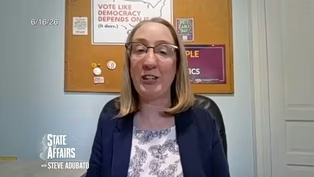
How New Jersey is preparing for the 2030 Census
Video has Closed Captions
Clip: S10 Ep12 | 9m 7s | How New Jersey is preparing for the 2030 Census (9m 7s)
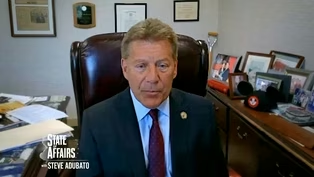
Sen. McKeon analyzes the rise and risk of online sports betting
Video has Closed Captions
Clip: S10 Ep12 | 9m 18s | Sen. McKeon analyzes the rise and risk of online sports betting (9m 18s)
Providing Support for PBS.org
Learn Moreabout PBS online sponsorship New Episode
- News and Public Affairs

Top journalists deliver compelling original analysis of the hour's headlines.
 New Episode
- News and Public Affairs

Today's top journalists discuss Washington's current political events and public affairs.


 New Episode
 New Episode
 New Episode
 New Episode
 New Episode

 New Episode
 New Episode
 New Episode
Support for PBS provided by:
State of Affairs with Steve Adubato is a local public television program presented by NJ PBS