
How the Public Reacted to Killing of UnitedHealthcare CEO
Clip: 12/9/2024 | 8m 51sVideo has Closed Captions
UnitedHealthcare CEO Brian Thompson was shot to death in Manhattan last week.
Investigators said the ammunition used in the attack was etched with the words deny, defend and depose. It's led to a wave of public feelings — like anger, resentment and frustration — over the health insurance industry.
Problems playing video? | Closed Captioning Feedback
Problems playing video? | Closed Captioning Feedback
Chicago Tonight is a local public television program presented by WTTW
WTTW video streaming support provided by members and sponsors.
How the Public Reacted to Killing of UnitedHealthcare CEO
Clip: 12/9/2024 | 8m 51sVideo has Closed Captions
Investigators said the ammunition used in the attack was etched with the words deny, defend and depose. It's led to a wave of public feelings — like anger, resentment and frustration — over the health insurance industry.
Problems playing video? | Closed Captioning Feedback
How to Watch Chicago Tonight
Chicago Tonight is available to stream on pbs.org and the free PBS App, available on iPhone, Apple TV, Android TV, Android smartphones, Amazon Fire TV, Amazon Fire Tablet, Roku, Samsung Smart TV, and Vizio.

WTTW News Explains
In this Emmy Award-winning series, WTTW News tackles your questions — big and small — about life in the Chicago area. Our video animations guide you through local government, city history, public utilities and everything in between.Providing Support for PBS.org
Learn Moreabout PBS online sponsorship>> New York police have named a suspect in the shooting death of United Healthcare CEO Brian Thompson in Manhattan last week.
Police say 26 year-old Luigi Manji only had a gun believed to be the one used in the killing as well as writing, suggesting his anger with corporate America last week, investigators shared that in munition found near Thompson's body was etched with the words delay, deny and oppose.
It's all led to a wave of public feelings like anger, resentment and frustration with the health care industry.
Joining us to discuss the range of feelings about health care or about health insurance are Mark Will Rowe president of a Safe Haven Foundation?
And Anthony Sasso a health care economist who is professor and chair of the economics department at DePaul University.
Thanks to both for joining us.
Mark Morrow lives.
Let's start with you, please.
There and I should also mention we also reached out to a number of health insurance.
They declined our invitation, though, the Illinois Life and Health Insurance Council also declined to join.
But they did provide a statement which we will share in a moment.
Again, thanks to the both of you for being here.
Marc Morial, let's start with you, please.
There was a barrage of social media posts from people showing some serious indifference to the death of Brian Thompson being murdered.
Some comments like, quote, thoughts and prayers are out of network, which is clearly very callous.
But why do you think this was the response from 70 people?
>> As you said, it's very callous response.
I think overall lot of people are frustrated with the cost of hired accessibility of it.
>> And they.
We're looking for a target.
And unfortunately, this poor man who was killed became a target of Those comments.
But it doesn't address what the situation is in the industry that costs are rising.
The access limited providers.
We're not compensate the way they should be.
And, you know, we have quality cost system.
That is it for an industrialized nation such as ours.
We're at the top of the industry.
But at the lower lines of health care and the consumers getting frustrated.
>> as you're speaking, of course, we're looking at some of the some of those tweets from some on your screen right now.
Anthony, let's also the words delayed tonight to pose and seeing different reports wasn't deny, defend pose, but we don't get the idea about those words etched on the ammunition, echoing words that are used by health insurance industry.
Critics.
What's your reaction to that detail?
>> terrible tragedy that individual.
Chose to.
Just a babe in this way to, you know, kill somebody over this issue.
So that I mean, you it's really a terrible tragedy for sure.
I do think that health insurance generally is one of these areas that it is always the focus of a lot of anger and frustration.
I'm not entirely convinced that all of it is justified.
I think that a lot of people don't quite understand exactly the fact that health insurers.
They do.
They do 2 things.
They try to protecting against these risks that we all face.
And that is undeniably a good thing.
We all benefit from that historically insurance has been one of the most amazing creations that humanity has done for itself.
But when you bring risk protection, what happens then is that you have the the flip side of that, which is that now people have an incentive to use more services.
Okay.
And it's and that's we call.
We call that in the industry.
Call it moral hazard.
And that is that's an issue.
It's a known issue.
Health insurers try to come up with ways to try to limit what we might call overconsumption of health care services.
gets even worse than that, though, because most individuals are gonna say I'm not going over consuming to do it.
My doctor tells your doctor knows that there is this built in moral hazard to get to use the jargon term in the health care and health insurance system.
Everybody, doctors, patients, they all want more care.
It's all expensive.
Okay.
So the insurer has the unenviable task of trying to judge what is worthwhile care?
What is less worthwhile care?
It is.
It is a terrible spot to be in.
But they are charged with that responsibility.
>> Mark, your organization, the safe haven, you will focus on providing assistance for suffering from complex economic challenges.
What sort of barriers to the people that you that you help or support?
What are they face when dealing with health care industries?
>> Well, I think well addition experiencing homelessness, their substance abuse, behavioral health care.
Issues.
There's trauma from poverty from living in areas that have a disparate health care.
One of our locations as pot.
6 blocks outside of the medical district.
But it's one of the lease or the city of Chicago.
So you see a lot of things that are coming into play said cause frustration and anger and you see a lot of the I think from the insurance standpoint, this is kind of the population that's often the last served.
gotten there left to the state and they're left to outside agencies to provide the gaps because our coverage, it's episodic coverage.
We'd rather treats somebody an emergency room then to preventative health.
rather treat somebody for a larger condition, which is higher reimbursement rate.
Then.
Teaching them how to maintain their health giving them the resources that they need to maintain health, housing, food making sure that they can afford to support their family.
That they have behavior, health care, all those things come into it and it becomes a bureaucracy of cost rather than a doctor making a decision with his patient or health care professional.
I think you were talking about up coating which it's a it's something of a very technical term.
look it.
That's kind of where, you know.
>> start out.
You keep building upon the insurance.
>> We'll start at the lowest level and build upon the testing, etcetera.
well, and I want to get to a statement.
I apologize.
But I as I mentioned, we did receive a statement from the Illinois Life and Health Insurance Council that reads, quote.
>> Violence is never the answer in the strongest terms possible.
We condemn any suggestion that threats made against anyone working in any industry in our country are ever, ever acceptable.
There's a time and place for further discussion.
But for now, let us not intermingle or conflate the justification of cold-blooded murder in broad daylight with policy discussions about the complexities of the United States health care system.
Anthony, to you first, while there is, as the statement said, there's never a justification for murder like this.
But could this discussion that comes out of it?
Could that lead to some changes or at the least a deeper examination into the practices of the industry?
Well, I guess I would hope that.
>> it's a good statement I think it's right points.
I would like to see, I think I'd like to see the insurance industry probably do a better job I think discussing why there are efforts at times.
Not always but to try to push back on what providers will often try to push on on patients again, not all providers, not all the time.
Both providers, of course, our try our have the patient's best interest in mind, but that every provider I know is human.
And and they respond to incentives to.
And so those incentives are to do more to do more invasive procedures.
Those are all costly.
And in the healthcare sector, as I think we all know at this point, there's a great deal of uncertainty about what works and what doesn't work and sometimes watchful waiting is the best thing to can bill for watchful waiting first is an invasive procedure.
>> 30 seconds left Mark Morrow.
Same question to you.
Do you think this could lead to this discussion could lead to a deeper examination into the health care industry?
I think it's sad that somebody has had to lose her life for us to have those discussions on how to effectively deliver health care in our system, especially a country as rich as ours.
I think there's a lot of challenging complex issues be addressed.
And we really can get that going through better utilization of our system, spare utilization of our resources are funding, but violence is never an answer
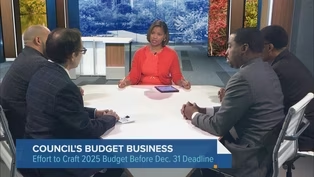
Alderpeople on Where Chicago's 2025 Budget Stands
Video has Closed Captions
Clip: 12/9/2024 | 11m 27s | The City Council rejected two previous plans that included huge property tax increases. (11m 27s)
Providing Support for PBS.org
Learn Moreabout PBS online sponsorship
- News and Public Affairs

Top journalists deliver compelling original analysis of the hour's headlines.

- News and Public Affairs

FRONTLINE is investigative journalism that questions, explains and changes our world.












Support for PBS provided by:
Chicago Tonight is a local public television program presented by WTTW
WTTW video streaming support provided by members and sponsors.