
How the South Side's Only Trauma Center Is Impacting Emergency Care
Clip: 3/5/2026 | 7m 44sVideo has Closed Captions
A new study looked at 14 years of shooting data in the hospital's service area.
Since it opened in 2018, the University of Chicago's Level 1 Adult Trauma Center has served more than 35,000 patients.
Problems playing video? | Closed Captioning Feedback
Problems playing video? | Closed Captioning Feedback
Chicago Tonight is a local public television program presented by WTTW
WTTW video streaming support provided by members and sponsors.
How the South Side's Only Trauma Center Is Impacting Emergency Care
Clip: 3/5/2026 | 7m 44sVideo has Closed Captions
Since it opened in 2018, the University of Chicago's Level 1 Adult Trauma Center has served more than 35,000 patients.
Problems playing video? | Closed Captioning Feedback
How to Watch Chicago Tonight
Chicago Tonight is available to stream on pbs.org and the free PBS App, available on iPhone, Apple TV, Android TV, Android smartphones, Amazon Fire TV, Amazon Fire Tablet, Roku, Samsung Smart TV, and Vizio.

WTTW News Explains
In this Emmy Award-winning series, WTTW News tackles your questions — big and small — about life in the Chicago area. Our video animations guide you through local government, city history, public utilities and everything in between.Providing Support for PBS.org
Learn Moreabout PBS online sponsorship>> More than 35,000 patients that 70 people, the University of Chicago's level one trauma center has served since it opened in 2018.
At that time, it filled a so-called trauma desert on the south side caused by the 1991 closure of Michael Reese Hospital's trauma center in Brownsville.
new study finds the trauma center is delivering on many of its promises.
The study looked at 14 years of shooting data and the hospital service area 7 years before and 7 years after the center opened and found it reduced travel distance by 3.4 miles after firearm injuries, reduced travel time by nearly 10 minutes and saved an estimated 79 lives per 2000 firearm injuries.
Joining us to talk about the study and the center's impact is doctor Selwyn Rogers, professor of surgery at the University of Chicago and founding director of the Trauma Center.
Welcome Back to the program.
Thanks so much for So, you know, before you Chicago Open the trauma center in 2018, how available was this kind of critical care on the South side?
we mentioned that the trauma does it there sadly night, 91 when Michael his hospital's trauma center close, they have not been existing proximate trauma care on the South side.
Chicago.
Obviously there were other.
>> Several other trauma centers in the city of Chicago.
Western Stroger Cook County Hospital as well as advocate.
But in terms of proxima trauma care on the South side.
Sadly, there was only a pediatric trauma center at the Comer Children's Hospital.
And how significant is it to be able to quantify the trauma centers impact after several years through the study?
>> Well, as you know, there was significant community activism advocating for trauma center on South side, Chicago to serve those people roughly 60,000 people who live in the South side and our proximate to the South side.
The trauma centers, lack of existence was a significant our focus of energy for South Siders related to getting early immediate patients, Senate access to trauma care on the South side, Chicago.
So this was a very, very important initiative that the community advocated for and ultimately in Russia, Congo came to the decision to open a level one trauma center over 7 years ago.
Yeah, you mentioned that that organizing that the community pressure head of the current center opening.
>> You know, absent even some of these remarkable medical results.
How has Yu Chicago's relationship with the surrounding communities changed?
Has it has benefited from the center will have great question.
I think it's a great question because outsiders, I can give you my own impressions as someone who lives in the South side.
>> It tends churches and town halls and meet people where there are everyday in many ways it's been a significant pay cut of the University of Chicago towards communities and Southside in a positive way as they won in the court TV land may know it's opening up of cancer center on the South Chicago to meet the needs sites, fighters both locally as well as the city Chicago and beyond.
You know, so let's get to some of these results.
The study found opening the center shaved off nearly 10 minutes of travel.
Time after shootings.
>> How important are those 10 minutes?
Well.
Trump comes in many forms, you know, trauma can be blunt.
>> Largely speaking, that is injuries that.
Suffer fall would be a collision or sadly.
Trauma can also come in the form of penetrating trauma.
And that's often times the most severe trauma, sadly in the city of Chicago, firearms-related injuries, par gunshot wounds.
The more severely injured.
You the more severely injured.
You are the more likely you are not only going to die a potentially lose a life for and your lamb, but you're going to suffer significant complications.
So time does matter.
We talk about minutes can matter.
The difference between life and death.
>> The study looked at the impact of the center in terms of mortality rates.
But you'll be on just saving lives.
How can you know this trauma center impact the overall quality of life for folks who are survivors of gun violence.
Well.
I you we started off by saying about 35,000.
You know, the exact number as of.
>> And the February 1st, 38,158 people that the Trump Senate, you go has served sadly 35%, one in 3 left week.
People come to the trauma center viewers.
Chicago have been shot.
that contacts every minute that someone remains in a state of shock, their likelihood of dying increases.
So when you start shaping up as many as 10 minutes and miles of transport time to an adult level, trauma center.
Not only do you give those people an opportunity for their life to be safe and we've seen it every day.
But you also give them opportunity for there.
Families.
2, see them again to hold him again to hug them again and ultimately for them to have a full recovery and hopefully.
The better than when they were injured.
Are there still gaps in the system?
Does the Southside need perhaps another level one trauma center?
Well, I think that's a question.
And I'm going to actually extend and say what we >> ultimately need is a trauma center.
system of trauma care that.
Bills itself out of it's I advocate very strongly for the important role of prevention.
All right.
That comes in 2 forms.
What we call secondary prevention.
That is someone who's are ready, injured and preventing recurrent injury.
That's a large part of the work that has been supported by the civic community with the partnerships for safe and peaceful communities as well as the city community largely committing 100 million dollars for community violence.
Intervention.
That's ecosystem of care to try to prevent retaliatory violence.
But also when you think about primary prevention, that is how can we prevent people from being injured in the first place?
That's even harder work.
And that really requires a deep investment can make in communities that historically have been this invested in.
And as I mentioned, if we can get.
Proximity get up strain so that we can prevent people from being injured first place.
That's ultimately the best trauma center that we can.
Politics are.
If you can make a public health comment.
Fires, house fires used to be a significant.
Negative impact.
Across the world talk about the great fire and Chicago and how that fire transform the city Chicago.
I wasn't quite uncommon now because we've made significant preventative efforts to help.
Alter that trajectory.
And I would hope that we can make a similar concerted effort to prevent trauma from occurring, especially gun violence from occurring in the first place.
Yeah, perhaps, you know, both prevention and certainly to remarkable results of this study can go a long way.
>> Adr selling Rogers, thank you very much for your time.
Thank you so much for having me.
Up next, a local university helps with an effort to bring home the remains of missing U.S.
service members.
That story right after this.
>> Reflecting the people and
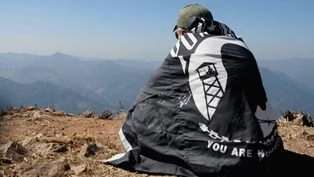
UIC Researchers Are Part of an Effort to Bring Home Fallen American Soldiers
Video has Closed Captions
Last year, researchers made a major breakthrough along a mountainside in Laos bordering Vietnam. (4m 43s)
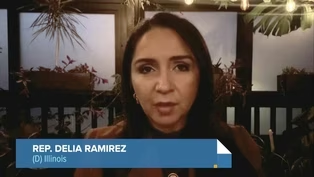
US Rep. Delia Ramirez on Krisi Noem's Firing, Immigration Enforcement
Video has Closed Captions
President Donald Trump announced he was replacing embattled Homeland Security Secretary Kristi Noem. (9m 5s)
Providing Support for PBS.org
Learn Moreabout PBS online sponsorship
- News and Public Affairs

Top journalists deliver compelling original analysis of the hour's headlines.

- News and Public Affairs

FRONTLINE is investigative journalism that questions, explains and changes our world.












Support for PBS provided by:
Chicago Tonight is a local public television program presented by WTTW
WTTW video streaming support provided by members and sponsors.