One-on-One
How this organization empowers & employs blind individuals
Clip: Season 2025 Episode 2871 | 8m 31sVideo has Closed Captions
How this organization empowers blind individuals through accessible technology
Jon Katz, President and CEO of Bestwork Industries for the Blind, joins Steve Adubato to discuss challenges facing visually impaired individuals in the workforce and how his organization empowers them through accessibility and innovative technology.
Problems playing video? | Closed Captioning Feedback
Problems playing video? | Closed Captioning Feedback
One-on-One is a local public television program presented by NJ PBS
One-on-One
How this organization empowers & employs blind individuals
Clip: Season 2025 Episode 2871 | 8m 31sVideo has Closed Captions
Jon Katz, President and CEO of Bestwork Industries for the Blind, joins Steve Adubato to discuss challenges facing visually impaired individuals in the workforce and how his organization empowers them through accessibility and innovative technology.
Problems playing video? | Closed Captioning Feedback
How to Watch One-on-One
One-on-One is available to stream on pbs.org and the free PBS App, available on iPhone, Apple TV, Android TV, Android smartphones, Amazon Fire TV, Amazon Fire Tablet, Roku, Samsung Smart TV, and Vizio.
Providing Support for PBS.org
Learn Moreabout PBS online sponsorship(upbeat music) - We're now joined by Jon Katz, who's President and CEO of Bestwork Industries for the Blind.
John, great to have you with us.
- Thank you for having me, - John, this is part of our "Manufacturing Matters" series.
We're doing it in cooperation with our partners of New Jersey Manufacturing Extension Program, NJMEP.
What exactly is Bestwork Industries for the Blind?
- Bestwork is a nonprofit.
We're located in Cherry Hill.
We were founded in 1981 by a veteran, Jim Varsaci.
He was blinded in combat in World War II.
Basically, we're an employment program.
We empower people who are blind or visually impaired by creating employment opportunities, providing them training, and offering blindness and low vision services.
We're the largest employer of people who are blind in the state of New Jersey, and we're the leading advocate and innovator employer for people who are blind and visually impaired.
We're also recognized as a center of excellence for our blindness and low vision services.
We have four lines of business.
We do textile apparel manufacturing.
We have an e-commerce business, document scanning, digital imaging and kitting packaging light assembly, and we're located in four places around the state.
In addition to our headquarters in Cherry Hill, we have satellites in Roselle, Montclair, and our newest one in Egg Harbor City.
- And also I was remiss, spent 20 years with the United States Marine Corps.
Thank you for your service, Jon.
- Thank you.
- This is also part of our series, honoring our Veterans.
Talk to us about the veterans you are serving who are blind.
What are a couple of the most significant challenges they face and what do they need to become gainfully employed?
- Yeah, that's a great question.
The most common misperception people have about blindness is that people who are blind can't function independently, you know, like they can't work, or they have diminished capabilities.
It's just not true.
With the proper training, you know, guides, jigs, fixtures and assistive technology, we can convert just about any job for someone who's blind.
In fact, we have a saying, "There's no such thing as a blind job.
It's all about training, accommodation, and accessibility."
- So go back to that.
I saw that in the notes.
There's no such thing as a blind job.
What does that really mean?
- I mean, exactly what it says.
We were certified by the state of New Jersey in 2022 as a competitive, integrative place of employment.
And what that means is our people who are blind are working right alongside their sighted counterparts, doing either the same or very similar complex operations.
And if you came to visit us, a lot of times it's hard to tell when you're looking at the manufacturing lines, who's blind and who's sighted.
- So someone goes on your website right now, which we'll put up as we speak, the Bestwork website.
What do they find, Jon?
- So they'll find an organization that is, you know, committed to providing opportunities to people who are blind and visually impaired, and, you know, have that full commitment to provide whatever the combination or accessibility is necessary to create a job opportunity for them.
- Hold on, John, how does it do that?
Help us understand the mechanics of this.
Someone goes on the site, okay?
And if someone is visually impaired, someone is blind, how do they navigate that?
How does that happen?
Does someone else have to help them?
I know I'm in the weeds here, but I'm trying to think through the process.
- Oh no, that's a great question, Steve.
So most people who are blind or visually impaired use different tools.
There's a very common software called JAWS, which allows people who are blind to actually see what you and I see on the screen.
It provides them an audio readout at extraordinary speeds.
And they're able to look at a screen, be able to watch us right now and see exactly what they're seeing through the audio feature of the software.
But also, you know, there are programs, you know, Microsoft is incredible with their accessibility features on all their software platforms.
I have a lot of people that are working in the back office using the programs that you and I use through the accessibility features.
And nowadays, smartphones are absolutely incredible.
Their software where people are blind can actually point their camera at objects, at scenes, at rooms, and it'll tell 'em what they're seeing.
- I'm curious, in some ways, while people worry about technology taking jobs away from human beings, from people, you talking about technology, and you and your colleagues at Bestwork Industries are focusing on using technologies to help provide jobs for people who happen to be blind.
- Yeah, absolutely, and you know, a great story, I was hired in 2021 by my board to diversify lines of business.
Historically, we were just a self-sustaining, textile manufacturing facility, and when we decided to launch new lines, like getting packaging and light assembly, or documents scanning, we said, "Where are we gonna find the people who are blind?"
You know, I can't go out on Indeed like everybody else to hire people who are blind.
And, you know, through brainstorming, we realized, we bought an automated folding, we got a grant, actually.
We got a grant with the assistance of NJMEP to purchase an automated folding machine.
And in my community, people shy away from automation because again, they think that it takes jobs away.
But what it did was we taught three people who are blind, how to run the automated folding machine to fold our textile apparel products.
And at the same time, I was able to repurpose about a dozen people in my packaging area to train them in document scanning and digital imaging, and kitting and packaging light assembly.
But so through automation and innovation, we're actually able to create employment.
- Before I let you go, one out of 10, the level of satisfaction you get outta your work is?
- 11 - 30 seconds because... - Oh, well, because I get double bang for my buck.
As you stated, I spend 23 years in the Marine Corps.
You know, obviously, continued service, creating jobs for people who are blind, but double bang for my buck is I'm still supporting the war fighter, and that means a lot to me.
- Jon Katz, President and CEO of Bestwork Industries for the Blind.
To our friends at NJMEP for helping us make this connection part of our series, not only honoring our vets, but also manufacturing matters.
It matters a lot, particularly for those who are challenged and want to work, and just need a little support in making that happen.
Thank you, Jon.
We appreciate it.
- Thank you Steve.
Appreciate it.
- And I'm Steve Adubato, and we appreciate you for watching us on a regular basis.
We'll see you next time.
- [Narrator] One-On-One with Steve Adubato is a production of the Caucus Educational Corporation.
Funding has been provided by Horizon Blue Cross Blue Shield of New Jersey.
RWJBarnabas Health.
Let’s be healthy together.
NJM Insurance Group.
PSE&G.
Johnson & Johnson.
New Jersey Manufacturing Extension Program.
New Jersey Sharing Network.
The North Ward Center.
And by the Adler Aphasia Center.
Promotional support provided by New Jersey Globe.
And by NJ.Com.
- How long you been waiting?
- About a half hour.
- Brutal.
This keeps up, I'm gonna miss my pickleball game.
- I've been waiting eight years for a kidney.
What can you do?
(gentle music) - [Narrator] Over 100,000 people in the US are waiting for a life-saving transplant.
But you can do your part in an instant.
Register as an organ donor today at NJSN.org.
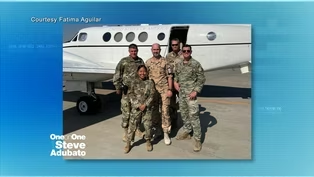
Mental health support for military personnel and families
Video has Closed Captions
Clip: S2025 Ep2871 | 9m 46s | Mental health support for military personnel and families (9m 46s)
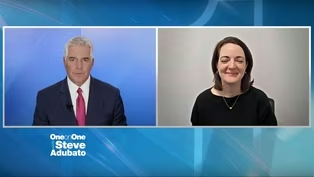
The role of employment in supporting autistic individuals
Video has Closed Captions
Clip: S2025 Ep2871 | 8m 56s | The role of employment in supporting autistic individuals (8m 56s)
Providing Support for PBS.org
Learn Moreabout PBS online sponsorship
- News and Public Affairs

Top journalists deliver compelling original analysis of the hour's headlines.

- News and Public Affairs

FRONTLINE is investigative journalism that questions, explains and changes our world.












Support for PBS provided by:
One-on-One is a local public television program presented by NJ PBS