
How to Tell Anxiety From Everyday Stress
Clip: Season 4 Episode 390 | 4m 50sVideo has Closed Captions
Psychologist explains how to tell anxiety from stress during Mental Health Awareness Month.
This is Mental Health Awareness month, and anxiety disorder is the most common mental health issue in the U.S. and worldwide. But how do you know the difference between anxiety and just being stressed out? Our Christie Dutton spoke with a psychologist about how to recognize the difference and when to reach out for help.
Problems playing video? | Closed Captioning Feedback
Problems playing video? | Closed Captioning Feedback
Kentucky Edition is a local public television program presented by KET
How to Tell Anxiety From Everyday Stress
Clip: Season 4 Episode 390 | 4m 50sVideo has Closed Captions
This is Mental Health Awareness month, and anxiety disorder is the most common mental health issue in the U.S. and worldwide. But how do you know the difference between anxiety and just being stressed out? Our Christie Dutton spoke with a psychologist about how to recognize the difference and when to reach out for help.
Problems playing video? | Closed Captioning Feedback
How to Watch Kentucky Edition
Kentucky Edition is available to stream on pbs.org and the free PBS App, available on iPhone, Apple TV, Android TV, Android smartphones, Amazon Fire TV, Amazon Fire Tablet, Roku, Samsung Smart TV, LG TV, and Vizio.
Providing Support for PBS.org
Learn Moreabout PBS online sponsorshipMay is Mental Health Awareness Month, and anxiety disorders are the most common mental health issue in the U.S.
and even worldwide.
But how do you know the difference between anxiety and just being stressed out?
Well, our Christine spoke with a psychologist about how to recognize the difference and when to reach out for help.
More about this important topic in tonight's Medical News.
Doctor Katie Hopkins from Norton Children's is here.
We're talking about anxiety, so a lot of people say they feel anxiety.
But what's the difference between feeling stress and feeling anxiety that might need attention?
Yeah.
So I actually think it's really important that we differentiate between what is an anxious feeling and what's an anxiety disorder.
What is stress and what's an anxiety disorder.
So as a clinician, when we diagnose an anxiety disorder we're looking at does the does a child or an adult's emotions be that anxiety, worry, stress get in the way of their daily functioning for a long period of time?
And when we talk about a long period of time, we're talking about months.
So where anxiety is really making their world smaller and getting in the way of them going to work, going to school, eating, sleeping, just really spending time with friends, really foundational issues.
That's when we call it a disorder.
Okay.
So like a worry that you can't shake off of the term work.
Okay.
What about kids?
Because experts say that kids are feeling anxious more and more now.
They're seeing a lot.
And I'm sure you work with kids.
You see a lot of this too.
Do you know why that's happening?
I think that there's a lot of factors up.
Certainly in society.
There's a lot of things happening in the world, and kids are more and more exposed to the things that are happening, you know, by watching the news alongside their parents.
Or maybe they're on social media, they're experiencing the stress of their parents.
Anxiety is very contagious.
So if their parents are stressed and anxious, their kids are going to pick up on that.
But it's also because we know that kids worlds are actually getting smaller and set.
A bigger part of a child's healthy development is about getting them continually exposed to new experiences.
And as kids spend more time at home, less time socializing with friends, more time on screens, less time experiencing real life out in the real world, that absolutely contributes to anxiety.
What are some specific examples?
Maybe the top sign or top few signs that we should pay attention to and think, well, maybe we need to seek out some help.
Certainly.
So, you know, it's not unusual that I'll have a parent bring their their child in to see me because their child is avoiding doing activities that their parent was doing when they were their age.
So they're like, you know, my child is afraid of learning how to ride a bike.
And they're ten.
And by the time I was ten, I was riding a bike independently in my neighborhood.
And they won't even get on a bike.
Or my child, is not wanting to go over to a friend's house.
And this is a friend that I know very well, and I know their parents, and they don't want to go over because they don't want to be away from me, or my child won't get out of the car in the morning to go to school because they're worried about what's going to happen at school.
Those are all things that when you when you anticipate that it could be something that a child their age or that when you were a child, you were able to do without fear.
That could be a good indication that maybe they're experiencing a level of anxiety that's really getting in the way.
If somebody is feeling that anxiety right now or somebody comes to you, they're feeling that feeling.
Is there an exercise or something that can be done right at that moment to regain control?
Yes.
If you are getting if you are well fed, if you aren't getting enough nutrition, if you are sleep deprived, it doesn't matter how many deep breathing exercises you do or how great your cognitive behavioral therapist is, you're not going to be able to cope with the basic stressors that come your way, and they're going to feel much more catastrophic because you're just depleted.
So making sure that you're getting plenty of rest, but certainly exercising relaxation exercises, those kind of things are really important for in the moment, control of your emotions.
But you got to get out there.
You got to expose yourself to the things that you're afraid of doing or that you're worried about, and surround yourself with support.
Parents can support their child and saying, I know you're worried about this, but I feel confident that you can handle it.
Okay, that's great advice.
Well, Doctor Hopkins, thank you so much for sharing this with us and for being here today.
You're welcome.
Thanks for having me.
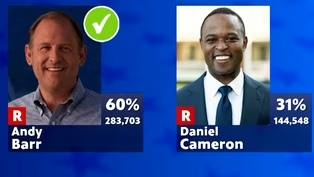
Andy Barr Wins GOP Nomination to Succeed Mitch McConnell
Video has Closed Captions
Clip: S4 Ep390 | 6m 6s | Andy Barr secures GOP senate nomination in race for Mitch McConnell's seat. (6m 6s)

Trump-Backed Challenger Wins Kentucky GOP House Primary
Video has Closed Captions
Clip: S4 Ep390 | 4m | Ed Gallrein defeats incumbent Thomas Massie in Kentucky’s 4th district GOP race. (4m)
Providing Support for PBS.org
Learn Moreabout PBS online sponsorship New Episode
- News and Public Affairs

Top journalists deliver compelling original analysis of the hour's headlines.

- News and Public Affairs

FRONTLINE is investigative journalism that questions, explains and changes our world.


 New Episode





 New Season
 New Episode
Support for PBS provided by:
Kentucky Edition is a local public television program presented by KET