
How United Way for Southeastern Michigan is fighting food insecurity in the state
Clip: Season 54 Episode 3 | 13m 30sVideo has Closed Captions
United Way for Southeastern Michigan is helping feed families affected by inflation and funding cuts
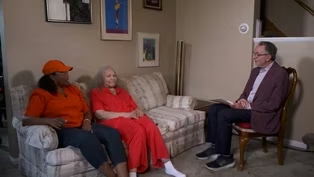
United Way for Southeastern Michigan has raised more than $700,000 for its emergency food fund, which gets distributed to 21 food pantries and banks. Host Stephen Henderson sits down with President and CEO Dr. Darienne Hudson and Pastor Velma Jean Overman, executive director of Operation Refuge, to talk about the growing number of working families in Southeast Michigan who are food insecure.
Problems playing video? | Closed Captioning Feedback
Problems playing video? | Closed Captioning Feedback
American Black Journal is a local public television program presented by Detroit PBS
How United Way for Southeastern Michigan is fighting food insecurity in the state
Clip: Season 54 Episode 3 | 13m 30sVideo has Closed Captions
United Way for Southeastern Michigan has raised more than $700,000 for its emergency food fund, which gets distributed to 21 food pantries and banks. Host Stephen Henderson sits down with President and CEO Dr. Darienne Hudson and Pastor Velma Jean Overman, executive director of Operation Refuge, to talk about the growing number of working families in Southeast Michigan who are food insecure.
Problems playing video? | Closed Captioning Feedback
How to Watch American Black Journal
American Black Journal is available to stream on pbs.org and the free PBS App, available on iPhone, Apple TV, Android TV, Android smartphones, Amazon Fire TV, Amazon Fire Tablet, Roku, Samsung Smart TV, LG TV, and Vizio.
Providing Support for PBS.org
Learn Moreabout PBS online sponsorship- Welcome to "American Black Journal."
I'm your host, Stephen Henderson.
Higher prices, federal funding cuts and an unstable economy are making it really difficult for a lot of families to put food on the table.
United Way for Southeastern Michigan has taken action to assist residents who are experiencing food insecurity.
The organization has raised $670,000 for its Every Family Fed Emergency Food Fund.
That money goes to 21 community-based food banks and pantries.
Joining me now is United Way President and CEO Dr.
Darienne Hudson, along with Pastor Velma Jean Overman, who is Executive Director of Operation Refuge, which is one of the grant recipients.
Thanks to both of you for being here.
I wanna start with something that President Trump said when he was here in Detroit that bothered me quite a bit.
He said, affordability, this issue of affordability is fake news.
Now, I live here.
I interact with people here.
I know lots of people like the two of you who are kind of called to pull up the nets for people who are suffering.
But you are the kind of people I thought of when I heard that.
I was like, there's nothing fake about what's going on, and your work every day to try to meet this this hunger need is proof.
- You're absolutely right.
We have 43% of the households in our region that are identified as ALICE, and that's essentially an acronym.
Asset Limited Income Constrained and Employed.
- Right, it's a measure of poverty.
- That's right.
These are working families who are still struggling to meet their most basic needs.
We receive 800 calls a day on our 211 helpline, and they ask for different needs.
It's not just one need that they call for.
It's food.
It's utility assistance.
It's transportation and childcare.
So these are very much things that are out of reach for many of our residents in southeastern Michigan.
- Yeah, so $670,000 raised, just saying now it's more, correct?
- It is, yes.
We are now at $710,000.
And so gifts just continue to come.
People are hearing about what we're doing.
They wanna be able to help.
Many people who've been doing their own individual drop-offs at pantries, they see the empty shelves, and they wanna be part of the solutions.
- Absolutely.
- Yeah, so one of the things I quite like about this program is you're collecting the money and the resources, but you're distributing it to the places where people are.
And that's where you come in, right?
- Absolutely, we're Mothers' Pantry, where our families are in line as we speak today, receiving the food.
And when we think about our ALICE families, I wanna make it very clear, they're working, but all you need is one thing to happen, - [Stephen] Right.
- Your dad's got COVID this week, and so the check doesn't come next week.
So I'm now in a position where I'm food insecure, and I can't make my ends meet.
And for the leader of the country not to understand how vulnerable the population of our families are is very disturbing.
But thanks to our partners, like the United Way, we were able to be recipients where we can make sure that we keep our shelves full because week to week they're full, and then they're empty.
- Yeah.
- And it's a very common practice in the city of Inkster, and we touch families all around our community, so.
- Yeah, so tell me more about Operation Refuge.
Where it is and how it works.
- It's in the city of Inkster, and it is a client choice pantry.
We've developed over the years.
Like most pantries, we started in a church basement with a bag of food.
- That's right.
- Right, but because of partners like the United Way, over the years, we've moved into our own facility.
It is client choice where the most important thing, me being the oldest of 14 children, I understand what it's like when families don't receive dignity when they need support.
So I wanna make sure that when you walk in our space, you are shopping for what you need.
We're very intentional with our partnerships where we have halal, we also have kosher, and we make sure that we have what you need on the shelves is nutritious, and you have access.
So we're very thankful for the partnership that we've had throughout the years with United Way, where we went from the basement to the support of partners in a building.
And I think when you are in need, you can't feel bad about it.
- How key is that support?
I mean, what are the the other ways you end up having to source the food that you're able to give TO families?
- So when you think about the key partnerships, it's the connections that United Way offer its partners.
Like we're connected through Forgotten Harvest to Gleaners, to Zaman to Yada Ezra, right?
So our needs are met in various ways, and we have a whole team that help us build our internal capacity where you're able to meet your family's needs.
- [Stephen] Yeah.
- So I'm very thankful for the connections.
- Yeah, when we think about what's going on right now with affordability and poverty, I'd love for you to put it in perspective.
You've been at this now for a while and with us here in southeast Michigan for a while.
- That's right.
- How bad is it?
- So in our state, 1.4 million, that's about, you know, 13% of the residents in Michigan receive SNAP benefits.
What people need to understand is that 78% of the households that are receiving these benefits are drawing down income.
They're working families.
- Right.
- About 10% of these individuals are veterans.
36% are older adults, and one in four are children.
- Wow.
- And I think these stats are so important because these are our most vulnerable populations.
These are, you know, we say our children are our most valuable resources and most important resources, but this is how they're being treated.
And so we have to put this in real time.
When people call 211, Stephen, it didn't matter if it was COVID, if there were floods.
- That's right.
- Gas leaks, food is still one of the top three needs.
- Yeah.
- That people have.
And so, you know, they call needing food.
When they have to start making different changes to their budgets, that's when they stop paying their utility bills.
That's when they're not able to get the transportation or their kids, you stop seeing them coming to childcare 'cause they can't afford it.
- Yeah.
- So it's a real challenge in our community.
We have social navigators that are actually providing concierge services, if you will, walking people through the different services that are available.
And it's painful, Stephen, to hear some of the stories.
We're getting people just in the gate for shelters because the shelters are full.
- Yeah.
- Yes.
- You know, we're able to send them to a pantry one day, and they're able to get a box.
They go the next day, their shelves are empty because the needs are so great.
But that's why we have these partnerships, and what Pastor Jean is talking about, it's hard for me not to smile when she's sharing these stories because we have a long history together.
- Yes.
- And I remember when it was literally just bricks on the ground, and we were trying to figure out how we could write some grants together to get resources into Inkster.
- Yeah.
- And that's what makes United Way go, it really is powered by people.
- I love that.
It is powered by people.
- Yeah, so 1.4 million people in the state, you know, I try to emphasize all the time that when we say poverty or challenged, for a lot of people, the first thing that comes to their mind is Detroit, which is our largest city, and of course, one of the poorest jurisdictions.
But, you know, one of the things that I think is becoming more and more evident right now is how hard this is hitting everybody.
- [Pastor Velma] Absolutely.
- And people in communities where.
- [Pastor Velma] Absolutely.
- You wouldn't necessarily jump to the conclusion that they would be.
- Absolutely, and I alluded to that earlier.
Our partners are coming from Berkeley.
- [Stephen] Yeah.
- Like we read, there is a shelter, Yada Ezra, where you would think the Jewish population didn't have the need, but it's there, and they're able to bring things that are not kosher all the way, Dave will drive it to Inkster, or my neighbors that need halal, right?
So it's not just who you think.
It is all of us.
- It's everybody.
- Because the challenges are real, and the fact that we think it's a-okay for us to be not on the agenda in this country at this time is totally ridiculous.
And I'm so thankful that we're able to share it, and you're able to get the word out that we need to make sure that we're intentional about supporting the United Way.
And if you bring food to Mothers' Pantry, we're forever grateful.
But I understand that if we could get a collective energy to make sure that our major partners are funded, and it's downstream.
You know, that agenda that they say we're supposed to receive from the very wealthy - [Stephen] Yeah.
- That their money's supposed to trickle down to those of us working that haven't found this way.
But what we do see is that those that have the heart for philanthropy and for organizations that support our larger organizations like the United Way that it really does get to us.
We were able to purchase a van through a grant where we're able to take the food to families that can't stand in the line.
- Yeah.
- Right, it's hard to be in a line waiting your turn to go inside when you have a walker in the cold.
- Sure.
- But if we can just get it to you.
- That's right.
- And we were able to receive a van, and now we have mobile access for our families.
So it's so many great things that happen when you're in partnership, and they're very intentional with reaching out and helping build capacity around smaller organizations like Operation Refuge.
- Yeah.
- Right, so for us to move in what we've done since 2008, I'm extremely thankful and proud of this work.
- And I would imagine that United Way, you're also in the middle of trying to meet other needs.
- That's right.
- That are coming up short.
I mean, food is critical, and a staple that we've gotta make sure everybody has access to.
But there are other things, healthcare.
- Absolutely.
- [Pastor Velma] Education.
- Education.
- [Pastor Velma] Summer discovery, right?
- We're really seeing a kind fraying of the public infrastructure around those things.
- We are.
I mean, we've had over 100,000 calls and rides delivered now for people who need transportation through Ride United.
You know, we still get calls all of the time for people trying to find affordable childcare.
You know, some of the most basic things.
You know, we have a partnership with Henry Ford and our local food pantries to try to close the loop, literally.
- Wonderful.
- When people are going to receive healthcare, then we refer them to the pantry.
So, you know, all of these things are interconnected.
These are systems that are not working for our families.
So we have to be strategic in how we bring our partners together and how we tackle these different issues.
- Yeah.
- The one thing I did wanna lift off, Stephen, is that, you know, we have our corporate campaign every year.
- Yes.
- But a number of our corporate partners, our community partners, they started doing their own food drives.
They started taking it upon themselves.
They just, you know, selected different agencies and said, we can make a difference from where we sit.
And that's the most important message I want everyone to hear.
If you're frustrated, if you're trying to understand like what we can do to tackle these numbers, everyone can make a difference.
- Yeah.
- You know, call your local pantry, take a ride down to your local church and and find out what their needs are.
- Yeah, I mean, I always feel like the church is the place that people kind of naturally gravitate to for.
- [Pastor Velma] Support.
- If they wanna do these things, right, if they wanna pitch in.
But there are other places as well.
- Absolutely, and we have a number, like I said, Stellantis, Clark Hill, Honigman, Accenture, you know, some of these large corporations, they just said, you know what we can make a difference in our community.
We can just come to work every day and bring resources to support those in need.
- Yeah, I wonder what else you guys think you need in the way of support.
I mean, we could talk about government, and that's always very difficult to deal with the politics there and things like that.
But what are some of the other ways that, other than even the corporate community that we can again, stitch together enough of a net so that people are just not falling through it?
- Well, one, I think that everyone has to understand ALICE is all of us.
- Yes.
- So no matter where you live, every community has a significant ALICE population.
So I think becoming more informed, understanding the communities that we are in, and who we are, who we serve.
- [Stephen] Yeah.
- Being strategic about, you know, how how we start to share resources.
We need to talk more about philanthropy and individual giving.
- [Pastor Velma] Absolutely.
- We need to do a better job, I think, of investing in our community organizations that are doing that work.
And then I would just say continue to ask the tough questions of why we are in these positions and figuring out how we can again, partner with local agencies and be a part of the solution.
We just need everyone being solution minded.
- And I think that's the key is the intentionality.
- Yeah.
- Like on purpose.
- Right.
- I'm looking for ways to support.
And for some of us, it's extremely easy to say, I have two hours I can donate to Mothers' Pantry.
What do you need?
Do like our link to feed?
How can I help you with administrative, right?
How do I help your families with information?
Because one of the big issues we have in our community is high blood pressure.
- [Stephen] Yes.
- So we are very intentional when we are giving out our canned goods that we just say rinse them.
- [Stephen] Yeah.
- Right, we just wanna make you have a healthy life.
Everyone deserves the American promise of life, right?
- Yes.
- And the scriptural promise of it being more abundant.
And we know we have access here in this country.
It's just how do we get it to the person that needs it.
- It's how do we get it to the people that need it.
- That's right.
That's right.
- Right?
It's here, but get it to those of us that need it.
- Well, congratulations to both of you on the work.
- Thank you.
- I know there's a lot of it, and there's a lot ahead, but I really appreciate you coming by "American Black Journal."
- Thank you for having us.
- Thank you.
And thank you for sharing.
Caregiving: Legal planning for the future
Video has Closed Captions
Clip: S54 Ep3 | 8m 4s | Discussing caregiving and planning for the future with an attorney and a mother and daughter. (8m 4s)
Providing Support for PBS.org
Learn Moreabout PBS online sponsorship
- News and Public Affairs

Top journalists deliver compelling original analysis of the hour's headlines.

- News and Public Affairs

Today's top journalists discuss Washington's current political events and public affairs.












Support for PBS provided by:
American Black Journal is a local public television program presented by Detroit PBS