One-on-One
Howard Reid/Bridget Nkatta; Angelica Berrie; Jess Rauchberg
Season 2026 Episode 2940 | 27m 51sVideo has Closed Captions
Howard Reid and Bridget Nkatta, DNP; Angelica Berrie; Jess Rauchberg, PhD
Howard Reid, SVP of Corporate Brand and Purpose at Johnson & Johnson, & Bridget Nkatta, DNP, Exec. Director of Bridge to Life Clinical Care, explore how to invest in nurses. Angelica Berrie, President of the Russell Berrie Foundation Board of Trustees, celebrates 30 years of changemakers. Jess Rauchberg, PhD, Asst Professor at Seton Hall University, examines how social media uses an algorithm.
Problems playing video? | Closed Captioning Feedback
Problems playing video? | Closed Captioning Feedback
One-on-One is a local public television program presented by NJ PBS
One-on-One
Howard Reid/Bridget Nkatta; Angelica Berrie; Jess Rauchberg
Season 2026 Episode 2940 | 27m 51sVideo has Closed Captions
Howard Reid, SVP of Corporate Brand and Purpose at Johnson & Johnson, & Bridget Nkatta, DNP, Exec. Director of Bridge to Life Clinical Care, explore how to invest in nurses. Angelica Berrie, President of the Russell Berrie Foundation Board of Trustees, celebrates 30 years of changemakers. Jess Rauchberg, PhD, Asst Professor at Seton Hall University, examines how social media uses an algorithm.
Problems playing video? | Closed Captioning Feedback
Where to Watch One-on-One
One-on-One is available to stream on pbs.org and the PBS app.
Providing Support for PBS.org
Learn Moreabout PBS online sponsorship- [Narrator] Funding for this edition of One-On-One with Steve Adubato has been provided by The Adubado Center for Media Leadership.
Because media matters more than ever.
Valley Bank.
The New Jersey Education Association.
New Jersey Sharing Network.
PSE&G.
Powering progress.
EJI, Excellence in Medicine Awards.
A New Jersey health foundation program.
Myron and Elaine Adler private foundation, in support of the Adler Aphasia Center.
Robert Wood Johnson Foundation.
Working to create a future where health is no longer a privilege, but a right.
And by Horizon Blue Cross Blue Shield of New Jersey.
Promotional support provided by CIANJ, and Commerce Magazine.
And by NJBIZ.
Providing business news for New Jersey for more than 30 years, online, in print, and in person.
- This is One-On-One.
- I'm an equal American just like you are.
- The way we change Presidents in this country is by voting.
- A quartet is already a jawn, it’s just The New Jawn.
- January 6th was not some sort of violent, crazy outlier.
- I don't care how good you are or how good you think you are, there is always something to learn.
- I mean what other country sends comedians over to embedded military to make them feel better.
- People call me 'cause they feel nobody's paying attention.
_ It’s not all about memorizing and getting information, it’s what you do with that information.
- (slowly) Start talking right now.
- That's a good question, high five.
(upbeat music) - Hey, everyone, Steve Adubato.
We kick off the program talking about nursing and everything connected to nurses, and why they're so important.
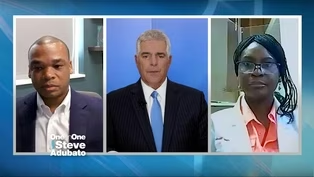
We have Howard Reid, who's Senior Vice President of Corporate Brand and Purpose at Johnson and Johnson, a long time underwriter of public broadcasting, and also Dr.
Bridget Nkatta, who is Executive Director of Bridge to Life Clinical Care.
Howard and Doctor, great to have you with us.
Howard put this in context for us, I've said this before, Johnson and Johnson has a long time history of being committed to nursing, the nursing profession.
What is this program, Bridge to Life Clinical Care, and how is it connected to J&J?
- Yeah, so we have a number of programs across New Jersey supporting nursing.
The one particular program you're talking about is the nurse practitioner entrepreneurship program, which is an incredible year-long program that provides nurse practitioners with essential leadership and business skills required to address some of the primary care and behavioral healthcare needs of the vulnerable populations within their community.
This is a program powered by Duke Health and it's supported by the J&J Foundation.
Equipping nurse practitioners with business acumen and leadership skills to establish their own nurse-led healthcare businesses.
I know Dr.
Nkatta can speak quite a bit to the program.
She was a part of our inaugural class of the program as well.
- Talk about that, Doctor.
You have a doctorate in nursing practice, you're a family nurse practitioner.
Talk about your journey and sort of connection to what Howard was just describing.
- Yes, thank you, Steve.
So I'm a family nurse practitioner licensed in the state of New York and New Jersey to provide primary care.
Bridge to Life Clinic is a nurse led primary care practice and it was established out of a need to close the gaps in care.
And so being part of the nurse practitioner entrepreneurship program that Howard mentioned was a way to empower nurse practitioners to provide, to implement and sustain practices that are expanding access to care and also providing culturally sensitive conscious care in order to improve patient outcomes.
So one of the things, first of all, I have to say, express my gratitude to Johnson and Johnson for staying true to their credo to advance nursing practice and help meet the needs of nurses.
Being in that program, I was empowered to gain that business skills that I was lacking.
One of the things that I learned throughout the program was creating a business plan.
When I started Bridge to Life clinic, I started with a one page business plan, which I mean, you can think about what that would mean.
And I really consider the end care program, I credit that for keeping me in practice to sustaining my practice.
Having that skills in the business arena was a blessing.
I gained mentors, I had mentors, I had coaches, my fellow nurse practitioners from across the country.
We learned how to use those business plan to create manuals and processes that helped us.
- Howard, let me ask you.
We've talked about this with J&J and again, to disclose a really long time support on the national level with public broadcasting, on the regional and state level as well with us as well.
Why the commitment that J&J has to nursing, particularly, with the nursing shortage being what it is today?
Please, Howard?
- Yeah, you know, it's a great question and it goes right back to the start of our company.
Nursing is a part of J&J's origin story going back nearly 130 years where we've been proud advocates for the nursing profession because we're really clear that nurses are the backbone of the healthcare system and ultimately they're critical to driving and improving patient outcomes.
And Steve, it comes back to the data.
If you look at the globe, nurses make up nearly half of the global health workforce and they're responsible for delivering over 80% of the hands-on care.
Many places around the world, a nurse will be the first healthcare professional you see.
They may be the only healthcare professional you see.
And when you think about the out-sized impact nurses are having, that's why we're championing the role that nurses can play.
They're essential not only to the foundation of the healthcare system, but they're essential to the future of the healthcare system as well.
- And to follow up on this, nurse practitioners, define, Doctor, what a nurse practitioner is and then the argument that many make that they're severely underutilized.
Please, Doctor, what's a nurse practitioner?
- A nurse practitioner is a nurse that has gone on to receive advanced knowledge, training and skills to be able to diagnose, assess, treat and manage both acute conditions and chronic conditions.
One of the things that we focus on is health promotion and reducing chronic conditions.
For me, I am so passionate about preventative care.
Throughout my over 20 years in the medical field, I've seen the health system, it's almost like we are putting bandaids over wound.
And, nurses, we are known, we are unique in terms of patient education.
Knowledge is power in my opinion and that's what nurse practitioners bring to the table to reduce chronic conditions and complications that come from.
- Yeah, I wanna follow up on this, for both you, Doctor and Howard.
A graphic will come up because we're involved in an initiative called Trust in Public Health.
And frankly, there's a lot of mistrust in public health.
For you, Howard, why is it more important than ever, particularly with all the medical and health challenges out there, and misinformation and social media, et cetera, et cetera, why is it more important than ever that there be trust questioning, yes, challenging, yes.
Put trust in the public health system.
Howard.
- Yeah, I think when it comes down to it, without trust, we're not going to see the types of patient outcomes we need to see in the healthcare system.
A patient is entrusting their healthcare provider, they're not gonna be compliant on their medication, they're not going to be compliant with their treatments.
Trust is the foundation of a healthy relationship, ultimately, resulting in a strong patient outcome.
And I think with that, in addition to trust, I think it's also recognition of the role that nurses play.
You know, one of the images that I always think about when I think about the pandemic is if you remember when the nurses would turn over their shifts, you would have people on their balconies, you would people hanging, have people hanging out other windows, banging pots and pans, celebrating the role that nurses played in delivering healthcare during one of the most vulnerable times in our country's history.
And we need to get back to that.
I mean, nursing in many ways is in a crisis.
If you think about what the WHO is releasing saying- - World Health Organization.
- Million nurses, that would be a shortfall globally by 2030 due to burnout, due to stressful work conditions, due to a whole host of complexities in their working environments.
This is absolutely something that we have to pay attention to, not only as J&J, but as a society.
- And as we move forward.
Final words on that, Doctor, real quick, 30 seconds.
Why nurses are so important to promoting trust in the public health system.
- So year after year, nurses have been voted as the most trusted profession.
- That's right.
- And as J&J rightly knows, without nurses in the healthcare system, you can't have things work.
We are the backbone.
We constantly put others ahead of us, not because we think about ourselves as less, but because it's a calling for us.
We are passionate about giving care, about taking care other people, and we are ready and willing to close that gaps in care, and we want the legislators and partners to work with us and give us the ability to be able to do what we love doing.
- Doctor, thank you.
Howard, thank you.
I promise, we'll continue to focus on the nursing profession, the nursing shortage, and the need to respect, appreciate our nurses, not just in a crisis but every day.
Thank you both for joining us.
We appreciate it.
- Thanks so much.
- Thank you.
- You got it.
Stay with us, we'll be right back.
- [Narrator] To watch more One on One with Steve Adubato find us online and follow us on Social media.
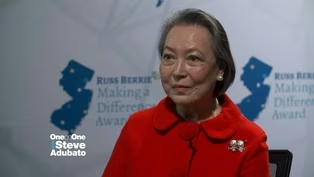
- Recently I had the chance to sit down with Angelica Berrie, the President of the Board of Trustees at The Russell Berrie Foundation.
30 years the foundation has been acknowledging, recognizing, honoring people who are making a difference.
The Making a Difference Award, you see it behind me, the logo.
These people are extraordinary.
The leadership of this foundation has been extraordinary.
This is the conversation with the President of the Board, Angelica Berrie.
Angelica, let's go back three decades.
Why did Russ start these Making a Difference Awards?
- He wanted to inspire people with amazing human beings whose stories haven't been told, who were unknown in their communities, and who have stories that will inspire others to follow by example.
And we've done that very, very successfully thanks to your efforts to amplify their stories, and we will continue doing that long after this award is finished.
- Explain that part, long after the awards are finished.
- Continuity is important for The Berrie Foundation and what we've done is we created a special category called the Ripple Awards, and these awards are meant to connect past honorees with emerging leaders and to be able to share wisdom, experience, and best practices so that long after the award is finished, it was never meant to be the award itself as the culmination of the values we wanted to preserve.
It's the spirit of generosity in New Jersey that we want to transmit.
And that spirit, I think, is carried by people.
And having past honorees pass on the torch is, I think, the most exciting part of the journey.
So this is not the end, Steve.
- You know, you've been talking about this Ripple for years.
For those who are hearing that term, the Ripple, explain where that came from for you and why it is as important today than ever.
- Because we believe one small act can make a difference and one person transmitting one value to another, whether it's lifting another person up, encouraging them to keep going, and to be able to recognize the same spark in others, I think this is what will carry on without us.
And this is just simply human connection, and it spreads.
You know, one person strengthens community, the community's enriched, and it's transformed by that one act that ripples out.
So that's how we explain the ripple effect, and that's why it's called the Ripple Awards.
- Yeah, it's a great name for them.
You know, as we get ready to celebrate 30 years of honorees, we'll be in this hall, the Berrie Auditorium, right?
Berrie center.
I'm always amazed, Angelica, that every time I meet as, and I've been proud to host these events for, MC these events for the last several decades.
- And you've met every single honoree.
- And that's what I'm about to tell you, is that I am struck every year by the impact, I'm not gonna make it about me, but the impact it has on me, because I realize that there are so many people who are, as Russ said and you said in the beginning, unsung heroes not looking for recognition.
It is a very emotional and powerful and impactful experience even after 30 years, for you as well.
- It's satisfying, Steve, in a way that we've seeded a field, a field of heroes, and I think that's the most important legacy we leave behind, to be able to have a full harvest of people who will continue to do good, whether we're here or not.
And that I think is our lasting contribution, and they're across all of New Jersey.
- Yeah.
Legacy.
Were you thinking, do you think Russ was thinking about, and do you think about, have you been thinking about all along legacy?
Or the legacy is the legacy, it's the work, it's the impact?
- It's the unintended but very wonderful consequence of these awards.
I think we did not expect to last 30 years.
We didn't know who would show up and whether we'd find enough people.
But Ramapo and your messaging on your show has been a great amplifier, and the most important thing is how people listen to these stories and relate to their own community and understand that this idea of making a difference applies not just to the person who won the award, but the people who are watching.
We shouldn't wait for heroes, because we are the change, we have to do things ourselves.
- Last question.
You and I were talking earlier about changes in media, technological changes, AI being what AI is, who knows what it's gonna be.
But this is what I'm curious about in terms of your perspective on this.
Making a difference, helping other people will never go out of style.
- It won't, because philanthropy is the gift of who you are.
And I think that when you give all of who you are to where you're going, it doesn't matter if someone saw it or not, it changes something.
And that's the whole idea that Russ had, one act can make a difference and you can change your own corner of the world.
- Finally, for me to have been able to do this for 30 years with you, with the board, with the staff, with the folks in Ramapo, with the honorees who are recognized, it is not always the case in media that you get to say that what you do with others, the work you do makes a difference.
I wanna say thank you and the fact that, and I wanna share the fact that I feel tremendous gratitude to have been part of a not-for-profit on our end who has received the gift of support from the foundation to allow us to feature these people.
That does not happen all the time, so thank you.
- And it's been a gift as well to partner with you, Steve, because those stories couldn't have been told, and I think the importance of what Russ wanted was that there should be positive stories.
The news is always negative and you have helped us to do that and I thank you for 30 years of a really wonderful relationship.
- Our honor.
Thank you.
- [Narrator] To watch more One on One with Steve Adubato find us online and follow us on Social media.
- She's backed by popular demand.
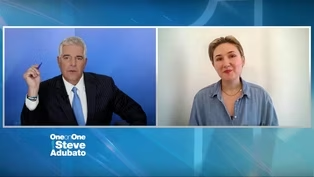
Dr.
Jess Rauchberg, Assistant Professor in the Department of Communication Media and the Arts at Seton Hall University, one of our longtime higher ed partners.
Jess, good to see you.
- Thanks for having me again, Steve.
- Yeah, this is part of our Media Matters series producing cooperation with the new foundation, we created a Center For Media Leadership.
It'll be, the graphic will be up.
This is one of the areas I wanna focus on that's so important.
What the heck is an algorithm and why is it potentially so dangerous, particularly to young people?
- Absolutely.
So an algorithm at its most basic form is a set of an equation that can solve some kind of problem.
And these equations are what power the social media and content creation platforms that more or less shape our media landscape in 2026.
The ways that these platform companies like Meta, ByteDance and Amazon, our designing them is to get our attention and to keep people on the platform.
So many experts say that these algorithmic infrastructures create really addictive relationships between a user and a platform.
- How?
Addictive?
Where?
Here?
Like where?
- Yeah.
So the thing with these platforms is that, if you take Facebook or Instagram, for example, Facebook and Instagram aren't the ones that are uploading content.
They created hosts or spaces, where us, the users are, who get a chance to host our own content on Instagram, right?
I sign up for an Instagram account and I'm agreeing that they can do whatever with my content, with whatever photos or stories or videos as I'm uploading.
And the ways that Meta profits from these users putting their information or putting their content on the platforms is by keeping us on there.
That's also how advertisers see an investment in social media platforms.
And so it's not just, you know, an automated system that's recommending content for us to see.
That is part of it.
But there's a whole team at these platform companies that are making these platforms, spaces that users want to stay on.
So there are psychologists, technologists, marketing experts, who are trying to create an experience where we feel like we never wanna log off.
And that can be dangerous if we don't do that.
- Stay on that.
And I don't wanna go too deep into this.
Last night I'm getting ready to, for an all day taping, today, going through my material.
Then I took out this, the danger device and I started scrolling, and I'm embarrassed to say it.
I started scrolling down.
I'm into mixed martial arts.
Not actually doing it 'cause I don't want to get hit.
But, you know, UFC, blah, blah, blah, blah, blah.
And an hour later I'm looking at fights from 10 years ago and going, what am I doing?
I have to get to sleep.
Why wasn't my brain... And I probably should talk to a psychologist about this.
Why wasn't my brain telling me, you need to go to sleep to get ready for tomorrow?
And why was I just scrolling, scrolling, scrolling.
- Yeah.
So I'm really glad you brought this up.
This is an important phenomenon that digital culture experts and media experts have termed as doom scrolling, where it feels like I watch one video and then I'm sucked in.
And that really shows how powerful on a psych, how powerful on a psychological level these algorithmic recommendation systems are.
So I watch an MMA video, I watch a sports video, a puppy video.
And if I spend a certain amount of time on that video, maybe I linger, I watch it again.
I scroll through the comments, I go to that profile.
The algorithmic recommendation system now makes an assumption, oh, this user will stay on the platform more the more we show them this kind of content.
And then, you know, it's two hours later and you are thinking, where did the time go?
So that's exactly how the algorithm works.
- I'm sorry for, I'm gonna move from mixed martial arts to politics and society.
- Sure.
- I've often said to my friends who will tell me they saw something in the media... And I'm so sorry for interrupting.
They saw something in which I think is affecting my attention span.
But that's another story.
So my friends will tell me, I saw it in the media such and such, about vaccines or health policy or anything, politics, the war, whatever.
And I realized that what they're looking at, their algorithm is designed to feed them information about the stuff not only they're interested in, but in the point of views that they appear to have.
And that what they're scrolling, doom scrolling, whatever kind of scrolling you wanna talk about, is telling 'em you're right.
And so therefore someone else's scrolling tells them something else.
Are we literally living in what Dr.
Richard Carlson, the author of, "Don't Sweat the Small Stuff", who passed away too soon.
He called it separate realities.
Are we living, Jess, in separate realities in part because of this?
- I think that there's some truth to that.
That really eloquent statement, that it does feel like we're in separate realities.
Our feeds, while we might see the same content, we might not even get it in the same way.
It feels really personal.
I think about TikTok for example, their home screen, what you open up when you, what you see rather, when you open up the app is called the For You Page.
ByteDance did that for a reason because they want your relationship to the platform to feel personal.
However, when it feels so personal can silo us.
I also am concerned with how quick information spreads on these platforms when we're thinking about media literacy and media leadership, or leadership, because we don't have time to process.
We don't like one video, okay, we're gonna get fed another one.
Or we see one thing about a political event or public health outbreak, some kind of election.
And there's no time for us to sit and think, what does this mean?
We're just fed another video.
And so when media tools like social media, algorithmic recommendation systems really collapse time and space, it does impact our attention.
It does impact the way we think, and it also can negatively affect how we're able to dialogue with each other.
- Okay, so what I'm curious about is this California lawsuit, March, 2026.
California jury found that Meta and Google, they were liable for contributing to a 20-year-old plaintiff's depression and anxiety after years of social media use in pre-adolescence.
The jury found that the social media apps slash the algorithms were being engineered to exploit the developing brains of kids and teenagers.
How important is this case and what does it mean moving forward?
- This is a landmark case for not just the United States, but for platform companies and how they operate around the world.
I mean, last year we saw the introduction of Australia's social media ban for users under 16.
And a lot of the experts are likening social media and algorithmic recommendation that feels so addictive, that feels so impossible to escape.
It's akin to drinking alcohol or cigarettes that it's difficult to do in moderation and that it can have adverse effects when you start in, consuming that product, whether it's a cigarette or a social media feed at a really young age.
So I do think we're gonna start to see more pushes toward regulation, but I'm not sure how effective that regulation can be.
And in Australia, we're already seeing users under the age of 16 start to bypass some of those restrictions, or it's difficult to enforce those restrictions.
So I think the intent makes sense.
We wanna protect kids.
We wanna make sure that they aren't hurting themselves by, you know, spending seven, 10, 12 hours a day on social media.
But it can be difficult to enforce that.
Dr.
Jess Rauchberg, Assistant Professor, Department of Communication Media and Arts at our higher ed partner, Seton Hall University, will in fact be a part of the new center that we have created, because they're promoting, training, teaching the next generation of media leaders.
Thank you, Jess.
Talk soon.
- Thank you.
Talk soon.
- I'm Steve Adubato.
Media really does matter.
See you next time.
- [Narrator] One-On-One with Steve Adubato is a production of the Caucus Educational Corporation.
Funding has been provided by The Adubado Center for Media Leadership.
Valley Bank.
The New Jersey Education Association.
New Jersey Sharing Network.
PSE&G.
EJI, Excellence in Medicine Awards.
A New Jersey health foundation program.
in support of the Adler Aphasia Center.
Robert Wood Johnson Foundation.
And by Horizon Blue Cross Blue Shield of New Jersey.
Promotional support provided by CIANJ, and Commerce Magazine.
And by NJBIZ.
- How long you been waiting?
- About a half hour.
- Brutal.
This keeps up, I'm gonna miss my pickleball game.
- I've been waiting eight years for a kidney.
What can you do?
(gentle music) - [Narrator] Over 100,000 people in the US are waiting for a life-saving transplant.
But you can do your part in an instant.
Register as an organ donor today at NJSN.org.
 New
New30 years of the Russ Berrie Making A Difference awards
Video has Closed Captions
Clip: S2026 Ep2940 | 8m 7s | 30 years of the Russ Berrie Making A Difference awards (8m 7s)
 New
NewHow social media algorithms keep users coming back
Video has Closed Captions
Clip: S2026 Ep2940 | 9m 28s | How social media algorithms keep users coming back (9m 28s)
 New
NewWhy investing in nurses strengthens our healthcare system
Video has Closed Captions
Clip: S2026 Ep2940 | 10m 39s | Why investing in nurses strengthens our healthcare system (10m 39s)
Providing Support for PBS.org
Learn Moreabout PBS online sponsorship New Episode
- News and Public Affairs

Top journalists deliver compelling original analysis of the hour's headlines.

- News and Public Affairs

FRONTLINE is investigative journalism that questions, explains and changes our world.




 New Episode
 New Episode




Support for PBS provided by:
One-on-One is a local public television program presented by NJ PBS