
Hudson’s Holidays/Considering Matthew Shepard
Season 5 Episode 40 | 26m 46sVideo has Closed Captions
Hudson’s Holidays/Considering Matthew Shepard | Episode 540
The Detroit Historical Museum takes us back in time to the magic of shopping at Hudson’s downtown during the holidays with its Hudson’s Holidays exhibit. The University of Michigan’s School of Music, Theatre and Dance along with the U of M Museum of Art filmed the U of M Chamber Choir’s performance of the oratorio “Considering Matthew Shepard.” And a profile of Epiphany Studios.
Problems playing video? | Closed Captioning Feedback
Problems playing video? | Closed Captioning Feedback
One Detroit is a local public television program presented by Detroit PBS
Hudson’s Holidays/Considering Matthew Shepard
Season 5 Episode 40 | 26m 46sVideo has Closed Captions
The Detroit Historical Museum takes us back in time to the magic of shopping at Hudson’s downtown during the holidays with its Hudson’s Holidays exhibit. The University of Michigan’s School of Music, Theatre and Dance along with the U of M Museum of Art filmed the U of M Chamber Choir’s performance of the oratorio “Considering Matthew Shepard.” And a profile of Epiphany Studios.
Problems playing video? | Closed Captioning Feedback
How to Watch One Detroit
One Detroit is available to stream on pbs.org and the free PBS App, available on iPhone, Apple TV, Android TV, Android smartphones, Amazon Fire TV, Amazon Fire Tablet, Roku, Samsung Smart TV, and Vizio.
Providing Support for PBS.org
Learn Moreabout PBS online sponsorship- Hi, I'm Christy McDonald and here's what's coming up this week on One Detroit Arts and Culture.
It's a flashback to holiday's downtown.
As the Detroit Historical Museum celebrates Hudson's during the holidays, plus a musical tribute at the University of Michigan to Matthew Shepherd's legacy, more than 20 years after his murder shook the nation.
And then the wonder of glassblowing.
It's all just ahead on One Detroit Arts and Culture.
- [Announcer] From Delta faucets to Behr paint, Masco corporation is proud to deliver products that enhance the way consumers all over the world experience and enjoy their living spaces.
Masco, serving Michigan communities since 1929.
- [Announcer] Support for this program is provided by, the Cynthia and Edsel Ford Fund for Journalism at Detroit Public TV, The Kresge Foundation, Community Foundation for Southeast Michigan.
- [Announcer] The DTE foundation is a proud sponsor of Detroit Public TV among the state's largest foundations committed to Michigan focused giving.
We support organizations that are doing exceptional work in our state.
Visit DTEFoundation.com to learn more.
- [Announcer] Business Leaders for Michigan, dedicated to making Michigan a top 10 state for jobs, personal income, and a healthy economy.
Also brought to you by, the Fred A and Barbara M. Erb Family Foundation and viewers like you.
(upbeat music) - Hi there and welcome to One Detroit Arts and Culture, I'm Christy McDonald.
Thanks so much for being with me as we bring in the holiday season.
Coming up, you may remember the decorations, Santa, and the magic of shopping Hudson's over the holidays.
Well the Detroit Historical Museum felt this year was the perfect time to celebrate the spectacle of Hudson's during the holidays with a new exhibit, we'll have it for you.
Then the power of music and art to pay tribute to the most difficult of tragedies.
The murder of gay college student Matthew Shepard over 20 years ago, was a hate crime that shocked the world.
Well, this weekend Detroit Public Television is airing a performance from the University of Michigan called "Considering Matthew Shepard."
We have a look at the production for you.
And then we'll end with April Wagner.
As she takes us into her Epiphany Studios, where she creates intricate pieces of glass art.
It is all coming up on One Detroit Arts and Culture.
All right and let's start things off with some holiday cheer.
If you grew up around here, you probably remember Hudson's.
Maybe you shopped downtown at Christmas, you saw Santa.
Maybe you had some Santa bears.
Well, my mom still has a Santa bear mug.
She still drinks from it, true story.
Well, this year, the Detroit Historical Museum is celebrating that Detroit tradition with an exhibit called "Hudson's Holidays."
Take a look.
(holiday music) - [Delisha] When I think of the holidays, I think of Hudson's.
Growing up in Detroit and one of my first memories of the holidays was getting all dressed up and going downtown to Hudson's to visit Santa.
- [Michael] I became enthralled with the store and the traditions the first time my folks brought me downtown to the store.
I had never seen a store that big and I just went nuts.
- [Delisha] Nobody didn't quite like Hudson's did it, from the big tree to all the beautiful things to buy.
I mean, it really was a place of wonder.
- [Michael] The show began on the sidewalk.
The minute you came inside you were literally thrown into a different world, with beautiful architecture and lighting and drapes and things like that, you forgot all your troubles.
- [Rebecca] We're sitting here today in the main area of our Hudson's Holiday Exhibit in the Detroit Historical Museum.
The holidays are a time when you want to share stories with your family, you want your kids to experience the things that you experienced when you were a kid.
And one of the things that we hear about here at the Detroit historical society most often, is Hudson's.
- [Michael] The company meant so much to so many people in this marketplace.
That store during the holidays employed 10,000 people, 100,000 people a day would visit that building to not only shop but dine.
The company through the years created so many of our iconic events.
The Thanksgiving Day Parade was begun by the company in 1924.
- [Rebecca] Hudson's was a huge department store.
And it had restaurants, it had Santa, and it was kind of the special place that you went particularly at the holiday season.
Here at the museum, we wanted people to have the idea and the feeling of what that might have been like years ago when our grand department store Hudson's, was in its heyday.
- [Michael] What we did is we edited down a lot of things.
What would be the most relevant for the greater public?
- [Delisha] There's a surprise and a delight to take you back to the Hudson's holiday experience.
And I love that about how we've set it up here.
It's not just one place, but it really is a vibe, if you will.
- [Rebecca] This exhibition was designed in much the same way that a department store was, is exactly what our exhibits team was thinking about when they put this thing together.
We've created 11 pop-ups all through the museum space.
When I was first touring this as it was kind of being put up, I realized as you walk down the stairs, right at the bottom of the stairs is some signage and advertising from Hudson's, back in their basement shops.
which were kind of their bargain.
That's where you got the term bargain basement.
Right?
One of the things that I love is that we actually created a little mini pop-up exhibit inside of the elevator.
And so it's really fun that we've been able to recreate that experience of going from floor to floor and experiencing this big department store by putting those departments in different places throughout the museum.
(holiday music) - [Delisha] The Santa bears are my favorite part of this exhibition.
I think the first Santa bears came out in 1985.
I remember that one.
I definitely remember the 1986 bear because he had the little 1986 on the sweater.
But we always got Santa bears for Christmas.
Every year the Santa bears were part of our Christmas tradition.
- [Rebecca] My favorite part of the museum, I kind of really love holiday sparkles.
So I do love all of the Christmas lights and the sparkly stuff here in Toyland, which is where we're sitting.
I also really love the fashion.
Our fashion collection here at the society is amazing.
- [Michael] In terms of what the public will be interested in certainly, Santa bears.
(laughs) has created a huge interest just from the social media thus far.
The delivery wagon, that was created for the 75th anniversary of the company.
Shopping bags that we hadn't previously displayed through the years, photographs that we blew up, things that were donated from the public.
The red carpet that you see here as you come into the Toyland area.
- [Rebecca] It's interesting when you think about kids now having the experience of shopping purely online.
Like they don't even get the big Christmas catalog, much less the experience of going to a really beautiful department store or even a mall.
And so bringing an exhibit back like this one where it is all decorated and everything is sparkly and beautiful, and you get to remember that and feel really special for a minute, gives the kids the opportunity to experience something that they're not experiencing in real life anymore.
This museum is a place where we want families to come together and come and visit us during the holidays.
We brought this really nostalgic exhibition to the public for that reason.
- [Delisha] It's about life and family and the opportunity to be together, which these days is certainly not something to be taken for granted.
So I really do think that it really is an inclusive exhibition that people can come and just really remember a simpler time and be amazed by these toys.
- [Rebecca] I think whenever you have the experience of being put back into a specific time, you have this moment where you get to imagine what it was to be there at that time, what those people's lives were like.
- [Delisha] I really hope that people come and enjoy it and feel really good when they're here.
- [Michael] I hope they take away a feeling of joy.
- [Rebecca] This exhibit is going to remind you once again, what it means to share memories with your family.
It's kind of the perfect entry to that holiday season for everybody.
(holiday music) - For more on Hudson's Holidays, just head to our website at onedetroitpbs.org.
The University of Michigan school of music, theater, and dance, along with the U of M Museum of Modern Art, collaborated on a project that is heading to Detroit Public Television this weekend.
It's called "Considering Matthew Shepard."
Matthew Shepard was a 19 year old gay college student at the University of Wyoming.
And it was 23 years ago that he was brutally murdered.
This production is a musical response to that hate crime and Matthew's legacy.
One Detroit's Zosette Guir, has the story.
(melancholic music) - [Eugene] "Considering Matthew Shepard" is what we consider a passion autorial that was composed by conductor and composer, Craig Hella Johnson.
And it is a powerful work that... is what we consider a musical exploration about the life and death of Matthew Shepard.
In October, 1998, Matthew Shepard was brutally killed by two individuals who pretended to be gay.
And sadly after that tragic evening, he was discovered 18 hours later and died five days afterwards in the hospital in Laramie Wyoming.
And so this work is a meditation, if you will.
(melancholic music) There's so many ways that Craig could have told the story.
I'm even moved by simply the title, "Considering Matthew Shepard."
That first of all sets us in a state of let's just pause.
Let's just take a moment and not point a finger at his perpetrators.
We need to tell that story, but think about ourselves as we relate to Matt, and think about ourselves and how we can even see ourselves actually in the story in the lives of his perpetrators and that hate will not win in any form.
As we think about social injustices in our world and all that we're dealing with, it's good to be reminded that love and forgiveness and that add in opposition to hate those things will overshadow hate in the end.
And I think we need that.
We need that reminder as human beings, we need that reminder more than ever today in our world.
And I believe that that's what our students, I know that's what our students are drawn to.
We all want to be inspired and this work constantly reminds us love and forgiveness in the end will win.
(melancholic music) Working with these talented students here at the University of Michigan is truly one of my greatest joys in my life.
And it was shocking to me to realize that these students actually did not know Matthew Shepard's story.
And so, it was such a powerful moment in my life as African-American gay man and someone who remembers all of that, went into that, and realized that the undergraduates especially had never even heard of him.
Telling that story with these incredible young students, seeing how they have taken to this, not only the music, but that story has been inspiring.
I've been encouraged to realize that our future is bright.
I believe a conductor has to program works of the past as well as the present.
And so, not only do we need to study great works by handling back and drums, but we need to keep telling stories also about today, (melancholic music) This work can stand on its own musically.
It is not just what some may say, a piece of propaganda.
It is not that at all.
It is a work that is rooted in great stories, as well as great musical styles and compositional technique.
And so.
I'm a firm believer in telling disparate stories, as many disparate stories as possible on the stage.
Can every audience member in some way or form see themselves through the stories that we tell on the stage.
(melancholic music) I think choral music, vocal music, choral music is positioned in a very unique way because of the stories we can tell with a community of voices, not just one person, but to see the different backgrounds from these students, telling the story together as a community, we've missed that in COVID.
And so this story right now, as well as telling the story together, it's been transformative for all of us.
(melancholic music) I would hope that people would watch this with an open mind.
There are some powerful moments, there are some tough moments.
We're not trying to preach, we're not trying to tell people how to think.
I think Craig says it best.
We're just asking them to consider, to just meditate, to just think about ourselves as it relates to Matthew and others.
♪ Some stormy story waiting to be told ♪ ♪ Where O where has the innocence gone ♪ - [Eugene] I think one of the things that's so special about music is because we get to, no matter what a person's background is, no matter what their socioeconomic status, religion, when we sit down together and focus all of our energies on this gift, I call it a gift of music and these stories, nothing else matters.
(melancholic music) Making music together with all of those individuals as a community, our hearts beating together as one, that forms lifelong memories that really unites us.
(melancholic music) - For more information on "Considering Matthew Shepard" which will air on December 11th here on Detroit Public Television, just go to our website at onedetroitpbs.org.
All right, turning now to the artistry of blowing glass, Metro Detroit glass artists April Wagner is the owner and the lead artist at Epiphany Studios and she let us take a look at how she creates her magical pieces, including ornaments for the holidays.
(upbeat music) - [April] Glass isn't like any other material.
It's very responsive, it's very visceral.
It's an intimate experience.
(upbeat music) I always knew I wanted to be an artist from a young age.
And then after I graduated, went to New York for a little while and was studying ceramics.
I ended up taking a glass class when I was in college there.
And it was just like one of those moments where you realize, "Oh my gosh, this is an epiphany.
This is what I want to do."
I feel like in my work I try to encapsulate like that moment in time or that thing just on the edge of turning into something else like the motion of a thing, or just like something caught in time.
And so I hope that that is what the viewer is taking away from it.
Glass is craft, so there's the technique piece where you have to learn how to manipulate the material and then a more esoteric piece, which is where you learn to think creatively.
What could I do with this material?
How can I express myself?
What am I thinking about as I'm working with it?
Why do I want the viewer to see, or how do I want the viewer to feel when they look at the piece.
So my work over the years has grown and transformed as I've transformed.
And I've tried to maintain a trueness to both of those things.
So the studio creates a line of functional pieces, which are very technically based and require high level of skillset.
And then I also create a series of sculptures that I take those skills then and I express myself in a more freeform manner using the glass as a sculptural element.
(upbeat music) I like to play with the glass and I like to respond to what the glass is doing.
And I'm always really interested in what that could turn into.
We use a blow pipe, which is about four feet long.
It's a stainless steel tube.
So it has a hole through the center of it and you'll get the glass on the tip of it.
And I will equate it to people, like when you're trying to get honey out of a honey jar and you use that stick, it's the same process.
You kind of have to twirl it, so it stays on there.
Otherwise gravity is going to pull it to the floor.
And you manipulate it the whole time on that blow pipe.
Blow again.
The blow pipe is like a Baton.
You control it around any direction you want.
Shapes are done a little bit with centrifugal force and a little bit with gravity, and then I'm manipulating them with hand tools.
So I've transferred it from the blow pipe which it has a hollow center through the middle of it to the solid rod, which is called the punty rod.
So basically I've shaped the piece as much as I can on the blow pipe.
And now I'm going to finish it over here.
We're really fortunate, we have such a great team right now.
I will design all of the pieces in the studio and then I'll have one of the other artists I work with make them because glass blowing is such a physical endeavor.
I really only have so much capacity.
And I want to really focus on the sculptural work with that.
Most of my work is site-specific.
So it's driven by the environment, the specifics of the environment.
What kind of lighting is available and who the viewer is.
Our clear glass comes from North Carolina, and when it comes to us, it's silica soda ash limestone.
And we'll take that and we'll put it into the 2,400 degree furnace.
And it will sit in that furnace for approximately 12 hours while it cooks and turns into glass.
And then we turn the furnace down to 2000 degrees.
So now we've got our clear glass ready to go.
And depending on if we're going to use color or not, we'll introduce the colors at different points, depending on what kind of piece we're making.
Those colors come from Manufacturers in Germany and Australia, and they're formulated with different minerals and metallic oxides that are combined with a glass base that matches my clear base.
So there's a little bit of chemistry in glass in that each of those chemicals that make those colors has to fit.
For example, copper is a really interesting one.
A copper can be red, it can be green, or it can be blue depending on what else it's mixed with, with the glass.
I really have an affinity for the colors that have... they're called reactionary colors, and they have a golden silver metallic sheen to them.
I think that they encompass all of the awesome things about glass, super sparkly, a little bit transparent, a little bit opaque depending on how the light's looking at it and just really fits in a lot of environments.
It could go in a contemporary home, it could go on or traditional home.
Everyone likes it.
It's like a universal favorite.
Education is a huge part of people understanding value.
Twice a year we open our doors for the public to come in and watch us build glass.
We offer hands-on experience where people can try making their own glass piece because I've realized over the years that we make it look easy and it's not.
(laughs) So we like to get people in there, let them figure out, "Oh my gosh, it is really hot and it is hard to work with."
But then also for them to have that experience and that memory, when they look at that piece, (gentle music) I think people like glass because it seems like it's alive.
It's something you want to touch, it sparkles, it really reacts well with light.
So it draws us to it.
And I think we use glass in so many different ways in our lives.
I mean, eye glasses, glass in our cars, glass in skyscrapers, glass to look through the Hubble Telescope at Mars.
And the technology that goes into glass manufacturing is so crazy exciting.
I think as an artist, I feel like that also adds to my passion of what I can do with this material.
I'm definitely much more interested in the process than I am in the product.
I have pieces that are all over the country that I will probably never actually see in person again.
And I'm good with that.
'Cause for me I feel like the spirit of that piece is embodied inside of me.
I did a piece for a hospital a couple of years ago, and the idea that so many people were going to be in that space and probably not there for good reason, and to be able to give them something else to contemplate, maybe take them to a different place for a while and have respite is really a powerful thing.
(gentle music) I love animals and we have a relationship with the humane society where we create work that we then donate a portion of the proceeds back to the humane society.
I adopted my cat from there.
And that makes me feel really good.
Because as an artist, you don't have a lot of extra money.
And one of the ways I can give back is to do things like that.
I think that we live in such a consumer society.
The nicest gift you can give is something that's handmade and supporting a local artist is keeping money in the economy around you, supporting creativity, adding uniqueness to your area.
And I think people will appreciate that.
(gentle music) - For more on our arts and culture stories, our live performances, just head to onedetroitpbs.org for more, as well as on social media @OneDetroit you can find us there.
That is going to do it for me this week, but I'm going to leave you with a look at a beautiful musical performance by Olivia Dear from "Detroit Performs: Live from Marygrove."
I'll see you next week.
Take care.
♪ Woke up in the middle of the night ♪ ♪ 'Cause I don't sleep so well with you so far away ♪ ♪ When this rogue is the federally ♪ ♪ It's nice to know that somethings never change ♪ ♪ You've been running at the speed of light ♪ ♪ Haven't slept since last July ♪ ♪ I've been saving up but am still spent ♪ ♪ So someday soon we'll have enough ♪ ♪ For our house on a hill or a corner lot ♪ ♪ And it will all be worth it ♪ I want a house, a home ♪ But memories don't hide ♪ No they just hold it close ♪ And every day we wake up ♪ We're just glad to know ♪ I've got you ♪ You've got me ♪ We've got these for us ♪ To call home
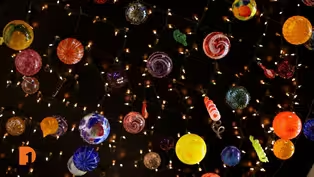
Video has Closed Captions
Clip: S5 Ep40 | 7m 32s | April Wagner | Episode 540/Segment 3 (7m 32s)
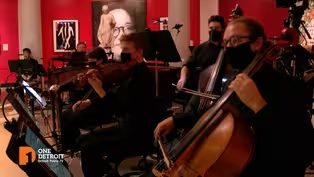
Video has Closed Captions
Clip: S5 Ep40 | 6m 58s | Considering Matthew Shepard | Episode 540/Segment 2 (6m 58s)
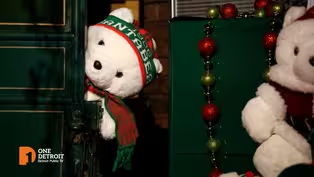
Video has Closed Captions
Clip: S5 Ep40 | 6m 1s | Hudson Holidays | Episode 540/Segment 1 (6m 1s)
Providing Support for PBS.org
Learn Moreabout PBS online sponsorship
- News and Public Affairs

Top journalists deliver compelling original analysis of the hour's headlines.

- News and Public Affairs

FRONTLINE is investigative journalism that questions, explains and changes our world.












Support for PBS provided by:
One Detroit is a local public television program presented by Detroit PBS