Made Here
I Know a Man...Ashley Bryan
Season 17 Episode 3 | 57m 59sVideo has Closed Captions
Poet and artist Ashley Bryan from Maine used art to celebrate joy, mediate on darkness.
Poet and artist Ashley Bryan lived on the remote Cranberry Islands, Maine, until his death in February 2022 at the age of 98. He used art his entire life to celebrate joy, mediate on the darkness of war and racism, explore the mysteries of faith, and create loving community.
Problems playing video? | Closed Captioning Feedback
Problems playing video? | Closed Captioning Feedback
Made Here is a local public television program presented by Vermont Public
Sponsored in part by the John M. Bissell Foundation, Inc. and the Vermont Arts Council| Learn about the Made Here Fund
Made Here
I Know a Man...Ashley Bryan
Season 17 Episode 3 | 57m 59sVideo has Closed Captions
Poet and artist Ashley Bryan lived on the remote Cranberry Islands, Maine, until his death in February 2022 at the age of 98. He used art his entire life to celebrate joy, mediate on the darkness of war and racism, explore the mysteries of faith, and create loving community.
Problems playing video? | Closed Captioning Feedback
How to Watch Made Here
Made Here is available to stream on pbs.org and the free PBS App, available on iPhone, Apple TV, Android TV, Android smartphones, Amazon Fire TV, Amazon Fire Tablet, Roku, Samsung Smart TV, LG TV, and Vizio.
Providing Support for PBS.org
Learn Moreabout PBS online sponsorshipMore from This Collection
Encounter diverse perspectives on a range of public affairs topics and contemporary social issues.
Making History: Moving the Johnson Library
Video has Closed Captions
How the Town of Johnson, Vermont got creative to save their 100 year old library from flooding. (7m 29s)

Video has Closed Captions
Investigating the eastern coyote hunting controversy in Vermont. (38m 6s)
Video has Closed Captions
BABYLON evokes refugee storytelling through puppet, actors and song. (1h 3m)
Video has Closed Captions
Peter Murray (1975) profiles a traditional furniture maker in Charleston, Vermont. (53m 51s)
Vermont People: Chester Grimes
Video has Closed Captions
A 1971 story of a 70-year-old logger in northern Vermont still working with his team of horses. (32m 2s)
Vermont People: Peter and Jane Flint
Video has Closed Captions
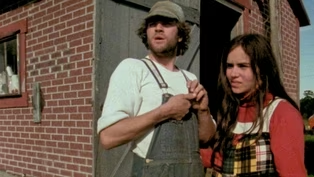
A young couple in Wolcott, Vermont in their first year running a small dairy farm. (1h 48m 5s)
Video has Closed Captions
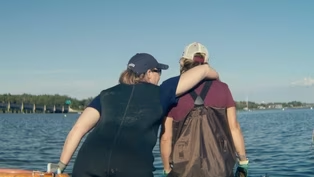
In New Hampshire’s small fishing and aquaculture industries, women have broken down barriers. (45m 31s)
Building Hope: Ending Homelessness
Video has Closed Captions
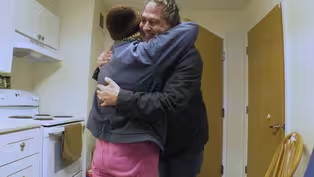
Puts a face on the unhoused in Maine and tells us it could happen to anyone (57m 43s)
Video has Closed Captions
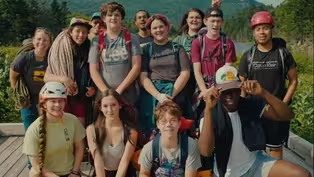
Teenagers spend a week making friends, rock climbing, and pondering the future in New Hampshire (35m 49s)
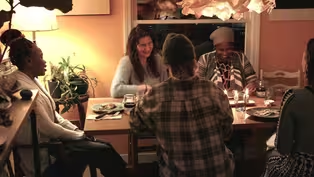
Video has Closed Captions
A portrait of a Ghanaian woman as she navigates life in Brattleboro, VT. (37m 33s)
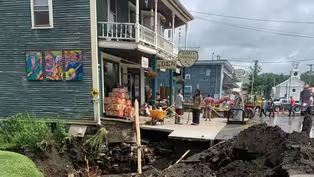
Harry's - One Vermont Community and the Flood of 2023
Video has Closed Captions
Harry's Hardware in Cabot, Vermont and the flood of July 2023. (19m 45s)
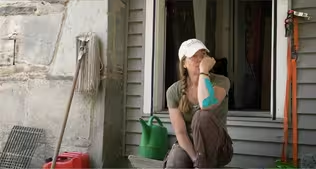
Video has Closed Captions
A story of the July 2023 Vermont floods that devastated a street but not the community spirit. (37m 21s)
Providing Support for PBS.org
Learn Moreabout PBS online sponsorship(boat engine whirs) - You know, you play with reality in different ways so that-- that you don't lose that child in you.
That's the one thing that's so important to me, that's what I reach for in everyone, the child in them.
Because it's the one thing we have in common.
Have a good day, have a happy school day!
- Bye-bye.
- Bye-bye.
(laughs) He goes and he-- he pukes up the cat.
- Ew!
(laughs) - [Ashley] So, it comes back to life, and then he chews up Janey, and he's so mad.
He pukes her up again!
(laughs) - [Girl] Ew.
- And then he eats her up again, and then he pukes her up again.
(laughs) And he's (laughs)-- he can't eat her just once.
That's not enough to punish her.
(laughs) He eats her, he swallows her back up whole, and then he swallowed it, chews it out again, and then he brings her back up again.
He pukes her back up, and then he eats her again.
(laughs) And this is how the story ends.
(children muse and laugh) (musical Amazing Grace) The artist from Sing to the Sun Poems by Ashley Bryan.
I know a man, like a child, he loves to paint.
He can paint anything he sets his heart to.
(orchestral Amazing Grace) He knows that to have anything he loves, he can have it fair and forever.
If he paints a picture of it, he knows that to face anything that hurts, he can do it.
Transform the sorrow.
If he paints a picture of it, this is how he lives.
This is what he does.
(orchestral Amazing Grace) When my dad came to this country, they gave him the mop and the broom, okay?
So, he's working, sweeping and mopping and everything, when I asked him about things, when I was growing up, he didn't tell me anything about racism.
But the mop and the broom is what you'd get.
You know, the-- the famous photograph of Gordon Parks is the woman with the mop, the broom, and the flag.
It says a lot.
Black bird stands out best of all!
- Black bird stands out best of all!
- Black bird is the most beautiful.
- Black bird is the most beautiful.
- His feathers gleam all colors in the sun.
- [Group] His feathers gleam all colors in the sun.
- [Ashley] Black bird is the most beautiful one.
- Black bird is the most beautiful one.
- [Ashley] Now, when the birds went into the steps, ring dove took black bird aside, oh, black bird, black bird, cukuroo, cukuroo, would you color me black, so I'll be black like you?
My neck is plain, and that's a shame cause ring dove is my given name.
And black bird says, "Color on the outside, that's not what's on the inside."
(group laughs) You don't act like me.
You don't eat like me.
You don't get down in the groove and move your feet like me.
(group laughs) The birds surrounded black bird, and they all sang.
(gasps loudly) A color sport, a brand new look.
- [Group] A color sport, a brand new look.
- [Ashley] A touch of black was all it took.
- [Group] A touch of black was all it took.
- Black is beautiful, aha!
- [Group] Black is beautiful, aha!
(laughs) (claps and cheers) - (laughs) Thank you all.
(claps and cheers) Thank you (laughs).
Thank you.
(claps and cheers) (laughs) Oh, my dad loved birds, and my mother said, because when he was a child growing up in Antigua, he had his slingshot, and picked off so many birds.
He was making up for it now by taking care of them.
But he would come home, even this depression he has, his hand would be behind his back.
And my mother would say, "Earnest, not another bird!"
My mother would say, "If I want any attention around here, I'd have to get into a cage."
- [Male] How about that one?
- [Ashley] Yeah, that's a market scene that I did.
- [Male] In New York?
- [Ashley] It was when I graduated high school, I was just 16, and I went out with my portfolio to get a scholarship to go to college.
My teachers at Theodore Roosevelt High School in the Bronx, worked very closely with me, and supportive of me, giving me materials, and everything through the depression years, because they knew that I had a talent.
I took my portfolio to get a scholarship.
I graduated in January.
All right.
When I went the rounds, I heard, this is the best portfolio we have seen, but it would be a waste to give a scholarship to a college student.
All right, I went back to the high school.
I knew I was black, they knew I was black.
They'd encourage me all through my school years, all through my school years, elementary, junior, all white teachers.
So, they said, look, Ashley, you come back and do a postgraduate course with us.
Take any course you like, work on the senior year book with us.
In the summer, you take the exam for the Cooper Union.
They do not see you there.
We had an exercise in sculpture, an exercise in architecture, and an exercise in drawing.
As we put them on the tray, and then we left.
Later, the professors, or the next day, came down.
They looked through all of the work that was handed in, and they selected those who would be selected as students for the art school.
I was fortunate in being one of that small group selected, and that was how I was able to go on to a college training, and what I love.
Because with six children and three cousins, there was no way we going further beyond high school without a scholarship.
I was in my third year at Cooper Union when I was drafted at 19 into the Second World War, into a port battalion of stevedores.
Knew nothing of docks, knew nothing of stevedores, knew nothing of any-- anything other than drawing and painting.
The stevedores working on the docks where you handle all the cargo, all the crates of ammunition, of food, of supplies, of clothing.
And with the winch, we'd raise them up and off, and then land them on the shore of the docks.
And I knew nothing about a winch.
So, initially when I was supposed to be learning how to run the winch, the fellows took over because some of them had been stevedores.
It was only when we were in the boat going overseas the first time, was going out of Boston to Glasgow, to Scotland, that the officers (mumbles), now every man will take over the job for which he has been rated.
(laughs) Oh, Lord, to (laughs)-- to run a winch.
And I would take out a pocket book of poetry, and I'm running the winch, the-- the gear going up, and the-- the-- the load and all will be coming up, coming up, come up to the boom, and I'm-- and it's reached the boom, and the boom is swaying, swaying.
And the signal will be screaming, and oh (mumbles).
Oh, and I'd let go, and then it would drop this way.
And then the person next to me with the other winch, would take it off to take to the-- to the outside.
I would either draw or cry.
It alternated, drawing or crying.
When we were leaving the Boston area, and they said we were going to Scotland, and that we'd be on the docks in Glasgow; and when we were in Glasgow, I went to the battalion commander.
And I asked permission to attend the Glasgow School of Art.
And I got to know the people in the art class, became good friends.
They invited me to their homes.
- [Nick] Ironically, the African American, when they went to Europe, they were treated a hell of a lot better (laughs) than they were treated back in their native land.
And on that well known irony that they were fighting for freedom in Europe, and didn't have the same freedoms when they came back.
- But they were always after me to stop drawing, and I said, if you're gonna put me in a guard house, put me in a guard house now, because I'll never stop drawing.
When we left the port in Glasgow, we had no idea we were going into an invasion.
(waves wash to shore loudly) When we finally reached this area, it was Omaha Beach at Normandy.
(suspense music) (gun shot fired) And the lands were mined, the pill boxes were manned, and there was extensive loss of life on those first days.
- [Nick] He doesn't really dwell on the horrors of war.
So, really what you see here, is the waiting, the sitting around and waiting.
- [Ashley] Now, when they went beyond the beach, that's when we started unloading the gear.
(truck engines whir) They didn't have time to bury dead.
The immediate thing was just to get them out of sight.
When we came ashore to dig our foxholes, three days later, we were walking sometimes on mined land or digging into landmines.
You couldn't always walk with that kind of tremendous fear of putting down your foot or anything, you just went.
- [Nick] He said that making art in a foxhole has its limitations.
He used toilet paper, anything that was at hand, he used as his materials.
He would then store them in flat pieces of cardboard, and then occasionally he would send them back to America.
So, that's how they survived.
- The white units always went home as units, and they were given these wonderful heroes welcome.
(crowd claps and cheers) And people were cheering and hooting, and hollering for the white units.
That was not the case with the black units.
They sent them home in dribs and drabs, often separated from their fellow soldiers that they were in units with, and that happened to Ashley's unit.
And there's a sketch that he drew right during that time, because it was so moving and poignant of a soldier just sort of in despair.
When they got word that there wasn't going to be room for all of them to get on the boat home.
It gives readers a sort of a sense of how devastating that that was.
- [Ashley] Well, I reacted as any human would, and that's why veterans are so disturbed when they come home, and a third of the homeless are veterans.
Psychologically, it's a tremendous thing that you never get out of your head.
If you don't have a strong support of family, friends, or some direction of study, or interest, you fall.
And you end up on the street because when you've experienced the incredible carnage and tragedies of war, I simply ask myself, why does man choose war?
That's why when I completed the work at Cooper, I started over again as a philosophy major.
I thought I would get answers.
I've always been naive.
My life has been in terms of what the world means after that experience, because I lived up to the time of Hiroshima and Nagasaki, and that did it.
(explodes loudly) Were we put in life to suffer only so that art could redeem suffering?
I don't know, but it is a mystery, and it is a miracle that artists can draw upon the tragic as well as the joyous, and make art of it.
(scrapes loudly) ♪ Oh Mary don't you weep don't you moan ♪ Let my people go.
♪ Pharaohs army got drowned ♪ Oh Mary don't you weep ♪ Moses stood on the Red Sea shore ♪ ♪ Splitting the water with a two by four ♪ ♪ Pharaohs army got drowned ♪ Oh Mary don't you weep ♪ Oh Mary don't you weep don't you moan ♪ ♪ Oh Mary don't you weep don't you moan ♪ ♪ Pharaohs army got drowned ♪ Oh Mary don't you weep - [Ashley] In Medieval times, it is said, all art was created for the greater glory of God, the cathedral, the stained glass windows, the ritual drama, the chance illuminated manuscripts.
Everything was created for the greater glory of God.
It is said that in the western world, the only time that spirit of an art created for the greater glory of God, came from black slaves.
With the thousands of songs they created under a system of oppression, and yet, out of that came things like, Swing Low Sweet Chariot, Go Down Moses.
They could sing of their longing from the Bible stories that they heard.
In the United States, spirituals are taught but not historically.
They do not know where they come from, and so, I have been doing books at the spiritual in different forms just to keep it going.
So they would know that this is a gift from black slaves, the thousands of these songs.
These mean everything to me.
So, I was so happy that they were brought back into print.
As Marian Anderson said, "In order to keep another down, you'll have to hold him down, and therefore you, yourself, cannot rise and soar to the potential within you."
♪ Mary don't you weep ♪ Baby baby ♪ Oh Mary don't you weep don't you moan ♪ ♪ Oh Mary don't you weep don't you moan ♪ ♪ Pharaohs army got drowned ♪ Oh Mary don't you weep ♪ When I get to heaven gonna put on my shoes ♪ ♪ Walk around heaven and tell the news ♪ ♪ Of Pharaohs army got drowned ♪ Oh Mary don't you weep ♪ Baby baby ♪ Oh Mary don't you weep don't you moan ♪ ♪ Oh Mary don't you weep don't you moan ♪ ♪ Pharaohs army got drowned - [Ashley] That's what the black slaves meant, we are all children of God.
♪ Oh Mary don't you weep - [Nick] We have to remember that in 1946, he was in the first class of students to go to the Skowhegan School of Art.
So, a very prestigious appointment.
And it was out of that, that he and a group of friends go to Mount Desert Island, and he sees the Little Cranberry's.
And for whatever reason, he says, that's where I want to live.
So, he was also able to forge an oasis for himself.
- [Ashley] And so, although I was always reading and writing during the school year, in the summer, I would come to-- to Maine, to the Cranberry Islands, and I would draw and paint all summer.
After the war, after the Columbia University studies in philosophy, I now knew I have to find some way of making sense of myself drawing and painting, and that was gonna be a pursuit.
So, I chose Aix-en-Provence in Southern France, which is the Cezanne country.
And when I heard that Pablo Casals this great musician was going to break his silence with a few other students at the L'Université d'Aix-Marseille, we decided we would go, and there would be an (in foreign language), which was in the Pierre Rene Oriental, where we could stay, and we'd come down to hear the concerts.
Pablo Casals was born in Spain.
He was considered the greatest instrumentalist of his time.
And in 1950, the 200th anniversary of the death of Bach, great musicians came to him to ask him to break his silence.
Which after the Second World War, he refused to play in concerts of other countries because it felt they had supported Franco in his overthrow of the people's revolution.
And so, he refused to play.
He said, "That's my only weapon, my bow."
These great musicians came to him, and he said, "If you come to this little town where I live, and perform with me, I will play, honoring Bach."
And people from all over the world came.
I'd sit close, I'd listened to the rehearsals, I'd draw during the rehearsals.
I began to get a sense of what drawing meant to me through those rehearsals, where I could sit unobserved in the cloisters of Sammy (indistinct), and I would draw the musicians practicing.
And so, I was always capturing something of the upstroke, the downstroke, the cross stroke, just the excitement.
But you can see in the rhythm of the instrument against her chin.
Now she's holding that in, and then he counters it with the way his face, and his instrument slant, the counter slant of his face to the rhythm there.
It's not just how they were moving, it's what-- what the music was welling up in you.
But I've always learned that in motion there is repetition, and you don't focus on any one moment.
You focus on the repetition of what you want to draw.
That one picks up so much of the spirit of the performer, that feeds into the drawing, that nothing else could come into it.
This was the slightest suggestion of another person playing against that.
But it's the strength of the position of the face and the force with it that's against the vertical thrust of the instrument, that makes that drawing.
And that spirit of drawing, the spirit of rhythm in which an artist performed, and trying to translate it into my own experience; gave me a sense of how my hand could move with a brush.
(Song of the Birds) It was so deeply moving.
I had such respect for him, how we could bring these musicians to express the music of Bach, and Mozart, and Beethoven so beautifully.
That when I went back to Aix-en-Provence, I worked on a little illuminated manuscript of a song that he played at the end of the festival, El Cant dels Ocells, The Song of the Birds, which is a song of mourning of the Catalan.
Which is a language that they speak in Barcelona, and Prades is just across the border from Barcelona.
Prades is a little town village, where he lived.
It's a very beautiful, very-- and everyone, when he plays that as the last piece of a concert, everyone is in tears.
(Song of the Birds) - [Nick] He had the potential for a career in America, and he certainly has forged a very suc-- successful career initially as a teacher of art, culminatings, and a professorship at Dartmouth College.
- But I think everything is interrelated, I have no categories, no walls.
Everything I do is related to everything else.
So, whether I'm working with puppets, or working with sea glass, or doing a painting, or working on a book, it's all the same challenge.
How can I live that moment?
Because that's all I have, and I've only this one life.
(car engines whir) - [Ann] You know I have a few things to show you.
- [Caitlyn] Cause you were thinking of going a little more formal, and then you were thinking of trying for something that-- - It felt-- - Felt a little more playful, and a little more childlike.
- Right, and a little bit more-- - So, I'm interested.
- And a little bit more like his personality.
So, I uploaded an additional-- - There's Ashley.
- So, this is where we started.
- [Caitlyn] Right.
But keeping this, not quite child squirrel looking.
- [Ann] Mm-hmm.
- You focused more on the puppets, and that's what Ashley would want.
- [Ann] Yeah, yeah.
- [Caitlyn] Is you to focus on the puppets.
Look at how these puppets are composed, each one is a beautiful, unique creation, and that's just like humanity.
Every one of us is different.
Every one of us is composed of different personalities and attributes, and negatives and positives, and things we're good at, and things we're terrible at.
But we're all fascinating, and color doesn't come into play, smart or not smart doesn't come into play.
Everything is of value, and those puppets embody, literally how everything can be of value.
And he's got this huge message in this puppet book, without saying one word about that at all.
- [Ashley] A storm's coming!
Help me build a hut before the storm hits.
(mumbles) A hut?
Not me.
Here's a neat hole.
I'm gonna jump into that.
Uh-uh, I will help you make a hut.
Suit yourself.
(mumbles) You won't help me, I'll make the hut myself.
And set to work, frog jumped in the hole.
While hen worked, frog sang, kwee kwo kwa kwa kwo kwee, a hole in the ground is a hut to me.
(laughs) - May I try one?
- Just lift the tray up.
You see, that's my stand up bottle with a towel.
(laughs) - We use those too (laughs).
- [David] We use those too.
- Oh, that's-- - Yup, that's-- that's puppeteer standard is a bottle.
- [Ashley] And I-- I've used this, but you can use any fingering that you go in at the skirt.
- Okay.
- Here's the skirt.
(somber music) Mm-hmm, yeah.
(somber music) Yeah.
You see Nick, you have two together.
You'd see just-- just the way they would look by their character, that would be all an audience would need.
(somber music) (rings and chimes) Yeah.
Yeah.
- This one has a language of sound to-- - Yeah (laughs).
(crosstalk drowns out speakers) - To go along with his language of gesture.
- The tin.
Yes, yes, yes.
I was walking the shore, and picking up driftwood, the bones, the sea glass, and I'm recreating from these images.
It wasn't until people began asking where in Africa did I find these puppets, that I realized that, that was the source that was directing and guiding me.
(somber music) But it's-- It's wonderful what cast off materials suggest, and through the ages, people would work with what's considered not important.
If-- if I take a puppet, like these are just the mussel shells that get washed in.
You see?
The mussel shells.
- Oh, boy.
- But it suggests the mask of face.
So, if I take this, and put it in my hand, and get it in (mumbles).
And there, so you see now.
(laughs) - It's done, it's just fabulous.
- [Male] Isn't that fabulous?
(laughs) - And oh, this is an old sweater turned over.
Now it doesn't matter which one I may use, but they all them work till that they come alive when they're taken off the stand, and you see how they will then work.
It could be bones, like these people know these are stew bones, okay?
But stew bones from different meats of your cooking.
So, when they get washed ashore, and cleaned, and whitened, and you pick them up.
Well, it becomes a possibility of a puppet.
When I was doing a play, I would say, this is a prince, this is a wise man.
This is a fishermen, this is a carpenter.
When you close a puppet in on the stage, they're absolutely believable no matter what they look like.
- Yes, yeah.
- A little imagination, they come alive.
- [Female] That's just (mumbles).
- So everything I see becomes possible, and it doesn't matter what it is.
It's the silence of gesture.
It's just a finger back and forth, but it tells everything (laughs) in such a detailed way, that you're often overwhelmed by the experience.
That-- that's why at the end of a puppet performance, if the performer then stands up in the stage area, you're always shocked because you've created a world, which has a dimension of this.
And not the-- the person who stands up with it, you see?
That's (laughs) the magic of the whole experience, you see?
(somber music) I'm working with a feeling of it, which enters the dimension of touching something of your being that's not always used.
You play with reality in different ways so that will-- that you don't lose that child in you.
That's the one thing that's so important to me, that's what I reach for in everyone, the child in them.
Because it's the one thing we have in common.
If we've survived, we all have the childhood within us.
This is fisherman's gloves.
- [Male] It's very easy to notice the hands gloves, but the-- the head is a glove also.
- Yeah, the head is a glove too.
Yeah.
- [Male] It's like a jester's cap.
- Yeah.
- [Male] It's wonderful.
- Yeah.
My sister and I used to walk the streets at the commercial streets to get those booklets of fabrics from interior decorating shops.
And then we would put them together as skirts, as vests, as quilts, but recreating them in that way.
I'm doing the same thing here on the Island that I did as a child, growing up.
Recreating from what is castoff, considered useless, has no life, and trying to create a life for it.
(uplifting music) I do greet them as real living creatures (laughs), and when I'm away, I ask if they've had a good time, and I know they carry on when I'm not here.
They're saying, thank you.
- [Male] Thank you.
- They'll tell the story to the other puppets tonight.
(laughs) You want the one to the children roller skating bits of pond.
- It's your call.
- Well, no, each one, this of course kids would relate to directly because it's figures in it.
This is more architectural, structural with the two heads.
Maybe pull out the bo-- the-- the set, the ice skating.
Pull this one out.
- This one better?
- Not better, but it may be one that would have more appeal.
- Okay, so this is folklore of the Antilles.
- [Ashley] Oh, yeah.
- Well, I'm sorry to tell you, they feel that nobody will pay attention to this.
- That's all right, ju-- all you need to say is that I draw many of my book work from Elsie Clews Parsons.
She was a great anthropo-- anthropologist and she was (mumbles) in French and English, and met my dancing Granny, the cats pur.
(mumbles) me all come from that book.
- [Male] Well, I'd like to include it.
- [Ashley] That's how I find an oral tradition, she-- - You take it up with-- (crosstalk drowns out speaker) - [Ashley] Gets it down, and I put it down.
Now-- - (laughs) I'll tell them.
What are these, the children playing?
- No, these are-- - I have wonderful drawings of the children playing.
- These are civil rights protests.
Can you place these roughly?
- [Ashley] It would be in the 60s, because that's when I was doing the brush painting of the children jumping up into the 70s.
What does it say?
Can I make out any of the words?
- Stop police brutality now, justice now, core.
- [Ashley] Oh, yes.
- [Henry] Congress on racial equality.
So, then we have-- the proverbs.
- [Ashley] The proverbs.
Yeah.
- Because they-- - [Ashley] My mom was always spouting proverbs, So I looked for the African proverb.
- [Henry] Which is here, it's the pipe you smoke, and the smiles you wear.
- [Ashley] Oh, yeah.
- [Henry] That's right here.
- [Ashley] You see?
So, we had to do cross stitches on my mother's samplers before we could go out to play (laughs).
Boys and girls in the family, Martha and her girls aren't gonna do everything.
The boys had to do their lot in it too.
- Leave this one out.
- [Ashley] And the one of the head.
- And this head?
- [Ashley] Yeah.
And then I'll see what else I'll find.
- [Henry] Okay, so put those someplace.
- [Ashley] Proverbs are for all ages.
- [Henry] No.
- [Ashley] Adults-- - And-- - [Ashley] Generate toward them.
Never try to catch a black cat at night.
As the crab walks, so walks it's children.
- But graphically-- - [Ashley] Better late than never.
Well, begun is half done.
There is no one way friendship.
How could you grow up without a proverb?
- [Henry] Graphically-- - [Ashley] Even went to Ben Franklins proverbs, he who rises late, must trot all day (laughs).
- [Henry] Let's just-- let's just-- - [Ashley] Five minutes to live.
- I'm just gonna pretend for a moment that he's gonna stay on topic.
- I'm not rebellious, I'm trying to pick up the spirit of what you're doing.
So you don't get dull and clunky.
- [Henry] Like you?
- Aha ha!
(laughs) - Did you tell them the sequel?
- I told them how he swallowed them down, and vomits them back up, and swallows them down and vomits them back up.
(laughs) He's so furious with me.
- You're saying he spit em up?
- [Ashley] Chewed her up thoroughly and swallowed it down.
- [Female] Spit em up (laughs).
Hi, Ruby.
- Don't pay attention.
(mumbles) - Okay, so here we're almo-- we have a-- we have a-- - [Ashley] Welcome, children!
- [Dru] We have a welcome children, and then above, see this dash line?
That's your installation.
You'll be able to see it.
- [Ashley] Hanging down.
- [Dru] Hanging above.
- [Ashley] Above the bird.
- Right, so it could go-- it could go, across quite a ways.
So, this whole thing is gonna be a picture that Josh takes of the inside of your house.
- Yeah.
- So, we have these different views.
And so, that'll be on a pylon over there, and that'll be on a pylon back there somewhere.
- Okay.
- Right here is the case black bird making a book.
- Well, usually, there'll be birds, but I'll also have sea glass pieces hanging.
They-- because they flicker.
- [Dru] Well, why don't we put those over by the puppets?
- That would be the puppets with the sea glass.
- [Dru] Sea glass.
- Alright.
- If this is all about puppets we could bring one of your first puppets, or a puppet that you could-- (mumbles) We could showcase and set out, but we picked three-- - [Ashley] You picked three.
- [Dru] Pine trees with words, like these are the words that I was thinking maybe you could pick some big words that mean a lot to you, like-- - [Ashley] Well, actually, I did these with the words, (in foreign language) God alone the glory, it's what Bach wrote on all of his compositions.
- [Female] Maybe you should meet with-- - [Dru] When people walk in the room, I think these should be words that you want to convey to people.
- [Ashley] Yeah.
- It feels like we're inside your head or something.
- Here we go home.
We're on our way home to get something warm to drink.
And another pizza.
You know what I did?
- What is that?
- I put pieces of glass, and back over.
- Oh!
- Cause (laughs)-- - Oh (laughs).
- Because when I looked at just the blue, it didn't hold strongly enough.
So, I put those pieces on the back.
So, that will hold it.
- So, simple, but again, it-- - Yeah, it-- - It creates this extra depth.
(laughs) - Glass is thick, it's curved, it's all of these things.
How can I hold those pieces of glass?
That's when I soaked the newspaper, and I'm using a cellular wallpaper paste, cause it's a bit stronger than the flour and water that I used as a child.
And then I pound.
Then I'll take this, and I will start working on the panel.
So, wherever I choose to go with this, I'll start setting the paste.
And then, when I went around the pieces, it didn't matter how thick or curved, or thin it was.
The mâché could-- could touch the shape of that glass.
That's how I began working with my sea glass.
And then at one point, I don't know where that came from, I am going to do nine panels, a series on the life of Jesus.
Five stories, and four flower panels alternate with them.
(somber music) And that's how it developed from the mid 50s.
Now, by the mid 80s, when I did the two units of nine panels, I said, I would like to do the writers of the story, the evangelists.
So, I'm going to do Matthew as a long three panel length, the wingered man.
(somber music) Mark, a lion.
(somber music) Luke, the winged ox.
(somber music) And John, the eagle.
(somber music) I chose to do them using the symbols of each of the evangelists, and they will come when they've seen these say, oh, that's why they have a lion on our church bulletins.
Or that's why the ox is on our church newsletters.
Well, that's why an eagle is there.
I grew up in a St. John's evangelical Lutheran church, and the eagle was a symbol everywhere.
And so, I-- I knew early on that the eagle was a symbol of St. John, you see?
If the symbol is there, it tells you the name, the ox is Luke, and the man is-- is Matthew.
(somber music) - [Jamie] I love that the imprints in the glass and the old bottles.
- [Ashley] Isn't that wonderful?
- [Jamie] Oh, It's just-- - [Ashley] How the light plays with it.
- [Jamie] Oh, it's so beautiful.
- All day long, you'll see words and things.
- What I also love is the dimension this way.
- Oh, flat.
- Your windows are not flat.
- Flat, yes, the-- - They-- they've got this kind of depth to them, it's just-- - Yeah.
(somber music) I love this texture again, the texture, and then the broken-- - Yeah.
- The way that the different pieces come together to form the honcho of the donkey there.
- [Ashley] Doesn't light play with it, when-- - [Male] Oh, it's spectacular.
- [Ashley] I get so excited when I'm telling you because no one-- you can carry on, but I jump over everything and everybody-- (laughs) they don't get a chan-- I don't know how they've come about.
I look at them (laughs), I'm just amazed by them.
You know, what it could do.
(church organ music) (congregation converses loudly) (mumbles) I'm so glad to see you.
(congregation converses loudly) (church organ music) - This is the day which the Lord has made.
Let us rejoice and be glad in it.
And happy Easter to you all on this glorious morning.
This morning, this Easter Sunday, when all the world is ablaze with the glory of God; we pause now in our celebration to dedicate to the glory of God alone, nine sea glass window panels made by the hands of Ashley Bryan.
(congregation claps) (mumbles) (laughs) (mumbles) (laughs) - [Ashley] Oh, it's such a joy to see them as a glowing jewel in this beautiful church.
And it's-- I made them in my home from what I picked up on walks along shore.
Just as you'd pick up things, as you walk the shores, and I'm always challenged to recreate what is cast off and considered unimportant, not usable, and to find a new life for them.
And with sea glass, it was quite natural.
And so, I began this series of nine panels, five story panels on the life of Jesus, and four alternating flower pieces with them, and that is a work that I've-- I've loved to do.
And people, all of you have responded over the years, and it's through you that they're here now.
I've made them so you see them in my home.
When I go, I say, put em back in the sea.
(congregation laughs) But our workers here have said, these are to be lasting for a hundred years, at least.
(congregation laughs) And the conservator and Theresa, and Henry and everyone who does-- there's Joy, and to Carrie, and Ana, and all of you have worked to feel you would like to enjoy them whenever.
You can always come into the church, and turn the switch on, when-- even at night, they will glow in that spirit of love and peace.
And of what Islesford means, and people coming to the Island will be reminded of the treasures that are given us each day.
- [Female] The greatest gift, Ashley, that you have given us, is the gift of yourself.
We-- (clears throat loudly) We thank you so much for everything you've done.
And who you are.
- Thank you, Ana (laughs).
(congregation claps) And that's the mystery, the miracle that we're put on this earth to resolve that interaction of how we could create art out of everything.
(somber music) In any edifice of mine, I want to have that element of surprise, of delight, so that when you walk in, airplanes hanging from the ceiling, glass mobiles, little windup toys.
The moment you walk in, you'll smile.
I want you to be reminded of a child in you, which you sometimes suppress.
But when you see these things, you become more honest about yourself.
You smile, you have a good time with them.
And I'm always trying to remind people of the excitement of being the discovery.
It's that sense of discovery of each day that I don't want to let go of.
And which, I want to remind people that is within them.
(somber music) Yeah, when I peel the wax paper off, the wax paper is there because I always have the drawing underneath, but I can see it through the wax paper.
See that gives me the guide, but it begins with this under this first, but that was the drawing that led to this.
And it's the temptation, Jesus in the desert, when the devil is tempting him, turn those stones into bread.
(You Raise Me Up) Well, when I speak of applauding, the sun come up, the trees, the birds fly the ocean.
Those are gifts that we have daily that we take for granted.
I don't want ever to take them for granted, no matter what I am doing, I want to be reminded that there is a gift from some force beyond me that really opens up my life in every way.
And no matter what else is happening, I don't want to forget that.
I want to recreate the-- the (in foreign language), to God alone the glory, which is what Bach wrote on all of his compositions.
Any gifts that you have do not come from just you.
There's some force that's inspired you, that led to it, and you may not recognize it.
I like to feel that I can recognize it in the sun, in the clouds, in the sea.
That all of those, a-- a persistent support, and asking you, do you see me?
One of the things that I enjoyed most about the plein air, the outdoor painting workshop, is that I tell them all, nature is very pleased if you're really looking at her and assessing qualities, and relating them to yourself.
So, all the while that you're doing your work, no matter how you feel, nature is applauding because you're giving her special attention.
- That's fascinating.
- Started with real play of dramatic contrast of the values.
- Yeah.
- And then you see what you want to do to fuse anything.
So, have you always worked with the pallet knife, Keith?
- Never.
- No?
Well, you're sure working with it now.
You're teaching us a lot too.
(in foreign language) - [Female] Right.
- [Ashley] Yeah.
Bravo, bravo.
(laughs) Cora, oh!
Oh, talk about the breath of light.
(laughs) If you develop the water in relation to it, it would be very, very lovely.
And what you painted, if that's beautifully set in the landscape, if you can develop the-- what you're doing behind it, as you touch it and see, it would be like, it was a gift to this scene.
Ha, you've got it made.
(laughs) Yes.
- All righty, yes.
(in foreign language) (laughs) Thank you.
- Good.
See, the unexamined life is not worth living, and that's a very basic Socrates saying, the unexamined life is not worth living, and so, we're always questioning ourselves.
- [Male] Mm-hmm.
- [Ashley] I look back at Who Built the Stable.
There's so much that's wrong in the drawing there, but it's me, and I've learned to accept the awkwardness that comes about in what I do.
And I just feel, if I try to correct all the awkwardness, I won't have any presence.
Moonlight night: Carmel by Langston Hughes, tonight the waves March in long ranks, cutting the darkness with their silver shanks.
Cutting the darkness and kissing the moon, and beating the lands edge into a swoon.
They just the way he wrote his poetry, he was never dense.
He was always very clear.
Off the coast of Ireland, as our ship passed by, I saw a line of fishing ships etched against the sky.
Off the coast of England, as we rolled the foam, we saw an Indian merchant man coming home.
He sits on a hill and beats his drum for the great earth spirits that never come.
He sits on a hill, looking out to sea, toward a mirage land that will never be.
So, I always begin with a poem by Langston Hughes that I ask everyone to chat with me.
My People!
- [Group] My people!
- By Langston Hughes.
- [Group] By Langston Hughes!
- The night is beautiful.
- [Group] The night is beautiful.
- So, the faces of my people.
- [Group] So, the faces of my people.
- The stars are beautiful!
- The stars are beautiful!
- So, the eyes of my people.
- So, the eyes of my people.
- Beautiful also is the sun.
- Beautiful also is the sun.
- Beautiful also are the souls of my people.
- Beautiful also are the souls of my people.
- Good, that brings us all together.
(claps along with audience) - This one here, this is where-- - That's our museum.
That's me stan-- see, that's my sign.
(laughs) Alright.
- [Nikki] So, once you meet Ashley (laughs), I-- I think you're always gonna be family (laughs).
- [Ashley] The Reason I Like Chocolate.
- [Group] The Reason I Like Chocolate.
- By Nikki Giovanni.
- [Group] By Nikki Giovanni.
- The reason I like chocolate, is I can look at my fingers, and nobody tells me I'm not polite.
I especially like scary movies, cause I can snuggle with my mommy, or my big sister, and they don't laugh.
I like to cry sometimes cause everybody says, what's the matter, don't cry.
- I like to cry sometimes.
- I like to cry sometimes.
- Cause every body says.
- Cause everybody says.
- What's the matter?
- What's the matter?
- What's the matter?
- What's the matter?
- What's the matter?
- What's the matter?
- Don't cry.
- Don't cry.
- Don't cry.
- Don't cry.
- And I like books for all those reasons, but mostly cause they make me happy.
- And I like books.
- [Group] And I like books!
- He likes books.
- [Group] He likes books!
- She likes books.
- [Group] She likes books.
- We like books.
- We like books.
- Books, books, books.
- Books, books, books.
- We like books.
- We like books.
- For all those reasons.
- For all those reasons.
- And especially because-- - And especially because-- - Books make me happy.
- Books make me happy.
- Books make me happy.
- Books make me happy.
- Happy, happy, happy!
- Happy, happy, happy!
- Books make me happy!
- Books make me happy!
- And I really like-- - And I really like-- - He really likes-- - He really likes-- - She really likes-- - She really likes-- - We really like-- - We really like-- - Like, like, like!
- Like, like, like!
- To be happy!
- To be happy!
(audience laughs and claps) - And I really like to be happy (laughs).
Now, Ashley drew himself, he drew a little boy.
(laughs) I'm a little girl.
(laughs) And this was a-- This was just funny, I mean, you-- I just love what he did with it.
Anybody that cares about art at all is gonna look at Ashley.
I mean, he has set another tone for bringing the African, and the African American visual to the paper.
(crowd sings) - [Sister Sheila] When the women come to Kopanang, they come very disempowered.
Ashley represents for them that there's a different way of being, because he's a man that makes them feel valued and honored, and dignified, and speaks to them.
Straight to their hearts in the beauty of their work, and the beauty of their person.
They can't help, but grow a few inches in his presence.
(laughs) - [Ashley] Now, we're talking about embroidery, the incredible work of the embroidery that is being done, and that is not just embroidery.
It's the life of people through the embroidery, with every stitch of the needle, it's a stitch of love, and patience, and care, and artistry.
Just look at the design, and look at the drawing that goes into it, and watch the motif that follows all of the cloths so that, that connects every cloth with a passage of-- the story of creation and evolution.
And this is done by women who come out of little shacks with nothing.
Very little, generally hungry, and they come to the center, they're transformed just by being together, and supporting each other.
- [Sister Sheila] There are very few elders, and there are very few good men.
So, it was an experience for them to meet somebody who was just full of love.
They're used to having to negotiate their space with men.
And here was a man who just had his arms wide open for them.
(crowd sings) - When I'm with the women embroiders, you walk into that center, where they're work-- they-- they jump up, they start clapping, they're singing, they're dancing.
They're, well-- you've come to help them, and they've done so much for you right off (laughs).
You don't know how you can match that.
Hands, hands!
- [Children] Hands, hands.
- Whole world.
- [Children] Whole world.
- Hands, hands.
- [Children] Hands, hands.
- [Ashley] You, me.
- You, me.
- [Ashley] You, me.
- You, me.
- In his hand.
- In his hand.
- In his hand.
- In his hand.
- We can go far!
- We can go far!
- We can go far!
- We can go far!
- We can go far!
- We can go far!
- We can shine.
- We can shine.
- We can shine.
- We can shine.
- We can shine.
- We can shine.
- Shine, shine, shine.
- Shine, shine, shine.
- Like a star!
- Like a star!
(crowd laughs and claps) (crowd sings) ♪ Give me hope ♪ Give me power ♪ Every hour ♪ Give me truth ♪ Give me power ♪ Give me power ♪ Every hour ♪ Truth ♪ Give me truth ♪ Give me power my Lord ♪ Give me power ♪ Every hour ♪ Give me truth ♪ There is a rain ♪ There is a rain ♪ There is a victory to be won ♪ Give me power ♪ Every hour - All that spirit of really being blessed that you have food, clothes, and shelter, but understanding that three quarters of the people of the earth are missing one or the other, or all of them.
So, you're always in a celebratory mood, even when I'm working on something, and it's not going, you're frustrated, you carry on frustrated, you're carrying on.
But you step outside, and they're all this flooding in of the gifts.
(laughs) And you ask yourself, what-- what am I carrying on about?
I have everything I need to face a challenge, and I want to face it as naturally, and deeply as I can, and as honestly as I can.
And in that way, I'm always singing out praise of thanks.
♪ Give me power ♪ Every hour ♪ Give me truth ♪ Give me power ♪ Give me power ♪ Every hour ♪ Truth ♪ Give me truth ♪ Give me power my Lord ♪ Give me power ♪ Every hour ♪ Truth ♪ Give me truth ♪ There is a rain ♪ There is a rain ♪ There is a victory ♪ To be won ♪ Give me power ♪ Every hour ♪ There's a rain ♪ There is a victory ♪ To be won ♪ Give me power ♪ Every hour ♪ Give me truth ♪ Give me power ♪ Give me power ♪ Every hour ♪ Truth ♪ Give me truth ♪ Give me (musical Amazing Grace)













Support for PBS provided by:
Made Here is a local public television program presented by Vermont Public
Sponsored in part by the John M. Bissell Foundation, Inc. and the Vermont Arts Council| Learn about the Made Here Fund