
#IamVanessaGuillen
12/19/2023 | 1h 14m 11sVideo has Closed Captions
The murder of Army soldier Vanessa Guillen hit too close to home for Karina Lopez.
The murder of Army soldier Vanessa Guillen at Fort Hood military base hit too close to home for Karina Lopez. Two years after surviving sexual assault on the same base, she created a viral Facebook post with the hashtag #IamVanessaGuillen. Facing retaliation, she and other Latina soldiers have pushed forward as they fight for justice.
Problems playing video? | Closed Captioning Feedback
Problems playing video? | Closed Captioning Feedback
GI Film Festival San Diego is a local public television program presented by KPBS
#IamVanessaGuillen
12/19/2023 | 1h 14m 11sVideo has Closed Captions
The murder of Army soldier Vanessa Guillen at Fort Hood military base hit too close to home for Karina Lopez. Two years after surviving sexual assault on the same base, she created a viral Facebook post with the hashtag #IamVanessaGuillen. Facing retaliation, she and other Latina soldiers have pushed forward as they fight for justice.
Problems playing video? | Closed Captioning Feedback
How to Watch GI Film Festival San Diego
GI Film Festival San Diego is available to stream on pbs.org and the free PBS App, available on iPhone, Apple TV, Android TV, Android smartphones, Amazon Fire TV, Amazon Fire Tablet, Roku, Samsung Smart TV, and Vizio.
Providing Support for PBS.org
Learn Moreabout PBS online sponsorship- I can't do splits, and flips, no, I'll break!
- You'd break your legs into two, - Yeah, I'd break my legs, my back, my head.
December 2018 was the first time that I got to see my mom in person after the sexual assault.
That was the first time that I had actually realized that I wasn't the same person.
I found that out from listening to my little sister.
She would say little things about the fact that I was sleeping a lot, or I would take a pillow and sleep on the floor.
I couldn't sleep with the lights off.
Awesome, thank you.
I didn't like being touched.
I didn't know how to interact with my mother.
I didn't know how to sleep.
I didn't know how to feel safe.
I didn't know how to do anything.
A part of me died.
Who I used to be died because of all of this.
Because somebody decided to do this to me and nobody wanted to listen.
(dramatic orchestral music) - Where is Vanessa?
- We need answers!
- Where is Vanessa?
- We need answers!
- [Reporter] Hundreds gathered to demand answers in the search for missing Fort Hood soldier, Vanessa Guillen.
- [Reporter 2] 56.
That's the number of days Fort Hood soldier Vanessa Guillen has been missing.
Her family says they will not rest until the 20-year-old is back in their arms.
- How can they not find my sister?
- We didn't know where she was and I was angry.
I'm going to come out and share my story because this isn't just a one time thing.
I reported it and I fought and I've gone through the trauma and the retaliation that I've faced.
And now you have a missing soldier that was sexually harassed.
And I put my picture beside Vanessa's, wrote my story.
(dramatic orchestral music continues) - [Reporter] #IAmVanessaGuillen is a hashtag going viral on social media, highlighting stories of sexual assault and harassment within the military.
- [Speaker] Hashtag #IAmVanessaGuillen hurt, it hurt so much.
People were speaking from everywhere, on different military bases, different generations that had kept their mouths shut for 20 years, for 30 years.
- [Speaker] That hashtag provided a voice for all these victims.
- [Speaker] We were all Vanessa and we were all ourselves as well.
- Both men and women were going through the same situations but my sister had to almost, like, pay the price.
(reporter speaking foreign language) - [Karina] I'd just left that base a month before her.
Is this what would have happened to me if I would have stayed?
- If you have more concern about the enemy within than the enemy outside, we have a serious problem.
- The American public often doesn't know what's going on with the military.
In the civilian world, prosecutors make the decision to prosecute; but in the military nonlawyer commanders make that decision.
99% of sex offenders in the military will never be held accountable.
Over the last 30 years, scandal after scandal has been met with promises of zero tolerance and assurance that commanders will eradicate sexual assault from the ranks.
After 246 years, it's time for Congress to give the men and women serving our nation a justice system worthy of their sacrifices.
- Say it louder!
- Vanessa Guillen!
- [Speaker] How can you let something like this happen in an installation that happens to be one of the most powerful installations in our country?
LaVena Johnson, Kamisha Block, Asia Graham.
Those are just a few of the women in a long list of men and women who have not received justice and whose families have not received answers.
- [Speaker] I was Vanessa.
I am Vanessa.
(dramatic music) - I don't recall what exact date I wrote this poem but it was very, very late at night.
I wrote it not only because of my sister and how she felt, but as many people felt using the #IAmVanessaGuillen hashtag.
Looking around for help yet people see me as joke.
I go back, "B-A-C-K" and just lay down.
I go back and just stay silenced.
I go back because people say "be quiet, you look prettier that way."
I go back because no one listens.
I go back because my sister and brotherhood do not care.
I go back because no one cares.
No one cares because there hasn't been a change, that's why I'm not here today.
(Gloria speaking foreign language) (dramatic music continues) - I remember early on when my sister was still missing, the #IAmVanessaGuillen hashtag, all those stories of sexual harassment and assault victims speaking out.
Karina, she sent me a message and she told me her story and she sent me actual documents about it.
In my mind, I actually said, "What, what the hell is going on?"
I was mad.
I was sad.
(all chattering and laughing) - With my family's military background and my mom's law enforcement background, I was extremely proud as a kid.
You're an amazing leader.
People look up to you.
I want to do that one day.
(Karina laughing) - [Speaker] Just throw it over.
- Knock, knock.
I have one just saved for you.
Knock, knock!
- Who's there?
- Banana.
(laughing) Go ahead!
Say it!
- Banana who?
- Banana you!
- You're grounded like two more years.
(gentle orchestral music) - Karina, she was a beautiful baby, a beautiful child, a beautiful spirit.
- I had Karina very young.
I was excited to have a daughter.
She was a really happy baby.
Very social, she made everybody laugh.
She waved to everybody.
She was a good kid.
- She knew about taking care of people and being a team player from a very young age, she helped her mother with her younger siblings.
She had what it takes to be a natural leader.
We were all very proud of her joining the military and following some of her family.
And we knew based on her personality and her spirit, that she would do well.
- Do you love me?
- I love you!
- Do you love me?
- I love you Karina!
- I love you too!
- I love you!
- Growing up as the oldest, you got to take care of the younger ones.
That kind of hurried my decision to go into the military because of you know, God forbid something had happened.
It was just so many decisions to make at that young age.
It was like, okay, well, I can't really lose anything if I go into the military.
- Ow, I got shocked.
- [Tina] Preparing for that was really hard for me.
I was very excited, I was very proud of her, it was something that she wanted to do.
- [Speaker] Just kidding.
- I want to get our nails done!
I need to get my nails done!
Get my nails done.
- In law enforcement, I struggled a lot, you know?
I got a lot of sexual comments and things that made me feel really like a piece of meat.
Like, I felt violated a lot, you know?
And having to prove yourself over males.
You know, you can have the same education, you can have even more experience.
But you were never going to be looked at the same way as a man.
I knew the military was the same.
- [Karina] I was sat down and talked to by my family, especially the women who had served, especially my mother.
To understand that I am Hispanic and African-American.
I am a minority not only as a woman, but in race and ethnicity.
They did talk about sexual harassment, sexual assault.
- When she left to the military, she was excited.
She was like, "I'm going to travel.
I'm going to go to school."
She had a game plan.
She was motivated.
She would talk about the military and her eyes would light up.
- [Karina] I joined the military in 2016 and went into basic training in South Carolina.
After basic training, I went to advanced individual training, which was in Georgia.
- With Private Lopez, as well as all the thousands of private soldiers that was under our command we always saw young, happy, energetic, ready to start their military careers.
(gentle orchestral music) - [Karina] From Georgia I got orders to go to my first duty station in South Korea.
I really loved my unit in Korea.
We didn't have toxic leadership.
We didn't have a hostile work environment.
We were like a family.
I felt safe with them.
- [Speaker] She was well received and did a very excellent job.
She was on a high.
(soft music) - If Fort Hood was going to be anything like Korea, I was going to love it.
At first I was really excited about the barracks rooms.
My roommate, she was very wild.
I can't have the loud music all the time.
And at first it seemed like she understood.
But then it was just crazy.
She would have parties in her room and the freezer and fridge would be stocked with alcohol.
The parties got 10 times louder, and more people.
It was so exhausting dealing with this.
(fireworks exploding) One of those events ended up leading to me being sexually assaulted.
(gentle orchestral music) My sexual assault happened in September 2018.
I was left with bite marks, a bruise down on my thigh.
A huge scar that just wouldn't go away.
That took so much away from me, having those marks on my body.
Being in the shower, trying to scrub them off because I didn't put that on my body, why is that there?
Because somebody felt like he could do that to me?
Disgusting, I hated them on my body, I hated them.
(gentle orchestral music continues) When this attack happened, I actually punched him in the face and it kind of had slit his eye.
For our formation I had seen him behind me because he was wearing shades.
Realizing he was that close to me, I sped walk and tried to get back to my room.
He had caught up to me behind in the parking lot.
And he had told me he had heard that I was trying to get help and I was trying to bring attention to this and if I kept on, I was going to be the next body found in the woods.
- [Tina] As a parent, you feel very helpless.
It was hard.
She was very closed off.
We would talk over the phone.
She wouldn't show her face.
She was scared.
She would call me crying, thinking something was wrong.
Somebody was going to break into her room.
She kept me up a lot.
You give them this child that's motivated, a social butterfly, wants to learn, eager, and then they give you back a child that is isolated.
She doesn't like to be around a lot of people, she's very quiet, you know?
- Yeah, I'll grab the wire.
Okay, we've got everything Don.
Except the wire.
- [Speaker] We have a porcupine problem.
- My family has been serving in the American military since before the Civil War.
My father and my grandfather were both career Air Force officers.
I'm a third generation Air Force officer.
(gentle orchestral music) I served 23 years in the Air Force as a military attorney.
My focus was prosecuting sexual assault cases.
The system was not well set up to provide justice for survivors.
I started seeing commanders increasingly side with the offender even if the offender was convicted.
The tipping point for me was United States v. Wilkerson.
I prosecuted that case.
It was a very senior Air Force pilot, very well connected.
I felt like I was prosecuting a gang member, they tried to intimidate the prosecution.
But we got the conviction.
He was sentenced.
And then a few months later, his commanding officer threw out the charges, which he had the power to do at that time, and set a convicted sex offender free.
For me, that was the last straw, especially seeing how the Air Force was not concerned about the victim, but they were only concerned about protecting the commander who set this sex offender free.
Oh, a snake?
Oh yeah.
Defense counsel are critically important to this process.
We have to have a fair process because not everybody who's been accused is guilty.
And even if they are guilty, they deserve a fair trial.
I did it for four years.
For me, it became difficult.
But it definitely informed the way I came back to the prosecution world.
I knew what I had done to those victims to make them look like liars.
I could not go back and be a defense counsel for sex offenses.
I couldn't.
I know what the odds are that's a false allegation, which is almost zero.
Since I've become a civilian, I'm free to expose what is wrong with the military justice system, go after those that fail to hold offenders accountable and fail to support survivors and to advocate for reform in Congress.
- Can you guys hear me?
- Yeah.
- Yeah.
- Okay.
Okay.
- Well, it's nice to see you.
- Yeah, it's nice to see you guys, too.
I think it's been a while since I've seen Don.
I've heard you've been busy.
- [Adelaide] Have you thought any more about what you want to do in honor of the anniversary?
- For the hashtag, tomorrow is the anniversary.
It's the one year and it's crazy.
And I guess to do just, update a little bit of my initial post, as well as kind of celebrate what we were able to achieve in a year.
- It's amazing where we are today from a year ago.
We went from looking like this would be multiple years before we were able to get legislation passed to looking like we are very likely to get it passed this year.
And I really think the #IAmVanessaGuillen hashtag, probably more than anything else moved that, propelled it forward.
- Before I made that hashtag, I had no idea there was a whole community, and honestly, after I made the hashtag and after I came out and after I found out all of this and I saw other survivors coming forward, I had a lot of survivor's guilt.
And I still do, but I remember even talking to Don for the first time.
It's so nice to have someone that had your power and your position who decided to leave and dedicate your career to helping soldiers.
So you're definitely an inspiration for me.
It's not easy.
(laughing) It's not easy.
- It's not.
But I really appreciate that and feel the same about you.
- Thank you.
- Karina, it's been wonderful seeing you again.
We will be on the lookout for anything that you post so that we can go ahead and repost.
- Military sexual trauma describes a spectrum of behavior that someone can experience during military service ranging from sexual harassment all the way through sexual assault and rape.
It can happen to anyone in the military: men and women, trans people, LGBT people.
People from all different backgrounds are being assaulted.
We know that about 25% of our female veterans and 1% to 2% of our male veterans will have these experiences.
So it's not about, oh, we're seeing military sexual trauma because we've let certain groups into the military.
This has been happening throughout the military history.
There's veterans that I work with in their late 70s who experienced MST, who are seeking care.
The issue more broadly is that there are people that are perpetrators in the military and that maybe these crimes are not being prosecuted to the full extent that they should be.
You expect the enemy to be trying to harm you.
You don't expect your fellow service members to be doing that.
That sense of self and safety and trust and power control, self esteem, intimacy, ability to connect with other people can be shattered for folks.
(dramatic orchestral music) There are strong links between military sexual trauma and PTSD.
Some research finds actually that folks that experience military sexual trauma are more likely to develop PTSD even than folks that experience heavy combat in the military.
It's characterized by having intrusive memories of the trauma, trying to avoid any reminders of the traumatic experience, changes in how you think and feel about yourself, hypervigilance and hyperarousal.
Feeling on edge and unsafe in the world.
(dramatic orchestral music continues) - The reason sexual harassment and sexual assault is so common is a couple of things.
Number one, right now, those who commit these offenses are unlikely to ever pay a price.
They feel comfortable to go ahead and do this.
The second thing is there is a subculture, I would say, within the military that is misogynistic.
Not everyone is, but it is there.
If we do not have enough of a disciplined force to say do not rape and sexually assault your teammates, how do we expect them to conduct combat operations ethically?
If they can't control their urges to not rape, how do we expect them not to control their urges not to commit atrocities?
(dramatic orchestral music continues) - [Anne] This shouldn't be something where you're saying "I want to defend my country," and then you're assaulted by one of the people that you're serving with.
That shouldn't be part of the job.
- We're gonna put these up in our brigade headquarters to show how many individuals have been affected by sexual assault within the last two fiscal years.
Just to bring awareness to all of our soldiers that we need to do better about changing the culture.
When a victim comes into our office, it's about empowering them.
We give them their reporting options and we also advise them.
We are not investigators.
We're just here to support them in whatever way that they need.
If somebody comes in and they want a forensic exam done, if they want to speak to a special victims counsel, which is a lawyer that does not work for the chain of command, that's something that we can also provide.
I want to empower everyone that comes into our office to speak up because this is how we change cultures.
Okay.
- When Vanessa Guillen was murdered I was horrified.
After her murder, I remembered that I had been assaulted as a young, young person going through initial training.
I had buried it so deeply that I forgot it happened.
(dramatic orchestral music) Could I have a couple of vets join me up here as we do this?
- [Speaker] C'mon, don't be shy!
- Thank you!
- I pledge allegiance to the flag of the United States of America.
And to the republic, for which it stands, one nation under God, indivisible- - I never thought about reporting.
They didn't even have a formalized structure.
I knew that if I had said anything, I would be ostracized even more than I already was.
I wanted to prove that women could be leaders, and I wanted to prove that Latinas could be leaders.
I realized that the military had a problem regarding harassment of anybody that wasn't the norm from day one because of the way I was treated.
I was reminded constantly that I really wasn't welcomed and I was reminded constantly that I was an other.
I was different from the norm.
(dramatic orchestral music) This was the early '80s.
The military was a different world back then.
However, some of this stuff is still occurring.
I wrote it on my phone, sitting at the VA waiting for an appointment.
Because every time I go to the VA, you know, sometimes better than others, usually I look around and I'm the only woman.
And then, I'm the only Latina too.
- Yeah.
- Yeah.
And I always get mistaken.
"Are you someone's wife?"
- [Speaker] Yeah.
- [Lisa] The 21-year-old Lisa was not ready for what happened to her, and she had to bury it until now, until she can talk about it and understand why it happened.
It wasn't me.
It wasn't me asking for what happened to me.
It was all about power.
It was all about power.
- [Don] The military has struggled with sexual assault and rape for decades.
The first time it really came to America's attention was in 1991 with the Tailhook scandal in which naval aviators sexually assaulted over 80 men and women at a convention.
And no one was ever really held accountable.
But it wasn't until about 2010 that it really started getting the attention again.
There was a huge push to take the decision to prosecute outside of the chain of command and give it to independent prosecutors.
Since then, the military has been very aggressive within the halls of Congress to do everything they can to stop any kind of real fundamental reform of the justice system.
(dramatic orchestral music) - Senators outraged by all those reports of sexual abuse in the military and saying one measure of the problem is in this picture: virtually every person testifying for the military today was male.
- It's repulsive and we are aggressively taking steps to eradicate it.
- [Reporter] But the Chiefs argued they must be the ones to police their own ranks.
- Command authority is the most critical mechanism for ensuring discipline, accountability and unit cohesion.
- [Don] I really feel like we're on the verge of success.
I'm 100% confident that we are going to reform this system and that we're going to get to a better place.
- The heart of the system remains the commander's control over the administration of justice.
Other democratic countries have been able to make this change without any impact on their mission readiness.
(gavel banging) - Good afternoon.
The subcommittee meets today to receive testimony on the epidemic of sexual assault in the military and the failure of military leadership to address it.
Despite 30 years of promises to change and over a billion dollars spent on prevention and response measures.
The Military Justice Improvement Act would put these serious criminal cases in the hands of senior, experienced military prosecutors.
It would eliminate command bias and create a fair impartial system.
Today we will hear from survivors and from survivor advocates on their experiences with the military justice system.
- My name is Natalie Khawam and I represent Vanessa Guillen's family.
- My name is Amy Braley Franck, currently employed as a Victim Advocate.
- I've been a military spouse for almost four years now.
In December of 2018 I was sexually assaulted by an E9.
- I am currently being retaliated against for reporting command for illegally concealing and failing to report three violent sexual assaults to law enforcement.
- I can recall SHARP training early in my career where soldiers were taught things like, "never go out alone, or to cover your drink so nobody could slip something in it."
We essentially taught soldiers how to avoid being assaulted, the onus or accountability was not on the person committing the act.
It was on the victim.
We now teach consent and intervention.
All of the efforts put into intervention are lost when we fail to hold people accountable.
- You members of Congress, you need to pass this legislation.
You need to do this for us.
- [Speaker] Next, Colonel Christensen please.
- [Don] Retaliation rates for those who report are consistently above 60%.
The DODIG report found one third of women who reported a sexual assault were forced out of the military within a year of reporting.
The military is always resistant to change, especially change that comes from the outside.
We've seen that with Don't Ask, Don't Tell or allowing women to serve, when President Truman ended segregation of the military.
Every one of those has been resisted.
And if the people at the top resist, then the institution itself resists.
- If this act were to pass, commanders would be just as responsible for their service members as they are today.
They would just have an emptier tool box.
- Do you think a contracts lawyer has the ability to assess a complex case of sexual assault?
- I think, yes I do.
- I do not.
I was a lawyer for 15 years.
There you develop special- - [Don] This has a devastating impact.
To see that institutionally, it has an attitude of disbelief and of retaliation.
- [Speaker] That is the end of our hearing.
Thank you for all the participants.
Adjourned.
- [Don] These cases drag on forever.
So many survivors say the process was worse than the assault itself.
- I want some ice cream.
- Or ice cream.
Oh, I didn't get any fried cheesecake that I wanted.
- If they are retaliating against you, they can literally make your life a living hell.
They tried to threaten me.
They tried to keep me quiet.
And it worked.
It worked because I was intimidated.
I was scared.
I didn't trust my unit.
It was a hostile work environment.
I didn't trust anybody.
- [Tina] I go back to that day when she called me and she told me she wanted to hurt herself and then hung up the phone and I couldn't get in contact with her.
(dramatic orchestral music) Everything dropped.
I go back to that often.
Like, that replays and replays and replays.
- [Karina] I couldn't stay strong and I couldn't hear her voice trying to reason with me.
So I hung up.
(dramatic orchestral music) - [Tina] My daughter has just hung up on me, she's not answering my calls.
I don't know who to turn to.
And I end up calling him.
- A very concerning call came in.
It was a very nervous voice.
She just said that something had happened and no one was believing her.
She did not know what else to do, and she was contemplating hurting herself.
She was in survival mode.
- [Karina] And he said, "Can you come to me?"
My heart was in my feet at that moment.
It was a couple of minutes but I swear, it felt like hours.
- She wasn't the soldier that I met back during that time period.
I immediately called the SHARP office.
- [Karina] So I go over there and I remember in the parking lot, I got out and these people just came out and got me.
And I just broke down because this was the first time that I got to write that report.
This was the first time that I was being heard.
After that, I was admitted into the emergency room for a high risk suicidal soldier.
- [Sheldon] Once she came out of treatment, I just told her, "Continue to do the things that you're required to do as a service member.
Continue to keep good records until you leave the military."
- [Karina] I had people fight for me.
I had my victim advocates.
I had my special victim's counsel.
I had those people who were just like, "Enough is enough."
- We talk about never leaving a fallen comrade.
Well, she wasn't someone that sustained an injury on the battlefield.
But throughout the harassment and the aggression she was going through, she was considered to be a fallen comrade.
And I didn't leave her.
I would not say the Army let her down.
I did everything in my power to ensure she was safe.
And if I did it, I represented the United States Army.
- There were things that happened and now we have to figure out how to get past it.
How to get through it, how to get over it and how to move forward.
- It's just so much more work to be done.
- Did you see how big I made her head?
(all laughing) - Remember I said that, we want the change, we want it to be more positive, we want this, you know, to get better.
So what are things we talked about that we, you, Dinh, you know, everyone, Delgado, what can you all do?
- Start walking around and checking if people are locking their doors, make sure windows are secured and no one can break in, and annotate it if they don't have it.
- You're in the Army, you could get robbed, everything could happen to you still.
It doesn't save you from that.
- I remember everyone saying females don't join the Army.
I don't even know where I'd be if I didn't join the Army.
I have so much structure.
I have so much passion.
There are things that I never thought I could do.
I was 17 years old when I joined the Army, just out of high school.
Back then, it was so crazy.
Back then, it happened all the time, sexual assault, sexual harassment.
- [Speaker] But if, after you were in first- - I felt very distraught when I heard someone was missing.
It brought me back to how many times I was harassed, until like the one time that I was sexually assaulted.
The perpetrator reached out to me last year.
He actually tried to small talk with me, and you know what's so insane?
I became that 17 year old.
Not the strong Sergeant First Class Ibarra over there saying, "Please, women report, you know, stand up for yourselves."
Instead, I became 17 again and I just shut down.
And I felt, again, like a failure.
But I think it was a good learning lesson.
I hope it helped a little to share my story.
When something tragic happens, everyone has a choice: they're going to acknowledge it, and do something about it, or they're just going to say it happened and that was it.
But something happened.
The independent review came.
They let us say something.
Vanessa gave us our voice.
(dramatic orchestral music) - [Speaker] For years it's been widely known that there is a cultural problem at Fort Hood.
But until just very recently, commanders were never held accountable.
- Once you get to the other side, you're going to sprint.
Everybody see that?
- The tragic disappearance and eventually death of specialist Vanessa Guillen really caused an outcry.
What we discovered was that Fort Hood has for quite a long time been kind of an outlier in terms of some of the problems that they've had.
They've been systemic for a long time.
For example, having some of the highest rates of crime, highest rates of drug use, highest rates of sexual harassment and sexual assault.
People did have not confidence in their leadership that if something was reported that it would actually be taken seriously and handled well.
There was fear that they would be retaliated against and that they would be ostracized.
We really took a very holistic and comprehensive approach.
We created a survey that was provided to everyone across Fort Hood, 30,000 people.
Our response rate was nearly 100%.
We also conducted over 80 group interviews, thousands of soldiers, including every single female that was assigned to the unit with Vanessa Guillen.
What we found were just failures in leadership.
- Fort Hood is no different than any other Army installation.
You know, with the Vanesa Guillen case not necessarily anything would have turned out different.
Military leaders and myself included, we've always been about people first.
- [Queta] What we discovered was that there were very junior people assigned to that installation that weren't properly trained, that weren't really equipped in the case of Vanessa Guillen's disappearance.
The way that they handled it, had it been someone a little bit more senior, we think that it would have resulted in a different outcome.
- [Shade] Sexual abuse and sexual harassment is obviously things I've dealt with in my career.
It is definitely something that's in the military, just like it is the rest of civilian life.
The Army is just a make up of a lot of civilians that decided to take the oath and join the military.
So we obviously get a lot of different walks of life.
There's people in the military that are still learning the Army values and trying to better themselves.
- It's a little bit of a copout, I think, for a leader to say, "Yeah, we're trying, but you know, you're not going to change somebody."
Well, the change starts from the culture itself.
The fact that they didn't take it seriously enough shows that the failures started at the top and worked their way down.
The environment at Ft Hood was permissive.
It allowed for these terrible things to happen.
- We're working on being more transparent.
We're just like any organization and we're all about making ourselves better.
Obviously in holding people accountable for their actions.
That is definitely how we eradicate this from the military.
- [Interviewer] Do you think the chain of command is perhaps an obstacle to these issues being tackled properly?
- We'll see where that goes.
Right now I support the chain of command.
(dramatic orchestral music) - [Interviewer] Karina, do you want to briefly talk about how you feel today?
- I can't even think of a word to say.
Like, I don't know.
I feel overwhelmed.
Like, I don't know, I don't know what to say.
I think I'm just tired of everything.
I'm just, I don't know.
I'm that meme with the penguin and he can't answer the phone or take the food off the stove, so he just sits down and cries.
(phone ringing) (penguin mumbling) (all laughing) Wait.
(dramatic orchestral music) When I think about my trauma, I don't think about the guy who sexually assaulted me.
Ultimately my PTSD didn't come from the sexual assault itself.
It came from the fact that the system failed me.
It came from the leadership that was supposed to protect me and help me.
Instead they treated me like I was the problem.
(dramatic orchestral music continues) It made me spiral down really, really fast.
I had a lot of breakdowns.
I had a lot of crying, panic attacks, avoidance, imposter syndrome, sleepless nights or sleeping too much.
The nightmares that I had, the paranoia, the feeling of suffocating and drowning every single day.
I went the whole time at Fort Hood without the proper care for PTSD.
(dramatic orchestral music continues) PTSD definitely fractured me into different versions of myself.
And the person I really dislike is person number two; is the person that went through that trauma.
And then the third one is this version of myself that I'm healing.
When I'm in my actual physical body, I'm in person number four.
But it's very difficult to get there.
Healing for me would be combining all four of those people into one and not only just having them there, but also loving them.
That's what PTSD is.
It's messy.
It's painful.
It's one moment feeling like you can take on the world, then the next feeling like you just want to run home and curl into your bed, into your only safe spot.
(dramatic orchestral music continues) - [Speaker] When she was diagnosed with PTSD, I didn't really understand it.
I thought when people go to war, they see all this death they're surrounded by and different things that trigger different emotions, I thought that's what it was.
It had a really tough impact on me.
As a parent, I felt everything that she went through.
When she was scared, I was more scared.
When it's a physical injury and you go to rehab or you take medication to fix it, it's one thing.
But when it's mental, I don't know what's going on in her head.
When she first came back, I was scared, because it's like, my God, how do we fix her?
How do we get her back to the way that she was?
She was happy, outgoing, and now it's just completely opposite.
She has these nervous tics where, you know, she'll pull out her eyebrows when she's nervous or she bites her lip or her leg will shake and bounce up and down.
She wants to get in everyone else's head and understand why it happened.
She's not going to get those answers.
I don't think she's ever going to get those answers.
(dramatic orchestral music continues) - What happened to her is the reason why I left the military.
I couldn't sit there and know that I was a part of an organization that doesn't care about its soldiers at all.
(dramatic orchestral music continues) I met Karina in Fort Hood.
Karina was my first friend, my first real friend.
And now we're family.
Karina did end up telling me at some point throughout our friendship that she was sexually assaulted by someone before she met me.
It made me angry and it just made me feel like I wasn't a good enough friend, even though I never even knew her when it happened.
I just felt like I couldn't be there for her.
She was just being retaliated against because of her speaking out against being sexually harassed and sexually assaulted.
And they didn't want to take it seriously.
Instead, they wanted to make it seem like she was the problem, but she wasn't.
The people in charge of her were.
(dramatic orchestral music continues) Now I'm part of their family.
I like being with them.
- [Tina] He's family and I was grateful for him because she didn't have me, but she had him.
And that meant a lot to me.
When he needed somewhere to go and somewhere to stay my doors were wide open for him.
- I discharged from the United States Navy honorably.
There wasn't a lot of discussion centered around women and PTSD.
I know a lot of women didn't speak up.
I know women that cannot have children as a result of their assault.
I know women that aren't alive today because they couldn't deal with what they encountered.
- In a difficult situation.
We're coming out of environments, we've had experiences that had left us very unsure of what's going on inside us.
We're very traumatized by an experience or experiences that left us unsure of even what we think or what we know to be true.
Horses bring us back.
- [Stephanie] Military sexual trauma ties back to the issues that we encounter within the mental health crisis; suicide, homelessness, the inability to work in a normal environment because some women don't trust being outside their home.
This has the ability to affect a woman in such a profound way that it can really make people wonder how it's gone unaddressed for so long.
- And sometimes the horses can teach us, your gut is a perfect indicator of something going on.
So, you're going to be with Paloma.
You're going to be with Strider.
You're going to be with Tony.
And you're going to be with Atticus.
All right, let's go get some horses.
Can I put my arm around you, is that okay?
- Yes!
- Okay.
Come on.
You're very brave to be here.
I am so proud of you for being here.
Put your hands right here.
Breathe in.
(all exhaling) One more.
(all exhaling) Atticus!
- We're here as survivors.
We're all survivors.
It's a very hard thing to talk about.
The hurt that is bestowed upon us or security that is taken away from us, the violation.
Even after years, this still hurts.
But being here has helped me a lot to overcome a lot of things.
- We're gonna do a little exercise here.
- [Speaker] Okay!
- [Speaker] The horse remembers exactly what he or she was doing before you release.
You're putting pressure on them to do something, and then as soon as you release... - I was a little apprehensive about working with the horses.
I love them.
I think they're beautiful animals and they're very majestic, but they're so big.
I don't have any animals myself.
I think being around other women that have gone through very similar experiences, it's very empowering.
(gentle orchestral music) Just knowing that they're there, there's an understanding that's silent, it's energetic.
And it lets us know that we're going to be okay.
(man chattering indistinctly) - In my 38 years of service with the military, the culture did not change.
I never talked about my experiences, not even with my family because I didn't know if they would understand.
So being around female veterans and hearing their stories, it's really helped me a lot because I realize I'm not alone.
In the past, I tried to tell my boss at one of my bases.
And she questioned me.
She goes, "What makes you think he wants you?"
I don't know if she didn't believe me or she just wanted to brush it under the rug because he was a higher ranking.
And so she actually had me sign a piece of paper saying that I would never talk about it.
And I signed it.
So after that, I just didn't bring it up to anybody ever again because I didn't think I would be believed.
- [Stephanie] The women veterans that you encounter have the ability to adapt and overcome, because that's what we've been taught.
But here's the thing, you've created a woman who is unstoppable.
- Right now I see the future as bright for me.
And it's been a long time since I could actually say that.
I have a bracelet and I was thinking about getting this tattoo for the longest time and it says, "I am enough."
And, I'm finally starting to realize that, that I am enough.
(gentle orchestral music) - [Speaker] I'm just going to have a beer.
Whatever you want.
On me.
(all chattering) - [Speaker] You guys doing good, you ok?
- Yeah, yeah!
Thank you, thank you.
- [Speaker] Don't worry, I'll make sure to take care of you, man.
All right, and cut scene.
Who was under the assumption that she was going to be the victim and that she was going to be the one to be taken advantage of tonight?
So, that's what we're trying to do, everyone has the potential to be the victim.
If you're so intoxicated that you can't think straight, or you can't make good decisions, it still doesn't give anyone the right to touch you, violate your space, or sexually assault you.
But there are still people out there that are gonna do it.
So that's why, as a team, we have to look out for each other.
And we need to change the culture.
- We've put so much focus on getting soldiers ready to deploy, it's come at this cost of taking care of our people.
This is one of the proudest things I think I've ever done in my military career, facilitating the creation and execution of this program here at Fort Hood.
It is extremely personal to me, both as a female having experienced sexual harassment of my own, and to be put in a position where I felt powerless and inconsequential to somebody, obviously drives my own ability to connect and resonate with these soldiers.
But you take that even further to the connection with my twin sister, who was raped while she was a service member by another service member, 20 years ago, and seeing how that event has impacted every facet of her life, it really drives me as a leader to do whatever I can to stop that from happening to anybody.
That drives me because it makes me angry.
With my twin sister and the impact of, the lifelong impact that sexual assault has on people, that really brings it home.
So, sorry.
What over time has kept me believing in the institution, especially after it affected my sister's life profoundly is because it wasn't the institution that let her down.
It was a person.
The institution just failed to recognize that the risk was there and take effective measures to stop it.
This program is about all of you and helping you get after culture and climate here on Fort Hood.
But the bigger reason why I don't lose faith in the institution, is because I am the institution.
I serve because I love what I do.
I'm passionate about taking care of soldiers.
And if I exist, I know that there are other people just like me that also exist that are in this for the right reasons.
That keeps me going.
It takes a long time to see tangible, meaningful cultural change.
So we know we're in this for the long game.
And I want the civilians and our political leaders to see profound change.
We owe that to them.
And if they give us a chance, I think we can do it.
(dramatic orchestral music) - The IRC has recommended shifting decisions about sexual assault and related criminal prosecutions, to experienced special victims prosecutors outside the chain of command.
The IRC found critical failings in victim care and support.
Every survivor that we interviewed told us that they regretted making a report.
Nearly all the survivors who we heard from had contemplated or attempted suicide.
We recommend that this area be prioritized for immediate action.
Making changes to the military justice system alone will not reduce sexual assault.
(dramatic orchestral music) - Every moment feels different to me, and every moment I'm hopeful that this will be the time.
Today, we announce the bicameral, bipartisan Vanessa Guillen Military Justice Improvement and Increasing Prevention Act.
We're here today for the service members who have spoken out or who have suffered in silence because the message and culture in the military has been clear: Shut up.
Suck it up and don't rock the boat.
The military is accustomed to getting its way.
I have been working on this issue now for 10 years, and every year, another horrific tragedy occurs and they are asked to come and speak before the Armed Services Committee, and they always say the right things: "We have zero tolerance for sexual assault in the military," and then nothing changes.
We have thrown about a billion dollars at this issue over the last 10 years with little to show for it.
In fact, in most cases the numbers are the same or they're worse.
- My name is Lupe Guillen.
I am Vanessa's youngest sister.
Sexual violence is so common in the military, that's why it's now considered a pervasive problem in the armed forces, resulting in 64% of the women who reported a sexual assault faced retaliations.
Reasons why Vanessa Guillen was afraid to report it.
Because no matter how much developing or funding the SHARP program receives, it's ineffective.
That's why law must be established and that law is the Vanessa Guillen Military- - We have a command structure that is so fixated on making sure they make all the decisions that they will put in jeopardy the lives of our service members, and that is not acceptable.
We have to keep the pressure up.
- Let's get it done.
(all chattering) - [Speaker] I see your door doesn't work again.
I am going through what we call EMDR therapy, eye movement desensitization reprocessing therapy.
- So what I want you to do is go ahead and bring that memory or image up.
You'll repeat the words in your mind.
Notice your emotions and body sensations.
And when you get that, let me know and we'll get started.
- I am not ashamed to say that I am in therapy.
I'm not ashamed to say I have PTSD, both combat related and military sexual trauma related.
Why am I alive?
Why am I here when some of these very young people are not?
That is hard.
But I have to make sure that I live my life to make it worth it, worth their sacrifice, right?
That's what I try to do.
(dramatic orchestral music) My body is showing the wear and tear that I went under more than I ever thought it would.
(dramatic orchestral music continues) So, yours is called Double Standards.
- Okay!
- So, look for any inaccuracies, like, I realized I need to write a book, I need to write a book telling my story and others because we need to educate the American public that this is an issue that is serious.
This brings back some memories?
- Oh, sorry.
- I wanted to advocate for all of us.
This issue is genderless.
It surpasses and crosses all genders, all ranks, all services, all eras.
I'm proud.
I'm proud of you.
- Thank you.
- This is not easy.
It's not easy talking about this- - It's not, it's not.
- [Lisa] Karina was the last person I added to the book.
- What I've learned through Lisa is how silent the older generations had to be.
I wasn't allowed to speak up, however, things were changed where I just told my story on Facebook, something that everyone has access.
And back in the day you didn't have that.
(dramatic orchestral music) Healing just never gets easier.
I was having issues with my eating.
I was having issues with, like, depression, and I felt like I was putting so much pressure on my family and I was spiraling.
Our loved ones can only support us the best they can.
They're not professionals.
It wasn't easy to choose to go to therapy.
It was very, very hard.
For me to learn what love is and learn how to give people what they need, I need to give it to myself first.
- [Speaker] One, two, one two, one, two.
- I'll see you tomorrow!
I'll be back tomorrow!
Okay?
Bye baby!
Don't cry!
Love you!
I know that change is coming, but I am also invested in ensuring that it happens.
We're not going to stop seeking justice.
This is the legacy that we leave behind for future generations.
And we don't want future generations looking back and saying, why wasn't anything done?
- Hi.
- Hi.
- Stephanie Gattas!
- I sent you a text.
Lucy.
- Hi Lucy, how have you been?
- A pleasure to meet you.
- Yeah!
- It is an honor, sir.
Thank you for everything you do.
- You're being way too kind.
- Oh my gosh, no really.
You are always front and center in terms of people needing help, and you're the first to speak on a panel and shed light.
- [Don] This is a landmark moment.
Protect Our Defenders other organizations have been working on for a long time.
And I honestly believe that the law can change culture.
The military changing the way legally they prosecute cases would send the right message.
- [Speaker] Our next speaker is going to be Don Christensen.
He is with Protect our Defenders.
He's been an incredible advocate.
(audience applauding) - It's a real honor to be here.
The Department of Defense has been in a full front attack against reform and they thought we would never get to the day we are at now.
They did not count on Jackie Speier.
They didn't count on Kirsten Gillibrand.
But I think most importantly, what they did not count on is the power of a family from Texas with immigrant parents.
The Guillen family would not stand in the sidelines when the Army wanted to put them in the sidelines.
(audience applauding) We are here today not only to honor Vanessa, but to honor the commitment of her family to ensure that this will come to pass.
Push that message that "I am Vanessa Guillen" was one of tens of hundreds of thousands of other survivors.
So thank you.
(audience applauding) (dramatic orchestral music) (all speaking foreign language) - This moment feels different because now that the conversations are happening and that the right people are listening, I'm very hopeful.
No justice!
My hope is that we are able to leave a legacy behind that will help women understand that the change took place because we weren't willing to give up.
- Say her name!
- Vanessa Guillen!
- Say her name!
- Vanessa Guillen!
(dramatic orchestral music) - [Speaker] I want you to close your eyes for the next 30 seconds.
And I want you to think about how your spark came back alive.
And I'll tell you when you open up your eyes.
- Okay.
- [Stephanie] Although I would have hoped it was different, I think the traumas have definitely made me stronger.
That has allowed me to really sift through my weaknesses and not allow the trauma to define me, and my hope is that it won't allow women coming forward to define them either.
- [Speaker] All right.
Open your eyes.
(camera shutter clicking) - [Karina] I had a point where I hated the uniform.
I was disgusted wearing it.
But now, after being out, I'm proud to have served.
As I sit here today, I really do see that even when something is painful, there's still good that comes from it.
Even when you're scared, there's still lessons to be learned.
(dramatic orchestral music continues) - [Don] I love the Air Force.
I want to see this institution that I love get to a place where it is the best justice system in the world.
(all chattering indistinctly) (camera shutter clicking) - [Karina] That little part, the fact that I didn't give up, there isn't a challenge that will stand in my way that I won't be able to get through.
And I think that is the most empowering thing that I understand today.
I will fight for whatever is right, always.
(dramatic orchestral music) (dramatic orchestral music) (dramatic orchestral music continues) (dramatic orchestral music continues) - While the world raged against the pandemic in 2020, the first in 100 years, I raged against the virulent strain of testosterone-filled traumas.
While the country... (dramatic orchestral music continues) (dramatic orchestral music continues) (dramatic orchestral music continues) (gentle orchestral music) (gentle orchestral music continues) (gentle orchestral music continues)
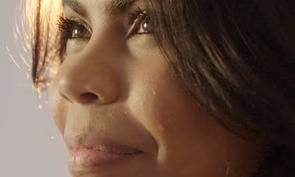
Video has Closed Captions
Preview: 12/19/2023 | 2m 42s | The murder of Army soldier Vanessa Guillen hit too close to home for Karina Lopez. (2m 42s)
Providing Support for PBS.org
Learn Moreabout PBS online sponsorship













Support for PBS provided by:
GI Film Festival San Diego is a local public television program presented by KPBS