
Idaho In Song Volume Two
Season 9 Episode 7 | 26m 46sVideo has Closed Captions
From folk tradition to a song of native tongue, we celebrate the heart of Idaho through music.
Music has lifted the spirit of its people since long before Idaho was named a territory. It has been a touchstone to our past while enriching our lives. In this Idaho Experience we explore the history of our state through music. From folk tradition to a song of native tongue we celebrate the heart of our cultural heritage that is “Idaho In Song.”
Problems playing video? | Closed Captioning Feedback
Problems playing video? | Closed Captioning Feedback
Idaho Experience is a local public television program presented by IdahoPTV
Major funding for Idaho Experience provided by the James and Barbara Cimino Foundation, Anne Voillequé and Louise Nelson, Judy and Steve Meyer. Additional funding by the J.A. and Kathryn Albertson...
Idaho In Song Volume Two
Season 9 Episode 7 | 26m 46sVideo has Closed Captions
Music has lifted the spirit of its people since long before Idaho was named a territory. It has been a touchstone to our past while enriching our lives. In this Idaho Experience we explore the history of our state through music. From folk tradition to a song of native tongue we celebrate the heart of our cultural heritage that is “Idaho In Song.”
Problems playing video? | Closed Captioning Feedback
Where to Watch Idaho Experience
Idaho Experience is available to stream on pbs.org and the PBS app.
Providing Support for PBS.org
Learn Moreabout PBS online sponsorshipAnnouncer: Major funding for Idaho Experience is provided by the estate of Darrell Arthur Kammer.
In support of independent media that connects communities and expands understanding.
Additional funding was provided by the James and Barbara Cimino Foundation, Anne Voillequé Louise Nelson Judy and Steve Meyer.
And from the Corporation for Public Broadcasting.
And contributions to the Friends of Idaho Public Television and viewers like you.
Thank you.
Narrator: In this episode of Idaho Experience, we tune our ears to a different frequency and and follow a musical thread to our past in search of some rare classics, Announcer: And time again.
for a song favorite style by the popular baritone of radio on the concert stage, Holden Bowler.
Judy Collins: Holden, was the most wonderful singer.
Holden Bowler: Oh, Danny boy, the pipes, the pipes are calling.
[RADIO TUNING] Gary Eller: Alright boys, we’re gonna do “While Away From Whiskey, Wild Women and Beer.” And old Harry Silvey probably played it in the Crescent Brewery back in his day.
Goes like this.
I happen to be one of these people that believe that there's value in history.
Beth Pederson: I'm home again.
I'm home in Idaho.
Narrator: Join us as we celebrate the heart of our cultural heritage that is, “Idaho In Song.” Narrator: Idaho.
With all that the state inspires, where did Idaho's name come from?
Some reports suggest our state's name originated from native tongue.
Meaning, “Behold the light shining on the mountains.” Another interpretation suggests its meaning is, “Gem of the mountains.” Two definitions that celebrate the natural beauty of our rugged landscape.
Keith Peterson: It was a made up name, apparently made up by a guy who is from what is now Colorado.
Narrator: When Coloradans were considering a name for their state, the word was a likely candidate.
That is until they discovered its origin was pure fabrication.
But by then, it was a word that had entered into the popular imagination of the day.
Keith: Somehow, people in the Willamette Valley heard this word “Idaho” being bandied about, and it gets attached to a small steamboat named the Idaho.
Then what happens is a party of people under Elias Pierce find gold in the Clearwater River.
So people are rushing into what was then eastern Washington Territory.
And many of them were on the steamboat Idaho.
So the saying was, “People are going to the Idaho mines.” So it kind of became attached to what we now know is Idaho.
It sounds so much like an Indian word, I guess, that people almost had a hard time believing that it wasn't.
But it's it's all made up.
It's a complete fabricated word, and we’ll never know exactly how it was made up.
Narrator: Whatever the word's origin, the mythology behind it would inspire songwriter Cinde Borup to craft a tune that reflects what is commonly beloved of our state, the natural beauty that surrounds us.
Beth Pederson: Cinde wrote it for the Centennial Song Contest.
She did not win.
But we always called it from then on, “The Idaho National Anthem.” Beth Singing: Sunlight shining on the mountains.
That's how you got your name.
Moonlight dancing cross your rivers.
Wild and the tame.
I’ve been with you all my life.
You're beauty I have known.
This is my song for Idaho.
I'll always call you home.
[Guitar Strumming] Wagon wheels forgotten now, coyotes lonesome call.
Mighty chiefs stare out through glass, on museum walls.
For the past is dead and gone, some would like to say.
“History repeats itself, and lives from day to day.” Here in Idaho, Idaho.
Though my feet may sometimes wander, my heart will always go.
Like a long-lost friend, I'm home again.
I'm home in Idaho.
[Guitar Strumming] Keith: It's a gorgeous song.
And I honestly don't think there's a place you can stand in Idaho that you don't have a mountain view.
So you know, it captures that.
You know it captures that beauty of Idaho.
[Music] Narrator: Music has lifted the spirit of the land and its people since long before Idaho became a state.
A source of that early music can be found in Lapwai, Idaho, on the Nez Perce Reservation, where Nakia Williamson Cloud sings a song of his people.
Nakia: The music of our people does a lot of things.
Some of the songs represented that deep spirituality of our people.
And it talked about the sacred and ancient relationship we have with the land, and all of the beings that we we share that kinship with.
All of these songs together are documented in the experience of our people.
And this song was sung prior to 1877, the Kiowas, Tonkawas had learned this song from the Nez Perce people.
The elders that had come before us said that this specific song was utilized to honor Hinmatóowyalahtq̓it or Young Joseph.
The Tonkawas still call this Chief Joseph's Honor song.
So this is a song we utilize to honor chiefs or warriors.
[Singing in Nez Perce] Nakia: These songs are our ways in which we recall and remember our history and the life of our people on this land.
And so many of the songs that you hear associated with the powwow were warrior songs, because that was the intent of of that particular dance.
It was a warrior dance.
And that's why in early years, it was mainly the men that were involved in that.
We had all these other songs, social songs.
We had women's songs.
But because of a lot of the kind of external historical pressures that happened, some of that has been lost.
[Singing in Nez Perce] Nakia: Then you have, some of the other sacred songs we call weyekiinípt.
Those were here at the beginning of time, the beginning of our creation.
So those are probably thousands of years old.
A form of spirituality, often referred to as “Seven Drums,” or “Longhouse,” we call Walasat.
That whole body of songs and knowledge was interpreting and basically prophesying of the changes that were going to come to the land.
That the new people were going to change things, were going to straighten out rivers, and were going to make mountains disappear, because it didn't suit them.
And it was talking about all of the infrastructure and things, hydroelectric projects that dammed up all of our rivers below us.
There's eight, eight dams, the highways and and all the things that we've seen that we live with as a reality.
Those things were talked about many years before the time of Lewis and Clark.
[Singing in Nez Perce] Narrator: Lapwai is also the birthplace of musician Chuck Collins, the father of folk singer Judy Collins, who wrote a song inspired by her dad, “Prairie Dream.” [Music Starts] Judy Collins: Daddy really really took after the Indians.
He loved the Indians.
He loved the stories.
He loved the lore.
He was very aware that we were screwing up the Indians lives, and would do so for a long time.
And, he just took on to Chief Joseph, and he would read us his speech about I can't fight anymore.
I'm done.
Always, I would be surrounded with the idea that these people had some special, special qualities.
And of course, my, my dad had a lot of input in that.
And I have a chorus in this song that says, “Sundown, Sunrise...” [Singing] Sundown, Sunrise.
Sundown... Judy: And “Sundown, Sunrise” is named after the Nez Perce Indian whose name was Jackson Sundown.
And I just was smitten by Jackson Sundown.
Nakia: So, Jackson Sundown, who is a very interesting figure in terms of his life that spanned the time of when our people roamed free and hunted buffalo, fished for salmon.
He was also involved in the events surrounding what is called the Nez Perce War of 1877.
He was of the age where those young men would be in charge of the huge responsibility of herding and watching over the horses.
And so he was able to utilize those skills that he learned as a Nimiipuu, Nez Perce person within the realm of kind of the newly emerging sport of professional rodeos.
Keith: His legend begins in 1911 at the Pendleton Round-Up, which was the big show, and still is in many ways.
And that was kind of immortalized in a Ken Kesey novel called “The Last Go Around.” And there are three guys who made it to the finals, and they were the heavy favorites going in.
One white guy, one black guy and one Indian.
The white guy ended up getting the, what was then known as the World Championship for saddle bronc.
And the crowd favorite was probably the black guy whose last name was Fletcher.
You know, we read the accounts from the time, the people who said had the toughest horse and probably had the best ride was Jackson Sundown.
Nakia: And he was operating in a situation where there was a lot of prejudice towards native Nez Perce man participating.
But he was able to rise above and became, even a fan favorite with a lot of different individuals.
And, it was there in 1916 where at the age around 52, 53, he won the World Champion saddle bronc riding.
Keith: Sundown was just apparently just this elegant horse rider.
There’s stories that when he would perform, the horse and he were one.
Nakia: For us, he’s definitely revered on a very high level simply because of being able to transition in a time when this was our land.
And we weren’t even yet U.S.
citizens.
And so, it was in a time period that was set up and favorable for anybody then white males to succeed.
His greatness was able to break through a lot of those barriers that were put in place naturally, to keep our people down.
And so I think that's really the the amazing story of him.
Judy: It just got me.
And one day I sat down and wrote that song, “Prairie Dream.” Belinda Bowler: It is beautiful!
Judy: Thank you.
Belinda: Beautiful.
When you write a song, this is.
I know people ask this, What?
What is the process?
Judy: I'm a note keeper, so I keep all kinds of notes of phrases I hear, I listen.
I write down things that I've heard.
Sentences, paragraphs, one line, a word.
And from that raw material came all the songs on Spellbound.
And, Now I have a poetry book coming out.
It's called “Sometimes It's Heaven.” It has 100 poems in it.
Radio Announcer: Time again for a song favorite style by the popular baritone of radio and the concert stage, Holden Bowler.
Judy: Holden was the most wonderful singer.
Holden Singing: Oh, let us come and dance with joy, since life and love are us.
Narrator: Judy's musical roots extend beyond her father's connection to the state.
Her Godfather, Holden Bowler from Gooding, was Chuck's lifelong friend.
Belinda: In fact, he met Chuck Collins.
They were, fraternity brothers at the Phi Gamma Delta House at Moscow, Idaho.
And dad would sing.
Chuck would play the piano, who he always refers to as Charlie.
Judy: Charlie.
Belinda: It was always Charlie.
Dad talked about how he really, really pushed to allow Charlie to come into the the fraternity because they were they were, you know, a blind man?
Judy: A blind man, no way.
Belinda: And that he turned out to be, you know, the, the thing.
Holden: Well, first of all, he thought I was great.
Now, as I said to you the other day, I didn't take that just as straight flattery.
Because he knew something about music.
Judy: He knew.
Holden: Charlie's sensitivity of accompaniment, Judy: Yeah.
Holden: of doing everything you can to enhance, but never enough to take away.
It was just automatic.
Belinda: And sensing your.
.
.
Holden: Yeah, I never sang with anybody during my whole life that could accompany like Charlie could, in the sense that he put you first.
Judy: He put you first.
Holden: And that's what accompanist is, you know.
Belinda: When I was talking to dad about Charlie, dad said that he wrote this song called “Land of Make Believe.” Uh, anyway, here is, this is the song.
Holden: You know, over the years we’ve talked a lot about this tune, “The Land of Make Believe,” which is probably the most, the best known song Charlie ever wrote.
A real slusher.
And Judy's always bugging me to see if I can put it together again.
Judy: Yeah.
Holden: He wrote it, I would have to take a guess, In the early 30s.
He was in love with a gal from Wheaton, Illinois.
Dorothy, somebody.
And I think she was the one that triggered it.
Though, it could have been anyone of 25 that could trigger.
It didn’t need to be Dorothy.
This is “The Land of Make Believe.” by Charles Collins.
[Holden Singing] Do you grow a trifle weary of our lives just as they are?
Would you like to make believe awhile?
Then let us just imagine we have found our lucky star, and lingered on some lovely dreamer’s isle.
All the things we do together, in that balmy summer weather, when we're living in the land of make believe.
Sweetheart, mine, I'm only dreaming.
But it's sweet for just the dreaming.
When we're living in our land of make believe.
That’s Charlie.
You should.
You should have heard him sing that with Judy: That’s Charlie.
Holden: a couple of beers and, and the lights down and of course, the audience thinking, “Think of this guy.
He hasn't seen a thing since he was two years old.” Judy: Yeah.
Narrator: Holden's musical talents never brought him fame, but his love for song did bring about good fortune.
Belinda: He had a radio show, and he always loved singing.
He sang with the Robert Shaw Chorale.
And he got a gig singing on a cruise line that sailed the coast of South America.
And that's where he met Jerry Salinger.
Dad did a couple of shows a night, and Jerry had to dance with the gals all night.
So, dad would sit at the bar and, and when he was off of his dancing shift, they would talk about being a writer, being a singer, their young lives.
Judy: Oh, of course they would do that.
Belinda: Yeah.
He sent dad Catcher in the Rye when it was published.
And he said, “Holden, I've used your name.
And take what you want of the character and leave the rest.” Judy: I was at the, one of the museums in New York.
And the guy who was the head of the library brought out a letter from Salinger to your father.
I think he was writing about Timmy’s death.
[Typing] [Actor] Dear Holden, If an old shipmate were to be in this neighborhood early in November, I'd run up the old skull and crossbones with the greatest pleasure.
That's some marvelous looking family you've got.
Ann looks like what she must actually be.
She reflects lightness and strength together.
Oh, that combination.
I've read and re-read about the shooting accident.
I don't know what to say, and I certainly can't say anything that you haven't said yourself.
I can only imagine what grief it must be not to be seeing and being with that boy every day.
I mean, you say it all.
And you say there's no getting over it.
I send you an honest to God, heartfelt handshake.
I'm so glad you have Ann.
Her value reflects everywhere in your letter.
Judy: Yeah, beautiful mother.
Belinda: Yeah.
Judy: She was amazing.
Belinda: She was.
Judy: Ann Bowler.
We adored your mom.
I mean, Ann was, you know, the dream mother of everybody.
And you tell us what she did.
Belinda: She worked at Bletchley breaking the code.
Her parents never knew what she did.
And 50 years later, she got a certificate and, this little gold medal that says, “I too served.” Gary Eller: All my life, since growing up in West Virginia, I've loved story songs about real people and real events.
Narrator: Folklorist Gary Eller writes, researches and performs songs that reflect Idaho's past.
Cheryl Oestriecher: It's really incredible the amount of material he’s been able to find about Idaho songs and songwriters, poets.
He digs and digs and digs, and it's wonderful.
Gary: I found a wonderful song from the 19 tens called “I Want to Go to Idaho.” It was in the National Libary of Australia.
Singer: I want to go to dear old Idaho and wed my Lindy Lou.
Gary: It was performed all over Australia and New Zealand.
And they were playing off the wild misconceptions about what life was really like in Idaho.
But I'm more interested in songs that give a truer picture of life in early Idaho.
Enter Ione Love Thielke.
She was the wife of a timber boss in Cascade, Idaho.
And the locals that remember her tell me she always dressed to the nines, and always carried a parasol when she's walking around town.
Cheryl: She was very unique.
Sometime in the 40s, she started a radio show.
Ione Singing: Please keep Idaho green.
If a trip you desire, out among the sheltering pines, beside a campfire.
Cheryl: And anyone could send her something.
And she would then play it and record it.
Gary: She had a recording device where you could sing into a horn, and it would cut a record.
So she developed a relationship with the poets around Idaho, and turned it into a business.
Five dollars you get your song recorded.
Such a deal.
Then one of the songs we heard was called “Give Me an Idaho Trail.” And, it was written by a gal named Esther America Nevada Brubacher.
And she loved the life in the Owyhees.
And she became known as the poetess of the Owyhees.
And, this one was set to music by the musical poem recorder of Cascade, Idaho, Ione Love Thielke.
So, Miss Becky’s going to sing this one.
Becky Borczon: Oh, yes.
[Guitar Strumming] Becky Singing: Oh, give me a trail up the mountain, where the sweet Syringas bloom.
Give me a camp in the open beneath an Idaho moon.
Gary: Oh, yeah.
Let me hear the wolf dog wailing unto the night.
Up on the old skarf banyard, when the moon is ghostly white.
Oh, give me a trail, an Idaho trail, where the first purple shadows lie.
And the big red flaming moon shines up in the Idaho sky.
Oh, give me a trail, an Idaho trail, a primitive trail and high.
Where the big snow capped mountains hold tryst with an Idaho sky.
Dennis Cooper.
[Harmonica solo] Gary: I happen to be one of these people that believe that there's value in knowing where you came from.
And the history of the world shows abundantly that we're capable of making the same stupid mistakes over and over and over again.
What I've learned is that other than nuclear weapons, there's almost nothing that's really new in the news today.
I mean, people in the Bible were complaining about politicians.
So, we're doomed to repeat some mistakes.
But I think, if you study those mistakes, perhaps we won't be so prone to making them.
[Becky Yodelling] Oh, give me a trail, An Idaho trail, where the first purple shadows lie.
And the big red flaming moon slides up in the Idaho sky.
Oh, give me a trail, an Idaho trail, a primitive trail and high.
Where the big snow capped mountains hold tryst with an Idaho sky.
Where the big snow capped mountains hold tryst with an Idaho sky.
[Laugh and Applause] Gary: Miss Becky B. Announcer: Major Funding for Idaho Experience is provided by the estate of Darrell Arthur Kammer.
In support of independent media that connects communities and expands understanding.
Additional funding was provided by the James and Barbara Cimino Foundation, Anne Voillequé Louise Nelson Judy and Steve Meyer.
And from the Corporation for Public Broadcasting.
And contributions to the Friends of Idaho Public Television and viewers like you.
Thank you.
[Music]
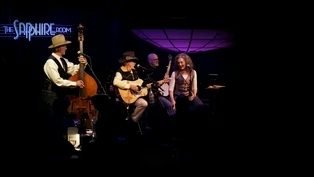
Introduction to "Idaho In Song Volume Two"
Video has Closed Captions
Clip: S9 Ep7 | 1m | From folk tradition to a song of native tongue, we celebrate the heart of Idaho through music. (1m)
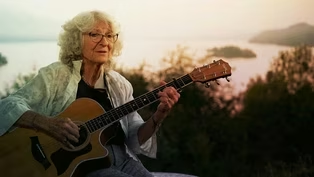
Preview of "Idaho In Song Volume Two"
Video has Closed Captions
Preview: S9 Ep7 | 30s | From folk tradition to a song of native tongue, we celebrate the heart of Idaho through music. (30s)
Providing Support for PBS.org
Learn Moreabout PBS online sponsorship












Support for PBS provided by:
Idaho Experience is a local public television program presented by IdahoPTV
Major funding for Idaho Experience provided by the James and Barbara Cimino Foundation, Anne Voillequé and Louise Nelson, Judy and Steve Meyer. Additional funding by the J.A. and Kathryn Albertson...